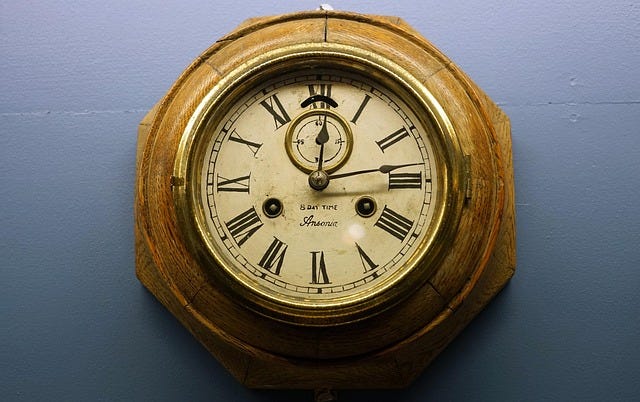
I've always loved old pendulum clocks – their rhythmic tick-tock of seconds, their chimes announcing each hour. In the stillness of a quiet room, their steady cadence serves as both companion and reminder. These do more than simply display the hour; they whisper a profound truth: each tick represents a moment gone forever, each tock a gentle nudge that our time on earth is finite.
As these mechanical timekeepers faithfully measure a day, they remind me that the most important moment is right now, and that we are to make the best use of time (Ephesians 5:16).
On the matter of time spent in our prayers, there are two questions: how often should we pray, and how long should we pray? The first has to do with the frequency of praying, and the other with the length spent in prayer.
And the answer is: as often and as long as is needed. Which is all the time!
That is not the practical answer people want. However, as there is always need, there is always need for prayer. As there is constant temptation, there will be need of constant praying.
We are asked to "watch and pray for one hour" and we are told to pray constantly—without ceasing; Paul says that Epaphras "always labored in prayers." Daniel prayed three times daily, and even fasted and prayed for 21 days.
Ideally this would be our desire also because we love to spend time in communication with the Lord Jesus. And one day, may we all actually do so! Prayer is one of the Christian disciplines and must be practiced and cultivated.
So it helps to start with a plan.
What does this look like practically?
We each have 168 hours in a week. If we consider portions of that, say 10 percent, is 16.8 hours committed to praying—or 2 hours 24 minutes each day. Does that sound like a lot? For just starting out, certainly for most of us it is.
So what about a one percent portion? That's just 1.68 hours per week, or just under 15 minutes each day. Certainly that's possible? But I fear even this is much too much for many believers.
"I always feel that there is something wrong if I go without prayer for even half an hour in the day," Spurgeon said.
Without prayer, our spiritual lives shrivel faster than leaves in a fire pit. We need prayer like plants need watering – not as an occasional blessing but as the very lifeblood that prevents our faith from collapsing into dust. A thousand messages cannot accomplish what persistent prayer can achieve in transforming our hearts and aligning our wills with God's perfect will.
If you are just now coming to the activity of prayer, make 15 minutes your minimum time praying each day. Do so, and soon it will be hard to do only that, for we will learn the sweetest times of a day are in prayer, and time spent will grow to be more often and longer.
Begin this as a scheduled time, which is best found by eliminating something from your schedule. Like a television show, a recreation activity, scrolling on social media, and the like.
Worldly pursuits are our biggest time wasters, and must become secondary to spiritual pursuits.
Get up 15 minutes earlier, or go to bed 15 minutes later, or use 15 minutes of a lunch time. Or all three! Commit to it, just like a diet or exercise plan, and stick to it. At first it will seem a labor, soon it will be all the sweeter. But recall Epaphras—who labored, wrestled, struggled—fervently in prayers.
We can do likewise, and we should. Continue earnestly in prayer, being vigilant in it, writes Paul in Colossians 4. This type of prayer can keep us from sinning, and keep us communing with our Lord. It keeps us alert, watchful, humble, dependent, and maturing in spiritual matters.
Pray today, pray with purpose, pray with persistence.
When struggles come, pray.
When blessings overflow, pray.
When darkness surrounds you, pray.
When light breaks through, pray.
Prayer changes everything – it changes circumstances, it changes others, but most importantly, prayer changes you.
Pray without ceasing, pray without doubting, pray without holding back.
Pray.