Welcome to The Poverty Trap, a newsletter and podcast for people who are fed up with the inequality baked into America’s system and want to individually and collectively make change.
Thinking about subscribing? Here’s what one “founding member” subscriber recently had to say about The Poverty Trap:
“You do great work, Joan. I don’t always get to read your newsletter, but when I do, I leave more informed and more compassionate…” Amy B.
Yes, data from the Federal Reserve through the fourth quarter of 2025 shows economic inequality, both income and wealth inequality, has worsened in the last 15 months since President Trump began his second term on January 20, 2025.
A CBS report analyzing this data says:
The top 1% of households owned 31.7% of all U.S. wealth in the third quarter of 2025, the highest share on record since the Federal Reserve began tracking household wealth in 1989. That share has increased even as wealth growth for the rest of the population has stalled or slowed, the data shows.
Collectively, the wealthiest 1% held about $55 trillion in assets in the third quarter of 2025 — roughly equal to the wealth held by the bottom 90% of Americans combined.
That last data summary is astounding: the richest 1% of Americans hold approximately the same amount of wealth as a combined 90% of Americans. And the forecast for 2026 and beyond is a continued widening of the income and wealth gap, with stipulations of course.
But why did the inequality gap widen significantly in 2025? Here’s what a few experts have to say:
— The stock market surged through 2025, but mostly due to AI investments. (Remember Attorney General Bondi shrieking into the microphone that the Dow had hit 50,000?) The rich disproportionally invest in stocks and other securities where they hold most of their wealth. A recent CBS article noted: “A May Gallup poll found that 87% of Americans who own stock live in households with incomes of $100,000 or more.” So when the markets go up, wealthy stock and securities’ investors get even richer.
That is in contrast to middle and lower income Americans whose main asset is the family home (if they are lucky enough to own one, likely with a hefty mortgage). Unfortunately, home prices and wage growth (measured against inflation), slowed during 2025 while the price of food, and other goods and services went up significantly, further draining wealth from average income Americans.
— But what about those taxes you paid a few days ago? Another unfortunate reality for middle and lower income Americans who pay most of their taxes on straight earned income—they pay a higher percentage of their income in taxes than the wealthy and uber-wealthy.
Why? Because the tax code levies lower rates on passive income (like dividends from stocks and bonds) than earned income from paychecks. Plus, there are more tax loopholes to “minimize the impact of the tax” for the passive income investments held in much higher amounts by the wealthy, than for salaried or hourly workers, like you or me. Don’t understand those complicated loopholes, anyway? Never mind, the wealthy and big corporations can afford tax attorneys and accountants to understand and apply every legal way to minimize their clients’ taxes.
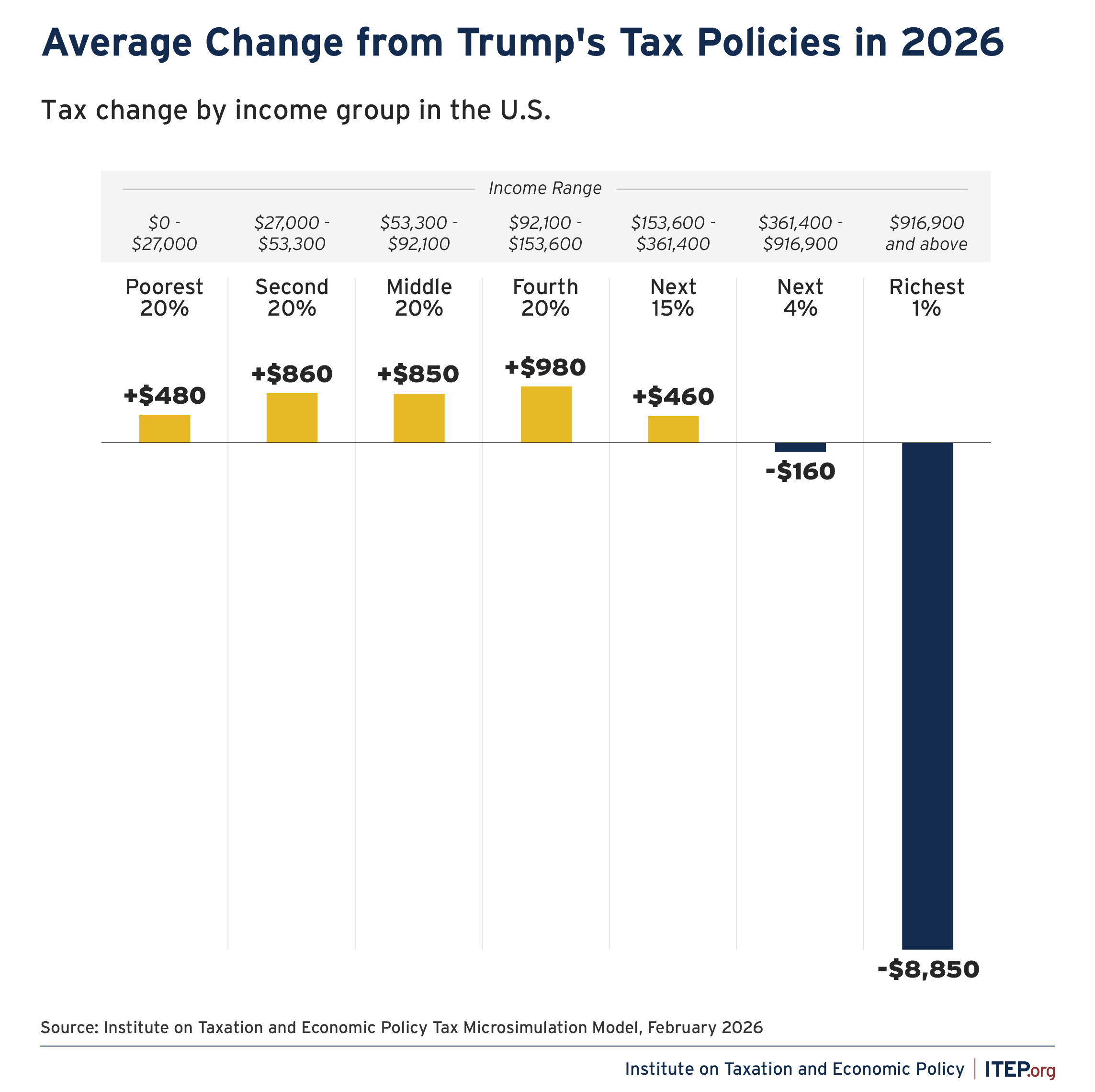
Thanks to Jeremy Ney from American Inequality for sharing the graph below on Notes along with the link to access it from The Institute for Taxation and Economic Policy (ITEP). Here’s what the ITEP article said about how federal taxes break down by income after the passage of the “One Big Beautiful Bill” in 2025:
Taking all the policies of President Trump and the Republican majority in Congress into account, all but the richest Americans are paying higher taxes on average in 2026 than they did last year. These policies include:
* Dramatically increased tariffs on goods from abroad, a tax that economists widely agree is mostly borne by American consumers.
* The termination of the Enhanced Premium Tax Credit (EPTC), which had made health care more affordable for millions of people.
* The so-called One Big Beautiful Bill Act (OBBBA), which overwhelmingly benefits the rich and corporations.
The combined impact of these policies in 2026 is a tax increase for the average American in all income groups except the richest 5 percent. This is illustrated in Figure 1 below. The richest 1 percent, in particular, receive a noticeable tax cut compared to all other groups. [Emphasis added]
FIGURE 1
— But wait, there’s more. There was rapid growth of the billionaire class in 2025. According to an Oxfam report published earlier this year: “…billionaire wealth in 2025 increased three times faster than the average annual rate over the previous five years.” And Elon Musk topped the billionaire list with an estimated $668 billion according to the Bloomberg Billionaires Index. Yes, that is the same Elon Musk, who as head of the now-defunct DOGE, fired approximately 270,000 federal workers in 2025, under the guise of “government efficiency”.
And U.S. billionaires absolutely pay both an effective lower tax rate and a lower percentage of their annual income in federal taxes, according to an August 2025 paper published by the National Bureau of Economic Research.
Why Growing Inequality Matters:
The extent of inequality we see today poses risks to pretty much everything, but particularly to our democracy and to our economy. Why? Briefly, here’s what a few experts have to say about the impact of our now egregious inequality:
— Glenn C. Altschuler, a Thomas and Dorothy Litwin Emeritus Professor of American Studies at Cornell University, discussed many reasons wealthy individuals and corporations have an outsized impact on our government’s laws and policies. This type of influence can and does skew federal policies in favor of the wealthy:
In 2025 alone, 13,000 lobbyists spent about $5 billion to influence Congress and federal government agencies. The top three spenders were the U.S. Chamber of Commerce, the National Association of Realtors, and the Pharmaceutical Research and Manufacturers of America. In 2024, corporate contributions to political candidates and parties exceeded campaign spending by labor unions by a ratio of 16 to one.
— Consumer spending has been increasing overall, but the spending is disproportionally from higher income households, and this might indicate a shaky economy. A CBS report from late 2025 lays out the statistics:
Consumer spending — which drives over two-thirds of economic activity — is growing overall in the U.S. These days, however, a large and growing share of that commercial activity is driven by upwardly mobile Americans. In the second quarter of 2025, the top 10% of income earners accounted for almost half of all spending, according to an analysis of Federal Reserve data by [Mark] Zandi [chief economist at financial research firm Moody's Analytics].
And this interesting article, published just a few days ago in The Street, explains why it might be dangerous for the top 10% of wealthy households to contribute over 50% to all consumer spending—when a broad economic base of Americans are not able to buy goods and services, it might be covering up a problem. The author, Hillary Remy, calls it “…a striking concentration of economic activity in a very narrow slice of the population.” This is what Remy says could happen:
When wealthy households carry a disproportionate share of consumer spending, the national data can look resilient even when most Americans feel financially pressured. A strong headline number on consumer spending can mask the reality that lower- and middle-income households are dealing with heavier debt burdens and slower income growth… [And] When a single percentage of households controls more wealth than the bottom 90% combined, the economy starts to function differently. Growth becomes dependent on a narrow group of asset owners rather than broad-based consumer activity.
That creates a fragile foundation.
————————————————————
I’d love to hear your thoughts on our country’s growing inequality. Are rich people’s spending propping up a fragile economy? What else? Please share your ideas in the Comment Section below:
The Poverty Trap is a reader-supported publication. To receive new posts and support my work, consider becoming a free or paid subscriber.