Welcome to The Poverty Trap, a newsletter and podcast for people who are fed up with the inequality baked into America’s system and want to individually and collectively make change.
Thinking about subscribing? Here’s what one, kind “founding member” subscriber recently had to say about The Poverty Trap:
“You do great work, Joan. I don’t always get to read your newsletter, but when I do, I leave more informed and more compassionate…” Amy B.
Wishing Our Substack Community A Happy And Healthy Holiday Season!
The largest social safety net program in the United States is Social Security, ninety years young this year. It is currently keeping over 22 million Americans, mostly the elderly and disabled, above the poverty line.
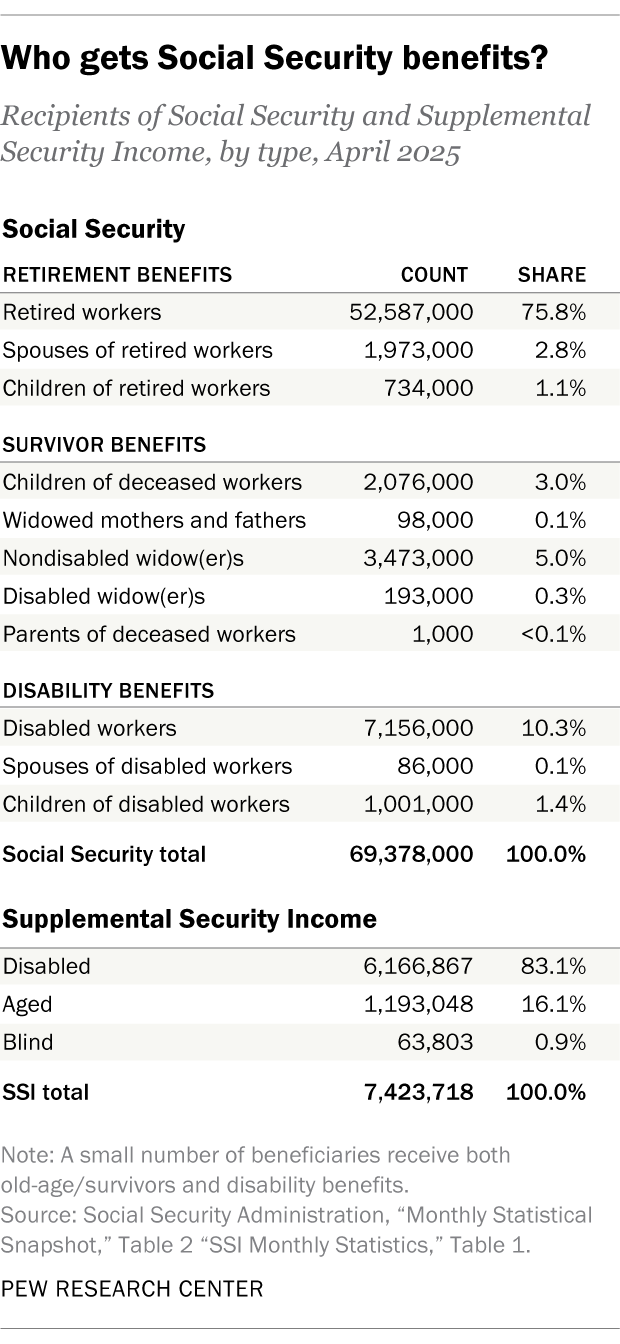
Here’s a current breakdown of social security recipients, courtesy of the Social Security Administration via Pew Research:
“As of April 2025, 73.9 million people – more than a fifth of the entire U.S. population – got benefits from at least one of Social Security’s programs,” including:
* 52.6 million retired workers
* 2.7 million spouses and children of retired workers
* 5.8 million survivors of deceased workers
* 7.2 million disabled workers
* 1.1 million spouses and children of disabled workers
* 7.4 million receiving Supplemental Security Income
Note: Some people qualify for more than one type of benefit, which is why these figures add up to more than the total number of beneficiaries.
In the mid nineteen seventies, I was one of the “children of deceased workers” who received Social Security benefits after my father died when I was 17. Because I was under 18 when he died, I received survivor benefits for about a year, and because I went directly to college, I received social security each month until my graduation. My mother also received Social Security benefits as my dad’s surviving spouse. I can’t tell you the sense of “security” this money gave my mother and me, which is exactly what we needed after suddenly losing the breadwinner and bedrock of our family.
And this is what Franklin D. Roosevelt intended when he signed the Social Security Act into law on August 14, 1935:
We can never insure one hundred percent of the population against one hundred percent of the hazards and vicissitudes of life, but we have tried to frame a law which will give some measure of protection to the average citizen and to his family against the loss of a job and against poverty-ridden old age.
The Social Security Administration website provides a good deal of FDR’s thinking about this law, both before and years after its signing, which you can read here.
And why not listen to this seven-minute, edited version of FDR’s fireside chat where he discusses the Social Security Act he will sign into law a few months later. Just hearing the caring and civility in his voice is worth your time.
According to an analysis published early this year by the Pew Research Center, a large percentage of the population receiving Social Security benefits literally depend on that monthly check to survive. According to the Census Bureau’s Survey of Income and Program Participation ( SIPP), in 2022, Social Security benefits accounted for three-quarters of the income for 26.5 million people. And for 16.4 million people, it was their only source of income.
Additionally, the several different Social Security programs are funded in different ways, making some more vulnerable than others. For example, Social Security payments to retirees, survivors of former workers and the disabled are paid through a payroll tax of 12.4%, split evenly between the employer and employee (the self-employed pay the entire 12.4%). These are the Social Security programs that might be in danger because the funds are substantially dependent on the ratio of the number of workers paying into the system versus the number of retirees collecting from the system. You can correctly blame it on the staggered retirement of the Baby Boom generation, whose large numbers sucked down its designated Social Security Trust Fund — the retirees have outnumbered the workers paying into the program so it no longer a “pay-as-you-go” system.
Supplemental Security Income, also managed by the Social Security Administration, is a need-based program for those over 65, disabled or blind and provides a small amount of additional cash each month to those who qualify (sometimes in addition to Social Security benefits). Unlike Social Security, this program is paid for through the general revenue fund and is considered solvent for the foreseeable future.
It’s important to add that the current Administration has slashed the number of workers employed by the Social Security Administration as part of its alleged cost-cutting efforts. According to an article published by NPR in late April of this year, “The Social Security Administration (SSA) has laid out plans to slash about 12% of its overall workforce, or 7,000 jobs.” This reduction in staff already has caused considerable delays in processing applications and handling of the numerous questions that arise just trying to get even basic retirement benefits.
_____________________________________
A large majority of Americans favor keeping or expanding social security benefits. What’s your take on this issue? Let me know in the Comment Section below—I’d love to hear your thoughts!
The Poverty Trap is a reader-supported publication. To receive new posts and support my work, consider becoming a free or paid subscriber.