Welcome to The Poverty Trap, a Newsletter and Podcast About the Politics And Policy Choices That Create a Cycle of Economic, Racial and Environmental Inequality...and What We Can Do To Change It.
I originally published this post a few months after I started The Poverty Trap, way back on September 15, 2021. I’m re-posting it today with a few tweaks and an updated preface because it remains a major topic of discussion as our mid-term elections approach, but it’s rarely acknowledged directly. In fact, the concept of corporate welfare is the argument that clearly counters the conservative rantings against the progressive agenda, an agenda that the majority of democrat and independent voters seem to favor.
An updated post, following shortly, will detail why the democrats should use our “corporate welfare system” like a battering ram against the current conservative agenda to slash social safety net programs. In the meantime, enjoy re-reading or reading for the first time this discussion of our real “welfare queens”.
DEC 09, 2021
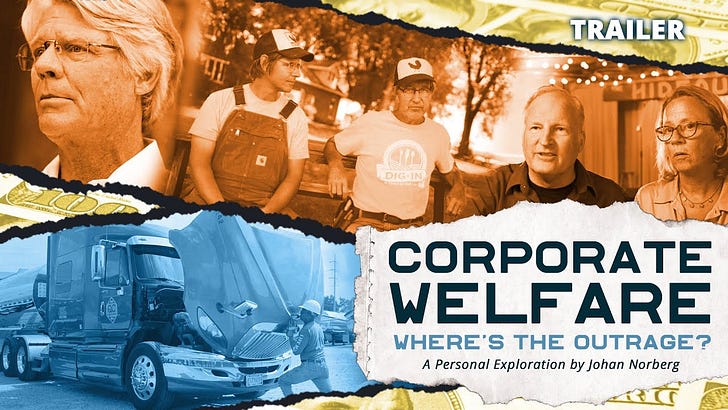
This is the trailer for the PBS film that explores the concept of Corporate Welfare and how it helps corporations to thrive, and allows average, working taxpayers to suffer.
I first heard the words “corporate welfare” when Senator Bernie Sanders was campaigning for President in 2015, although the concept had been discussed for easily 50 years before I heard it put into context. Although I had closely followed politics for decades and worked on a few campaigns, I never heard this concept mentioned, let alone explained and made an integral part of a presidential campaign. Senator Sanders described how workers for Walmart, as an example, made so little in wages as full time employees, that they still qualified for food stamps and other forms of government aid for the poor. In other words, the taxpayers were subsidizing Walmart’s low wages with taxpayer funded government programs.
I probably hadn’t heard of corporate welfare because I was watching and reading what now is dubbed “mainstream media”, which not only didn’t cover this issue, but repeatedly branded Senator Sanders as a socialist “kook” for daring to call attention to our government’s hypocritical entanglement in this scheme.
What I did know is that our government’s social safety net was too lean, and the constant complaining, mostly from the right, that cuts had to be made to these “handout” programs, and the talk of “welfare queens” were thinly-veiled, racist code. But this disingenuous scapegoating of the poor continues today with Senator Joe Manchin (D-WV), for one example, and many others. “I don’t believe that we should turn our society into an entitlement society,” Manchin said, as he was whittling down the “Build Back Better” bill of his own party’s President.
And then I learned about the grotesque amount of money in the form of tax abatements, incentives and bailouts that federal, state and local governments provide large companies for the pleasure of gracing their communities with factories, warehouses and mega stores. This 2020 article from Business Insider cites a Princeton study that “finds that most states and local governments offer $30 billion a year in welfare — as a ‘low-end estimate’ — to corporations, and in some states the outgoing incentives exceed corporate tax revenues.” So our government is losing money — your money — on these “incentives” to draw businesses to local communities.
But wait, there’s more. This 2014 article from Forbes, probably one of the antecedents to this year’s PBS film “Corporate Welfare: Where’s the Outrage?”, gives a few frightening examples of government subsidies to corporations. Here’s just one: “The 965 companies in the [ Good Jobs First Report prepared in 2014] received over $110 billion of public money. Berkshire Hathaway, a company with $485 billion in assets and $20 billion in profits, received over $1 billion of that money. Its chair, Warren Buffett, is worth about $58 billion.”
It’s true that at least some of these companies never provide the jobs and tax base they promise in exchange for the subsidies they receive. In 2019, for example, General Motors decided to close its auto making plant in Lordstown, Ohio, allegedly because of the decline in demand for the small cars it was making there. But the state had signed several economic development agreements with GM which specified that the Lordstown plant would remain open until 2027 in exchange for tens of millions in tax breaks. As early as 2017, however, GM started cutting jobs and shifts at this plant and “announced it would build its new Chevrolet Blazer in Mexico.”
The partial good news from this scenario is that Ohio’s Tax Credit Authority demanded its $60 million back, and in September 2020, GM agreed to repay $28 million and contribute $12 million in community support where the plant was located, presumably leaving the state about $20 million in the hole from it’s broken economic development agreements.
Now that’s an entitlement society, Senator Manchin.
You can watch this excellent film: “Corporate Welfare, Where’s the Outrage” on PBS by checking your local PBS guide for days and times or by accessing specific segments here: https://www.google.com/search?client=safari&rls=en&q=PBS+corporate+welfare&ie=UTF-8&oe=UTF-8
________________________
Let me know what you think about the idea of corporate welfare, and whether we should continue on this path. Is it outlandish to suggest our government help individuals a bit more and corporations quite a bit less? Leave your ideas in the Comment Section below:
The Poverty Trap is a reader-supported publication. To receive new posts and support my work, consider becoming a free or paid subscriber.