Someone asked me a question after a recent talk, and I haven’t been able to stop thinking about it.
“What if we come here just to experience the uncontrollable?”
Not to complete a mission. Not to fulfill a contract. Not to check off some cosmic to-do list. Certainly not to follow a pre-determined path.
Just to feel the weight of something we couldn’t predict, plan, or prevent. That would be the real challenge.
That question stopped me cold. Because if it’s true — and I think it might be — it changes everything about how we understand why we’re here.
First, Let’s Talk About What a Soul Plan Actually Is
I want to be careful with language here, because words carry weight.
You’ve probably heard the term “soul contracts.” I’m not a fan of it.
The word contract has legal baggage. It implies offer, acceptance, consideration — and breach clauses. It turns our pre-life agreements into something adversarial, like we’re going to get sued by the universe if we veer off course.
I prefer soul plans or soul agreements.
Not because it’s softer. Because it’s more accurate.
These aren’t rigid legal documents with remedies if we miss a clause. They’re more like loose frameworks — a relationship between us and our higher self, our guides, and perhaps others who agreed to journey alongside us.
The universe is not a cosmic courtroom.
And I don’t think we need to spend much energy worrying about whether we’re “breaching” anything. That framing misses the point entirely.
The Question That’s Haunted Philosophers for Centuries
Here’s where it gets interesting.
If soul plans exist — if there’s some pre-life framework guiding our experience — then how much of what happens here was chosen?
And if it was chosen... does that mean free will is an illusion?
This is one of the oldest philosophical debates in human history. The old Newtonian model treated the universe like a billiard table. Know the position and velocity of every ball, account for friction and force, and you can predict every outcome that follows.
If that’s true of the entire universe, then what we call “choices” are just dominoes falling. Predetermined since the Big Bang.
But here’s where it breaks down.
Even if physical systems can be modeled and predicted — and look how far weather forecasting has come with satellites and data — human behavior isn’t just a physical system. We have thoughts. We have feelings. We make decisions based on things we can’t fully measure or explain.
Yes, some say we are purely biological robots.
If we’re purely biological robots, then free will is an illusion.
And if free will is an illusion, so is moral responsibility.
And if moral responsibility is an illusion, then the whole framework of growth, learning, and accountability collapses, along with a legal system or anything that holds us accountable for our actions.
Which means: what are we even doing here?
My “So What?” Test
When a philosophical debate starts spinning me in circles, I apply what I call the “so what?” test.
Here it is: Whether free will is ultimately real or not, we have to act as if it is.
Even if soul agreements exist, most of us have no memory of making them. From inside these bodies, life feels full of the unexpected and uncontrollable. Navigating that uncertainty with wisdom and compassion — that’s the real curriculum. Regardless of what was planned before we arrived.
So I don’t get too worked up about the determinism debate. From our perspective inside this biological unit, inside what some might call the simulation, it feels real. It feels like we’re choosing. And that felt experience is what we have to work with.
A Better Model: The Adjustment Bureau
There’s a movie I recommend to almost every client I work with. The Adjustment Bureau, based on a Philip K. Dick story.
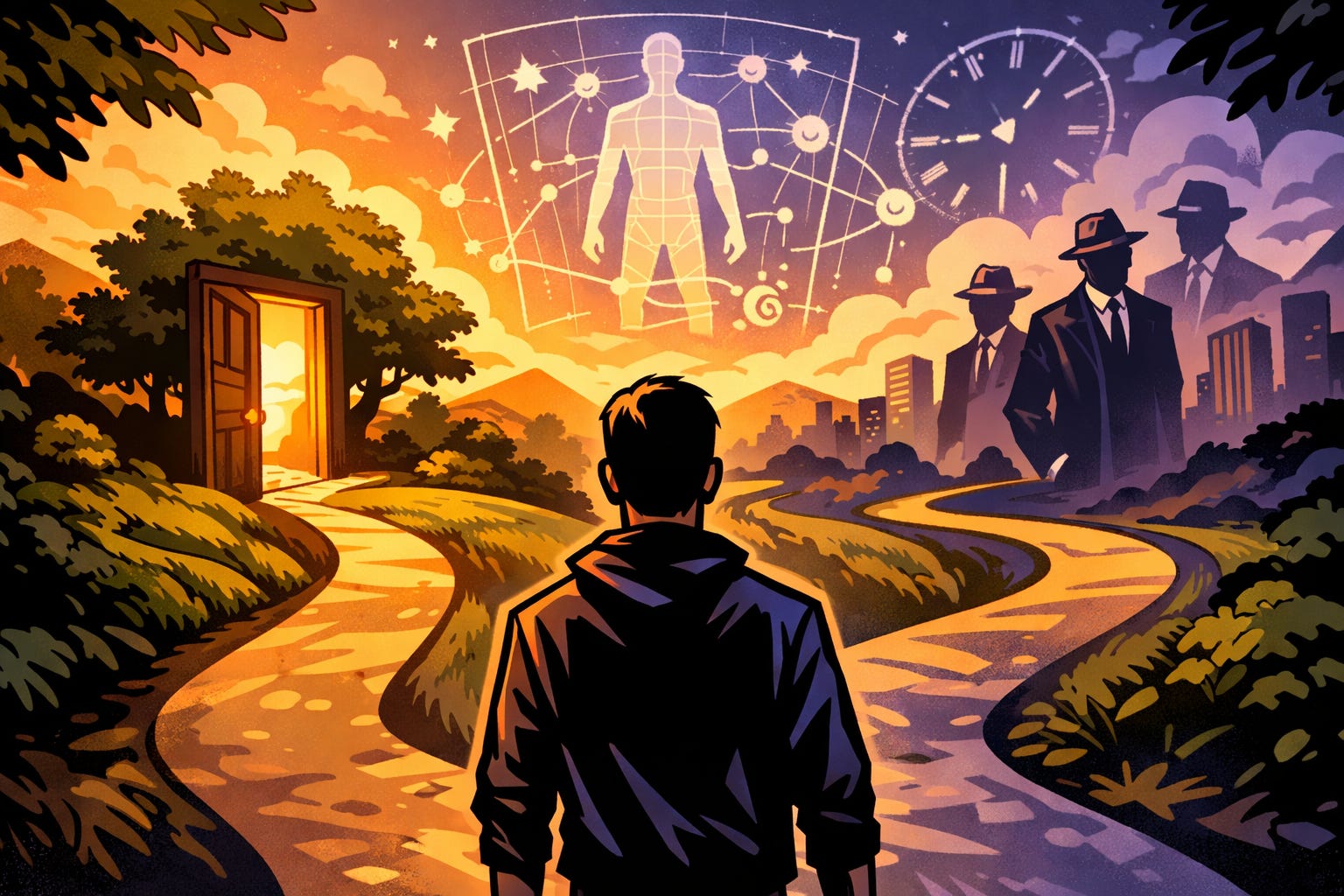
The premise: there’s a plan. But free will continuously shapes and reshapes it.
Agents in the bureau — call them guides, call them whatever resonates for you — are constantly adjusting possibilities and probabilities based on the choices we make. They make small tweaks to nudge things back on track.
Not overriding our choices. Working through them.
That model feels closer to how soul planning actually works than either extreme — pure randomness or pure determinism.
It’s not that everything is set in stone. And it’s not that nothing means anything.
It’s that there’s a framework, and we’re living inside it with genuine agency.
The Part of You That Never Fully Arrived
Before I move on, I want to pause on something that I think is profound.
I believe there’s a larger, wiser aspect of who we are that never fully incarnates.
What comes into the body is more like an emissary. An ambassador. A portion of a much greater self that remains, at least in part, on the other side.
We call that our higher self or our Oversoul.
And that connection — to what remains beyond this physical experience — is always available to us. Even when we can’t feel it. Even in our darkest moments.
That’s not just a poetic idea to me. I think that’s literally how this works.
Why Are We Here? The Answer Might Be “Yes”
Now, for the third question this person raised. And it’s the one I keep turning over in my mind.
Do we come here to help others grow? Or for our own development? Or both?
My honest answer: yes. It’s both. It’s all of it.
Here’s the framework I find most useful, drawn from a series of books called The Team by Frances Key — channeled, from her mother on the other side. The core idea: as individual as we feel inside these bodies, we’re part of something larger. A team. A community. A body.
Think of cells in a body. Cells make up organs. Organs make up systems. Systems make up the whole. Every part serves the whole, and the whole sustains every part.
When people ask, “Am I here for myself or for the greater good?” — I think the answer is it’s not either/or.
It’s both. Always both.
Not Everyone Is Here for the Same Reason
Here’s something that shifted my thinking about the people around me.
Not every soul comes to Earth for growth or development.
Some come to learn through difficulty — and we can see evidence of that everywhere we look. People who face the hardest things and emerge transformed.
But as my friend Kelvin Chin points out, not everyone seems to be here to learn or grow. Some people, as he says, appear to be sleeping through school.
Maybe they’re here just to taste physical existence. To watch a sunset. To feel love. To experience something that only a body can make possible.
Maybe even something as simple as ice cream.
That’s not a lesser purpose. It’s a different one.
This physical world offers something the other side apparently doesn’t in the same way. And some souls simply want to experience that contrast — the weight, the texture, the beauty, and the pain of being here.
The Bodhisattvas Among Us
Buddhist tradition describes souls called bodhisattvas — beings who have moved beyond needing Earth as a personal classroom. They arrive specifically to assist others.
Some souls may be here not for their own development at all.
They come as guides. As catalysts. Sometimes even as the people who cause us the most pain, because that’s what we needed to grow.
It’s a humbling idea.
It means the most difficult relationships in our lives might carry more meaning than we’ve allowed ourselves to consider.
Where You Stand in the Infinite Spectrum
One more thing, and this matters to me deeply.
We talk about souls as advanced, or as masters, or as beginners. I sometimes use the term “unskilled” instead of “baby souls” — it feels gentler and more accurate.
But here’s what I want you to hear: this is all relative.
There’s an almost infinite spectrum of development. And you are always simultaneously a beginner relative to souls further along — and a teacher or master relative to souls just starting out.
Before you get too full of yourself for being spiritually advanced, there are almost infinite souls further ahead.
Before you get too down on yourself for being a beginner, there are almost infinite souls behind you.
You’re always somewhere in the middle.
For me, that means humility is the right posture. No matter where you think you stand.
And also this: you’re doing just fine. You’re where you need to be. And this isn’t your only chance. Whether you believe in reincarnation or not, this is one small chapter in the much larger life of an eternal soul.
The Question I’m Leaving You With
Back to that question someone asked me after my talk.
What if we come here just to experience the uncontrollable?
What if the greatest curriculum isn’t the lessons we planned — but our response to the things we never could have?
What would change for you if you believed that the chaos in your life wasn’t a deviation from the plan — but might actually be the plan?
I’d love to hear your thoughts. Drop them in the comments, or reply to this email. These are the conversations that matter most to me.
And if this resonates, share it with someone who’s been asking the big questions. Sometimes a different frame is all we need to take the next breath.
Brian D. Smith is a grief guide, certified grief educator, and host of the Grief 2 Growth podcast. After losing his daughter Shayna in 2015, Brian dedicated his life to exploring the intersection of grief, consciousness, and hope.