“But Mike, we’re dealing with an abstract problem. It requires more nuance.” ~🤡
The Signal in the Noise: Why JTBD Needs First Principles
Modern innovation is a graveyard of good intentions. It is populated by brilliant teams, well-funded startups, and legacy enterprises that all committed the same fatal error: they fell in love with a solution before they understood the problem.
We’re told to “listen to the customer.” We are told to map “pain points.” We are told to create Job Maps. And yet, despite the ubiquity of these frameworks, failure rates for new products remain catastrophically high, or teams are overwhelmed with data that doesn’t really point anywhere.
Why? Because traditional research is polluted.
When you ask a customer what they want, they’ll tell you what they know. They’ll describe a faster horse, a sharper blade, or a slightly less annoying spreadsheet. This is Reasoning from Analogy—building slightly better versions of what already exists (automobiles, paint, circular saws). It creates noise, masking the true opportunity.
To innovate, we need to stop listening to the noise. We need to find the Signal. And the only way to isolate the Signal is to subject our assumptions to a process of intellectual demolition known as First Principles Thinking.
The Indictment: The Trap of “Reasoning from Analogy”
The standard approach to customer research is fundamentally broken. Researchers accept the “Problem As-Is.” They walk into a room, look at the customer’s current workflow, and ask, “Where does this hurt on the doll?”
This is a trap. By framing the inquiry around the current solution, you guarantee an incremental result. You’re not discovering a new market; you are optimizing an old one.
Consider the cognitive bias at play. Humans are wired for Analogy Bias. We look at a problem and immediately associate it with pre-existing solutions.
* If you see a transportation problem, you think “Car.”
* If you see a data problem, you think “Database.”
When you combine the researcher’s Analogy Bias with the customer’s Confirmation Bias (the tendency to interpret information in a way that confirms prior beliefs), the result is an echo chamber. Especially when you also have sample bias. You aren’t validating a market need; you’re validating a shared hallucination.
We don’t need more focus groups. We don’t need more consultants who have done the same thing over and over for 30 years. We need less bias.
This reliance on analogy is why companies spend millions building products that are 10% better but fail to change the world. They’re solving the symptoms of the “Problem As-Is” rather than addressing the root cause.
The Intervention: Intellectual Demolition
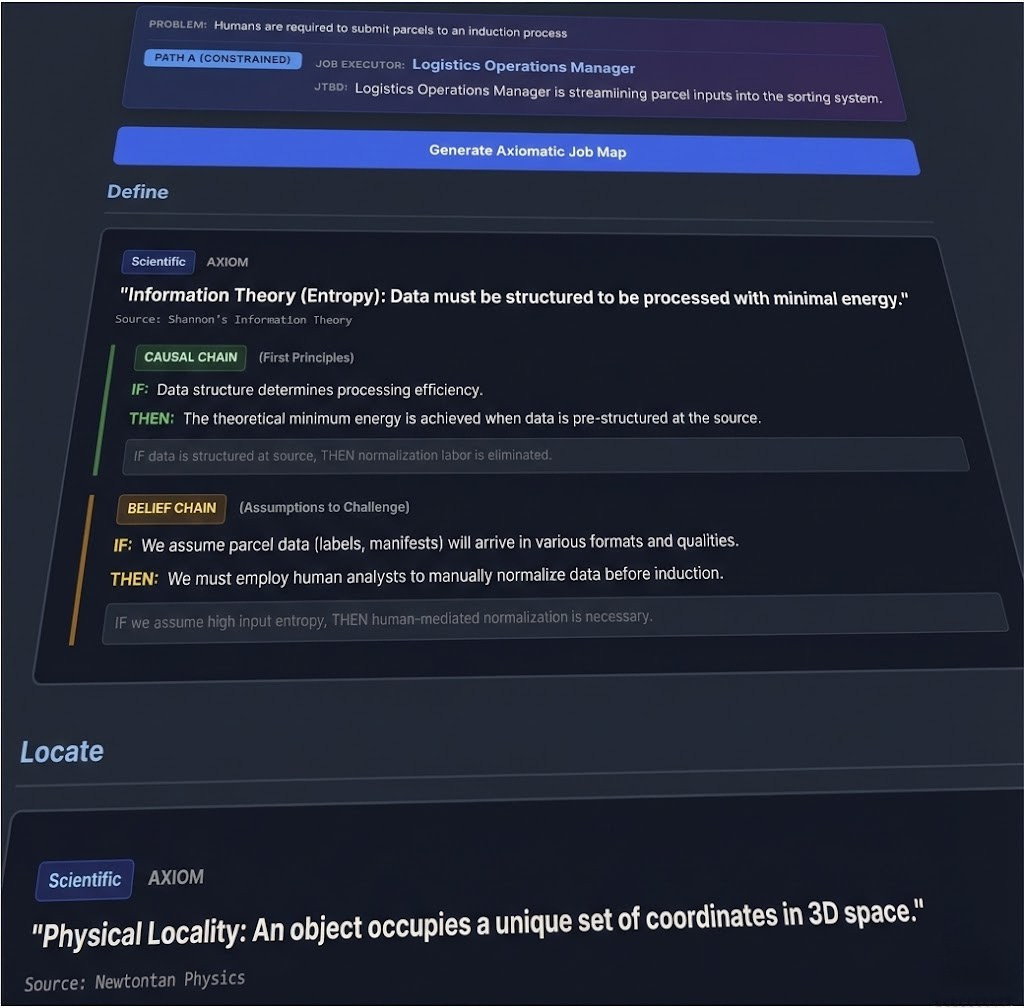
First Principles Thinking is often misunderstood as a “brainstorming technique.” It’s not. It’s a weapon. It is the act of boiling a process down to the fundamental truths that cannot be deduced any further—the Axioms. And thankfully, it can be done quite easily without workshop theater. Theoretical floor: $0.01
Before we define the Job-to-be-Done, we must destroy the “Problem As-Is.” We must use Socratic Deconstruction to peel away the layers of solution bias until only the raw physics and logic remain.
The Carbon Pivot: A Case Study in Deconstruction
Let’s look at a practical example: Carbon Management.
The Analogy Approach (The Trap): A software company interviews sustainability officers. They ask about their struggles. The officers say, “It’s hard to collect data from all our factories to report our emissions.”
* The Insight: “Data collection is manual and slow.”
* The Solution: An automated dashboard for tracking emissions.
* The Result: A slightly better spreadsheet. Low value.
The First Principles Approach (The Intervention):
We ignore the dashboard. We ignore the spreadsheet. We ask Why.
* Why do you track emissions? “To report them.”
* Why do you report them? “To comply with regulations.”
* Why must you comply? “Because if we don’t, we get fined or taxed.”
* Why does the tax matter? “It impacts our balance sheet.”
* The Axiom: Carbon is not an environmental metric; it is a Financial Liability.
By drilling down to the Axiom, the entire landscape changes. We’re no longer building a tool for an Environmental Manager (low budget). We’re building a risk management asset for the CFO (high budget).
We moved from “building a better calculator” to “creating a financial instrument.” That’s the power of deconstruction.
The Purification: Defining the Job Executor
Once the Axioms are exposed, we can finally engage in true Jobs-to-be-Done. But now, the process is purified. We’re no longer asking questions about a specific product; we’re asking questions about the fundamental reality we uncovered.
This allows us to strip away the “Persona.” Marketing personas are distractions—collections of demographics and hobbies that tell us nothing about causality. Instead, we identify the Job Executor.
The Job Executor is not a person; it is a functional role defined by the Axiom (not a consultant). In our example, the Job Executor is not “Sustainability Susan, who likes hiking and recycling.” The Job Executor is “The mitigator of balance sheet liability.”
When we view the user through this lens, the “Job” becomes pure and solution-agnostic:
* Impure Job: “I want to automate my carbon data entry.” (Solution Bias)
* Pure Job: “I want to minimize exposure to regulatory financial risk.” (Axiom-based)
Observation: The rarely happens 👆. That’s why my approach provides dual paths. More on that another time.
Job Maps map the edges and inner objectives of the future state. They will help you size an opportunity. They’ll segment the opportunity. And they’ll explore the depth of the opportunity.
They’re simply not something dreamt up after a handful of interviews, or by filtering through a ‘seasoned’ practitioner. Here’s a book on statistics.
Only now can we measure the market.
The Signal: From Insight to Heatmap
We’ve stripped away the noise. Now we hunt for the Signal.
Traditional research yields qualitative “insights” … fuzzy feelings that a customer might buy something. First Principles yields quantitative certainty; but I’ll address the ID10T Index another time.
By mapping the purified Job Steps against the customer’s ability to achieve them, we create a Heatmap. We’re looking for the gap between the Job Executor’s goal (the Axiom) and their current reality.
* Where is the friction highest?
* Where is the satisfaction lowest?
* Where is the outcome most underserved?
This Heatmap is the Signal. It is not a guess. It is a mathematical representation of unmet demand. It measures an actual hypothesis based on First Principles. It tells us exactly where the opportunity for 10x innovation lies. It prevents us from wasting resources on “nice-to-have” features and focuses our energy on the critical “must-have” utility. It brings clarity, not just dots-on-a-plot.
Innovation is not about creativity. It is about the rigorous application of logic to identify an underserved Axiom.
Call to Action: Escaping the Monolithic Fallacy
The corporate world is addicted to the Monolithic Fallacy—the belief that you must bet the entire company on a single, massive, unverified solution. They build the factory before they have isolated the Axiom. They scale the “Problem As-Is” and wonder why they fail. Consultants love this since they are guaranteed their payday. The company is left with 100% of the risk.
You must reject this path.
Stop building factories. Start buying options.
When you reason from First Principles, you earn the right to buy an Option to Explore. An option is a small, calculated bet to validate an Axiom. It is low-cost, high-velocity, and rooted in truth rather than analogy.
The Roadmap for the Radical Strategist:
* Rejection: Refuse to accept the “Problem As-Is.”
* Demolition: Deconstruct the problem until you hit the Axioms of physics or logic.
* Purification: Define the Job Executor and the Job without solution bias.
* Quantification: Measure the Signal to find the Heatmap of opportunity.
* Execution: Buy Options to Explore, not Monolithic gambles.
The noise is deafening. The market is filled with copycats reasoning by analogy. Do not join them.
Deconstruct. Verify. Innovate.
This is the way of First Principles.
If you find my writing thought-provoking, please give it a thumbs up and/or share it. If you think I might be interesting to work with, here’s my contact information (my availability is limited):Book an appointment: https://pjtbd.com/book-mike
Email me: mike@pjtbd.com
Call me: +1 678-824-2789
Join the community: https://pjtbd.com/join
Follow me on 𝕏: https://x.com/mikeboysen
Articles - jtbd.one - De-Risk Your Next Big Idea
New Masterclass: Principle to Priority
Q: Does your innovation advisor provide a 6-figure pre-analysis before delivering the 6-figure proposal?