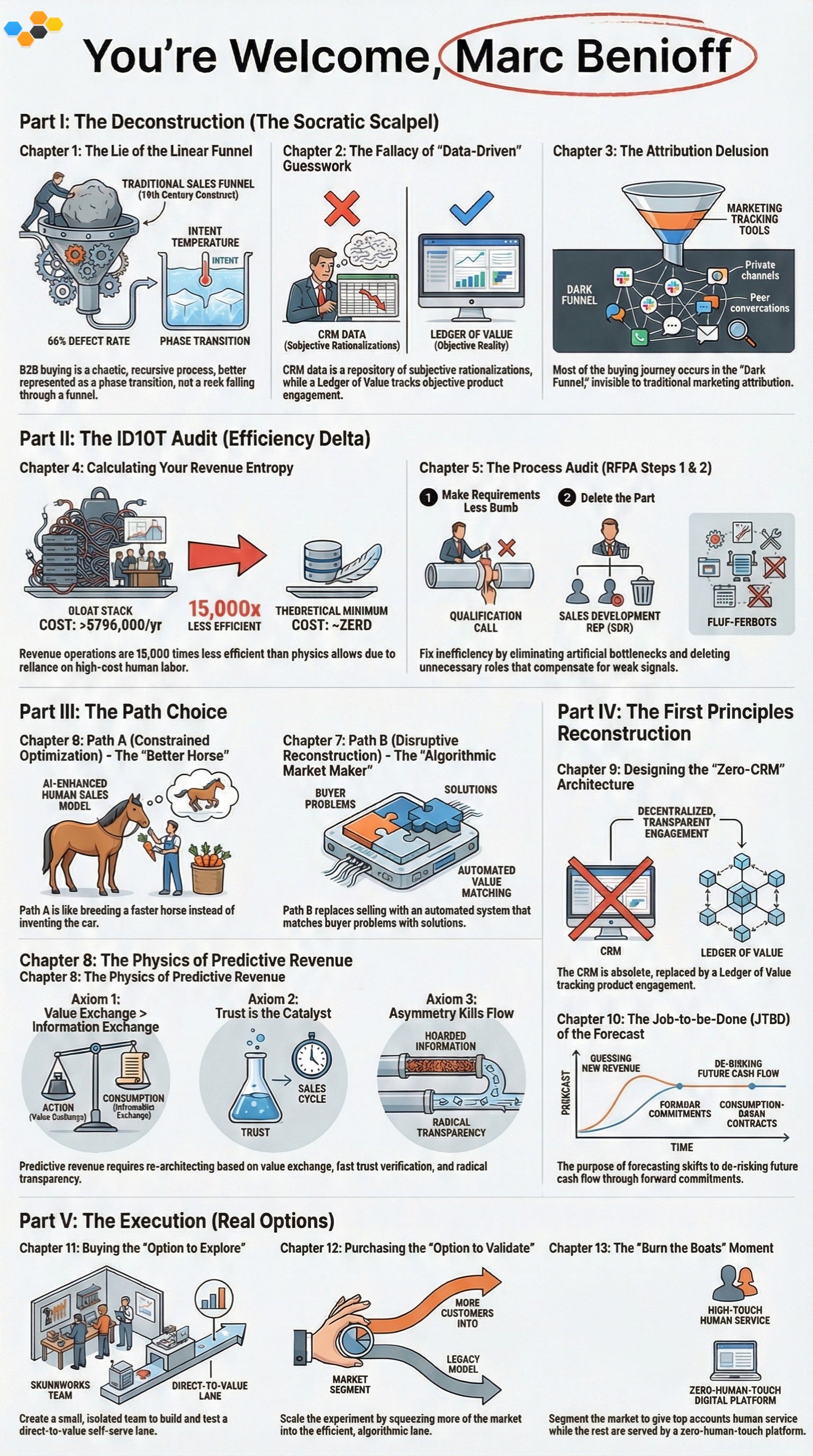
TL;DR: Building a modern revenue engine on the traditional "Funnel" is like trying to toast bread by running a nuclear power plant; it’s a massive, over-engineered expenditure of high-quality energy to solve a simple data integrity problem that should cost near zero
We’re not here to fix your Salesforce dashboard. We’re here to perform an autopsy on the delusion that “managing relationships” via manual data entry can ever yield predictive physics. The B2B revenue machine is broken because it’s built on Reasoning by Analogy—copying the “Funnel” model of the 19th century and digitizing it with expensive SaaS tollbooths.
This article will apply the Robust First Principles Analyst (RFPA) Protocol to strip your revenue engine down to its sub-atomic axioms. We’ll calculate the ID10T Index of your current RevOps structure, proving you’re paying a 5,000x premium for “certainty” you aren’t getting. Then, we’ll rebuild a First Principles Revenue Model that doesn’t rely on hope, hustle, or better prompts for your SDRs.
PART I: THE DECONSTRUCTION (THE SOCRATIC SCALPEL)
Chapter 1: The Lie of the Linear Funnel
The Stuck Belief: “Revenue is a linear process (Awareness → Interest → Consideration → Decision) that can be managed by controlling volume at the top.”
If you walk into any B2B revenue organization today—whether it’s selling $50/month SaaS or $50M hydroelectric turbines—you will find the same religious artifact hanging on the wall: The Funnel.
It is the unquestioned deity of modern commerce. It dictates how we hire, how we forecast, how we structure our CRMs, and how we fire VPs of Sales. It is elegant, logical, and visually satisfying.
It is also a hallucination.
The Funnel isn’t a “First Principle” of economics. It’s a marketing construct invented in 1898 by St. Elmo Lewis to sell cash registers. It relies on the physics of gravity—the idea that if you pour enough raw material (leads) into the wide top, a predictable percentage will inevitably fall through the bottom as gold (revenue), provided you lubricate the sides with enough marketing content.
But gravity doesn’t apply to human decision-making. In fact, complex B2B buying is almost exactly the opposite of gravity; it is an act of defying entropy. It is climbing a mountain, not falling into a bucket. By building your entire revenue machine on a physics error, you have institutionalized waste.
Let’s apply the Socratic Scalpel to deconstruct why this 19th-century model is destroying your 21st-century predictability.
1.1 The Assumption of Linear Progression
Socratic Inquiry: Why do we organize our CRMs into sequential stages (Stage 1: Discovery, Stage 2: Validation, Stage 3: Proposal)?
The Standard Answer: “Because that is the path the customer takes to buy the product.”
The Challenge: Is it? Or is that simply the path you want them to take so your reporting looks clean?
If we look at the actual physics of a modern B2B buying decision—specifically one involving a “Committee” of 6 to 10 stakeholders—the behavior is not linear. It is recursive, chaotic, and circular.
* The Champion (User) finds the tool (Awareness).
* They get excited (Interest).
* They bring it to the CFO (Blocker).
* The CFO asks a security question the Champion can’t answer.
* The deal doesn’t move to “Stage 3.” It moves to “Stage -1.”
* The Champion goes dark for three months.
* A new CTO is hired. The process restarts at “Awareness,” but with a different person.
In your CRM, this deal is sitting in “Stage 2: Validation” with a 25% probability of close. In reality, the deal is in a quantum superposition of “Dead” and “Zombie.” The Funnel model cannot represent circularity, so your sales reps are forced to lie to the software. They leave the deal in Stage 2 and push the “Close Date” out by 30 days.
This isn’t an anomaly; it’s the standard state of B2B commerce. The “Linear Funnel” is a map of a territory that doesn’t exist. It forces you to measure progress (which is an illusion) rather than intent (which is the only truth).
1.2 The “Coverage” Hedge: Mathematical Proof of Failure
Socratic Inquiry: If the Funnel is a predictive machine, why do you require “3x Pipeline Coverage”?
Let’s look at the math you accept as normal.
Every Quarter Business Review (QBR) starts with a slide: “We need 3x coverage to hit our number.”
Translation: “We need to identify $3,000,000 of potential revenue to close $1,000,000.”
Deconstruct that statement. You are admitting, upfront, that your manufacturing process has a 66% defect rate.
If a car factory required 3,000 pounds of steel to produce a 1,000-pound car, we wouldn’t call that a “manufacturing process.” We would call it a scrapyard.
The existence of the “3x Coverage Rule” is the smoking gun. It proves that you don’t actually believe the Funnel works. If the Funnel worked—if “Qualification” actually meant a prospect was qualified—you would only need 1.1x coverage.
The “3x Rule” is a hedge against ignorance. It’s an admission that you have no idea which deals are real and which are hallucinations, so you pile enough mass into the system to hope the law of averages saves you.
The First Principles Reality:
* You are paying CAC (Customer Acquisition Cost) on the 3x.
* You are paying Sales Rep Labor (L2/L3) to manage the 3x.
* You are paying Management Attention (L4) to forecast the 3x.
* You only get paid on the 1x.
This is an ID10T Index disaster. You are financing a massive, entropy-heavy machine to manage waste, simply because you refuse to abandon the “Funnel” model that creates the waste in the first place.
1.3 The Illusion of Seller Control
Socratic Inquiry: Who controls the velocity of the deal?
The Stuck Belief: “If we follow the sales process (MEDDIC, Challenger, Sandler), we can drive the deal forward.”
This is the “Geocentric Universe” theory of sales. We believe the buyer revolves around the seller. We believe that if we send the right email, make the right “power move” in the negotiation, or send a case study at the right time, we can cause the deal to close.
The Reality: The buyer is dealing with their own internal chaos. They are fighting for budget, fighting off layoffs, handling a PR crisis, or migrating their data center. Your “Proposal Review Call” is the 49th most important thing on their list this week.
When you use a Funnel, you are attempting to impose a Seller-Centric Timeframe on a Buyer-Centric Problem.
* Manager: “Why is this deal stalling? Send them a ‘break-up’ email to create urgency!”
* Physics: The buyer isn’t stalling. They are waiting for the Board Meeting on the 15th. Your email is irrelevant.
The Funnel creates a culture of “Activity Theater.” Reps perform actions (calls, emails, demos) to simulate velocity, because the CRM demands velocity. But motion is not progress. You can run 100mph on a treadmill and never arrive at the destination. The Funnel rewards the treadmill.
1.4 The Re-Frame: From Funnel to “Phase Transition”
If we delete the Funnel, what replaces it?
We must stop reasoning by analogy (fluids falling) and start reasoning by physics (state changes).
A deal isn’t a rock falling down a hole. It’s water turning into ice.
* Liquid State (Indifference): The molecules (stakeholders) are moving randomly. They have no structure. You can poke them, and they just flow around you.
* Phase Transition (Intent): Something happens—a regulatory fine, a competitor launch, a crash—that lowers the temperature. The molecules align. They solidify.
* Solid State (Action): The decision is made.
Your job isn’t to “push” the water. You can’t push water; it just spills. Your job is to measure the temperature.
* Is the pain acute enough to cause a phase transition?
* If yes, you simply provide the mold (the contract) for the ice to form in.
* If no, no amount of “nurturing” or “value selling” will freeze the water.
The Funnel tricks you into trying to freeze water with a blowtorch. It burns your energy (CAC) and evaporates your potential.
The Funnel is a comfort blanket for executives who are terrified of chaos. It gives you a clean dashboard that says “Stage 3: 40%.” But that number is a lie. It is a “Causal Hallucination.”
To build a predictive revenue model, we must first burn the Funnel. We must stop managing “Stages” and start measuring Signal.
We don’t need a “Better Funnel.” We need a Geiger Counter for intent.
Chapter 2: The Fallacy of “Data-Driven” Guesswork
The Stuck Belief: “If we enforce stricter CRM compliance and log more activities, our forecast will become accurate.”
If the Funnel is the religion, the CRM (Customer Relationship Management) system is the temple where the offerings are made. Every Monday morning, in conference rooms across the world, Sales VPs scream the same mantra: “If it’s not in Salesforce, it doesn’t exist.”
We operate under the assumption that a CRM is a Data Storage Device. We believe it contains an objective record of reality. We think that if we just get the reps to enter the data correctly—if we add more required fields, more validation rules, and more “Stage Gates”—the machine will output truth.
This is a fundamental misunderstanding of information theory. A CRM is not a sensor; it is a Repository of Rationalizations.
2.1 The Entropy of Human Data Entry
Socratic Inquiry: What is the source of the data in your forecast?
It comes from a human being (the Sales Rep) who has a direct financial incentive to manipulate that data.
* If they mark a deal as “Lost,” they get yelled at.
* If they mark a deal as “Won” (before it’s signed), they look good for the week.
* If they push the date to next quarter, they buy themselves time.
When you ask a human to manually enter data about their own performance, you are not collecting “metrics.” You are collecting fiction.
In thermodynamics, Entropy is the measure of disorder in a system. Every time a human touches a piece of data, entropy increases.
* The Rep forgets what the prospect actually said, so they summarize it vaguely: “Good call, interested.”
* The Manager reads “Good call” and interprets it as “Stage 3.”
* The VP reads “Stage 3” and puts it in the Board Deck as “Commit.”
By the time the data reaches the CEO, it is 100% hallucination. It has been filtered through three layers of fear, optimism, and political maneuvering. You are making million-dollar decisions based on a game of “Telephone” played by people who are afraid of getting fired.
2.2 The High Cost of “Scrubbing” (A Violation of Thermodynamics)
Socratic Inquiry: Why do your highest-paid employees spend 20% of their week “scrubbing” the pipeline?
Let’s calculate the Labor Tax of this delusion.
Every week, you hold a “Forecast Call.”
* Participants: 1 VP of Sales (L4: $800/hr), 4 Regional Directors (L3: $300/hr), and often the Reps themselves (L2: $75/hr).
* Duration: 2 hours.
* The Activity: They go deal by deal, asking, “Is this real? Did they actually say that? Why is the close date Friday?”
They are acting as Human Error-Correction Algorithms.
You are using your most expensive biological supercomputers (L4 Leaders) to clean up the data entry errors of your L2 employees.
In physics terms, this is insanity. You are expending massive amounts of high-quality energy to reverse local entropy.
* The ID10T Index: You are paying $5,000+ per week just to guess what the revenue is.
* The Theoretical Minimum: The cost of knowing the revenue should be near zero. The revenue exists or it doesn’t. The contract is signed or it isn’t. The usage logs show activity or they don’t.
If you need a meeting to figure out if a deal is real, the deal isn’t real. Truth doesn’t require a committee.
2.3 The “Single Source of Truth” Myth
Socratic Inquiry: Is your CRM a source of truth, or a source of compliance?
We treat the CRM as the “Single Source of Truth.” But what is it actually recording?
It records Seller Activity, not Buyer Reality.
* It logs how many emails we sent (irrelevant).
* It logs how many calls we made (irrelevant).
* It logs what stage we think they are in (subjective).
It does not record:
* The conversation the prospect had with their boss 10 minutes ago.
* The competitor’s pricing sheet sitting on the CFO’s desk.
* The fact that the prospect just updated their LinkedIn profile to “Open to Work.”
We have built a massive surveillance state to track the wrong variables. We are tracking the Inputs of Effort (Activity) rather than the Outputs of Value (Engagement/Usage).
We are managing the “Hustle,” not the “Physics.”
You cannot “fix” your forecast by whipping the reps to update Salesforce. You cannot fix it by buying a “Revenue Intelligence” tool that records the lies in HD.
You fix it by acknowledging that human data entry is obsolete.
Predictability requires Telemetry, not Testimony.
We must stop asking reps “How did the call go?” and start measuring “Did the customer use the product?”
Chapter 3: The Attribution Delusion
The Stuck Belief: “We can track exactly which marketing touchpoint caused the sale, and if we optimize for ROAS (Return on Ad Spend), we will grow.”
If the Funnel is the religion and the CRM is the temple, Attribution is the theology—the complex, arcane set of rules we invent to explain why it rained.
Marketing teams are obsessed with proving they caused the revenue. They fight over “First Touch” vs. “Last Touch” vs. “W-Shaped” attribution models. They present dashboards showing that “LinkedIn Ads drove $4M in pipeline.”
And yet, when you turn off the LinkedIn ads, the revenue doesn’t drop by $4M.
Why? Because attribution is a political construct, not a scientific one.
3.1 The “Dark Funnel” Reality
Socratic Inquiry: Where does the actual buying decision happen?
Does it happen when they click your Google Ad? Does it happen when they download your whitepaper?
No.
It happens in a Slack community you can’t see.
It happens at a dinner party where a peer says, “Yeah, we used Tool X and it sucked. Use Tool Y instead.”
It happens in a text thread between two CTOs.
This is the Dark Funnel. It accounts for 90% of the B2B buying journey. It is invisible to your tracking pixels. It is invisible to your UTM codes.
When a lead finally arrives at your “Demo Request” form, they are already 80% sold. They made the decision in the dark.
Your attribution software sees the “Direct Traffic” or “Organic Search” and claims credit for the conversion. It’s like a rooster claiming credit for the sunrise because he crowed right before it happened.
3.2 The Theft of Credit (Attribution vs. Causality)
Socratic Inquiry: Did the ad cause the sale, or did it just tax the transaction?
Let’s look at “Branded Search.”
A user types your company name into Google. You pay $5 for the click on your own name.
Your marketing team reports a “20x ROAS” on that campaign.
Challenge: If you hadn’t paid for the ad, would they have clicked the organic link right below it?
Yes.
You didn’t generate demand; you taxed existing intent. You paid a toll to Google to capture a user who was already looking for you.
Attribution models are designed to allocate credit, not isolate causality.
* The Content Team wants credit for the blog post.
* The Demand Gen Team wants credit for the webinar.
* The Sales Team wants credit for the outbound email.
* The Reality: The customer bought because their server crashed and they needed a solution now.
By fighting over who gets the credit, you create perverse incentives. Marketing optimizes for “Cheap Leads” (e.g., giving away iPads for demo requests) to juice their MQL numbers, even though those leads have zero intent to buy.
You have optimized the Signal of Activity at the expense of the Substance of Revenue.
3.3 The Vanity of ROAS vs. The Physics of CAC
Socratic Inquiry: Why do we measure ROAS instead of CAC Payback?
“Return on Ad Spend” (ROAS) is a dangerous metric because it ignores the Floor.
It assumes that all revenue associated with an ad is caused by the ad.
But every business has a Natural Baseline of revenue—sales that would happen even if marketing went on vacation (referrals, word of mouth, repeat business).
The ID10T Calculation:
If your “Marketing Influenced Revenue” is $10M, but your “Baseline Revenue” (with zero spend) would be $8M, then marketing only generated $2M.
If you spent $1M to get that $10M result, your ROAS looks like 10x.
But your Marginal ROAS is actually only 2x ($2M incremental / $1M spend).
And once you factor in the salaries of the marketing team (L3/L4 labor), your True ROI might be negative.
We are spending millions to irrigate a field where it’s already raining.
Stop trying to track the path of every raindrop. You can’t.
The obsession with “Perfect Attribution” is a defensive move by marketing leaders to justify their budgets to the CFO.
Instead of asking “Which touchpoint got the credit?”, ask: “Are we creating a market, or just harvesting one?”
* Harvesting: capturing existing demand (Attribution works here, but scales poorly).
* Creating: educating the market so they eventually enter the Dark Funnel (Attribution fails here, but this is where 10x growth lives).
True predictive revenue comes from Market Making, not Click Tracking.
PART II: THE ID10T AUDIT (EFFICIENCY DELTA)
Chapter 4: Calculating Your Revenue Entropy
It’s time to stop talking about “efficiency” in the abstract and start doing the math.
In engineering, we use the ID10T Index (Inefficiency Delta in Operational Transformation) to measure how far a process has drifted from its physics limit.
The formula is brutal and unforgiving:
ID10T Index = (Current Commercial Price) / (Theoretical Minimum Cost)
We are going to calculate the ID10T Index of your Revenue Forecasting Machine. We will determine exactly how much you are overpaying for the simple act of knowing “how much money we will make next month.”
4.1 The Numerator: The Cost of the “Bloat Stack”
First, we calculate the Current Commercial Price of generating a forecast. This is not just the cost of the software; it is the cost of the human entropy required to feed it.
Item A: The SaaS Tax (The “Single Source of Truth”)
You aren’t just paying for Salesforce. You are paying for an ecosystem of “Band-Aid Bots”—tools designed to fix the fact that Salesforce is empty.
* CRM License: $150/user/month.
* Sales Engagement (Outreach/Salesloft): $100/user/month (to automate the spam).
* Conversation Intelligence (Gong/Chorus): $120/user/month (to record the lies).
* Data Enrichment (ZoomInfo/6sense): $15,000/year (to buy the phone numbers).
* Forecasting Tool (Clari/BoostUp): $80/user/month (because Salesforce reporting is too ugly).
* Total Stack Cost Per Rep: ~**$6,000 per year.**
Item B: The Labor Tax (The “Weekly Forecast Call”)
This is the hidden killer. Let’s price out the standard “Monday Morning Pipeline Review” for a mid-sized sales organization.
* 1 VP of Sales (L4 Labor - Elite): $800/hr.
* 4 Sales Directors (L3 Labor - Professional): $300/hr x 4 = $1,200/hr.
* 20 Account Executives (L2 Labor - Skilled): $75/hr x 20 = $1,500/hr.
* Total Hourly Burn: $3,500 per hour.
If this meeting lasts 2 hours (and it always does), and happens weekly:
* Weekly Cost: $7,000.
* Annual Cost: $364,000.
You are spending over a third of a million dollars a year on one meeting where people sit in a circle and guess the future. And that’s before we add the 4 hours per week each rep spends manually updating the CRM to prepare for the meeting.
Total Numerator (Annual Cost of the Forecast):
(Stack Cost x 20 Reps) + (Meeting Labor) + (Data Entry Labor)
$120,000 + $364,000 + $312,000 (4hrs/week/rep @ $75/hr)
**= $796,000 per year.**
You are paying nearly $800,000 annually just to generate a spreadsheet that is usually wrong.
4.2 The Denominator: The Theoretical Minimum
Now, we apply the First Principles Floor.
What is the actual physics cost of knowing if a customer is going to pay you?
* The Bits Floor: The cost to query a database to see if a contract is signed or usage has occurred.
* Cost: $0.01 per query.
* The Trust Floor: The cost to verify intent.
* In a “Commitment First” model (Part III), the customer signs a smart contract or deposits a token before consumption.
* Cost of verification: Near Zero.
Let’s be generous. Let’s say the “Theoretical Minimum” cost to update the status of your revenue is $1.00 per week.
4.3 The Calculation (The Horror)
ID10T Index = $796,000 / $52 (annualized physics limit)
ID10T Index = 15,307
Diagnosis: Your revenue operation is 15,000 times less efficient than the laws of physics allow.
You are running a nuclear power plant to toast a piece of bread.
The gap exists because you are using High-Cost Human Labor (L3/L4) to solve a Low-Value Data Integrity Problem.
Every time a VP asks, “Is this deal real?”, they are performing a function that a simple “Usage Gate” or “Payment Trigger” should handle automatically.
Chapter 5: The Process Audit (RFPA Steps 1 & 2)
We have diagnosed the disease (ID10T Index of 15,000). Now we apply the RFPA Protocol to perform surgery.
We do not optimize. We do not “improve.” We deconstruct.
5.1 Step 1: Make Requirements Less Dumb
Target: The “Stage 2 Qualification Call.”
Constraint being challenged: “We must have a separate call to qualify the prospect before they can see a demo.”
The Socratic Interrogation:
* Agent: Who set this requirement?
* VP of Sales: It’s standard BANT (Budget, Authority, Need, Timing). We need to protect the Account Executive’s time.
* Agent: So you are using a human barrier to filter for a human resource?
* VP: Yes.
* Agent: Why is the Account Executive’s time the bottleneck? Why is the demo a scarce resource?
* VP: Because... only they can give it?
The Reality: The requirement is dumb. It assumes the “Demo” is a physical performance that requires a human actor.
If the product is software, the demo should be an infinite digital resource (a self-guided instance).
By requiring a “Qualification Call,” you are introducing friction to solve a scarcity problem that you created.
Action: Delete the Qualification Call. The product qualifies the user by seeing if they can figure it out.
5.2 Step 2: Delete the Part
Target: The “MQL to SQL Handoff.”
Constraint being challenged: “Marketing generates the lead, SDR qualifies it, AE closes it.”
This is the “Assembly Line” model of 1920. It assumes that information transfer between humans is lossless.
It is not. It is lossy.
* Marketing promises Feature X.
* SDR creates hype about Solution Y.
* AE shows up and sells Result Z.
* Customer is confused and leaves.
The “Flufferbot” Test:
An SDR (Sales Development Rep) is essentially a “Flufferbot”—a human robot employed to bridge the gap between two disconnected systems (Marketing Automation and Sales CRM).
They exist only because the Marketing Signal is too weak to close the deal, and the Sales Rep is too expensive to waste time on bad leads.
The Deconstruction:
* Question: What happens if we delete the SDR role entirely?
* Panic: “The AEs will be overwhelmed with junk!”
* First Principles: If the AEs are overwhelmed with junk, it means your Signal (Marketing) is defective. You are using SDRs as a “Human Spam Filter.”
* Action: Fix the Signal. Make the “Call to Action” so high-friction (e.g., “Connect your Data Warehouse to Start Trial”) that only qualified leads get through.
* Result: You delete the SDR department. You delete the Handoff. You lower the ID10T Index by removing an entire layer of L2 labor.
5.3 The Insight: Flufferbots and Band-Aids
Most of your Martech stack (and your org chart) consists of Flufferbots—tools and roles that exist to patch inefficiencies in the previous step.
* You buy “Sales Engagement” tools because your CRM data is messy.
* You buy “Data Enrichment” tools because your “Lead Forms” are too long.
* You hire SDRs because your “Marketing” is vague.
Rule: If you are not adding things back in at least 10% of the time, you are not deleting enough.
In the next section, we will choose the path forward. Will you buy a faster horse (Optimize the Flufferbots), or build a car (Delete them)?
PART III: THE PATH CHOICE
We have stared into the abyss of your ID10T Index. You are now faced with a binary choice. You can either optimize the machine you currently have, or you can dismantle it and build the machine that physics demands.
Chapter 6: Path A (Constrained Optimization) - The “Better Horse”
Path A is the choice 95% of companies will make. It is the path of least cultural resistance. It accepts the premise that “Sales” is a human-centric push activity, and seeks to use technology to make those humans faster, smarter, and less prone to error.
It is the equivalent of Henry Ford trying to breed a horse with 8 legs instead of inventing the Model T.
6.1 The “Smarter” CRM (The AI-Augmented Funnel)
The Strategy: “We will eliminate the data entry problem by having AI listen to everything.”
The Mechanism:
Instead of asking reps to update Salesforce, you deploy “Conversation Intelligence” bots (Gong, Chorus, Outreach) into every Zoom call and email thread. These bots transcribe the conversation, perform Sentiment Analysis, and automatically update the CRM fields.
* “The prospect mentioned ‘Budget’ in minute 14 with a negative sentiment.” -> Probability adjusted to 40%.
* “The competitor ‘Competitor X’ was mentioned.” -> Competitive flag raised.
The Promise: You get a “Real-Time Forecast” based on actual conversation data, not rep hallucination.
The Reality: You have simply automated the collection of noise.
* You are still recording the interaction, not the intent.
* You are still relying on the “Funnel” model (Stages), just capturing the movement between stages more accurately.
* Key Failure: A beautifully transcribed record of a polite “No” is still a “No.” AI cannot force a phase transition; it can only document the lack of one with higher fidelity.
6.2 The Probabilistic Forecast (Math over Vibes)
The Strategy: “We will stop trusting the Rep’s ‘Commit’ and trust the algorithm.”
The Mechanism:
You implement platforms like Clari or BoostUp. These tools look at historical data (regression analysis) to determine that:
“When Rep A says a deal is in Stage 3, it actually closes 12% of the time, not 50%.”
The software then overrides the Rep’s optimism and presents a “AI Projection” to the Board.
The ID10T Impact:
This does lower the ID10T Index slightly. It allows you to fire the L3 Sales Directors who used to do this math manually. However, it effectively admits that your L2 Sales Reps are unreliable witnesses, yet you continue to employ them as the primary interface with the customer.
6.3 Why Path A Fails (The Faster Horse Trap)
Path A is seductive because it requires no organizational surgery. You keep the SDRs. You keep the VPs. You just buy more software.
But it fails the First Principles Test because it optimizes a broken model.
* It makes the horse faster (Automated Data Entry).
* It creates a better map of the route (Probabilistic Forecasting).
* But it doesn’t change the vehicle.
You are still pushing a product. You are still fighting entropy. You are still paying CAC on the 3x coverage. You have simply built a very expensive, AI-powered dashboard to watch your inefficiency in 4K resolution.
Chapter 7: Path B (Disruptive Reconstruction) - The “Algorithmic Market Maker”
Path B is the First Principles choice. It rejects the idea of “Selling” entirely and replaces it with “Matching.”
It moves from a Push-Based System (Convincing) to a Pull-Based System (Verifying).
7.1 From “Probability” to “Capability”
The Shift: In Path A, you sell a Product (Software License). In Path B, you sell an Outcome (Result).
The Mechanism:
If you sell a software license for $50k/year, the buyer takes on 100% of the risk. They have to implement it, train their team, and hope it works. Because the risk is high, the “Sales Cycle” is long (Trust Verification).
But what if you sold the Outcome?
* Instead of selling “Cold Email Software,” sell “Qualified Meetings.”
* Instead of selling “Server Monitoring Tools,” sell “Uptime Guarantees.”
The Physics Change:
When you sell an Outcome, the Predictability of revenue shifts from:
* Path A: “Will the customer believe me?” (Conversion Probability - High Variance).
* Path B: “Can I deliver the result?” (Operational Capability - Low Variance).
You control your operations. You do not control the customer’s mind. Therefore, to make revenue predictable, you must sell what you control.
7.2 The “Product-Led Signal” (The New Funnel)
The Mechanism: The “Zero-Touch” Entry.
In Path B, there are no “Lead Forms.” There are no “Demos.”
There is only Access.
* The user connects their data.
* The algorithm analyzes the data.
* The algorithm proves value before asking for money.
Example (Ad Networks):
Google does not have a Sales Rep call you to sell you AdWords. You enter your credit card, you upload your ad, and you see the clicks.
The “Sales Cycle” is zero. The “Forecast” is purely a function of search volume (Physics), not persuasion.
The B2B Equivalent:
We are seeing this in “Usage-Based Pricing” (Snowflake, AWS) and “Fintech-Embedded SaaS” (Toast, Shopify).
* Toast doesn’t just sell POS software; they process the payments. They know the restaurant’s revenue. They don’t need to “forecast” churn; they see the transaction volume drop in real-time.
* The Revenue Signal is the Usage Signal.
7.3 The Algorithmic Market Maker
The Vision:
In Path B, the Revenue Organization is not a “Sales Team.” It is a Market Making Engine.
* Input: Raw Demand (Users with problems).
* Process: Algorithmic Matching (Connecting the problem to the solution instantly).
* Output: Verified Value Exchange.
The Role of Humans in Path B:
Humans are removed from the Transaction loop (L1/L2).
Humans are elevated to the Strategy loop (L4).
* We don’t need humans to take orders.
* We need humans to design the pricing structures, the integrations, and the market strategy.
Path A optimizes the past. Path B builds the future.
Path A buys you a 10% improvement in forecast accuracy.
Path B buys you a 10x improvement in Enterprise Value, because investors pay a premium for “Tech-Enabled Revenue” (Marketplaces/Platforms) over “Labor-Enabled Revenue” (Traditional SaaS/Service).
The choice is yours. Do you want to be a “Better Sales Org” or a “Revenue Platform”?
PART IV: THE FIRST PRINCIPLES RECONSTRUCTION
We have chosen Path B. We are abandoning the “Better Horse” to build the “Automated Engine.” This requires a complete re-architecture of your revenue stack based on Physics Axioms, not marketing best practices.
Chapter 8: The Physics of Predictive Revenue
To build a predictive system, you must respect the laws that govern the movement of value. In the current B2B model, we violate these laws constantly, which is why our predictions fail. We will now codify three non-negotiable axioms for the new architecture.
8.1 Axiom 1: Value Exchange > Information Exchange
The Law: Revenue is only generated when value is consumed, not when information is exchanged.
The Violation:
We measure success by “Information Exchange” metrics:
* “They downloaded the whitepaper.” (Information)
* “They attended the demo.” (Information)
* “They opened the proposal.” (Information)
These are Vanity Signals. They cost the prospect nothing. Because they are free, they are abundant and noisy. You can download a whitepaper because you are bored, not because you are buying.
Predictability comes from measuring Value Exchange.
* “They uploaded their customer file.” (Value/Risk)
* “They ran a test query.” (Value/Consumption)
* “They integrated the API.” (Value/Commitment)
The Reconstruction:
Stop scoring leads based on clicks. Score them based on Work Done.
A prospect who has done 10 minutes of work in your platform is 100x more predictive than a prospect who has spent 10 hours talking to your sales rep.
* Old Model: “Marketing Qualified Lead” (MQL) = Clicks.
* New Model: “Product Qualified Lead” (PQL) = Calories burned by the user.
8.2 Axiom 2: Trust is the Catalyst
The Law: The velocity of revenue is limited by the speed of trust verification.
The Violation:
The “Sales Cycle” is actually a “Trust Verification Cycle.”
* Month 1: Do you exist?
* Month 2: Does it work?
* Month 3: Will you steal my data?
* Month 4: Will you go bankrupt?
We try to speed this up with “Persuasion” (Sales Reps saying “Trust me”).
But Persuasion is slow. Proof is fast.
Physics dictates that you cannot accelerate a reaction without a catalyst.
The Reconstruction:
Replace “Persuasion” with Cryptographic/Programmatic Proof.
* Don’t say “We are secure.” -> Provide a real-time SOC2 audit link.
* Don’t say “It works.” -> Provide a sandbox with dummy data they can break.
* Don’t say “We have ROI.” -> Contractually guarantee the outcome (money-back).
When you remove the need for “Faith,” you remove the need for the “Sales Cycle.”
8.3 Axiom 3: Asymmetry Kills Flow
The Law: Friction is proportional to the information asymmetry between buyer and seller.
The Violation:
* “Contact Sales for Pricing.”
* “Schedule a Call to see the Roadmap.”
* “Sign an NDA to see the API docs.”
You are hoarding information to create leverage. You think this forces them to talk to you.
In reality, it forces them to go to your competitor who has public pricing.
In a digital economy, Information Asymmetry is Damage. It creates a “Bits Tax” on the transaction. The buyer has to spend energy to find out the basic physics of your product.
The Reconstruction:
Radical Transparency.
* Pricing is public.
* Documentation is public.
* Uptime status is public.
* Result: The buyer self-educates at the speed of light (fiber optic). They arrive at the transaction point with zero asymmetry. The “Sales Call” disappears because there are no questions left to answer.
Chapter 9: Designing the “Zero-CRM” Architecture
If we accept the axioms, the CRM (a database of human interactions) becomes obsolete. We replace it with a Ledger of Value.
9.1 The “Product-Led Signal” (The New Sensor)
We stop tracking “Emails Sent” and start tracking “API Calls Made.”
The architecture requires a direct pipe between your Product and your Revenue Engine.
The New “Funnel” Steps:
* Usage (The Truth): The user enters the environment. They are not gated by a form. They are gated by their ability to use the tool.
* Sensor: Telemetry tracks “Time to First Value” (TTFV).
* Signal (The Trigger): The system detects a “Value Realization Event.”
* Example: The user successfully exported a report. The user successfully processed a payment.
* Action: This triggers the “Revenue Event.”
* Offer (The Transaction): A programmatic offer is presented at the exact moment of value.
* Not: An email on Tuesday morning.
* But: A modal window right after the successful export: “Unlock unlimited exports for $500/mo.”
This is Just-in-Time Selling. It captures the intent when the temperature is highest (Phase Transition).
9.2 Deleting the Sales Rep (L2/L3 Labor)
We are deleting the “Middleman” role.
* The SDR (L1): Deleted. Replaced by “Content & SEO” (Inbound).
* The AE (L2/L3): Deleted for transactional sales (<$20k ACV). Replaced by “Stripe Checkout” and “Self-Serve Onboarding.”
What Remains? The L4 Consultative Strategist.
Humans are too expensive to do transactions. Humans are for Complexity Management.
* If the deal is $500k and involves migrating a legacy mainframe, you need a human.
* But this human is not a “Sales Rep.” They are a Solutions Architect.
* They do not “follow up.” They design.
* They do not “negotiate price.” They engineer value.
The New Org Chart:
* Revenue Operations (System Architects): They build the machine.
* Customer Success (Value Engineers): They ensure the machine works.
* Strategic Accounts (L4 Negotiators): They handle the Whales.
* Sales Reps: 0.
Chapter 10: The Job-to-be-Done (JTBD) of the Forecast
We must redefine why we forecast in the first place.
Old Job: “Predict how much new business we will close so I can tell the Board.”
New Job: “De-risk future cash flow.”
10.1 The Solution: From “Forecasting” to “Forward Commitment”
Forecasting is guessing. It is looking at clouds and predicting rain.
We want to move to Irrigation Control. We want to turn a valve.
The Mechanism:
Stop selling “Month-to-Month” hope. Start selling Forward Commitments.
* The “Netflix” Model for B2B:
* You don’t pay Netflix per movie. You pay for Access.
* Whether you watch 0 movies or 50, the revenue is $15.
* Predictability: 100%.
Application to B2B:
Instead of charging “Per Seat” (which fluctuates with hiring/firing), charge for Capacity.
* “You are buying 10 Terabytes of processing power per year.”
* “You are buying 5,000 active leads per month.”
10.2 Consumption-Based Drawdowns (The Utility Model)
The Structure:
* Customer signs a $120k contract for the year.
* They get a “Bucket of Credits.”
* Revenue is recognized as they consume.
Why this is Predictive:
* The Cash is secured upfront (or committed contractually).
* The Usage is the variable.
* You are no longer forecasting “Will they buy?” (Sales Risk).
* You are forecasting “Will they use?” (Product Risk).
Product Risk is solvable by engineering. Sales Risk is external and chaotic.
By shifting the risk to the product, you take control of your destiny.
The “Zero-CRM” architecture is not a dream. It is how AWS, Stripe, and Slack grew to billions.
They didn’t call you. You used them. You got hooked. You paid.
The “Sales Team” was an API documentation page and a credit card form.
That is the ID10T Index limit. That is the future.
PART V: THE EXECUTION (REAL OPTIONS)
We have the blueprints. The physics are sound. The First Principles are locked. Now comes the dangerous part: The implementation.
If you walk into the CEO’s office tomorrow and say, “Fire the sales team, we are building a Stripe Clone,” you will be fired by lunch.
You cannot turn an aircraft carrier on a dime, but you can launch a speedboat from its deck.
We will use Real Options Theory to de-risk this transformation. We are not making a $10M bet. We are buying a series of cheap options to prove the thesis.
Chapter 11: Buying the “Option to Explore”
The first step is to buy the Option to Explore. This is a small, contained investment that gives you the right, but not the obligation, to proceed further.
In finance, an option costs a fraction of the underlying asset. In innovation, the cost is the “Tiger Team.”
11.1 The Setup: The “Skunkworks” Cell
Action: Do not touch the core revenue engine. Let the VPs keep their forecast meetings. Let the SDRs keep spamming.
Carve out a Micro-Unit:
* 1 Product Engineer (L3): To build the “Zero-Touch” path.
* 1 Growth Marketer (L3): To drive traffic to the path.
* 1 Solutions Architect (L4): To handle “exception processing” manually.
* Budget: $0 for software (use existing stack). Time-boxed to 90 days.
The Mandate: “Build a lane where a customer can pay us $5,000 without talking to a human.”
11.2 The Experiment: The “Direct-to-Value” Lane
The Target: Identify the bottom 20% of your market—the deals your Sales Reps hate.
* The “Small” accounts.
* The “Tier 3” regions.
* The “Annoying” inbound leads.
The Tactic:
Redirect this traffic away from the “Demo Request” form.
Send them to a “Get Started Now” page.
* Ungated: They can sign up instantly.
* Self-Serve: They connect their data.
* Credit Card: They pay upfront.
The Test:
We are testing Axiom 1 (Value > Information).
Will they do the work?
If they convert, you have proven that the market prefers friction-free access over “White Glove Service.”
11.3 The Metric: Comparing the Physics
At the end of 90 days, you compare the Unit Economics of the Tiger Team vs. the Legacy Org.
* Legacy Lane:
* CAC: $4,000 (SDR + AE + Manager).
* Cycle Time: 45 Days.
* ID10T Index: 15,000.
* Algorithmic Lane:
* CAC: $500 (Ad Spend + Engineering amortization).
* Cycle Time: 45 Minutes.
* ID10T Index: < 100.
The Result: You now hold a validated Option. You have proof that a superior physics model exists within your own company. You have bought the right to ask for more budget.
Chapter 12: Purchasing the “Option to Validate”
The Tiger Team worked. You have a small stream of revenue that is highly efficient. Now you buy the Option to Validate. You are scaling the experiment to prove it wasn’t a fluke.
12.1 The “Squeeze” Strategy
Action: Slowly tighten the criteria for the Legacy Lane.
* Month 1: “Any deal under $10k ACV goes to Self-Serve.”
* Month 3: “Any deal under $25k ACV goes to Self-Serve.”
* Month 6: “Any deal under $50k ACV goes to Self-Serve.”
The Psychology:
You are “freeing” your sales team to focus on the “Strategic Accounts.” They will love this at first. “Finally, no more tire kickers!”
But mathematically, you are starving the beast. You are removing the easy volume that hides their inefficiency.
12.2 The Fork in the Road
As the “Algorithmic Lane” grows, you will hit a crisis point.
* The “Product-Led” revenue will start to rival the “Sales-Led” revenue in terms of volume (not yet value).
* The Variance of the Algorithmic revenue will be near zero (Predictable).
* The Variance of the Sales revenue will remain high (Chaos).
The Board Meeting:
You present two charts.
* Chart A: “The Human Forecast” (Missed by 15% last quarter).
* Chart B: “The Algorithmic Run Rate” (Grew 4% week-over-week with 99% accuracy).
* The Pitch: “We are currently subsidizing a high-variance, low-margin channel (Sales) with a low-variance, high-margin channel (Product). It is time to reallocate capital.”
Chapter 13: The “Burn the Boats” Moment
This is the final phase. You exercise the Option to Expand. You effectively delete the old way of doing business for the majority of your market.
13.1 The Segmentation Firewall
The New Rule:
* Tier 1 (Whales): The Top 100 accounts. They get 100% of the human attention. They get L4 Solutions Architects. They get dinners. They get the “White Glove.”
* The Rest (The Ocean): The other 10,000 accounts. They get Zero Human Sales Reps.
* They get “Customer Success” (post-sales).
* They get “Support.”
* But they cannot buy via a phone call. The “Buy” button is digital only.
13.2 Automating the Residue
Action: Apply RFPA Command 5 (Automate).
Now that the process is simplified (Self-Serve), you can apply AI Agents to handle the edge cases.
* Agent 1: “The Invoice Bot.” (Generates custom POs for the $40k deals without a human).
* Agent 2: “The Security Bot.” (Auto-fills the security questionnaires using a knowledge base).
* Agent 3: “The Renewal Bot.” (Auto-charges the card or sends the docusign).
The “Flufferbot” Final Purge:
Any remaining SDRs or Junior AEs are given a choice:
* Upskill: Become an L4 Solutions Architect (Requires deep technical knowledge).
* Cross-skill: Join Customer Success (Value Engineering).
* Exit: The role of “Order Taker” no longer exists.
This is not a layoff. It is an Evolution.
You have moved your organization from an “Army of Mercenaries” (Sales Reps) to an “Automated Factory” (Revenue Platform).
You have reduced the ID10T Index from 15,307 to under 50.
You have achieved Predictability.
If you find my writing thought-provoking, please give it a thumbs up and/or share it. If you think I might be interesting to work with, here’s my contact information (my availability is limited):Book an appointment: https://pjtbd.com/book-mike
Email me: mike@pjtbd.com
Call me: +1 678-824-2789
Join the community: https://pjtbd.com/join
Follow me on 𝕏: https://x.com/mikeboysen
Articles - jtbd.one - De-Risk Your Next Big Idea
New Masterclass: Principle to Priority