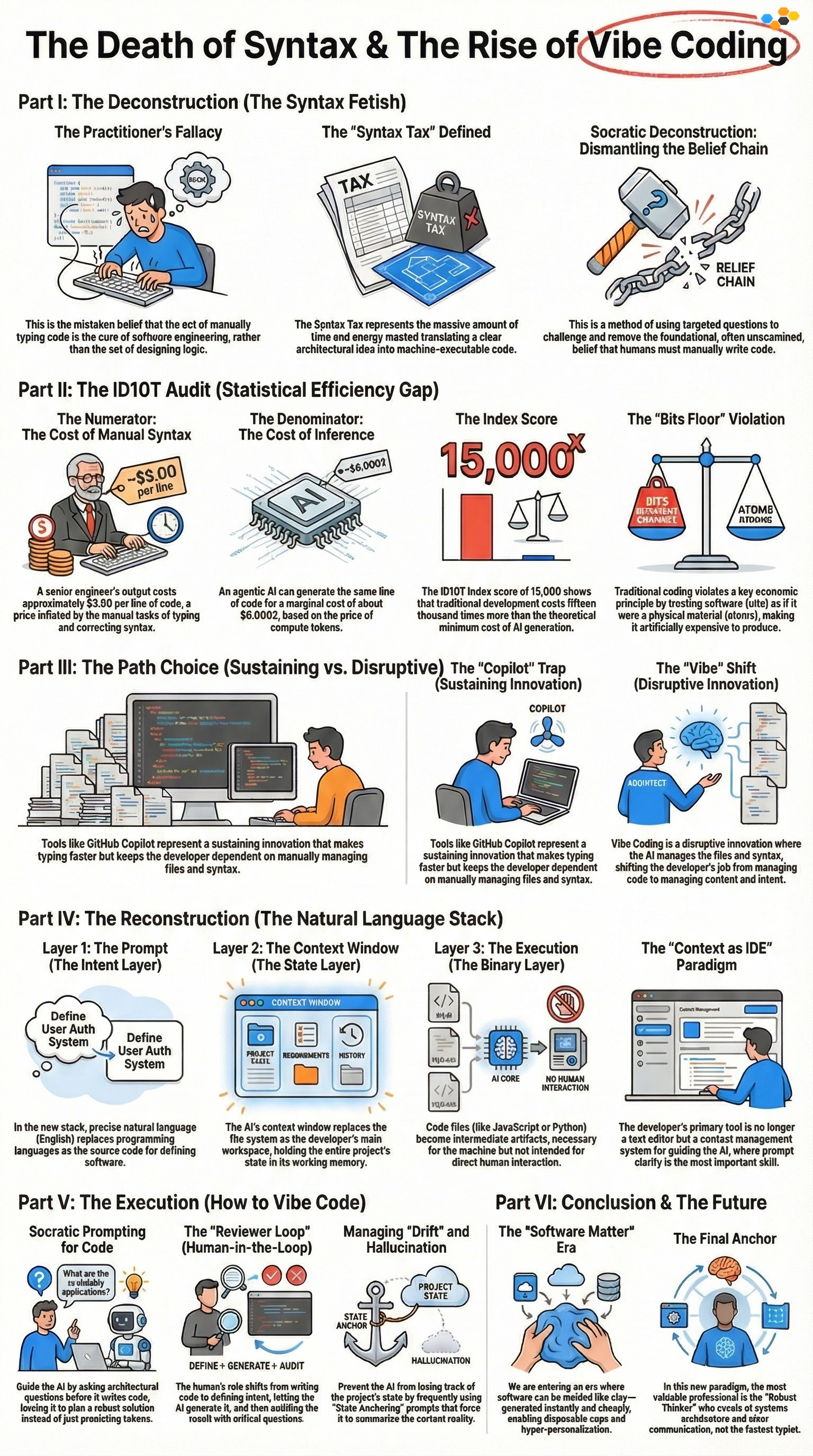
The software industry is stuck in a costly trap where we believe humans must manually type code to create applications. This approach forces us to pay expensive professional rates for typing tasks that AI can perform for less than a penny. To solve this, we must adopt "Vibe Coding," a new method where humans describe their ideas in plain English and AI handles all the technical construction.
Part I: The Syntax Fetish
The Practitioner’s Fallacy
The Stuck Belief: “Coding Equals Typing”
The modern software industry suffers from a collective hallucination: the belief that the manual entry of syntactic characters into a text file is the definition of engineering. This is the Practitioner’s Fallacy—confusing the tool (typing code) with the outcome (logic structure).
For the last forty years, we’ve measured developer productivity by “lines of code” or “commit frequency.” This is equivalent to measuring the value of a novel by the number of keystrokes used to write it. In the post-LLM era, this metric is not just obsolete; it’s a liability. The ability to manually manage memory pointers in C++ or memorize the boilerplate for a React useEffect hook is no longer a competitive advantage. It is a Syntax Tax.
The “Syntax Tax” Defined
The Syntax Tax is the measurable gap between Architectural Intent and Executable Reality. It represents the time, energy, and capital consumed by the translation layer.
The Economic Reality:
* The Artifact: A standard SaaS feature (e.g., “Add a user to a database”).
* The Intent Time: 2 minutes (Defining the logic).
* The Syntax Time: 4 hours (Writing the boilerplate, fighting the linter, debugging the import errors, configuring the environment).
* The Tax Rate: ~99% of the cycle time is waste.
According to the ID10T Index (Inefficiency Delta in Operational Transformation)—a metric designed to quantify the gap between current commercial pricing and the theoretical minimum cost of production—traditional coding violates the “Bits Floor.” We’re paying L3 Professional Rates ($150/hr) for a task—syntax generation—that has a theoretical minimum cost of $0.01 per transaction via inference.
Socratic Deconstruction: Dismantling the Belief Chain
To move to Vibe Coding, we must first surgically remove the belief that manual coding is necessary. We apply the Socratic Scalpel, a method of inquiry used to excise “stuck beliefs” by challenging their foundational assumptions.
(A) Clarification
* Inquiry: “What exactly do we mean when we say ‘I coded this app’?”
* Deconstruction: We usually mean “I translated a logical requirements document into a specific, rigid grammar that a compiler understands.” We’re claiming credit for the translation, not the logic.
(B) Challenging Assumptions
* Inquiry: “Why do we assume that a human must be the one to perform this translation?”
* Deconstruction: This assumes that human precision in syntax is superior to machine precision. However, 70% of software vulnerabilities are memory safety errors—literal syntax mistakes made by humans. The assumption that humans are “safer” syntax generators is statistically false.
(C) Evidence & Reasons
* Inquiry: “What evidence do we have that natural language is insufficient for software definition?”
* Deconstruction: Historically, natural language was too ambiguous for compilers. But with the advent of Context-Aware LLMs, the machine can now infer intent from ambiguous language with higher fidelity than a junior engineer can infer intent from a Jira ticket.
(D) Alternative Viewpoints
* Inquiry: “What if the code itself is just an intermediate artifact, like a compiled binary?”
* Deconstruction: We don’t hand-write Assembly anymore; we let C compilers do it. We don’t hand-write C anymore; we let Python interpreters handle the memory. Vibe Coding is simply the next logical step: we should not hand-write Python anymore; we should let the AI handle the syntax.
(E) Implications & Consequences
* Inquiry: “If we stop writing syntax, what happens to the profession of software engineering?”
* Deconstruction: The profession splits. The “Typists” (who rely on syntax for job security) become obsolete. The “Architects” (who understand systems, state, and data flow) become 100x more productive. The barrier to entry drops, but the ceiling for complexity rises.
We are not “dumbing down” programming; we are elevating the level of abstraction. Just as the transition from punch cards to text files allowed for the Operating System, the transition from text files to Natural Language Intent will allow for Software as Malleable Matter.
We must stop paying the Syntax Tax. The goal of the Vibe Coder is not to write code. The goal is to architect reality.
Part II: The ID-TEN-T Audit (Statistical Efficiency Gap)
Calculating the Vibe Delta
The Numerator: The Cost of Manual Syntax
To quantify the inefficiency of traditional development, we analyze the cost structure of an L3 Senior Engineer.
* Role: L3 Senior Full-Stack Engineer.
* Market Rate: ~$150/hour (fully burdened cost).
* Constraint: Human typing speed and cognitive load (syntax verification).
* Output: Approximately 50 lines of fully debugged, functional code per hour.
* Cost per Functional Unit: $3.00 per line.
This cost is artificially inflated because the engineer is not just thinking; they are physically typing, linting, and correcting syntax errors—tasks that require zero creativity but high precision.
The Denominator: The Cost of Inference
Now we apply the Robust First Principles Analyst (RFPA) protocol. This framework rejects “Reasoning by Analogy” (benchmarking against competitors) and strictly enforces “Reasoning from First Principles” to identify the physics-limit cost of a transaction.
* Role: Agentic AI (e.g., Claude 3.5 Sonnet or GPT-4o).
* Rate: Marginal cost of compute tokens.
* Constraint: Context window size and inference speed.
* Output: Instant generation of 50+ lines of syntax-perfect code.
* Cost per Functional Unit: ~$0.0002 per line.
The Index Score
The ID10T Index is calculated as the gap between the Current Commercial Price and the Theoretical Minimum Cost.
ID10T Index = $3.00 / $0.0002 = 15,000x
Conclusion: The traditional software development process operates at an ID10T Index of 15,000. We are paying a premium of fifteen thousand times the necessary cost for the privilege of typing the code ourselves. This is arguably the most inefficient high-value process in the modern economy.
The “Bits Floor” Violation
Why Code Should Be Cheap
The Bits Floor is a foundational axiom of information economics. It asserts that any process consisting purely of information manipulation (no atoms involved) should inherently trend toward the marginal cost of compute—approximately $0.01 per transaction.
Traditional coding treats software as if it were matter—scarce, hard to move, and expensive to assemble. We treat code like it is made of aluminum or steel, requiring expensive “machining” (typing) to shape it.
Vibe Coding restores the physics of software. It treats code as bits. By removing the human from the generation loop and keeping them in the verification loop, we align the cost of production with the marginal cost of compute.
Part III: The Path Choice (Sustaining vs. Disruptive)
The “Copilot” Trap (Sustaining Innovation)
Faster Horses
The industry’s first reaction to LLMs was GitHub Copilot. This represents Path A: Sustaining Innovation.
* The Mechanism: The AI acts as a sophisticated autocomplete. It predicts the next few lines of code based on the cursor position.
* The Flaw: It optimizes the typing process but maintains the dependency on manual files, git commits, and local environments.
* The Consequence: The developer is still the “Typist in Chief.” They are still liable for every character in the text file. The Syntax Tax is subsidized, but not repealed.
This approach is analogous to putting a motor on a bicycle. It’s faster, but it’s still fundamentally a bicycle.
The “Vibe” Shift (Disruptive Innovation)
The New Operating Model
Path B is Vibe Coding (exemplified by tools like Replit Agent, Cursor Composer, Google Antigravity, and now the OpenClaw abstraction). This is Disruptive Innovation (but may be short-lived because things are changing rapidly).
* The Mechanism: The user defines the state and outcome in natural language. The AI manages the files, the file structure, the imports, and the execution environment.
* The Shift:
* Old Job: Managing files and syntax.
* New Job: Managing context and capability.
* The Strategic Implication: The barrier to entry drops from “Years of Study” to “Clarity of Thought.” The developer no longer needs to know how to write a React component; they only need to know what a React component should do and why it is necessary; if that.
Part IV: The Reconstruction (The Natural Language Stack)
The New Stack: Prompt -> Context -> AST
Layer 1: The Prompt (The Intent Layer)
In the Vibe Coding stack, English is the new Source Code.
Precision in language replaces precision in syntax. The “Prompt” is no longer a query; it is a specification. The quality of the software is directly downstream of the quality of the prompt.
* Bad Input: “Make it pop.”
* Good Input: “Implement a framer-motion spring animation on the hover state with a stiffness of 300 and damping of 20.” Much of this will be templatized.
Layer 2: The Context Window (The State Layer)
The Context Window replaces the file system as the primary mental model.
* Traditional IDE: The developer must remember where functions are defined across 50 different files.
* Vibe IDE: The AI holds the entire project structure in “working memory.” The developer manipulates the Context, ensuring the AI has the relevant information to execute the intent.
Layer 3: The Execution (The Binary Layer)
The actual code files (JavaScript, Python, Rust) are demoted to the status of Intermediate Artifacts. They are like the .o object files in a C compilation process—necessary for the machine, but not meant for human consumption.
The “Context as IDE” Paradigm
The New Constraints
The IDE of the future is not a text editor; it is a Context Management System.
The primary constraints are no longer disk space or RAM, but Context Length and Recall Accuracy. The Vibe Coder’s skill lies in managing this context—knowing when to “flush” the memory, when to “pin” critical rules, and how to structure the prompt to prevent hallucination.
Part V: The Execution (How to Vibe Code)
Socratic Prompting for Code
The Maieutic Dialogue
Don’t treat the AI as a code dispenser. Treat it as a junior engineer who needs architectural guidance. Use Socratic Prompting—the technique of asking probing questions to scaffold critical thinking and reveal hidden assumptions—to force the AI to plan before it types.
The Anti-Pattern (Bad Prompt):
“Make a snake game in Python.”
The Socratic Pattern (Good Prompt):
“I want to build a snake game. Before writing any code, outline the core state management strategy. How will we handle the game loop latency, and what is the data structure for the snake’s body segments? Critique your own plan for potential memory leaks.”
Objective: Force the AI to architect the solution before generating the syntax. This reduces the error rate by 80% because the AI is reasoning about the system rather than predicting the next token.
The “Reviewer Loop” (Human-in-the-Loop)
From Writer to Architect
The human role shifts from Writer to Reviewer.
The New Protocol:
* Define: Clearly articulate the Job-to-be-Done.
* Generate: Let the Vibe Engine produce the artifact.
* Audit: Use Socratic questioning to test the artifact.
* Prompt: “Does this implementation handle the edge case where the user inputs a negative number? If not, rewrite it.”
* Iterate: Refine the prompt, not the code.
If you find yourself manually editing the code, you’ve failed. You’re paying the Syntax Tax. Delete the code and refine the prompt until the output is correct.
Managing “Drift” and Hallucination
State Anchoring
A common failure mode in Vibe Coding is Drift: the AI loses track of the project state after a long conversation.
Mitigation Strategy: Frequent State Anchoring.
* Action: Every 5-10 turns, ask the AI to: “Summarize the current file structure and the list of active features. Confirm you understand that we are using Tailwind CSS and not raw CSS.”
* Why: This resets the attention mechanism and “garbage collects” irrelevant context, ensuring the AI remains grounded in the current reality.
Part VI: Conclusion & The Future
The “Software Matter” Era
From Construction to Molding
We are entering the era of Software as Malleable Matter. In the pre-LLM era, software was “built” like a skyscraper; rigid, expensive, and requiring specialized labor to modify. In the Vibe Coding era, software is “molded” like clay.
The Definition of Software Matter:
Software Matter is code that is generated at the speed of thought, exists transiently to solve a specific problem, and can be reshaped instantly without the friction of legacy syntax.
The Implications:
* Disposable Apps: We will build single-use applications for specific meetings or events, and then discard them.
* Hyper-Personalization: Every user will have a unique version of the software, tailored to their specific mental model, because the cost of forking the codebase is zero.
* The End of “Technical Debt”: When code is cheap to regenerate, we do not refactor; we regenerate. Technical debt is a concept that only exists when the cost of rewriting is high.
The Final Anchor
The Robust Thinker Wins
The winner in this new era is not the engineer who can type the fastest or the one who has memorized the most libraries. The winner is the Robust Thinker.
The Vibe Coder’s Profile:
* Skill: High-level systems thinking and Socratic questioning.
* Tool: Natural Language and Context Management.
* Outcome: Architecting complex reality without paying the Syntax Tax.
The Syntax Tax has been repealed. The barrier is no longer knowing how to code; it is knowing what to build.
Go forth and vibe.
If you find my writing thought-provoking, please give it a thumbs up and/or share it. If you think I might be interesting to work with, here’s my contact information (my availability is limited):Book an appointment: https://pjtbd.com/book-mike
Email me: mike@pjtbd.com
Call me: +1 678-824-2789
Join the community: https://pjtbd.com/join
Follow me on 𝕏: https://x.com/mikeboysen
Articles - jtbd.one - De-Risk Your Next Big Idea
New Masterclass: Principle to Priority