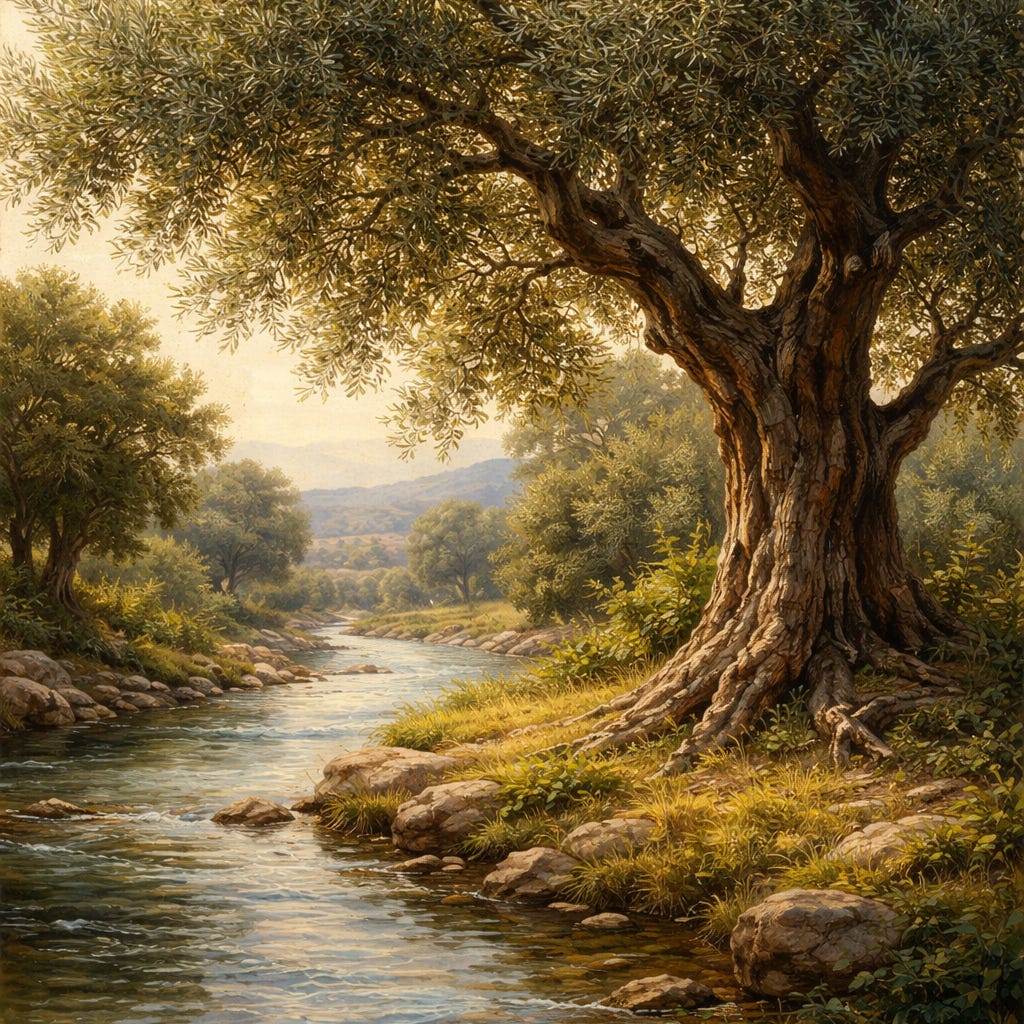
Do you like olives? Maybe in a salad, stuffed with feta cheese or pimentos? Or maybe atop a slice of supreme pizza. I suppose it’s a mature taste; I don’t think I started enjoying olives until I was an adult.
Olive trees and olive oil are images God uses throughout His word and one morning during my quiet time, I stumbled into studying the historical and cultural significance of olives. It was a blessing to me, and I’d like to share it.
That day, my reading found me in Psalm 1. The first three verses read:
Blessed is the man that walketh not in the counsel of the ungodly, nor standeth in the way of sinners, nor sitteth in the seat of the scornful. But his delight is in the law of the LORD; and in his law doth he meditate day and night. And he shall be like a tree planted by the rivers of water, that bringeth forth his fruit in his season; his leaf also shall not wither; and whatsoever he doeth shall prosper.
The Psalm is short but descriptive. A blessed man is like a tree that is alive and rooted near a steady water supply. It does not bear fruit year-round, but in its season. And even when it is not bearing visible fruit, its leaf does not wither.
A fruit yielding tree, with a leaf that does not wither when it is healthy—what type of tree was the Psalmist picturing when he wrote those words? I wondered.
I then turned over to Romans 11 for my New Testament passage for the day, and read Paul’s description of the nation of Israel:
And if some of the branches be broken off, and thou, being a wild olive tree, wert grafted in among them, and with them partakest of the root and fatness of the olive tree;—Romans 11:17
Could the olive tree be the tree in Psalm 1? I decided to dig into it.
Under normal circumstances, I learned, an olive tree is in fact evergreen. Right now, in winter, most fruit tress have lost their leaves, but the olive tree, even when it is not bearing fruit, still retains its dense, silver-green foliage. Fruit appears in the proper season, but the tree never appears dead.
Olive trees are pollinated mostly by wind, which I found to be a fascinating little detail. Much like the work of the Holy Spirit, wind is unseen and uncontrollable, but extremely effective.
Harvesting olives requires shaking or thrashing the tree to force the fruit to fall. In Bible times they would have been struck repeatedly to shake the olives out. Even today, mechanical shakers are used to grip the tree’s trunk and use vibration to drop the olives into nets.
I was also surprised to learn that ripe, raw olives are bitter and inedible. Thousands of years ago, olives were primarily grown to use their oil instead of using on a charcuterie board. “Oil olive” was used in lamps and cooking, for sacrifice, anointing, and even wound care. The olives were crushed into a pulp and pressed to squeeze out the valuable liquid. But once extracted, the oil brought life—light, nourishment, worship, and healing.
Those details stuck with me. The true value of the olive wasn’t in the fruit as it ripened on the tree, but in what the fruit released under pressure. The oil wasn’t visible, nor was it immediate. Both the tree and the fruit must go through beating, pressure, and time before the oil comes forth.
The blessed man in Psalm 1 is not described as a man of constant production. Like the tree, he is fruitful, but only in season. The rest of the year he is quietly sustained by the river, rooted and alive.
Sometimes we can feel like our fruit is delayed or unseen. We are rooted and faithful, but sometimes quiet and unnoticed. We know we are alive in Christ but...can’t see any proof. Nothing that feels measurable or impressive. It can be easy to feel like those seasons are wasted, or worse, that they are evidence of failure.
Sometimes the blessings of God can feel hidden. The imagery of Psalm 1 tells me that if my roots are near the water, near the Living Water—if my heart is cleansed by “the washing of water by the word”—if I delight in the law of the Lord and meditate therein day and night—life is present.
And if life is present, and the promise is sure—”whatsoever he doeth shall prosper”—then I will bring forth fruit—in season.
Other times that we can see fruit in our lives, but it feels small. And harvesting that fruit can sometimes be done in ways we would never choose, in the same way the olive tree is beaten, shaken, and the olives pressed for their oil. But remember, the olive itself is not immediately useful.
Olive oil was never rushed. It was expected, and waited for, with hope and trust that it would appear at the right time. Similarly, we do not need to rush to prove ourselves in every moment. We may not be able to comprehend exactly what the Lord is doing in our lives, but it isn’t our job to understand.
It is enough for today that you remain faithful, steady, rooted in God’s Word and planted by the river of Living Water.