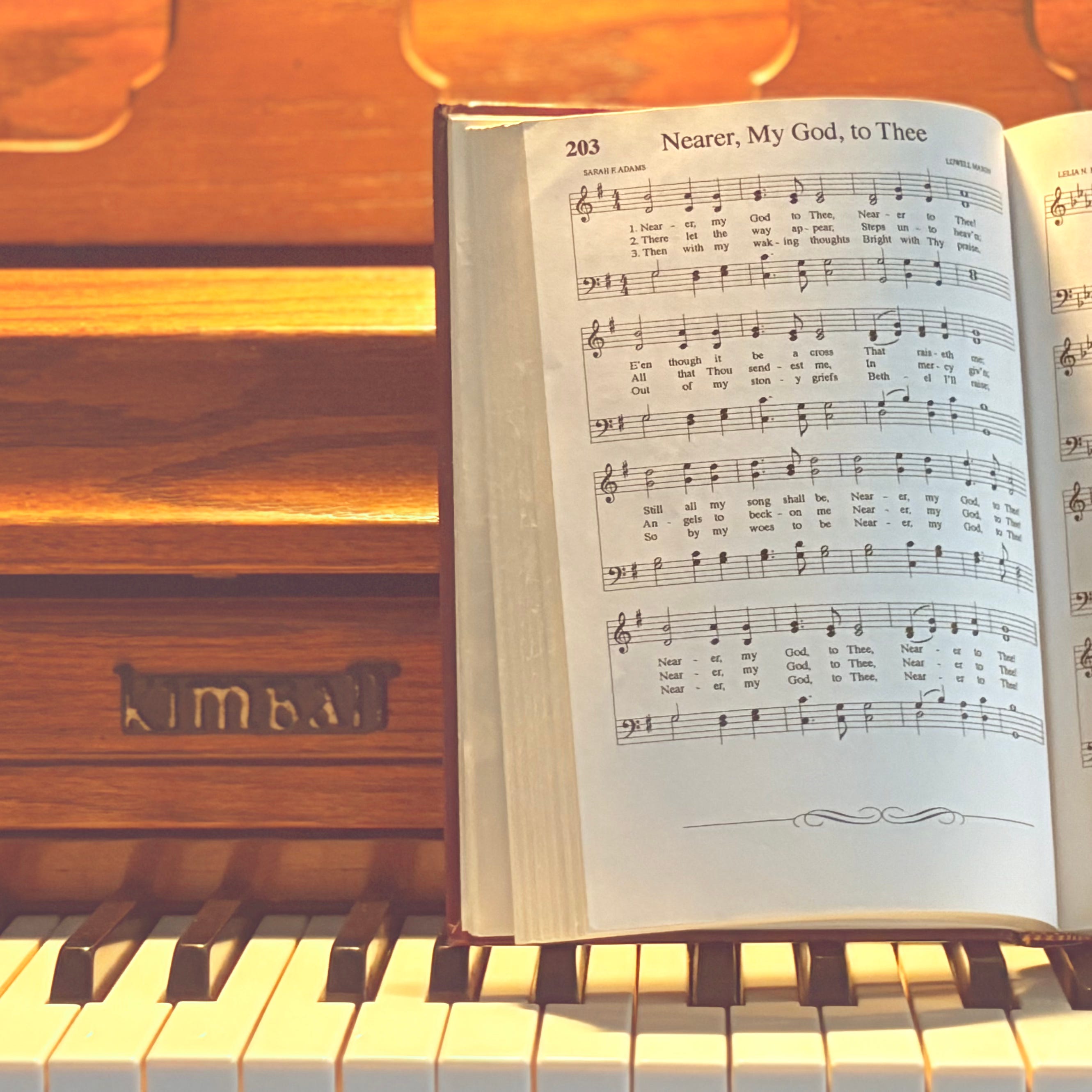
This past Sunday in church, we sang that beautiful, contemplative hymn, Nearer, My God, to Thee. With most familiar songs, it can be easy to sing the words almost mindlessly, but this time, I found myself meditating on the words. Do we long to be nearer to God? And does it matter how He chooses to draw us?
I can testify that God is true to the promise of James 4:8—Draw nigh to God, and he will draw nigh to you. Bible reading and prayer have been crucial in shaping my walk with Christ, but I have been surprised to learn that it has often been the valleys—the things I never would have chosen—that have drawn me nearest to Him.
“E’en Though It Be a Cross”
As we sang, this line was the first to arrest my attention:
E’en though it be a cross that raiseth me…
A cross? No one would choose a cross as the means of drawing nearer to God, would they? The cross speaks of suffering, of pain, of burden. And yet the hymn writer says, even if it’s a cross that draws me nearer, still all my song shall be, Nearer, my God, to Thee.
Being surrendered to affliction is not a natural response. We don’t seek out trials or difficulties in life. But I’ve learned there is a kind of fellowship with God that you cannot experience apart from suffering. It’s what Paul meant when he talked about the ‘fellowship of his sufferings’. And as Christ said:
…If any man will come after me, let him deny himself, and take up his cross, and follow me. —Matthew 16:24
The very burden we might refuse may be the very thing that raises us closer to Him. The hymn encourages me to not just survive the suffering, but sing in the midst of it.
“All That Thou Sendest Me”
Another line that gave me pause:
All that Thou sendest me, in mercy giv’n.
With this verse, I sense a shift in perspective. No longer is the writer simply enduring a trial, but there is recognition that even the hard things are sent in mercy. Everything in my life—good or bad—has come from the merciful hand of God.
The world talks about fate or luck, but we don’t serve a God of chance or chaos. We serve a God of order, intention, and mercy. He’s not dealing cards or drawing straws.
In Job, we read:
…What? shall we receive good at the hand of God, and shall we not receive evil? —Job 2:10But he knoweth the way that I take…—Job 23:10For he performeth the thing that is appointed for me…—Job 23:14
He knows the path. He knows the portion. And He performs all things with care.
The Psalmist tells us:
The LORD is the portion of mine inheritance and of my cup: thou maintainest my lot. —Psalm 16:5
What does that phrase mean, ‘maintainest my lot’? The word maintain implies care and attention. You maintain a garden by pulling the weeds, you maintain a car by changing the oil—you maintain the things that matter to you. So when the Psalmist says, “Thou maintainest my lot,” it's as though he’s saying he knows that the Lord cares for him and for the details of his life.
When difficulties come and we cry, “Why was this my lot in life?”—we are often forgetting the truth: God carefully chose this for us.
Like Joseph who told his brothers:
But as for you, ye thought evil against me; but God meant it unto good… —Genesis 50:20
With God’s help, we can reframe our trial not as punishment, but as an instrument of His mercy. And when we cannot understand why, we can trust Him.
For my thoughts are not your thoughts, neither are your ways my ways, saith the Lord.—Isaiah 55:8
“Out of My Stony Griefs”
The final verse in our hymnal is the line:
Out of my stony griefs, Bethel I’ll raise;So by my woes to be Nearer, my God, to Thee!
That phrase, ‘stony griefs,’ and a preceding verse that says ‘my rest a stone,’ comes from Genesis 28. In fact, the hymn was written in 1841 by Sarah Flower Adams at the request of her pastor, who was preparing a sermon from this passage.
In it we read of Jacob, who, fleeing for his life, lays his head on a stone and dreams of a ladder reaching to heaven. When he awakes, he calls the place Bethel, meaning house of God. That stone pillow became a place of worship.
Likewise, in our lives—our woes, our trials, can become altars.
I don’t mean that we exalt the suffering itself, but rather we should give our suffering back to the Lord as an offering, and allow Him to be glorified. Altars are a memorial of God’s goodness. Memorials remind us of His mercy. Like Samuel’s Ebenezer stone, Jacob’s altar at Bethel marked a place where the Lord helped and proved faithful.
Every time we share a testimony of God’s goodness—each time we choose to praise the Lord—each time we decide to trust Him—we raise a memorial to God’s mercy and give Him glory.
That this may be a sign among you, that when your children ask their fathers in time to come, saying, What mean ye by these stones? Then ye shall answer them, That the waters of Jordan were cut off before the ark of the covenant of the LORD; when it passed over Jordan, the waters of Jordan were cut off: and these stones shall be for a memorial unto the children of Israel for ever. —Joshua 4:6-7
This week, I’d like to invite you to slow down and consider the words of this old hymn. As I look back on my life, I can testify that the hardest times were the very valleys where the Shepherd led me. The stony griefs that drove me to prayer also drew me closer to Him.
If you’ve been called to bear a cross— if your portion includes a grief you never asked for—don’t let it drive you from God. Let it draw you nearer.
And may all your song still be, Nearer my God, to Thee.