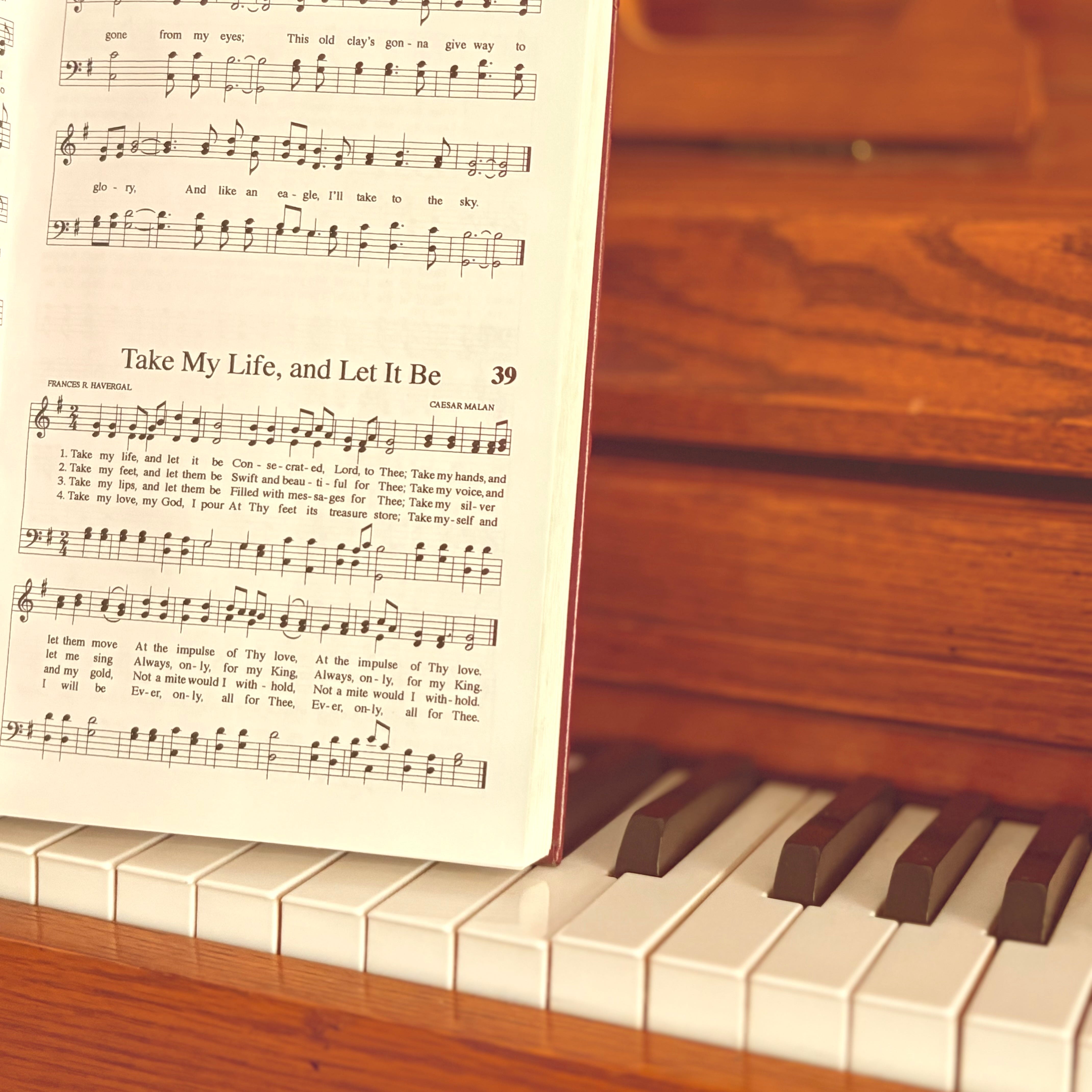
Sunday morning before the baptism, our church sang Take My Life and Let it Be. I nudged my husband. This hymn and the author of it has been an interesting point of study for me this summer.
Frances Ridley Havergal wrote the hymn, but more than that, she strove to live out the meaning of each word.
She suffered from poor health during her life, including typhoid fever, and died in 1879 at just forty-two years old. Before her death, she wrote a devotional book titled Kept for The Masters Use. She begins the book by explaining if we are asking the Master to “take” our lives, shouldn’t we also trust that he will “keep” them? And in letting Him take and keep our lives, all becomes kept for the Lord’s use, however He sees fit.
The book, published posthumously, carefully combs through each line of the hymn and considers a life kept for Him—our hands, our voices, our silver and gold, our intellects, will, and heart—all kept for the Master’s use.
The last line of the hymn we sang so breezily that morning says: Take my self and I will be Ever, only, all for Thee.
Take my… self?
What sobering words those are! Especially in 2025 when “self-care” and “self-love” have become big business. As women we’re told to “take time for yourself…don’t neglect yourself… do something good for your self.”
I wonder what Frances would have thought about all that.
This know also, that in the last days perilous times shall come. For men shall be lovers of their own selves… —2 Timothy 3:1-2
Please don’t think that I am suggesting you cover yourself in sackcloth and ashes and deny every little comfort for the cause of Christ. But I would like to challenge us, myself included— have we gotten too focused on our selves and our comforts?
Romans 12:1-2 calls us to present our bodies a living sacrifice to our Lord and tells us that this is our “reasonable” service.
“Sacrifice” does not call to mind comforts and self-indulgence. Sacrifice sounds like pain. Suffering. Taking up a cross.
Take my self and I will be — Ever, only, all for Thee.
Those closing lines of her hymn —“ever , only, all”— are small words with deep meaning to Havergal. She wrote:
Dear friends the ‘all’ must be sealed with ‘only.’ Are you willing to be ‘only’ for Jesus? You have not given ‘all’ to Jesus while you are not quite ready to be ‘only’ for Him. And it is no use to talk about ‘ever’ while we have not settled the ‘only’ and the ‘all.’ You cannot be ‘for Him,’ in the full and blessed sense, while you are partly ‘for’ anything or any one else.
Havergal then points to our influence as a critical reason why we must live ever, only, all for Christ.
Influence is another big business these days. Social media has propelled otherwise ordinary people onto a worldwide platform, with brands and businesses lining up to collaborate with them for a share of their audience.
As a mom of five daughters, I think often about the comparison trap. Even without social media accounts, I sense it occasionally in my girls. A YouTube video here, a Pinterest search there—it doesn’t take much to notice what someone else has and feel a twinge that our own lives don’t measure up.
One of my creative girls once designed a Perler bead pattern and excitedly asked me to share it on Pinterest. There’s nothing wrong with sharing creativity, but that moment struck me how natural it is, even for a child, to want to be seen on a public stage.
It’s easy to scroll and see shiny, curated reels. As we thumb past beautifully staged homes or enticing vacation photos with perfectly worded captions, we may quietly wonder why our own life feels so ordinary in comparison. We may even notice how some posts draw hundreds of likes while ours barely move and we can wonder if we matter as much.
But God’s Word shows us that He does not value visibility as much as surrender. As Havergal says, we may feel we have very little talent, nothing special to offer Him. But as she points out, “[influence] is not what we say or do, so much as what we are, that influences others.” In what she describes as the “influence of a very average life,” Havergal points out the fact that God does not need to put you on a big stage to give Him glory.
Gideon thought of himself as the “least in [his] father’s house” yet God called him a “mighty man of valor.” God didn’t call Gideon because he was famous, he called him because he was faithful. Gideon saw himself as poor. We too, may feel as though we have nothing to offer but a broken heart. The truth from God’s Word is that He will not despise that broken and contrite heart.
There’s nothing wrong with sharing the good in our lives. But if God has given you a life that doesn’t draw attention, a life that feels less than exciting or even “ordinary,” don’t believe Satan’s lie that you are less valuable in His eyes. God can take an average life and use it for His glory in ways that we may never know about on this side of eternity.
The world tells us to build a platform, chase a following. Christ calls us to lay our selves on the altar. To sacrifice our broken spirit and present our bodies a living sacrifice.
You don’t have to be Instagram-famous to make an eternal difference.
Re-read the last lines of the hymn:
Take my self and I will be ever, only, all for Thee.
Perhaps the most influential thing you can do today is just live in surrender to the Savior who sacrificed His own life for yours. And when others look at your “average life” they can’t help but see Him, first.