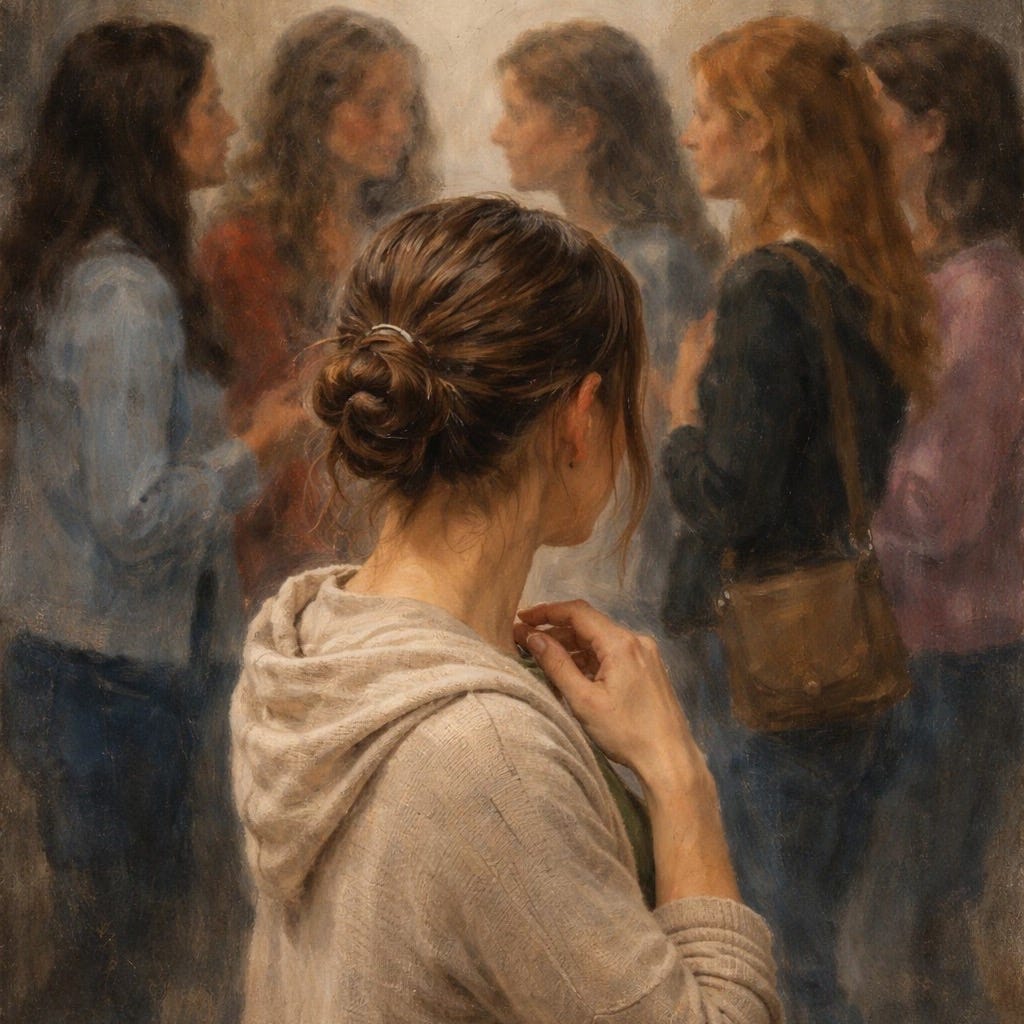
Everyone is looking at me...I don’t know what I’m doing...Someone else could do this better...I don’t belong here...
Do your thoughts ever sound like that? Struggling with self-confidence and doubt is common, even for women who appear to be confident or capable. Sometimes our fears are just loud.
But before we run off to YouTube or Google how to be more confident, let’s look at Gods Word. Not only does the Bible give us examples of people who chose faith over fear, but there are also stories of those who believed their doubts and fears.
1 Samuel 27 opens by saying:
And David said in his heart, I shall now perish one day by the hand of Saul: there is nothing better for me than that I should speedily escape into the land of the Philistines...
When I come to this chapter, I want to argue with David. Get a hold of yourself! This is the same man who faced Goliath with a sling and unshakable confidence in God. He had already been anointed king. God had delivered him over and over again.
But here we see David had a thought in his heart that he believed to be true. And that one thought was louder than anything God had said or done in David’s life. And David followed it.
He defected to Achish and began living among the Philistines. He was living a double life of sorts—invading enemies like the Amalekites and Geshurites—while letting Achish believe he was attacking Judah. He was so convincing that verse 12 tells us “Achish believed David saying, He hath made his people Israel utterly to abhor him...”
All of that came from a single fear that David accepted as truth.
We do the same thing sometimes. Have you ever walked into a room and thought “hmm…they don’t really like me, I don’t really belong here, I should keep quiet”?
And instead of examining the thoughts and asking—is this true? We begin to adjust. We pull back. We stay quiet. We protect ourselves.
Our minds are wired for survival. Subconsciously, we’re constantly scanning for threats, even emotional and social threats, and we respond, often without ever realizing it.
Not every thought we have about ourselves is true. But to overcome those doubts we have to examine our thoughts.
Casting down imaginations, and every high thing that exalteth itself against the knowledge of God, and bringing into captivity every thought to the obedience of Christ;— 2 Corinthians 10:5
I think when we read that verse we overlook how serious the word “captivity” really is. Captives do not go down without a fight. Captives are apprehended, captured, arrested, imprisoned—those words paint a much more vivid picture of what I am instructed to do with my thoughts. I am to grab hold of every thought and bring it into line with what the Word of God says.
David didn’t examine his fears, he accepted them as truth, and he allowed those fears to guide him. He began trying to survive in his own strength.
Now Esther is a Bible example of fear that feels a bit more relatable. Unlike David, I don’t see where she had a clear calling on her life. There hadn’t been a prophet anointing her, telling her she would be an advocate to save her people from genocide.
Her Uncle Mordecai could see that she was “come to the kingdom for such a time as this.” But for Esther, it wasn’t just uncomfortable for her to go in unto King Ahasuerus, it was risky! She could have been put to death if the king didn’t extend his golden sceptre. I imagine everything in her mind was tense with fear saying “don’t do this!” But while she did not have certainty, she did have a strong faith that allowed her to say “if I perish, I perish.”
In the face of her fear, Esther took counsel from her uncle Mordecai and took time for prayer and fasting. She didn’t ignore her fear, she just refused to let it lead her.
(For we walk by faith, not by sight: ) —2 Corinthians 5:7
Faith does not remove the fear. Faith trusts God in the face of fear.
Now when David was at his best, he lived this way too. When faced with Goliath, David rehearsed the times God had protected him and boldly came to the giant in the name of the Lord.
But I appreciate that the Bible includes the side of David that gave into his fear. It helps me to not feel alone in my own doubts.
The world is full of instruction on how to eliminate our fears and build confidence in our selves. The world’s advice would say that confidence comes after action. And in the Bible, obedience usually comes before clarity.
David didn’t wait to feel like a giant killer—Esther didn’t wait until she had certainty—Sometimes like Peter, we have to step out of the boat in faith. When we obey God, our trust and our faith will grow. When I am in a weakened state of fear, I have an opportunity to put my faith in God and trust in His strength.
As Paul says in 2 Corinthians 12:10— When I am weak, then am I strong.
The goal shouldn’t be to eliminate fear and never feel hesitation. The goal is to be dependent on God and not to let fear decide.
Finally, brethren, whatsoever things are true, whatsoever things are honest, whatsoever things are just, whatsoever things are pure, whatsoever things are lovely, whatsoever things are of good report; if there be any virtue, and if there be any praise, think on these things. —Philippians 4:8
Fill your mind with thoughts that are true about yourself, grounded in God’s Word.
Trust in the LORD with all thine heart; and lean not unto thine own understanding. —Proverbs 3:5