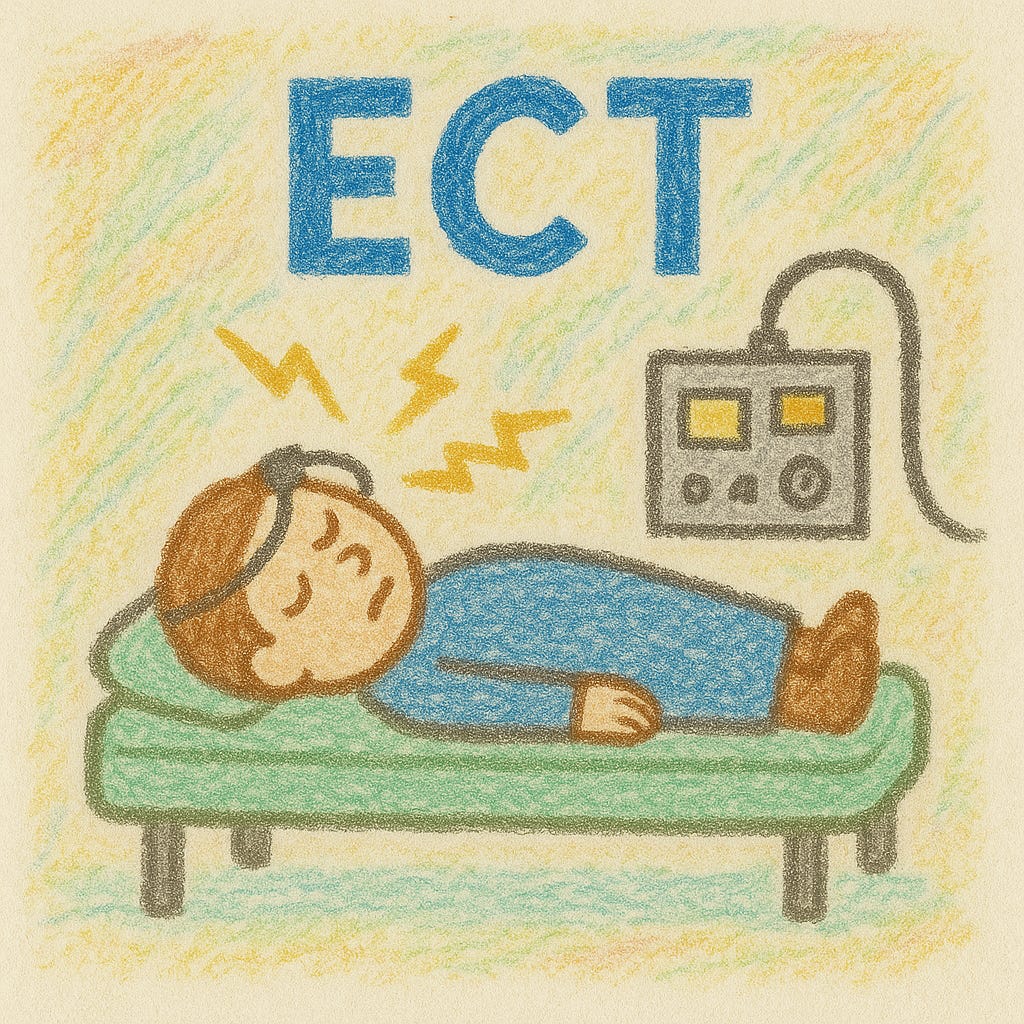
In this third episode on electroconvulsive therapy, I dive into the details of how ECT is actually delivered at the machine level.
I start by breaking down what the ECT device is really doing: delivering bidirectional square-wave pulses defined by four key parameters pulse width, frequency, train duration, and amplitude. I explain how these combine into total charge (in millicoulombs), how that relates to device “percent intensity,” and why ECT machines deliver far less energy than a typical cardioversion.
From there, I walk through:
* Brief vs ultra-brief pulse width (≥0.5 ms vs <0.5 ms), and why ultra-brief right unilateral is associated with fewer cognitive side effects, but may require higher dosing and more treatments.
* Frequency (Hz) and train duration, and how these shape the density and length of the stimulus.
* Electrode placements:
* Bitemporal (fastest and often most effective in high-acuity inpatients)
* Right unilateral (especially ultra-brief) as a more cognitive-sparing option
* Bifrontal as a potential memory-sparing bilateral placement
* LART (left anterior, right temporal) as a more experimental bilateral memory-sparing configuration
* Why right unilateral is standard (left-hemisphere language dominance) and when left unilateral might make sense.
I then go into how we actually choose the dose, contrasting three approaches:
* Fixed high-dose for life-threatening or profoundly impaired states (e.g., severe catatonia where cognitive function is already essentially offline).
* Formula-based dosing, using age and other demographics to estimate an initial dose.
* Seizure thresholding / dose titration, which is now the standard of care: starting at a low setting, stepping up until a seizure occurs, and then treating at a multiple of that threshold.
I talk through the typical dosing ranges:
* For bitemporal ECT, treating at ~1.5–2.5× seizure threshold.
* For right unilateral ECT, often needing ~6–10× seizure threshold to match bitemporal efficacy, while watching cognitive side effects.
I also cover how I judge seizure quality in practice:
* Minimum adequate motor seizure duration (roughly ≥15–20 seconds).
* The distinction between motor seizure length and EEG seizure length.
* EEG features: rhythmic high-amplitude activity, bilateral coherence, and especially post-ictal suppression — why a “flatter-than-baseline” EEG after the seizure is a good sign.
Finally, I discuss how seizure threshold drifts upward over the course of a series, when and how to increase dose mid-course, and a practical way to structure acute, taper, and maintenance ECT (including when catatonia may not need maintenance, versus recurrent mood disorders that often do).
Let me know what you think, email me at brandon@brandonbrownmd.com