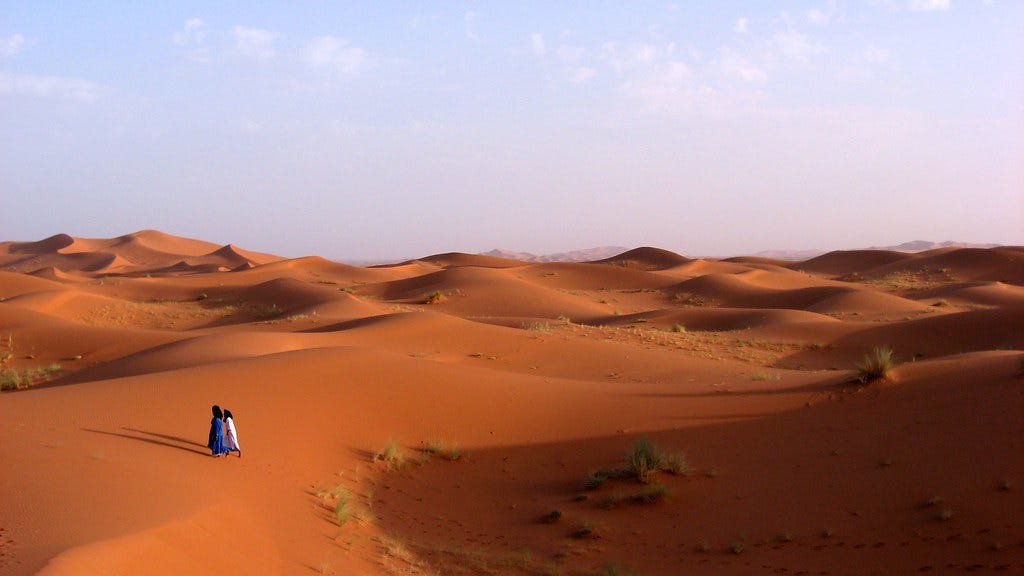
It‘s hard to believe its December already, but here we are! We’ve spent the bulk of the year talking about land form myths from across the continent so I figured we could zoom in and look at things from another perspective: how these myths influence daily life. However, I don’t live on the African continent and the MA annual budget cannot support travel at this time, so my best bet is to do another kind of traveling: through books.
Now, if one wants to travel by book across the African continent in a way that allows for close contact with the land, where does one go to, quite literally, book this trip? I don’t know about other parts of the continent but I do know that if you want to travel the Sahara region by book, you will find no better map and travel guide than the work of Libyan writer, Ibrahim al Koni.
I was going to do a fresh episode on the Sahara desert before we start talking about Ibrahim al Koni’s “The Bleeding of the Stone.” But as I thought about what to say, I realized we already have several episodes in which we introduce the Sahara. And so, instead of reinventing the wheel this week, we’re going to revisit a snippet from one of those episodes. How about we save the fun for later this month and sprinkle more fun facts about this foremost of all African geographical landforms in upcoming episodes?
(I’ve also had a long work week. I need a hot soak in a bath with some Samara Joy playing, and then cuddles with my cats. Thanks for understanding!)
PS: I experimented with sound effects when I produced this episode. That was fun, but I don’t think I’ll be doing that again!
Don’t forget to tune in next week as we start discussing Ibrahim al-Koni’s “Bleeding of the Stone.”
References
* al-Majus or through the Labyrnith by Ismail Fayed
* Rawafed: Documentary Interview with Ibrahim Kuni
Can’t Get Enough?
Still Can’t Get Enough?
The Watkins Book of African Folklore (…or The Mythological Africans Book) is out!
The Watkins Book of African Folklore contains 50 stories, curated from North, South, East, West and Central Africa. The stories are grouped into three sections:
* Creation myths and foundation legends
* Stories about human relationships and the cultural institutions they created
* Animal tales (with a twist…the folktales are about some of the most unlikely animals!)
I thoroughly enjoyed digging into the historical and cultural context out of which the stories, their themes, and protagonists emerge. There is something for everybody!