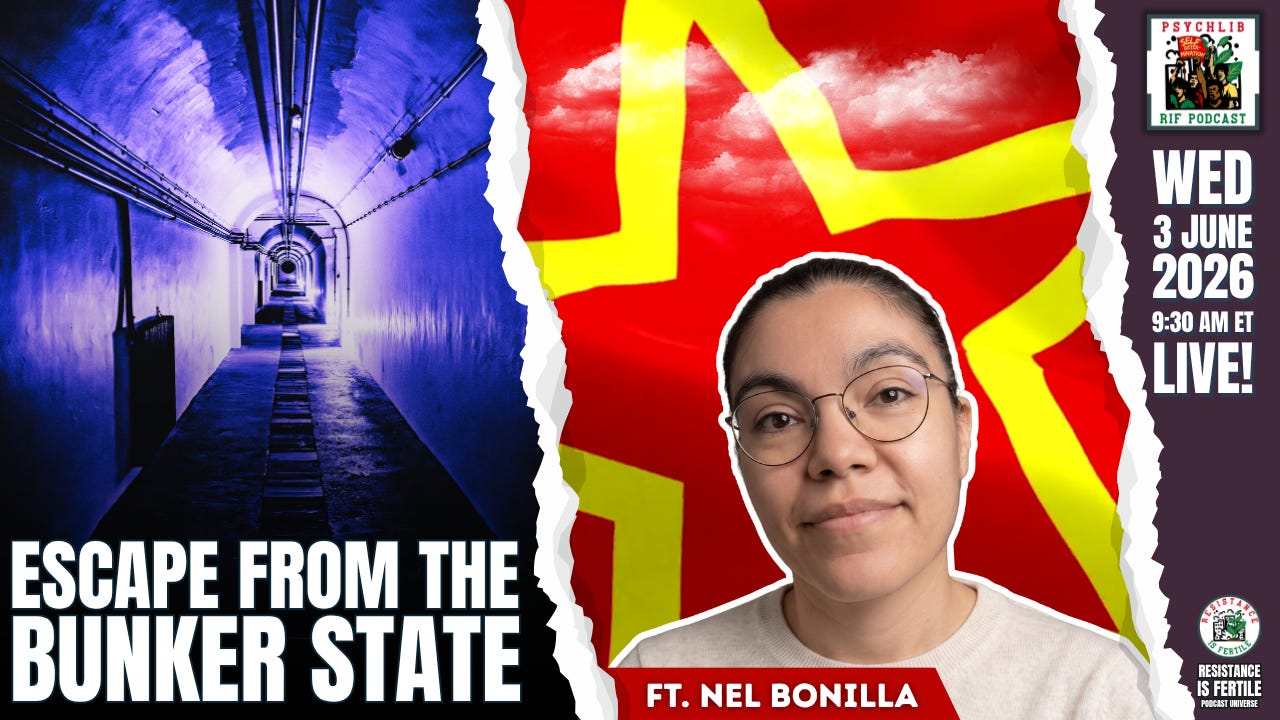
In this incisive seventy-fourth installment of the PsychLib series, co-hosts Benji and Indica welcome urban planner and political analyst Nel Bonilla for a probing exploration of her emerging conceptual framework: the Bunker State.
Nel, whose work bridges Latin American anti-colonial consciousness and European historical analysis of fascism, introduces the Bunker State as a diagnostic tool for understanding the psychological and material trajectory of Western imperial powers—particularly the United States—as they confront declining hegemony, internal contradiction, and external resistance. Rather than a static descriptor, the Bunker State is a dynamic process: a political formation that responds to crisis not by transformation but by fortification, surveillance, ideological containment, and the taking of its own population hostage.
Thanks for reading Resistance is Fertile! This post is public so feel free to share it.
Key Themes Explored
1. The Bunker State DefinedNel articulates the Bunker State as a regime that, facing systemic crisis, retreats into defensive postures: militarizing borders, suppressing dissent, controlling information, and projecting external threats to justify internal repression. The bunker is not merely physical infrastructure but a psychological architecture—a way of organizing power, knowledge, and social relations to preserve elite dominance amid collapse.
2. Personal Journey, Political AnalysisNel shares her formative influences: growing up with Latin American consciousness of U.S. imperialism, combined with time spent in Germany studying the historical trajectory of fascism. This dual perspective enables her to identify patterns of bunkerization not as uniquely American but as recurring features of imperial decline—patterns that demand historical materialist analysis rather than moralistic condemnation.
3. Material Reality vs. Ideological ProjectionA recurring thread is the tension between the Bunker State’s narrative projections (external enemies, internal subversion, existential threats) and the material conditions that undermine those narratives: hunger in Argentina, infrastructure decay in the U.S., popular movements in Latin America. Nel insists that analysis must begin with lived experience, not abstract theory—a methodological commitment that aligns with the podcast’s broader epistemological stance.
4. Tunnels vs. Bunkers: Directionality in ResistanceIn a memorable metaphor, Nel distinguishes tunnels from bunkers: tunnels go somewhere; bunkers are just bunkers. Resistance movements dig tunnels—paths toward liberation, connection, transformation. Bunker states dig bunkers—static fortifications that may preserve power temporarily but offer no future. This distinction invites listeners to evaluate political formations not by their rhetoric but by their directional logic.
Resistance is Fertile is 100% free. To receive new posts and support our work, consider becoming a free or paid subscriber (all money paid sent to Gaza families with a boost of between 50% and 75%, receipts published on here).
5. The Psychology of Hostage-TakingNel explores how Bunker States maintain control not only through force but through psychological mechanisms: the weaponization of surveillance (Epstein files, Palantir), the suppression of alternative languages and epistemologies, the cultivation of fear that discourages looking “out the window.” These tactics aim to produce a population that polices itself—a psychological bunker within the physical one.
6. Popular Culture as Psychological OperationThe conversation turns to the Apple TV+ series Silo as a potential example of cultural preparation for bunkerization: narratives that normalize sealed environments, class stratification within confinement, and the demonization of external threats. While speculative, such analysis invites critical engagement with media as a site of ideological struggle.
7. Latin America as CounterpointNel highlights movements in Mexico (Morena under AMLO and Sheinbaum) and broader Latin American experiments in sovereignty as alternatives to bunker logic. These formations, while imperfect and contested, demonstrate that crisis can catalyze transformation rather than retreat—a reminder that history remains open.
A Note on Method
True to the PsychLib ethos, this episode models dialectical analysis: holding contradiction, tracing development, and centering the voices of those who theorize from lived struggle. Nel’s framework is offered not as dogma but as a tool—one that listeners are invited to test, refine, and apply to their own contexts.
As Benji reflects: “If you address people’s concerns earlier, then you don’t get a protest.” The Bunker State, by contrast, addresses concerns only through repression—a strategy that may delay but cannot prevent the qualitative shifts that come when material reality breaks through ideological containment.
🔗 Follow Nel Bonilla: Explore her Substack and political analysis Nel Bonilla Substack and political analysis.🔗 Support material resistance: Lifeline for Gaza
🔗 This week’s highlighted fundraiser https://chuffed.org/project/134655-help-ibrahim-his-baby-and-his-pregnant-wife-survive-the-genocide
Free Palestine. Land Back. Swift victory to the free people of the world.
Timeline
(00:00:13) Welcome & Introductions: PsychLib Episode 74(00:02:42) Introducing Nel Bonilla: Urban Planner, Political Analyst, Concept-Builder(00:06:48) Nel’s Psychological-Political Journey: Latin America, Germany, Anti-Colonial Consciousness(00:15:31) The Bunker State Concept: Definition, Origins, Analytical Utility(00:19:54) Theory vs. Facts: Marxist Method and the Danger of Abstraction(00:31:40) Architecture of the Bunker: Literal and Metaphorical Fortifications(00:37:34) Tunnels vs. Bunkers: Directionality in Resistance and Retreat(00:42:27) Language, Windows, and the Psychology of Containment(00:51:21) Hostage-Taking as Governance: Epstein, Palantir, and Elite Mutual Assurance(01:01:13) Material Reality Interrupts: Argentina, Hunger, and the Limits of Narrative(01:10:35) Popular Culture as Preparation: Silo and the Normalization of Confinement(01:15:41) Latin America as Counterpoint: Morena, Sovereignty, and Transformative Crisis(01:26:09) The Bunker State and U.S. Policy Documents: Continuity Across Administrations(01:37:34) When Bunkers Become Graves: Historical Precedents and Future Possibilities(01:45:12) Closing Reflections: Tools for Analysis, Calls for Solidarity, Open Questions
Summary and timeline drafted with help from Qwen AI
Don’t give us any money! Give instead to Gaza!
Give to the small Gaza fundraisers that have received the least lately:
Palestinian-Run Mutual Aid (independent of the imperial NGO-military complex)
Help Gazans provide essential services to Gazans with the Sameer Project.
Team Hussein, a grassroots volunteer initiative working tirelessly to bring urgent relief to those suffering in displacement camps and shelters across Gaza.
Contribute to the Abu Hureirah Network, launched by our friend Hamza to support mutual aid groups in Gaza and Sudan.
Or contribute to Benji’s Gaza fundraisers
For Omar and his family of seven: https://bit.ly/omargaza
For Ibrahim, his wife, newborn baby and extended family! https://bit.ly/IbrahimGaza
For a pregnant lady and her family: https://bit.ly/PregnantMotherGaza
For Mustafa in North Gaza: https://bit.ly/MustafaGaza
For Khaled and his six children: https://bit.ly/khaledinGaza
You can also support
RIF Linktree https://linktr.ee/resistanceisfertile
Share with comrades who believe another world is not only necessary, but already in motion.
Thank you Abra, Ny, and many others for tuning into our live video!