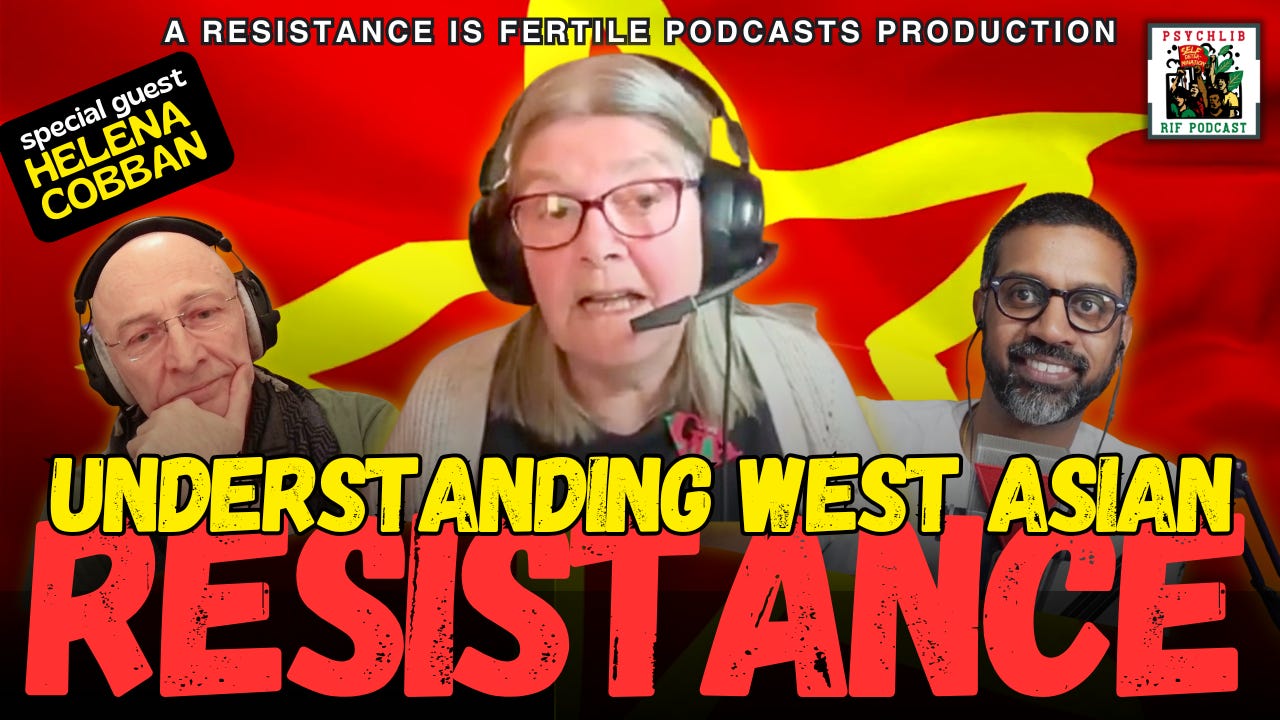
In this deeply illuminating episode of the PsychLib series, we welcome veteran anti-imperialist journalist, author, and educator Helena Cobban for a wide-ranging conversation about the psychology of resistance, the ethics of journalism, and the material realities shaping West Asia today.
Helena begins by recounting her own political awakening—from a boarding school debate about Rhodesia to her first encounters with Palestinians in Beirut in 1970. She explains how the Christian Science Monitor, uniquely insulated from advertiser pressure, enabled her to practice journalism as truth-seeking rather than stenography for power. This freedom allowed her to write her groundbreaking 1984 book on the PLO, treating it not as a “terrorist” organization but as a national liberation movement with coherent political aims—a radical act of epistemological resistance in a media landscape that demanded dehumanization.
The conversation turns personal as Helena reflects on teaching English to girls in Shatila refugee camp, and the searing trauma of being unable to return after the 1982 massacres. These experiences ground her analysis in lived reality: resistance is not abstract theory but the daily choice to exist on stolen land, to remember, to organize, to hope.
Resistance is Fertile is 100% free. To receive new posts and support our work, consider becoming a free or paid subscriber (all money paid sent to Gaza families with a boost of between 50% and 75%, receipts published on here).
We explore why so many Western journalists fail to understand movements like Hamas. Helena’s answer is stark: dehumanization. When you refuse to recognize Palestinians as fellow humans with legitimate aspirations for sovereignty and dignity, you cannot analyze their politics—you can only demonize them. This psychological operation serves empire by foreclosing empathy and justifying endless violence.
Helena then offers a masterclass in materialist analysis. Iran’s resilience—military, infrastructural, social—is not accidental but forged through 47 years of withstanding U.S.-Israeli hostility. Dispersed command structures, redundant power grids, underground missile launchers: these are adaptations born of necessity. The same logic applies across West Asia: drone warfare, missile capabilities, and the financialized decay of the U.S. military-industrial complex are shifting the balance of power in ways that narrative propaganda cannot reverse.
We examine the geopolitical inflection points: Saudi Arabia’s quiet withdrawal from the Abraham Accords framework, China’s diplomatic brokering of Iran-Saudi reconciliation, and the return of the Indian Ocean as a zone of free trade rather than imperial control. These are not minor adjustments but structural transformations that render U.S. bases—once symbols of protection—into vulnerable targets.
Helena also breaks the taboo on Israel’s nuclear arsenal, exposing the vow of amimut (omerta) that has silenced discussion for decades. She connects this to broader patterns: the eliminationist logic of settler colonialism, the parallels between Gaza and the fate of Native peoples on Turtle Island, and the historical precedents of white settler societies collapsing under the weight of their own contradictions.
The episode closes with a reflection on narrative warfare. Iranian-produced content—from Lego animations to poetic rap—demonstrates a sophisticated understanding of Western culture and psychology. As Helena puts it: “The truth is on their side.” For listeners in the imperial core, the task is not to lecture but to listen—to recognize that West Asian resistance movements understand empire far better than empire understands them, and that this epistemic advantage is itself a form of power.
🔗 Explore Helena’s work: Just World Educational📚 Recommended reading: The Palestinian Liberation Organisation: People, Power, and Politics, Cambridge University Press, 1984Cobban, Helena; Khouri, Rami G. (2024). Understanding Hamas: And Why That Matters. OR Books. ISBN 978-1-682196-34-2.🎧 Listen to Just World Educational’s podcast with Yusuf al-Jamal for frontline perspectives from Gaza
Resistance is fertile. Truth is resilient. And the map is not the territory—especially when the map is drawn by those who profit from the war.
Summary and timeline drafted with help from Qwen AI
Don’t give us any money! Give instead to Gaza!
Give to the small Gaza fundraisers that have received the least lately:
Palestinian-Run Mutual Aid (independent of the imperial NGO-military complex)
Help Gazans provide essential services to Gazans with the Sameer Project.
Team Hussein, a grassroots volunteer initiative working tirelessly to bring urgent relief to those suffering in displacement camps and shelters across Gaza.
Contribute to the Abu Hureirah Network, launched by our friend Hamza to support mutual aid groups in Gaza and Sudan.
Or contribute to Benji’s Gaza fundraisers
For Omar and his family of seven: https://bit.ly/omargaza
For Ibrahim, his wife, newborn baby and extended family! https://bit.ly/IbrahimGaza
For a pregnant lady and her family: https://bit.ly/PregnantMotherGaza
For Mustafa in North Gaza: https://bit.ly/MustafaGaza
For Khaled and his six children: https://bit.ly/khaledinGaza
You can also support
RIF Linktree https://linktr.ee/resistanceisfertile
Share with comrades who believe another world is not only necessary, but already in motion.
While you’re here, sign the petition to get YouTube to reinstate the Resistance is Fertile channel!