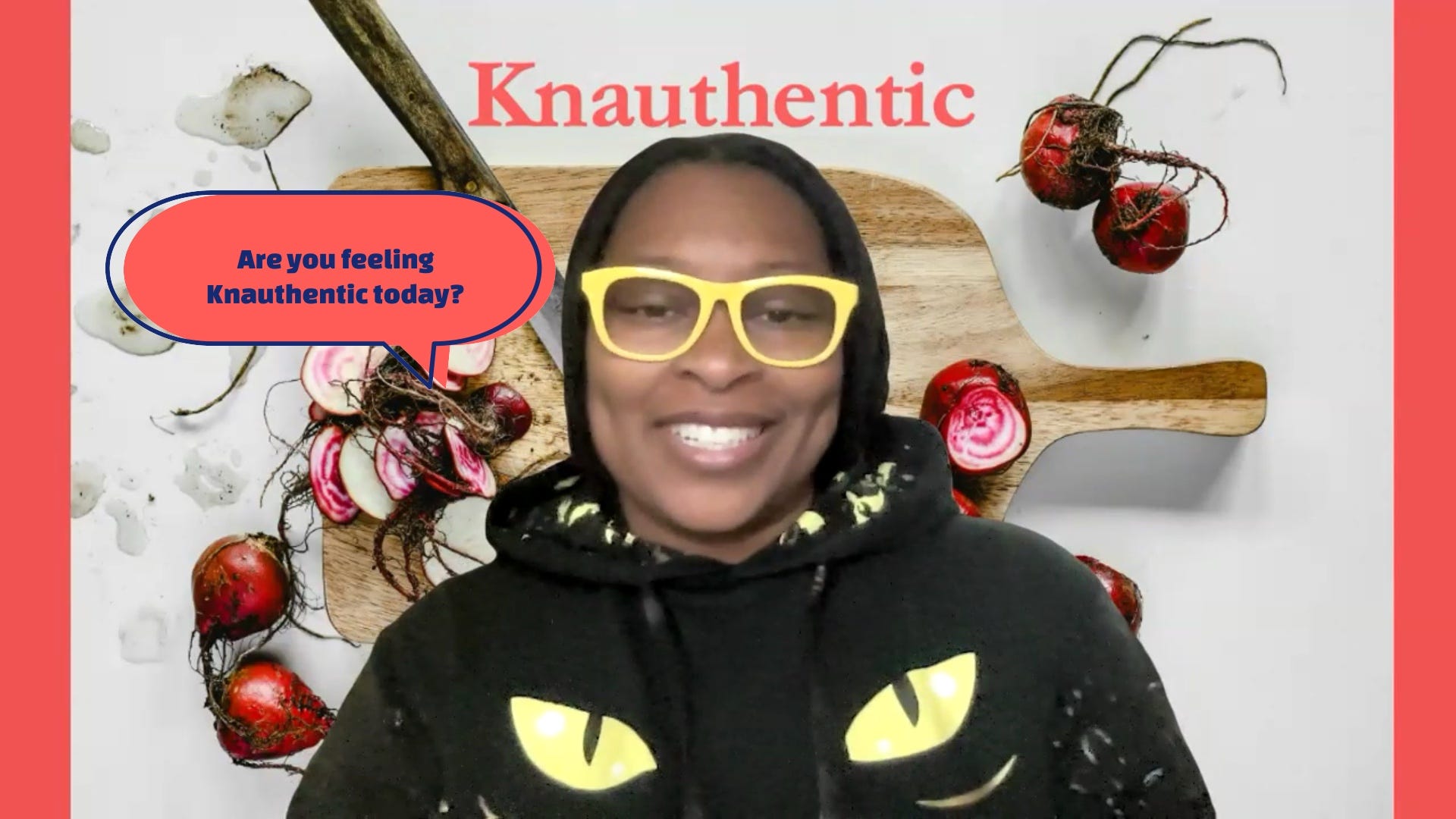
The text featured below is the transciption of the video above.
Hi guys. It’s time to learn more about Knauthentic. All right, so this is, I guess, my official, Knauthentic, kind of blogging platform for the podcast. I have so much to to say. I’m not going to try to say it all today, but this is a good starting point. So last week I posted my introduction. And so let me just explain what’s happening in case you don’t know because you probably don’t.
So first of all, I have, um, lots of health issues. I’m not the only person with lots of health issues. And so I have, a restricted diet. So it’s very kind of all consuming. And so I’ll be talking about that a little bit. Um, in addition to having like my food restrictions, I also try to use food as part of my healing process, with my ongoing health issues. And so, I would say this journey, um, that I am, that I’m currently on started five years ago, that’s when I became aware of like the issues and things started to change and so much and so, um, the reason why we’re here now and I’m using this term authentic is because, I, I’m, I’m, I’ve written a book, a memoir, and, um, I’m going to be jumping around a lot. I should have probably.
I tend to be the kind of the person who plots things out, who scripts things, plans things. But I also find that sometimes I can overdo it with that. So I’m trying to be off the cuff a little bit here. So anyway, this book that I’ve written, I am currently taking a class at the Muse Writers Center. Nonfiction three. And so I’m hoping to work workshop it a little bit to see if what I’ve written is actually something that might appeal to people. I know for myself, it’s been a tremendous therapeutic process to write this book, so much to the point where it’s already inspired me to outline two additional books following this one. And so, but part of that process was me, um, thinking about all of the things that I’ve learned.
You have to excuse me. I’m out of breath a little bit. All of the things that I’ve learned and experienced in the last five years, dealing with my health and discovering limitations and, um, finding out new things and, you know, putting my foot down and saying, I don’t have to settle. You know, this is something that was done to me or, you know, and I’m not I’m not going to be beaten down by it, that kind of thing. I started thinking about all of the different, amazing communities that already exist. And so I’ve really started to, like, follow, like content creators and, you know, people who inspire and coach and all these things. And in doing so, I really, couldn’t really find a community that was specific to me. And that’s okay. I don’t, I don’t I’m not trying to say that this Knauthentic label is going to solve everyone’s problems.
Excuse me, but, um, so I just know that sometimes I know, I know what it’s like from a medical standpoint to not have a diagnosis because you can’t get proper treatment without a diagnosis. So having that diagnosis, whether you like it or not, is really the key to you being able to like, take the next steps to be able to do what’s right for you. Beyond that, being able to have a label that you and other people can quickly and easily identify with also makes a huge difference. I mean, when I, go into a restaurant and I say that I have food restrictions and the first thing that pops out of the waiter or the waiter, the person taking my order, the first thing to pop out of their mouth will be, are you vegan? I want to say that would be great if I was, you know, and and I’m going to talk about that more.
But the idea here is that there’s so many things out there and none of them fully apply to me. And I think there’s probably other people out there too who they don’t have something that fully applies to them. And I’m not saying that, again, that Knauthentic is the answer to all of that, but that’s where this stemmed from. I wanted to create an authentic, um, uh, gumbo recipe. My father is an amazing cook. He worked with, um, chefs in New Orleans, and he has, like, the formal training, but he’s, you know, he’s a good home, good old, like, down home guy, um, nice guy in the world. And but when he cooks it, it, people have an experience when they, like, eat his food. And I learned a lot of things from him. I can remember being in college and making kind of money on the side, because I would make gumbo and sell it to people in the dorms.
Uh, sorry. Um, but my point is, is that now that, gumbo that I made back then to make extra money on the side, I can’t eat that now. You know, it’s a it’s a traditional, authentic, delicious recipe that means a lot to me as a person. It also means a lot to me culturally, it’s part of my heritage. But I can’t eat that anymore. And that’s where Knauthentic comes from. When you, have these limitations and you feel like you, um, are missing out on something, or that you’re being removed or separated from something, um, that’s where it stemmed from. So, you know, since then, I’ve created a very wonderful, delicious, gumbo recipe that’s not authentic in any way whatsoever, but it tastes authentic. You know, it’s very delicious. I mean, my father himself. I didn’t even tell him that it was gumbo. When I gave it to him, I told him it was a stew because I didn’t want to hear him, you know, eating it and be like, hey, it doesn’t really like it to me”, you know. That kind of. So I didn’t even tell him that, that’s what it was. My version of that. I just told him it was stew, but he just kept saying, it tastes like gumbo to me, you know, which that’s that’s that meant a lot to me, because other people out there who are experiencing maybe not the exact same, you know, scenario, but the having this experience of they are separated from their family traditions or their culture because of their dietary restrictions or their needs, nutritional needs. And it was just a way for me to say, “hey, this is me being as authentic as I can be”, you know?
I even spell it the way that I spell it because ‘cause I really want to just emphasize that it’s not about this, you know, preconceived notion that something isn’t good if it’s not the genuine article. If it’s not authentic, then it’s not good. And that’s just not true. Um, of course, you know, the authentic thing is the original, is the original. It’s, you know, probably the best thing. But why should people have to be excluded because they don’t fit into the perfect little, you know, square pegs of these cultural standards. I don’t think cultural standards should change in any way whatsoever. But I do think, culture, people, society in general could be a little bit more open and exclusive.
I, I it drives me crazy when I see people online angry at vegans for eating non-dairy cheese. And I’m like, what difference does it make whether it comes from a lactating mammal, or if it comes from beans, if this person is enjoying it. If they get to have their own authentic experience, let them have that. Why are you upset that someone else is eating a cheese that’s different from the cheese you are eating? I saw one content creator go off about how people get angry when you have, you know, vegan butter. I’m sorry, but I love apple butter and it doesn’t come from a lactating animal. You know what I mean?
And so we have these preconceived notions and ideas and concepts, and a lot of times people don’t even realize how intrusive and exclusive. And, you know, I hate, oh, this is not political, but xenophobic. I mean, if you don’t eat the same thing that someone else eats, you are treated as other. And I don’t think it should be that way. I don’t want to be that way. I want to try to help people explore different options. I spoke to, uh, one of the teachers at our center, and she was telling me a story about her daughter who has all of these dietary restrictions, and I don’t know how she felt about it, but I felt good about myself when I gave her an alternative recipe for something like he…