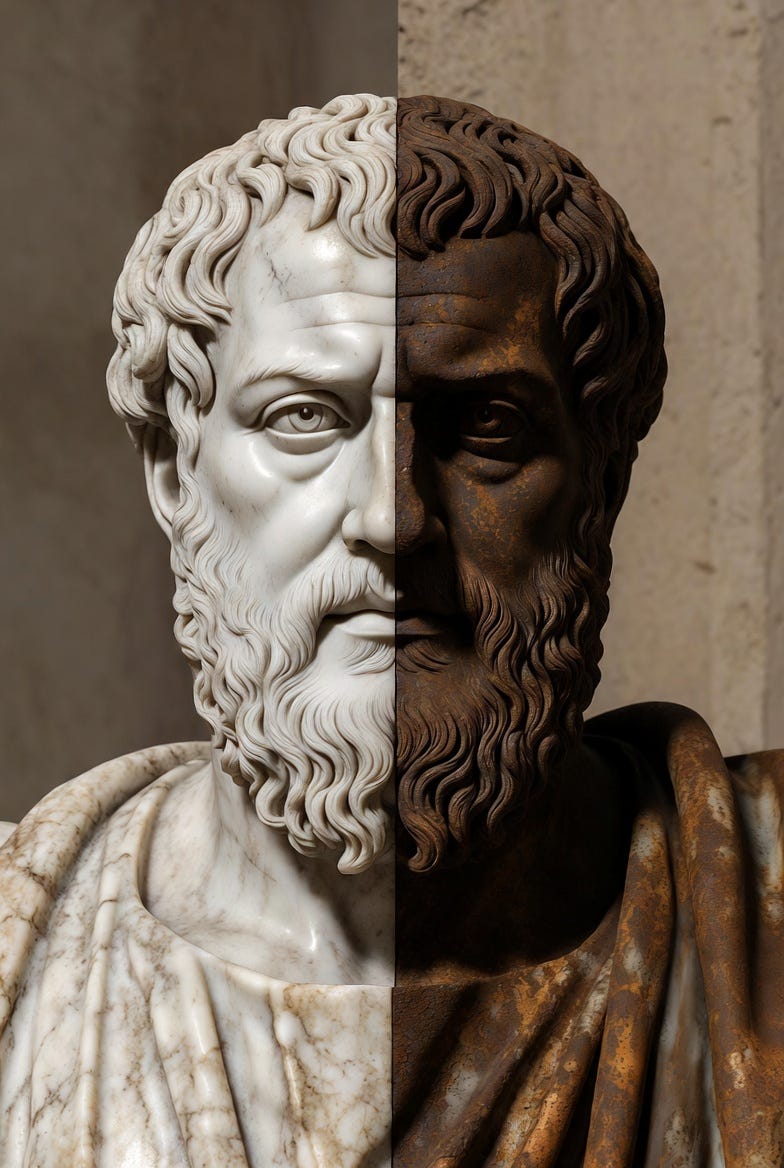
In the previous episode, I provided an introduction to the fundamental questions of being, becoming and knowing, and as explained by a preeminent thinker on the topic - and of course using a certain train of logic and argument. You might say, well, ok it may be ‘logical’ but surely someone else could come up with different logic? How I can really know - or do we leave it to the so-called sages? Today we’ll explore all this further.
Article written by Ash Stuart
Images, voice narration and some footnotes generated by AI
Further Reading & Reference
* Sonneborn, Liz. (2006). Averroes (Ibn Rushd). Rosen Publishing Group. ISBN 978-1404205147.
* Urvoy, Dominique. (1991). Ibn Rushd (Averroes). Routledge. ISBN 978-0415055673.
* Adamson, Peter; Di Giovanni. (2018). Interpreting Averroes: Critical Essays. Cambridge University Press. ISBN 978-1107114883.
* Turner, Howard R.. (1997). Science in Medieval Islam: An Illustrated Introduction. University of Texas Press. ISBN 978-0292781498.
* Ozment, Steven. (2020). The Age of Reform, 1250-1550: An Intellectual and Religious History of Late Medieval and Reformation Europe. 40th Anniversary. Yale University Press. ISBN 978-0300203554.
* Popper, Karl. (1972). Objective Knowledge: An Evolutionary Approach. Oxford University Press. ISBN 978-0198750246.
* Deutsch, David. (2012). The Beginning of Infinity: Explanations that Transform the World. Penguin Books. ISBN 978-0143121350.