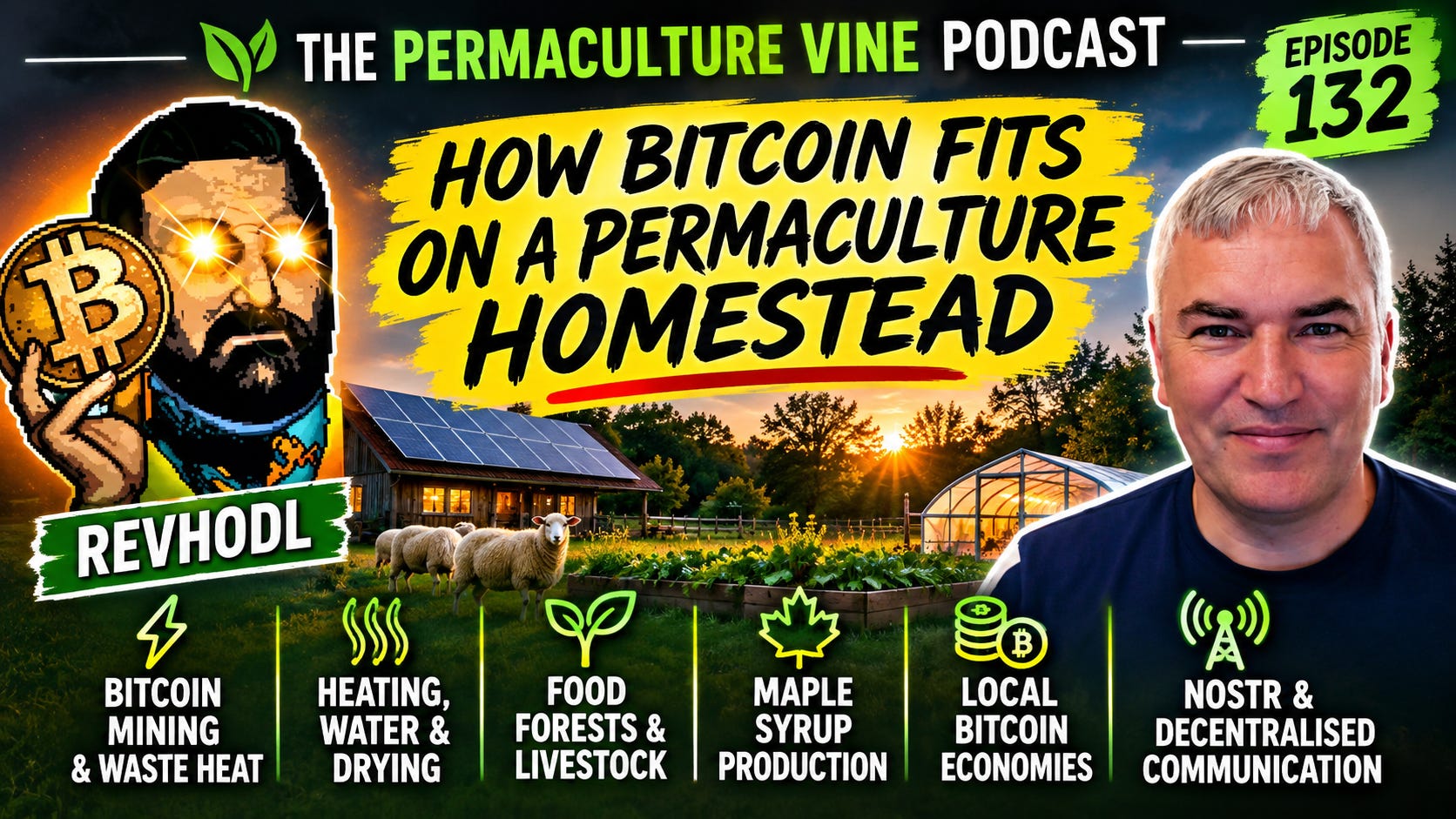
In episode 132 of The Permaculture Vine Podcast, host Cormac Harkin was joined by RevHodl to discuss his experience of developing a 20-acre homestead and integrating Bitcoin into his permaculture systems.
The conversation covered food production, livestock integration, the practical applications of Bitcoin mining, alternative payment systems and the overlap between local Bitcoin and permaculture communities.
Who’s at the Table
RevHodl is a permaculture practitioner based in Southwest Michigan, USA, where he has been developing his 20-acre homestead since 2015. He previously worked in the television and film industries before undertaking an Earthship building apprenticeship and completing his Permaculture Design Course in 2016. He also hosts the Local Bitcoiners podcast and runs a Bitcoin meetup in South Bend, Indiana.
Rev’s Nostr npub: npub1f5pre6wl6ad87vr4hr5wppqq30sh58m4p33mthnjreh03qadcajs7gwt3z
Rev’s Podcast: https://localbitcoiners.com/
From Earthships to Permaculture
Rev first encountered permaculture in 2011 while undertaking an Earthship building apprenticeship in New Mexico. He described how Earthships incorporate reclaimed building materials, rainwater harvesting, water reuse, passive heating and cooling, and renewable energy.
Following his apprenticeship, he moved to Los Angeles, where he began experimenting with permaculture in his apartment. His early projects included a hydroponic window farm, a worm bin and growing microgreens.
In 2015, he purchased his property in Michigan and completed an intensive, residential Permaculture Design Course with Bill Wilson of Midwest Permaculture the following year.
Developing a 20-Acre Homestead
The property consists of approximately ten acres of pasture and ten acres of mature hardwood woodland.
Rev spent his first year renovating the house, which also gave him time to observe the land before beginning work outside.
His initial projects included hügelkultur beds constructed using trees removed from the pasture and shallow swales created using a borrowed plough. He discussed how the hügelkultur beds ultimately proved unsuitable for his circumstances.
Over the following ten years, he developed a mature food forest, a maple syrup operation with 200 taps, rotational grazing systems, a rabbit colony and a cannabis garden for commercial seed production.
He also constructed a tiny house and a yurt, which are used for short-term accommodation and for people attending permaculture courses on the property.
Integrating Plants and Livestock
Rev keeps Katahdin hair sheep and East Friesian dairy sheep within a rotational grazing system incorporating linear food forests.
These plantings contain apples, peaches, cherries, plums, pears and other perennials, including hazelnuts, which provide an additional layer of feed for the sheep.
Horse manure is incorporated into his chicken paddock, where chickens consume fly larvae and break down the manure. Rev reported that this arrangement had reduced his chicken feed costs by approximately 75%, while also producing compost for his growing systems.
In his apple tree nursery, strawberries are used as ground cover to reduce competition from grass. Weeds removed while harvesting strawberries are fed to the rabbits, which are integrated into his cannabis growing system.
Bitcoin and Permaculture Ethics
We discussed Bitcoin from the perspective of someone unfamiliar with digital currencies and interested in their potential applications within permaculture.
Rev explained his preference for describing the third permaculture ethic in terms of non-extraction. He discussed this in relation to conventional currencies, barter, gift economies and Bitcoin.
The conversation also covered Bitcoin as a decentralised digital currency, its use as a medium of exchange and the distinction between holding Bitcoin and using it to purchase goods and services.
Bitcoin Mining and Waste Heat
A significant part of the conversation focused on the heat generated by Bitcoin mining computers and how Rev incorporates that heat into existing systems on his homestead.
He explained that, at his residential electricity rate, spending one dollar on electricity might generate between 60 and 80 cents in Bitcoin. Mining alone, in this example, would not cover the cost of electricity.
However, by using the heat generated by the computers for activities that already require electricity, Rev explained how he reduces his operating costs while receiving Bitcoin.
His installations have developed gradually, beginning with supplementary space heating before progressing to more complex applications.
Heating, Laundry and Food Dehydration
Rev initially used a Bitcoin miner to heat his bedroom overnight, supplementing an existing rocket mass heater.
He subsequently incorporated miners into his domestic heating system, modified a clothes dryer and constructed a food dehydration system.
The clothes dryer was initially noisy, but subsequent modifications allowed him to reduce the noise considerably.
We also discussed the difficulties of drying clothes in Ireland’s humid climate and the potential use of warm airflow from a Bitcoin miner to assist indoor clothes drying, alongside the need to manage humidity.
Domestic Hot Water and Maple Syrup Production
Rev described how he moved from air-cooled mining systems to liquid-cooled systems using canola oil and heat exchangers.
One of these systems is integrated into his domestic hot water supply.
Another is used in his maple syrup operation, where reverse osmosis removes approximately 70% of the water from the maple sap before it is boiled using propane.
By using heat from a Bitcoin miner to preheat the sap before it enters the reverse osmosis filter, Rev reported that he had doubled his sap processing speed.
Once the maple syrup season ends, the same miner is connected to an underground water loop in a cold frame, providing bottom heat for his cannabis seedlings.
He also described using warm air from a Bitcoin miner to help warm hypothermic newborn lambs during winter.
Solar Energy and Bitcoin Mining
The solar power installation at Rev’s yurt incorporates Bitcoin mining for load balancing. The heat generated by the miners is directed into a dehydration box used for drying food and medicinal plants.
We discussed the use of surplus solar electricity for Bitcoin mining alongside other potential uses, such as pumping water and charging batteries.
Rev also shared examples of people attending his local Bitcoin meetups who have integrated mining into their own solar installations, including one person using miners to heat a swimming pool.
Bitcoin Wallets and Accepting Payments
We covered the basic requirements for sending and receiving Bitcoin, including digital wallets, key pairs and receiving addresses.
The conversation touched on how a permaculture practitioner might accept Bitcoin payments for products or services, including selling produce at a farmers’ market.
We also discussed transaction fees, credit card processing charges and the differences between conventional electronic payment systems and Bitcoin.
Local Meetups and Circular Economies
Rev attends several Bitcoin meetups in Southwest Michigan, where he has encountered considerable interest in permaculture.
He uses these gatherings to sell surplus produce from his homestead in exchange for Bitcoin, without needing to attend a regular farmers’ market.
He shared an example of another meetup participant who collects yoghurt from a creamery near his home and distributes it to other members in exchange for Bitcoin.
These meetups also provide opportunities to exchange technical knowledge, discuss homesteading projects and find sources of Bitcoin mining equipment.
Through his weekly Local Bitcoiners podcast, Rev interviews Bitcoin meetup organisers about their communities.
Cultural Capital and Holding Bitcoin
The conversation also covered the eight forms of capital, a framework to which Rev has added a ninth form.
We discussed cultural capital, the origins of the term HODL within the Bitcoin co…