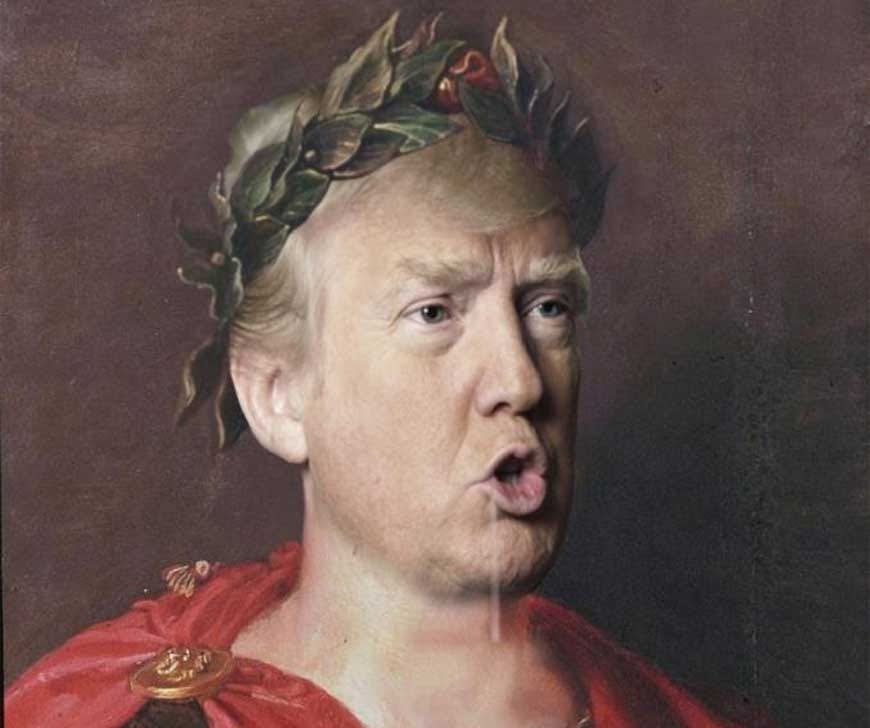
History is a repeating rhythm of “ontological confusion,” a state where society can no longer distinguish between a leader’s personhood and the mythic role they inhabit. We look at certain figures and see something simultaneously more and less than a human being. They are liminal entities, standing at the threshold of the divine and the infantile.
In 37 AD, the Roman legions looked at a young man in a miniature soldier’s outfit—the caligae from which he derived his hated nickname, “Little Boot”—and saw the savior of a dynasty. In 2016 and 2024, millions of Americans looked at a gold-plated penthouse and saw a brand capable of salvaging a declining nation. To understand the “Manchild with a God Complex,” we must look past the surface-level “madness” of the Roman Emperor Caligula and Donald J. Trump to find the deep psychological patterns that connect them.
The Atemporal Void of the “Episodic Man”
Most of us navigate existence through a cohesive life story, a narrative arc that connects our past failures to our future aspirations. As Dan P. McAdams observes, Donald Trump is a curious psychological exception: he is the “episodic man.” He exists in an eternal moment of combat, unmoored from a self-defining past or a prospective future. This is the “Rain Man of nationalism,” a figure who possesses superhuman charisma but lacks a complex inner life.
Because there is no internal story to maintain, the leader becomes a television character—a role that is performed with such total conviction that the mask becomes the man. This mirror-like quality creates a “Satanic” liminality, echoing the Harvard psychologist Henry Murray’s 1962 profile of the mythical figure. Like Satan, the episodic leader is a one-dimensional superhero; he is gifted with the charisma to “perfect the deal,” yet he lacks the humanizing qualities of wisdom, love, or moral ambivalence.
At the center of Trump’s personality lies a narrative vacuum, the space where the self-defining life story should be but never was. As such, Trump is rarely introspective, retrospective or prospective. There is no depth, no past and no future.
The Imperial Prank: Humiliating the Elite
Historical tradition mocks Caligula for attempting to name his favorite horse, Incitatus, as a Roman Consul. Similarly, critics decried Trump’s elevation of family members like Jared and Ivanka to the highest echelons of government. However, viewing these as mere acts of insanity misses the clinical utility of the “Imperial Prank.”
By threatening to promote a horse or an inexperienced relative, the leader isn’t just indulging a whim; he is demonstrating the meaninglessness of the existing establishment. It is a byword for the promotion of incompetents, designed to prove that the leader’s will is the only source of authority. Both leaders utilized “Name Branding” to reinforce this dominance over reality:
• Appropriating History: Caligula would finish existing public projects and rename them after himself to erase his predecessors. Trump utilized a relentless multimedia assault to place his name on every available surface, from skylines to steaks, turning a surname into a singular source of sovereign power.
• Replacing the Divine: Caligula reportedly replaced the heads of statues of gods with his own likeness. Trump branded his movement so thoroughly that the brand superseded the party, forcing the elite to either bow to the new iconography or face execution (politically or, in Rome, literally).
• Monuments of the Ego: Caligula built floating palaces on Lake Nemi; Trump utilized gold-plated toilets and private aircraft to project a “shopping mall glitz” version of imperial success that resonated with a base that viewed traditional taste as elitist gatekeeping.
The Bodyguard vs. The Husband: The “Divine” Weapon
A recurring paradox is why the least religious leaders—men of “sordid soap opera” personal lives—secure the most fanatical religious support. Whether it is Caligula being received as a “New Sun-god” or Trump being compared to the biblical King Jehu, the dynamic is the same: the followers are not seeking a moral exemplar.
As Peggy Young Nance famously noted, “We weren’t looking for a husband... we were looking for a bodyguard.” Followers perceive the world as a fallen, dangerous place (”the den of vipers”) and they require a “meanest son of a gun” to fight for them. Jordan Peterson’s analysis of “Agreeableness” explains this: the leader is intentionally impolite and abrasive, yet this “ruthless sense of humor” is perceived as a form of compassion for the in-group. His rudeness is his shield; his lack of traditional virtue is his primary weapon.
The Thin-Skinned Superhero: Clinical Volatility
These leaders cultivate an image of “Plasticity”—the capacity to constantly reinvent themselves as a superhero, whether it’s the “stable genius” or the savior of the “normies” from the monsters of the deep state. This is the X-Men dynamic, where a “misfit mutant” arrives to rescue society.
However, clinical reality reveals a comically thin skin that belies the superheroic armor. In psychological terms, these figures exhibit high “volatility” paired with low “withdrawal.” They are difficult to stop and can handle immense pressure—demonstrated by Trump’s “morningness” (rising at 5:30 AM to begin the day’s combat)—but they are aggressively touchy. Caligula executed critics for slight insults to his ego; Trump utilized Twitter for “multimedia assaults” on journalists and comedians. The need for absolute adulation means that no slight is too petty to ignore, as the ego cannot withstand the “viciously funny” mockery of others.
Jouissance: Why Perception Devours Data
The 2024 election provided a masterclass in the triumph of “vibes” over verity. While “Bidenomics” could point to a record 16 million jobs, the narrative of a “poisoned” nation and economic ruin was more psychologically resonant. This is the power of Jouissance—the raw, jaded fun of knowingly cultivated outrage.
Authoritarianism is a two-way street of enjoyment. When the leader mocks the common enemy, the followers experience a “delicious enjoyment” that borders on farce. The “Let’s Go Brandon” chants and the prideful adoption of the “Deplorable” label are not just political slogans; they are invitations to a party where being “bad” feels good because the enemy is “totally worse.” In this psychological state, fearmongering about immigration and inflation functions as a unifying myth, creating an “alternative reality” where the thrill of the fight is more valuable than any economic statistic.
The Monster in the Mirror
The rise of the “God-King” is not a failure of the leader’s sanity, but a symptom of a society that has lost faith in the power of its own institutions. Whether in Rome in 41 AD or America in 2026, the “strongman” emerges when the public begins to look toward the “eccentric and supernormal” for salvation.
These leaders do not create the division; they are the lightning rods for it. They are the “Monster in the Mirror,” reflecting our collective anxieties and our secret desire for a warrior who will bulldoze the rules we no longer trust. We must ultimately ask: Is the God-King a tragedy of one man’s ego, or the final act of a civilization that would rather be entertained by a tyrant than governed by a person?
If you enjoyed this post, you can support my work & help me fight homelessness in the following ways:
Like & Share this postRepostSubscribe to Sincerely, TBuy me a coffee (or a book!)Become a founding memberVenmo: @tay88
Thank you for your support
Sincerely,
-T