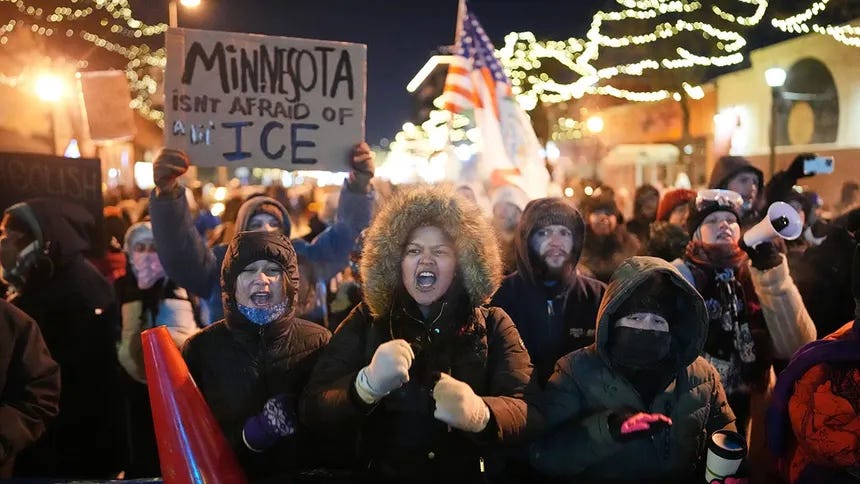
On February 4, 2025, a ten-year-old girl with brain cancer was stopped at an immigration checkpoint while en route to an emergency medical appointment. Despite her U.S. citizenship, she was deported to Mexico alongside her family. It was a clinical, quiet start to a year that would fundamentally rewrite the American social contract.
Over the past twelve months, the map of American civil liberties has undergone a seismic shift. In what the Department of Homeland Security (DHS) calls the “largest immigration enforcement operation ever,” the ICE budget has tripled and its force size has doubled. This expansion has transformed the agency into something resembling an occupying force in American cities, managing a record 66,000 detainees. For those watching from the corridors of constitutional law, the 2025-2026 escalation is not merely a policy shift—it is a profound stress test for democracy.
👆🏽👆🏽-SIGN YOUR STRIKE CARD NOW- 👆🏽👆🏽
1. The Death of the Judicial Warrant (May 2025)
The first pillar of the “New Normal” arrived in May 2025 with the “Warrantless Entry Memo.” For over two centuries, the Fourth Amendment has stood on the principle that a home is a sanctuary, accessible to the state only via a judicial warrant signed by an impartial judge.
This directive effectively bypassed that tradition, authorizing ICE officers to enter private residences using only “administrative warrants”—documents issued by the immigration officers themselves. This policy grants the executive branch the unprecedented power to authorize its own entries without independent oversight. Whistleblowers have since revealed that ICE trainees were explicitly instructed to prioritize this memo over traditional training that emphasized constitutional constraints. It is a legal sleight of hand that effectively declares the Fourth Amendment void for immigration enforcement.
2. The Citizen’s Dragnet: No One is “Safe”
The past year has proven that the distinction between “immigrant” and “citizen” has become dangerously porous. Driven by a “Documentation Challenge” and poor record-keeping, federal enforcement has increasingly snared those the law is meant to protect.
• The Disarmed Officer: In January 2026, a uniformed Brooklyn Park police officer was pulled over by ICE agents while on duty. When she attempted to record the encounter, agents drew their weapons and knocked the phone from her hand. As Police Chief Mark Bruley noted, the officer was forced to identify herself as law enforcement simply to “slow and de-escalate” the federal aggression.
• The Angola Detention: Chanthila Souvannarath, who held substantial claims to U.S. citizenship for over 20 years, was detained at his annual check-in and sent to Camp 57 at Angola Prison—a facility built on a former slave plantation. In an act of open defiance against the judiciary, ICE deported Souvannarath to Laos despite a federal judge’s temporary restraining order explicitly prohibiting his removal.
• The Faulty Intelligence: ChongLy “Scott” Thao, a 56-year-old U.S. citizen, had his St. Paul home stormed by agents searching for suspects who never lived there. Thao was dragged into the 10-degree cold wearing only shoes, underwear, and his 5-year-old grandson’s blanket, while agents ignored his family’s pleas to show identification.
3. The Lethal Cost of “Operation Metro Surge”
In December 2025, the federal government launched “Operation Metro Surge,” deploying 3,000 federal agents to the Twin Cities. While the official narrative focused on “the worst of the worst,” ICE’s own data reveals a different reality: 95% of those arrested had no record of violent crime. This mismatch in rhetoric turned lethal in January 2026.
Renée Nicole Good, a 37-year-old poet and mother, was killed when Agent Jonathan Ross fired three shots into her vehicle. While the government claimed she tried to run the agent over, video evidence showed the vehicle turning away from Ross when he fired. Her death marked the ninth time since September 2025 that agents had opened fire during operations.
Seventeen days later, Alex Jeffrey Pretti, a 37-year-old ICU nurse at a VA hospital, was killed. During a protest, six agents wrestled Pretti to the ground. Although he was a licensed concealed carry holder, video evidence confirms an agent had already disarmed Pretti and moved away before another agent opened fire at point-blank range. Representative Kelly Morrison’s question remains the haunting refrain of the surge: “Two 37-year-old Minnesotans are now dead, a poet and a nurse, for what?”
4. The Insurrection Act and the “Imperial Boomerang”
As civil unrest followed the Minneapolis killings, the White House repeatedly threatened to invoke the Insurrection Act of 1807. To the constitutional scholar, this represents a dangerous flirtation with the end of civilian law. While the Posse Comitatus Act generally prohibits federal troops from domestic policing, the Insurrection Act serves as the rare exception.
Critics point to the “Imperial Boomerang” effect: the return of military tactics and personnel from foreign wars to the American interior. Agent Jonathan Ross, whose career path took him from the battlefields of Iraq to the Texas border and finally to the streets of Minneapolis, embodies this shift. The triggers for a military invocation—ranging from the January 23 General Strike to state-federal confrontations—risk violating the precedent of ex parte Milligan, which holds that military trials cannot replace civilian courts while those courts remain open and functional.
5. The Human Toll and the Shadow Safety Net
Beyond the legal briefs and the tactical gear lies a human cost best measured in small, heartbreaking images. It is found in the memory of a 10-year-old girl with cancer being driven away from her medical care, and in the image of a grandfather shivering in a child’s blanket.
In response to the state’s escalation, a shadow social safety net has emerged. In Minneapolis, local churches have delivered 12,000 boxes of food to families in hiding—American families now afraid to step onto their own porches. This community-led resistance serves as a silent, moral rebuke to the federal machinery. While the state has prioritized “temporary safety” through force, the community has stepped in to preserve the dignity the system has discarded.
A Stress Test for Democracy
The events of 2025-2026 represent more than a year of aggressive enforcement; they are a fundamental challenge to the American legal framework. As the ACLU files class-action lawsuits and state attorneys general like Keith Ellison fight to preserve evidence from federal destruction, the nation is forced to confront Benjamin Franklin’s enduring warning: “Those who would give up essential Liberty, to purchase a little temporary Safety, deserve neither Liberty nor Safety.”
The 12,000 food boxes in Minneapolis represent a community choosing liberty and compassion over fear. The question for 2026 is whether our legal system can reassert its oversight or if we have accepted a new normal where the Constitution stops at the front door. Are these 365 days an aberration to be corrected, or have we witnessed the permanent expansion of executive power beyond the reach of the law?
If you enjoyed this post, you can support my work & help me fight homelessness in the following ways:
Like & Share this postRepostSubscribe to Sincerely, TBuy me a coffee (or a book!)Become a founding memberVenmo: @tay88
Thank you for your support
Sincerely,
-T