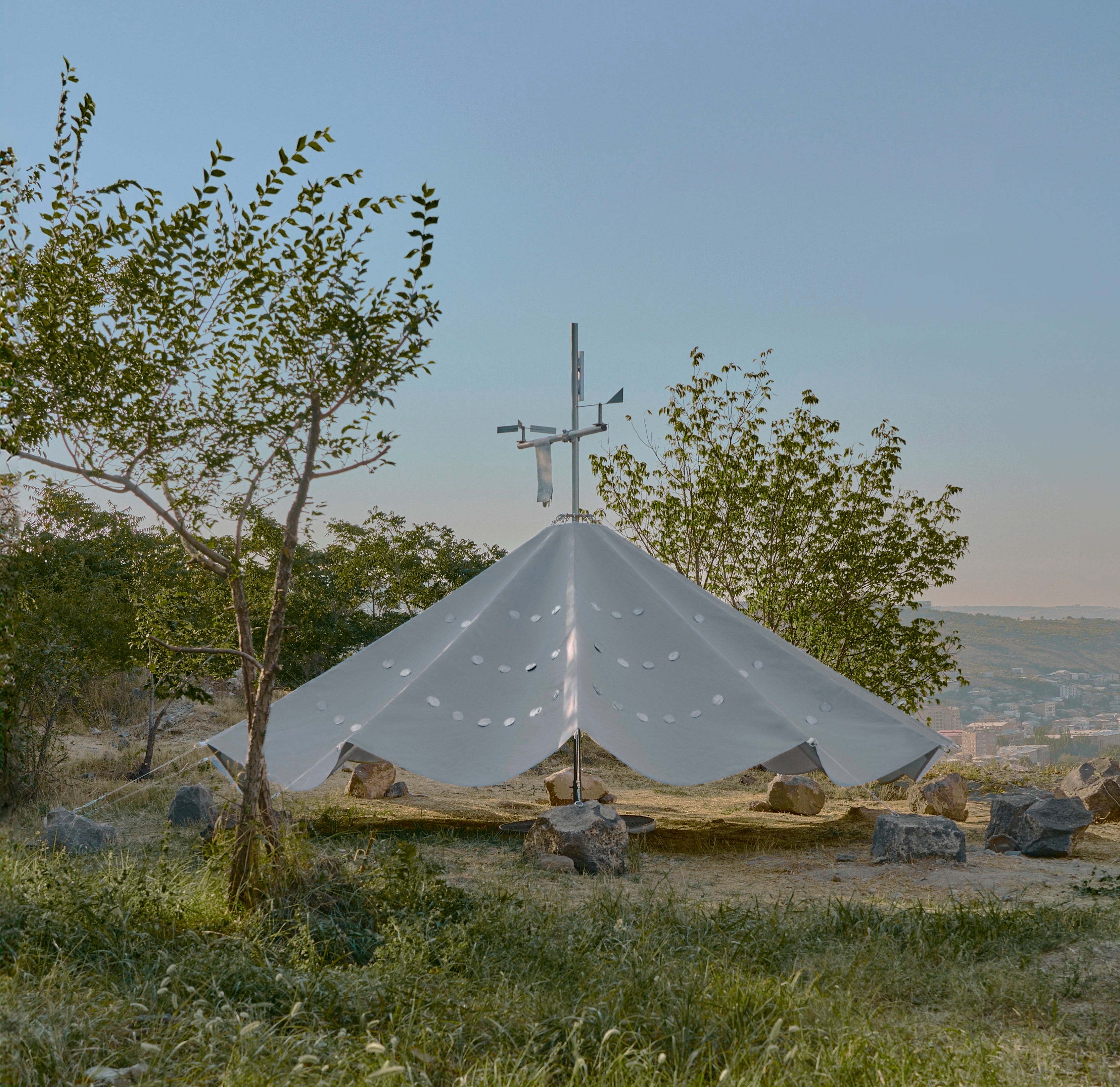
This month, I interviewed architect and researcher Alessandro Pasero, a PhD candidate at Politecnico di Milano. We talked about his research on performance and the histories of ephemeral architectural production, and reflected on the tension between temporary spatial practices and the enduring weight of our built environment.
This episode was moderated and produced by Leon Hidalgo.
lllightness is a reader-supported publication. To receive new posts and support my work, consider becoming a free or paid subscriber.
The following article is meant as an informational extension of the podcast episode:
Alessandro’s practice moves between architecture, installation and performance. In this dance between disciplines the research and practice necessarily inform each other. When he speaks about lightness, he places it at the edge of architecture as defined by Vitruvius’s firmitas.
Lightness¹ the quality of having little weight
Alessandro finds himself in the paradox of living a somewhat nomadic life while carrying the massive weight of cityscapes and infrastructures that are nonetheless assigned to him. When he visits a city, he tends to observe its small, temporary spaces of flux, as they reveal the conditions of inhabitants and their ways of life more clearly than monuments do. In his master’s thesis, he explored this idea by designing an ephemeral place of gathering built from scaffolding elements.
When thinking about his favorite structures, his mind naturally turns to the early works of Diller & Scofidio, particularly projects such as Slow House and Moving Target.
lightness² the state of being light in color or shade
Thinking of light as an ephemeral agent, Alessandro argues that architecture should no longer be concerned primarily with form, but also with the fluxes of matter. While light embodies these fluxes, our built environment doesn’t. In this context, he refers to the work of Andrés Jaque with his Office for Political Innovation, citing the Reggio School as an example of architecture that openly acknowledges and makes visible its material, social, and environmental flows.
In regard to supposed lightness of fully glazed façades, Alessandro points to the problematic qualities of glass, when it is placed uniformly or without regard for what it reveals. In this way, architecture can produce conditions of surveillance and broadcasting, as Beatriz Colomina has described in her books Privacy and Publicity and Domesticity at War.
When thinking about moments defined by special light qualities, Alessandro, having grown up in Rome, inevitably recalls visiting the Pantheon on a Sunday, where the light materialized as a central column coming down from the skylight. He also connects this memory to the flickering beams cutting through darkness while clubbing. Alessandro was reminded of this experience in a light installation at Horst Arts & Music Festival in 2022, where the Belgian architecture practice Traumnovelle designed a mesmerizing light installation.
lightness³ being carefree or feeling without burden
Alessandro feels lightness when he can be in a moment fully immersed while at the same time having no attachments or lingering doubts. While recently building a pavilion for the Armenian Architecture Biennale, he had the opportunity to visit the country and, in particular, the Geghard Monastery, where a spiritual space carved deep into massive rock unexpectedly evoked in him a strong sense of lightness.
video by ©LorenzoBasili
The idea of lightness also brought Alessandro back to a quote from a book that was read to him as a child and that he recently revisited:
“Take life with lightness, for lightness is not superficiality, but gliding over things from above, not having weights on your heart.”— Italo Calvino, Six Memos for the Next Millennium (Sei proposte per il prossimo millennio)
Mirabilia was a project developed for the Architecture Festival in Rome in 2022, where Alessandro understood that, in this very specific local condition, minimal actions such as marking abandonment and accumulated trash could be a more effective architectural response than any imagined built intervention. He reflects that this project marked the first instance of a pattern he began to recognize, one that may become to define his way of working.