In the past 30 days since I started doing these podcasts, over a thousand people a day are have been downloading them, but of course not subscribing. I’m not too worried about that. But I’m going to keep going.
What follows is testimony. A man named Mario Pavlovich gave it to me in the way men give testimony when the world has cracked open and shown them what lies beneath. He is a social worker. Croatian by birth, Canadian by circumstance. My age. I trust him because I have sat with liars and I have sat with men who have seen things, and the difference is in the eyes and in the pauses between words. This account is one I pulled from many, from chapters I mean to bind into a book if the world permits it. I chose it because the themes recur. Case after case after case, the same architecture of the uncanny, built and rebuilt in the lives of strangers who will never meet.
The Shooting, Spring 2022
At 2:45am in Edmonton, Alberta, a red Ford Focus stopped one block from Ertale Lounge. Four masked men stepped out with semi-automatic handguns and opened fire on a crowded corner. Seventy rounds tore through glass, brick, flesh. People dropped screaming. One man, Imbert George, twenty-eight, was dead before sirens arrived. Seven others lay bleeding on the curb.
The shooters fled, triggering a fifteen-minute chase through downtown Edmonton at highway speeds. They fired into the night and vanished into the sprawl. The neighborhood was left marked by one of the worst mass shootings in Canada’s history.
Mario Pavlovich wasn’t in the lounge when the bullets flew, but his business sat in the same neighborhood, its windows facing the street where blood pooled under yellow tape. In the days that followed, customers stayed away. Foot traffic collapsed. His bar’s name became tied to a massacre. What the gunmen hadn’t destroyed with bullets, they finished with fear.
The Ruin, Autumn 2022
Mario has lived with that night ever since. The silence of emptied rooms, and the weight of bills stacked higher than his receipts. And above it all the memory of the city where the violence fell, just beyond his balcony, altering not only the lives of the dead and wounded but the course of his own.
Mario had grown up in Croatia, in a home stripped of God. No prayers at the table, no quiet assurances that suffering had meaning. When the night club collapsed after the shooting, when the money and the pride drained from his life, he had nothing larger to hold on to. He was alone with the ruin.
The nights at the group home stretched long. He worked as a social worker now, watching over residents with disabilities in a house that looked ordinary from the street. The work kept them fed, and little more. The true labor was in his mind, holding himself back from the abyss that opened when all was lost.
The Meditation, Spring 2023
With no faith to fall back on, Mario tried the only thing he could imagine might steady him; he had heard it worked for some people. He sat down, closed his eyes, and began to meditate. At first it was clumsy, ten minutes of breathing, his thoughts tumbling like stones. But over time it became his only refuge. He wasn’t after enlightenment. The work was to blunt the pain, to carry it past another night.
On April 26, 2023, at 10:30pm, the rain had eased and left a skin of water on the porch boards. The clouds lay low over the city, white and depthless. Despite the hour, the sky yet held its light, a pallid glow that dies slowly this time of year in Alberta. Mario sat cross-legged on his porch in the damp air, eyes closed, breathing. He thought about his losses, about the years, about how far away home felt. He asked questions into the silence. Is there anyone out there? Is anyone listening?
And in the dark behind his lids there came eyes. Not dreamt nor figment. Eyes that looked back at him. They were not wholly human but they bore weight and will. In that moment he was pierced through. Not only seen but known.
When he finally opened his eyes, the world outside had gone strange. He didn’t hear the night insects, or the wind, or even the faint hum of the city. The silence was total, pressing, as though the air itself had gone still. Then he saw it.
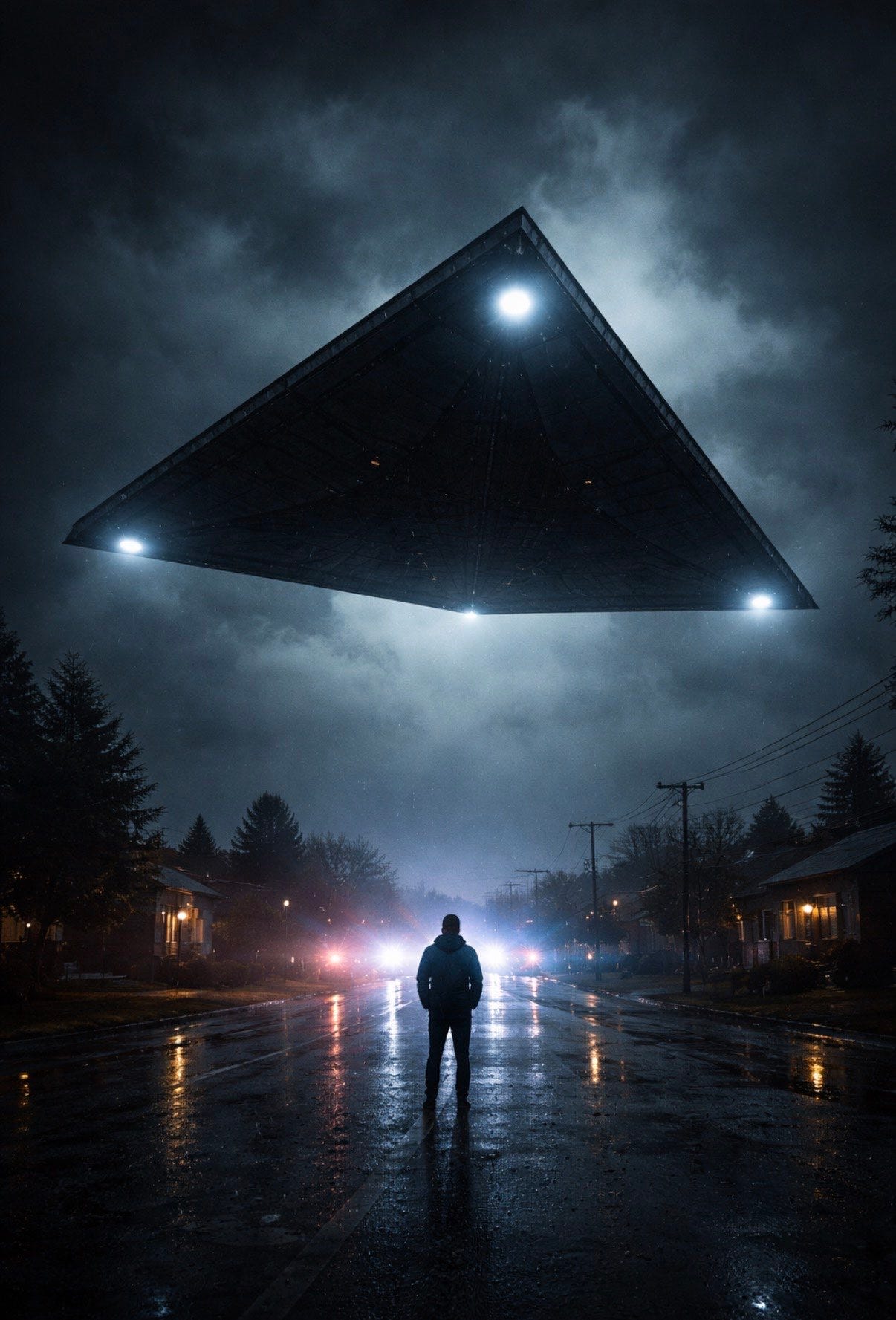
A black triangle moved slowly across the low ceiling of clouds, about a hundred yards away, and larger than any plane or helicopter he had ever seen by a factor of ten. The edges cut hard against the bone-pale sky, each corner set in dreadful clarity. There was no sound of engine nor any labor of machine. Only the slow and fated passage of the thing, black and geometric, borne across the heavens by a will unseen.
Mario’s breath caught. He stared until it faded into the distance, swallowed by the night.
It was the eyes he remembered most. The triangle was extraordinary, but the eyes were intimate. They followed him afterward, into his sleep, into the blank hours of his shifts, into the silence of his apartment. They made the experience personal, impossible to forget.
The Child in the Hall, Spring 2023
The night he saw the triangle, he woke at exactly three in the morning. No sound woke him – no creak of pipes, no rustle from upstairs – just the instinct that something was there.
Mario’s head turned toward the hallway. The bathroom light was on, casting a pale wedge of yellow across the basement. And in that light stood a figure.
It looked like a kid. Eight, maybe ten years old. About five feet tall, slim, the body in proportion the way a child’s would be. But that was the problem. Kids don’t stand still. Kids fidget. They shift their weight, scratch their noses, shuffle their feet. This one didn’t move at all. Its stillness was absolute, the kind that belongs to mannequins or corpses, not children.
Its face wasn’t a face, just a smooth impression of a head where features should have been.
Mario’s chest tightened. He tried to move but his body felt unresponsive. Not fully paralyzed, but weak, sluggish. He managed to press himself up on his elbows, muscles trembling. The figure took a few steps closer, small and deliberate, like it knew there was no hurry.
Mario fought his body upright, his heart hammering, his mind bracing for a fight with something he couldn’t name. And then, just like that, the fear was gone. Not lessened, not fading. Erased. In its place came a calm that didn’t belong to him, as though the figure had reached inside and flipped a switch.
It kept standing there, impossibly still, as Mario stood trembling, no longer afraid but knowing he should have been. Then it spoke:
Don’t be afraid.
Not in some alien whisper, nor in a stranger’s voice, but in his own. The words came from inside his skull, clear as thought but not his thought, as if something had borrowed his voice to soothe him.
The child-shape stood there, silent, motionless, the words still ringing in his head. Mario trembled, caught between the knowledge that he should have been terrified and the unnatural calm that held him fixed in place.
He stared at it. It stared at him. And in that frozen stillness, the command repeated inside him, steady and undeniable:
Don’t be afraid.
And somehow, against every instinct in his body, he wasn’t.
He asked it again, the words sharp in his mind: Who are you –
The reply slid back in, wearing his own voice like a mask, speaking over him as if disinterested in Mario’s shock: Don’t be afraid. Time is not what you think it is.
He pushed harder, his thoughts cracking with urgency, suddenly unsure of how many beings he was addressing: Who are you…guys?
This time the answer changed. The words struck like a match in the dark.
We are you.
The phrase echoed inside him, not whispered but installed, like a truth dropped into the machinery of his brain. It made no sense. It made all the sense in the world. The child-figure didn’t move. It didn’t need to. The words had moved instead, reaching across the line between him and it and smudging it away.
And then it was gone. Instantly, like a shadow when the light switches off.
The basement hall was empty, but Mario could still feel it there, pulsing in his chest, repeating in his skull:
Don’t be afraid.
Time is not what you think it is.We are you.
He stood alone in the silence, knowing he would never again be able to call himself alone.
When it was gone, Mario didn’t lie back down. He couldn’t. He sat in the stillness of that basement, every nerve alive, his own voice echoing with words that weren’t his: We are you.
He wasn’t afraid. That was the strangest part. Something had stolen the fear, hollowed it out, and left him calm. But the calm wasn’t the comforting kind, and more like intrusion. It was the knowledge that something could reach inside his mind and twist the dials at will. He felt stripped, re-wired, no longer entirely his own.
The hours crawled. He kept waiting for the figure to return, for the words to come again. They didn’t. By sunrise he was exhausted, but he knew sleep wasn’t going to save him. The world had changed. The rules he thought held steady no longer applied.
The Orbs, Spring 2024
On the night of April 8, 2024, Mario stepped onto his balcony in downtown Edmonton. The city around him was too quiet, the kind of quiet that sets the body on edge. He wanted the visitors to come back. Then he saw them.
Three orbs.
They were each a little bigger than a basketball. Dull metallic at first, no shine, no light of their own. They kept three or four feet apart, gliding in a line that looked practiced. Then, with no hesitation, they shifted into a triangle and held it, as if they had always intended to.
From twenty feet away, Mario could see the distortion around them – a ripple in the air, like heat shimmer or water bending light. The sky blurred around the spheres. Then the distortion itself lit up, bright white, liquid in its glow. In the same instant, all three orbs transformed, their metallic skins gone, replaced by spheres of pure, radiant light. Yet they somehow did not cast light upon their surroundings.
They were silent. Not a hum. Not a whisper of air.
Mario’s stomach dropped, pulse hammering. But he couldn’t look away. As he stared, he had the sudden unmistakable sense that they were staring back. Not with eyes, but with awareness, tuned to him and no one else. His thoughts tumbled: Why me? What are you? And as the questions hit, the orbs shifted, as if in response, changing formation and then locking in again.
“I would ask something in my head,” he explained, “and the orbs would react to that. It wasn’t random. It was like they were showing me – we hear you.”
It was like being studied in return. He thought, and they moved. He wondered, and they answered with silence and pattern. The feeling wasn’t random; it was connection.
“It felt like they were reading my thoughts,” Mario said later. “Like they knew exactly what I was thinking, and when I thought it – they moved.”
Mario felt exposed, but he also felt chosen. He didn’t know if the orbs were answering him or playing with him, but the rhythm was undeniable: whatever they were, they were listening.
The Orbs Return
It didn’t end that night.
Over the weeks that followed, the orbs came back. Always three. Always together. They would appear in the same stretch of sky, silent and deliberate, their movements too exact to be chance.
Mario started to notice the rhythm. The way they slid into line, then shifted into a triangle, then broke apart again. He felt it wasn’t a show for anyone else – it was directed at him.
“They kept coming back,” he said. “Every time, it was three of them. Always three. And every time I thought something, they would answer by moving.”
Sometimes they drifted closer, the blur around them thickening, the liquid-white glow blooming until they looked like molten glass suspended in the air. Other times they stayed high, distant, but the effect was the same: Mario would think a question, and the orbs would respond.
“I tested it,” he admitted. “I’d think about them moving in a certain way – and they’d do it. Not every time. But enough times that I knew it wasn’t a coincidence.”
The silence was always total when they were near. No city noise. No traffic hum. Not even the sound of his own breath seemed right. It was as if the orbs carried their own pocket of stillness, and whenever they returned, the world around him bent to it.
The sightings stacked up until Mario no longer counted them as separate events. They felt like one long encounter, broken into visits. Each time they came back, it carried the same message: they weren’t done with him.
The Blue Woman, Summer 2023
It began in meditation on June 6, 2023, in the same posture that had first brought him the triangle and the orbs. This time the shift was sharper. The body remained seated, but Mario was no longer inside it. He was out – lifted, placed elsewhere – looking into his living room as though it had been fractured into hundreds of copies, layered one on top of the other, marching upward and forward like panes of glass.
In one of those rooms stood a woman.
She was blue. Not pale, not painted. Her skin carried a color that the night could not dissolve – a solid, mineral blue, like copper turned pure.
Mario did not see her arrive. One moment the room was empty, the next she was present, and her presence made the air different. The silence thickened, the way silence does in the woods when something alive has entered.
She was over six feet tall and bald, her scalp gleaming. Across her face she wore golden ornamentation, bright as foil, catching light where no light should have been. A long skirt shimmered with flecks like stars sewn into fabric.
Her face was proportionate, human. The lines of her cheek, the set of her eyes, the slope of her shoulders – nothing exaggerated, nothing grotesque. In fact, she was strikingly attractive, almost unnervingly so. There was symmetry in her features, an elegance in her bearing. She looked, Mario thought, like “a perfect image of a woman in a sci-fi movie”. Beautiful, idealized, but impossibly present in his room.
Mario noticed the stillness. She did not sway or fidget; she did not need to. She was as fixed as stone, and yet there was no doubt she was alive. He felt it in the way his own pulse quickened, registering her before his mind could.
The light in the room seemed to know her. It lay against her skin and gave back no shadow, only a soft radiance that was not cast but absorbed.
She stepped across the threshold from her fractured version of the room and into his own. The movement was deliberate, unhurried, unchallenged by the division between worlds. She was there.
Then the lesson began.
She looked at his coffee table. It began to vibrate, the edges quivering until the wood lost its solidity and turned to light – pure, radiant, humming with the impression of energy. Then, as quickly, it returned to wood. She did the same with other objects: the room’s contents dissolved into luminous energy, then snapped back into form. Over and over, the rhythm was the same: vibration into light, light into matter.
Mario asked, not aloud but in thought: If this was how the world worked, if vibration gave shape to matter, then what did that mean of God? Was God a musician? An artist?
The woman inclined her head. The answer was yes.
The teaching was a demonstration, a transmission – it was not conversational. One-way. Yet it was not impersonal. He felt guided, attended to, as if this presence had come specifically for him.
Mario tried to speak again, but no sound left him. What he felt was recognition, sharp, immediate, and not that he had seen her before, but that she belonged, and always had.
When it ended, she was gone. The layered rooms collapsed back into one. His body reclaimed him, heavy, earthbound. But he carried the knowledge with him: that what he had seen was both intimate and immense, and that the lesson was not about objects at all, but about the nature of existence itself.
Aftermath
In the days that followed, Mario lived inside the echo of the vision. What unsettled him most was not the spectacle of it all: the layered rooms, the blue woman crossing thresholds, the way objects dissolved into light and returned. What lingered was the intimacy.
He grew up without religion, in a family that called on no god when the world came apart, like every place in the shadow of the Soviet Union. After the shooting, after the loss of his business, he had turned to meditation not because he sought transcendence but because it was the only thing left. And so when the divine finally came to him, it came not in the language of scripture but in a lesson made to fit his own room, his own furniture, his own body.
Mario felt it as care. Not vague, universal benevolence, but care directed at him specifically, as though this blue-skinned woman had been dispatched to remind him that his ruin was not final. It’s very personal, he said later. I felt like they cared. It’s like they set my life straight.
That was the marrow of it. To be singled out, in the midst of loneliness and failure, by something he could only describe as divine. To be told,not with words, but with demonstrations that bypassed doubt, that the world was built on rhythm, that creation itself was music, that God was not a bureaucrat tallying sins but a composer.
It did not erase his grief. But it altered the landscape of it. The loss of his livelihood, the long shifts at the group home, the exhaustion of being misunderstood; these burdens did not vanish. Instead, they were reframed inside a larger order, one in which his suffering was no longer senseless but part of a structure he could not yet name.
And in that reframing was relief. A reprieve from meaninglessness. The possibility that the worst things that had happened to him were not the whole story.
A Pattern Emerges
When Mario first saw the black triangle blot out the stars, he thought it was an aberration or a mistake in the sky, something that happened to him but did not belong to him. The eyes that followed, the childlike figure in the hallway, the orbs gliding in formation: each new encounter unsettled him further, but he held them apart, isolated phenomena, strangeness without coherence.
It was only after the blue-skinned woman that he began to understand these were not fragments. They were a sequence. A curriculum.
The triangle had been terror, the brute fact of the unknown imposed on him from above. The eyes had been intimacy, the gaze of an intelligence that not only observed him but knew him. The child-figure had been initiation, demanding that he face a presence in his own space and accept its ability to dismantle his fear. The orbs were dialogue, their movements responding to his thoughts, showing him that communication could take forms other than language. And the woman was instruction, embodying divinity in human shape to teach him that matter itself is vibration, that the universe is art, that he is cared for.
Taken together, they formed a story larger than survival. What had begun as a collapse – a man bankrupted, alone, stripped of his past – became the site of revelation. Each visitation arrived when his losses were deepest, and each one suggested that the emptiness he thought was his undoing was in fact a clearing, a space in which new meaning could enter.
Mario’s grief did not vanish. His disappointments remained real. But the encounters threaded his sorrow into a larger fabric, in which ruin could coexist with wonder, and in which personal devastation could sit beside cosmic attention. It left him with a sense not of answers, but of trajectory – that he was being guided, step by step, toward a truth both intimate and immense.
And so he began to live differently, not as a man undone by chance, but as a man being remade by contact with something that insisted his life had purpose beyond what he could measure.