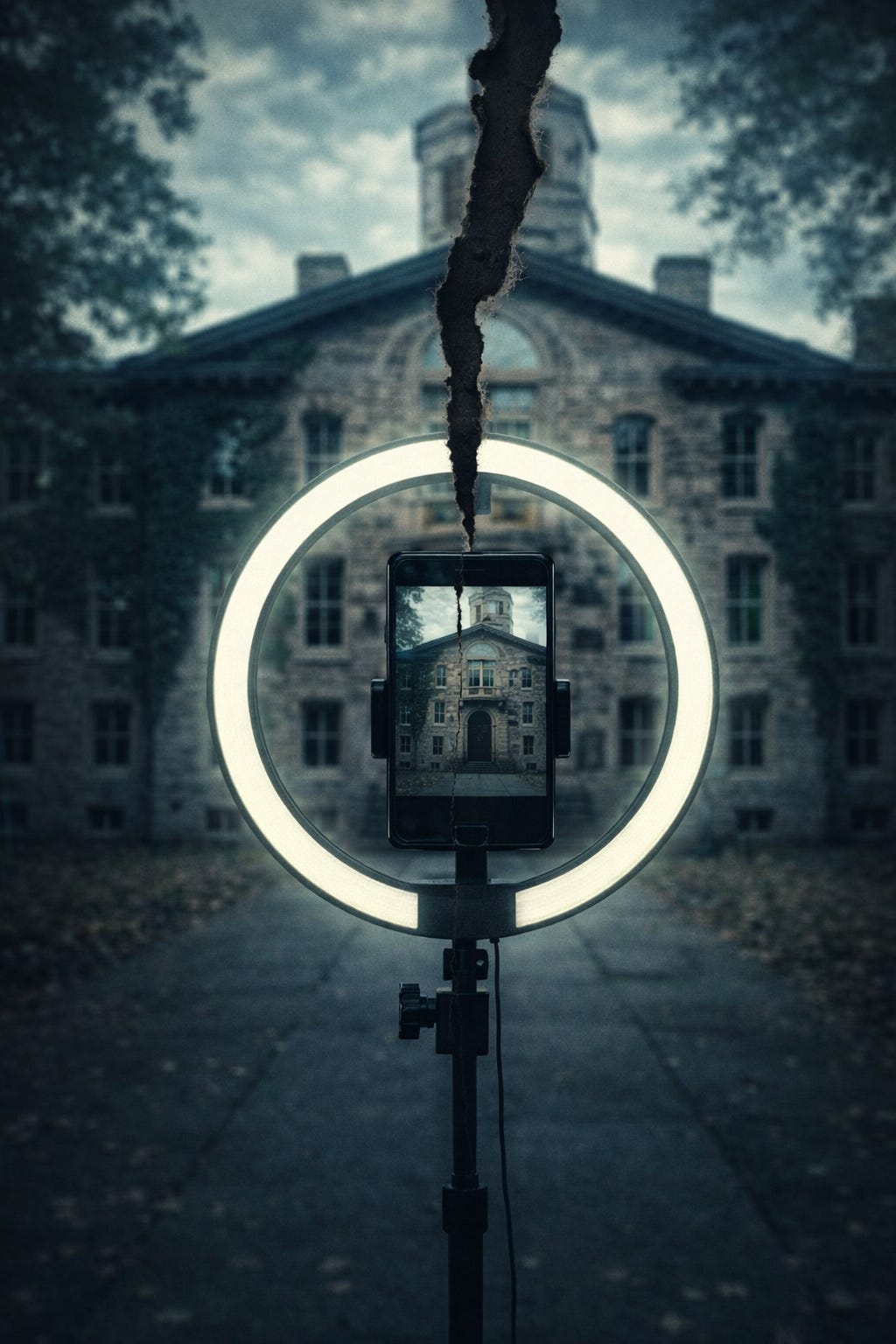
I recently walked around Princeton University’s campus on a Saturday afternoon. It was beautiful in the way old American campuses always are: stone buildings with ivy climbing the walls, oak trees filtering the light, the kind of place that was built to make you feel small in the presence of something lasting.
And every single person I passed was taking a picture of themselves.
Not of the buildings. Not of the trees. Of themselves, standing in front of the buildings and the trees, so that later they could prove they had been near something meaningful. The whole campus had become a backdrop, or a set. A place where people came not quite to think, but to be seen appearing to think.
I sat on a bench for a while. I watched a woman in a cashmere sweater take over 20 photos of herself in front of Nassau Hall.
Twenty.
I went home and opened the New York Times, which is something I do when I want to know which direction the worry is blowing. There was a column about the crisis of modern masculinity. The author had been writing about the crisis of modern masculinity for what appeared to be most of her adult life, the way some people restore boats they never intend to sail. The prose was immaculate, the author fluent in the language of insight. If you’d read it out loud at a dinner party, people would have nodded and said, “That’s so true,” and then somebody would have asked if there was more wine. I finished it and sat there for a moment, trying to figure out what I’d just learned. The answer, I think, was that things were bad, and that the author had noticed.
I closed the Times and opened X. A man with a jawline and a ring light was explaining to his followers that the key to surviving the age of AI was to “acquire assets.” He said this with the serene certainty of a man who has never been asked a follow-up question.
Below him, another man was arguing with a woman he had never met about whether feminism had destroyed the family, conducting in public the exact argument he could not win at home. Below that, someone with a graduate degree in something important had posted a statement so detached from observable reality that reading it felt like being gently concussed.
Everyone is talking. Everyone is performing a version of seriousness so convincing that it has become indistinguishable from the real thing, except for one detail: nothing is changing. The conversations circle, and the arguments repeat as the selfies accumulate. And underneath all of it, something has gone quiet that used to be loud.
The Greeks had this word, phronesis. We translate it as “practical wisdom,” which flattens it a little. Phronesis is the capacity to perceive what a situation actually requires and to act on that perception. It doesn’t mean expertise. An expert knows what to do in general. A person with phronesis knows what to do here, now, when the textbook doesn’t apply and the stakes are real.
Aristotle paired it with arete, which we translate as “virtue,” gutting it of its original force. Arete meant something closer to excellence aimed at the whole. A life organized around becoming the kind of person who could be trusted with responsibility. Not trusted because of their credentials. But trusted because of character, built through practice, tested through difficulty, refined in community over years.
Greeks did not care whether virtue felt good. They asked what was owed. A Roman would have understood the distinction. The Roman concept of pietas, the debt you owed to family, city, ancestors, and the gods, was not a lifestyle preference. It was the architecture of civilization.
Christianity added another layer: the idea that consciousness is not confined to the body. That something in us persists, connects, transcends. That we are answerable not only to each other but to something larger. Islam carried a similar conviction, that submission to the divine was the foundation of justice. Buddhism taught that the self was an illusion, and that liberation came from seeing through it. Hinduism mapped the interior life with a precision that Western neuroscience is only now beginning to approach, describing states of consciousness that modern researchers are rediscovering under fMRI machines and publishing as if they were new.
I bring up these traditions not because I think we should live like them. Much of what they built rested on slavery and conquest. But they took a question seriously that we have almost entirely stopped asking: what kind of person should a human being try to become? They built institutions around that question. They organized education around it. They selected leaders, at least in principle, on the basis of it.
We have no equivalent today. We abandoned the question when we abandoned the religious traditions that once carried it, and we never replaced it with anything that could bear the same weight.
Some of what we abandoned deserved abandoning. The dogmas, the hierarchies, the weaponized certainties, the priests who turned out to be predators. Scientific rationalism arrived and offered something genuinely better: a method for distinguishing what is true from what is merely comforting. We needed that. Badly.
But somewhere along the way, the method swallowed the worldview. We moved from “we should test our beliefs against evidence” to “only what can be tested against evidence is real.” And in doing so, lost the vocabulary for everything that makes life bearable: meaning, duty, grace, forgiveness, the sense that you are part of something that did not begin with your birth and will not end with your death.
If we are not going to return to religion, fine. Maybe that’s for the better. But we cannot replace religious ethics with no ethics at all and expect the structure to hold.
I say this because the structure is being tested right now, and it is failing the test.
The systems we are building, the ones that will outlast every person reading this, will inherit whatever values we pour into them. Right now we are pouring in efficiency, optimization, engagement metrics, and quarterly returns. We are building minds without conscience. I’m not saying that to be cute. That is exactly what we are doing. And the market will not correct for this, because markets do not account for the soul. They never have.
In the dust of this new age the tools we shape begin to shape us. The machines do not wait. They learn. They judge. And they do not pray before they act. In the old world a man’s conscience was his compass. In this one, it is the code he leaves behind. There is no virtue in speed without wisdom, and there is no mercy in power without restraint. We are not merely makers now; we are translators of our own soul into systems that will outlast us. And if we do not set the bones of those systems in ethics, in something older and truer than profit or pride, then they will speak in the voice of no one, and answer to nothing.
This is where the selfies and the AI converge. The woman in front of Nassau Hall and the algorithm curating her feed are participating in the same economy: one that measures everything and values nothing that can’t be measured. She is responding rationally to a system that rewards visibility while punishing depth. The system is the problem.
And the system is about to get a lot more powerful.
An AI trained on engagement will optimize for engagement. An AI trained on profit will optimize for profit. An AI trained on wisdom would optimize for something else entirely, but we would have to know what wisdom looks like before we could train for it. And we have spent the last century systematically dismantling every institution that once tried to answer that question.
People mythologize Elon Musk for his technical brilliance, equating that for wisdom. This is a category error as old as history.
This is the gap, and it’s not technological, but moral. We have the tools to build systems of extraordinary power and no shared framework for deciding what those systems should serve. The engineers building these models are, in my experience, thoughtful people asking hard questions. But they are building on a foundation that the rest of us forgot to pour.
The question we need to answer is a design question: how do you build systems, political, institutional, technological, that select for wisdom and moral courage rather than ambition? Every serious civilization before ours organized itself around some version of this question. We have stopped asking it, and the cracks in the walls are the predictable consequence of a civilization that scoffs at concepts like duty and integrity.
Part of the answer to all of this involves taking consciousness seriously. Not as a new age branding exercise, but as the deepest unsolved question in science. The fact that anything is experienced at all, that there is something it is like to be you reading this sentence, remains unexplained by any model we have. Researchers who ask fundamental questions about the nature of mind should not be treated as if they’ve committed a professional indiscretion. They are working on the thing that matters most.
Part of the answer involves rebuilding the practice of interiority. Not the kind found in TikTok clips, spoken by people with jawlines you could teach geometry with. I’m talking about the actual discipline of sitting with yourself long enough to discover what you think, rather than what the feed thinks, rather than what performs well, rather than what is safe. This is unglamorous work and it does not photograph well.
And part of the answer might just be this, and I’m sorry it isn’t more complicated: try to get interested in other people. Actually interested. Use the phone to find out how someone is doing, not to watch a twenty-six-year-old in a rented apartment explain the universe to you while you lie in bed feeling like something the dog brought in. Choose depth over visibility, in the small ways, on the days when nobody’s grading you.
Look, I know how that sounds.
It sounds like the kind of thing someone writes on a bench at Princeton while feeling superior to the woman with the phone. I am aware of the irony. But the irony does not make it incorrect.
Tonight, somewhere, in a room without a camera, someone will sit quietly and ask the only question that has ever mattered: what kind of person am I becoming?
And whether anyone is watching will be, for once, not the point.