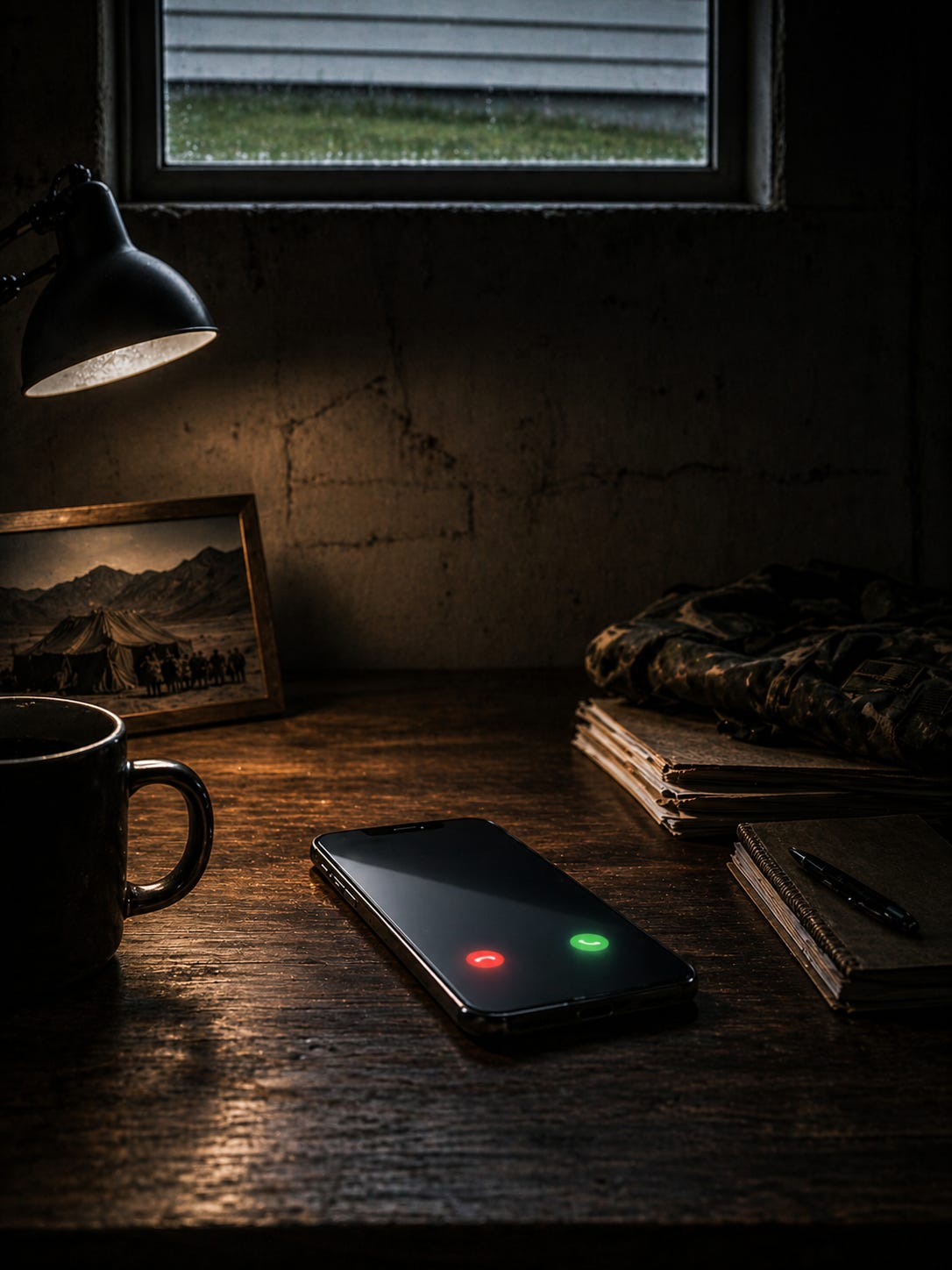
You sit at the desk in the basement corner you call your office. The window above it looks at nothing. Just a wedge of grass and the foundation of the neighbor’s house. The screen glows the pale blue of a thing that doesn’t sleep, and you have been staring at it long enough that your eyes have stopped registering the words. Behind you the house has settled into its night sounds. The refrigerator cycling. The heater ticking through the walls. A beam contracting somewhere over your head as if the house is trying not to wake anyone.
From the kitchen comes the smell of the chicken your wife roasted at six, garlic and rosemary gone cold on the stovetop, the kind of smell that means a family ate and a woman cleaned up and a man was not there for either part. Your daughter is asleep upstairs. Your son is asleep in the room across from hers. Your wife has been asleep for an hour. You can hear her breathing through the floor if you listen, and sometimes you do.
The phone lights up on the desk. It is your friend from before. From the unit, from the years you both ate the same dust in the Mojave desert, and slept under the same blanket of low grade stress. The screen shows his name and you look at it. You wanted to ask him whether he ever thinks about the young kid from second platoon platoon, the one with the sister, the one whose name you can no longer say without your throat closing. You wanted to ask him whether his father has died yet. You wanted to ask him if he was okay, which is the only question that has ever mattered between you, and which neither of you has ever once asked aloud.
You let it ring. You watch the screen go dark. The house keeps breathing.
In the morning you send him a text. Hey brother, saw you called. All good?
What you meant to say was that you have been sitting at this desk most nights for a year and you do not understand why. What you meant to say was that last week at the gas station you saw a kid who reminded you of the kid from second platoon, and you sat in the truck for twenty minutes afterward and could not turn the key. What you meant to say was that you have not heard your friend’s voice in eleven months and you are afraid the next time you hear it will be at his funeral service, and you will stand there in a suit you bought for someone else’s funeral and not know what to do with your hands. The text said none of this. The text was four words and a question mark, a green rectangle on a piece of glass. He sent one back an hour later. All good brother. You? You wrote Same. You put the phone down and went and made the coffee.
What was lost was the breath between the words. What was lost was the catch in his voice when he heard yours, the small involuntary thing the throat does when a man hears a man he has loved for twenty years. What was lost was the chance, the single chance, on a Tuesday night in October at twenty-three minutes past eleven, to be known by another man before the dark comes for them both. Two men can love each other their whole lives and never say it. What saves them is the hearing of it. And there is no hearing in a green rectangle. There is no breath. There is no man on the other end. There is only the silence after, which is the silence that will be there when one of them is gone and the other is left with a phone that does not ring anymore, and a question he never asked.
The phone call as the last unedited medium.
The dread is new. A phone rings on a desk at night and the person whose desk it is looks at it with the fixed expression of a man watching an animal he has not yet decided to feed. The name on the screen belongs to someone he loves. That is what makes the dread interesting. To be known by people who already know us, at a moment for which we have not prepared, is now the thing we are most afraid of.
We did not used to prepare. We just picked up. The voice came out of us with whatever fatigue or irritation or grief the day had left in it, and the person on the other end heard it and made of it what they would. Now we draft. Voice memos can be re-recorded until the catch is gone from the throat. Texts can be edited until they say the thing we wish we felt. The little green dot beside our name can be turned off, so no one knows we are home.
What we have built, over fifteen years and without quite meaning to, is a publicist’s job inside every friendship. We manage our image for the people who have watched us cry. We curate our availability for the people who held our children. The phone call is the last room we have not redecorated. This is why the ringing of it produces what it produces. This is why we let it go.
What we lost is rhythm.
Conversation has a tempo, which is to say it has pauses, and the pauses are where the meaning lives. A held breath before an answer means one thing. A laugh that arrives a beat late means another. The voice that drops a half step on a particular word, the cough that interrupts a sentence and then declines to finish it, these are the structures through which one human being learns what another human being is actually saying. They are also, almost without exception, involuntary. They cannot be drafted.
Text removes them, and what remains is the sentence stripped of its weather. We send messages over hours that would have taken twelve minutes by voice and carried, in those twelve minutes, the entire emotional truth of an exchange the texts will never approximate. What looks like a pause in a text thread is an absence. Someone has put the phone down. Someone is in a meeting. Someone is choosing not to answer yet because the appearance of immediacy is socially expensive.
A thread that ran across a Tuesday afternoon feels, in retrospect, like a long conversation. It was not a long conversation. It was a series of micro-performances separated by the silences in which we did other things. The twelve-minute call would have left us with the residue a real exchange leaves, the small ache of having been present to another person’s life. The thread leaves nothing. We scroll up the next week and cannot remember what we meant.
A commander walks the line at the end of a long day. He does not have a clipboard. He does not ask the questions a survey would ask. He stops at a man and looks at him, and the looking is the thing. He sees the weight under the eyes, the small tremor in the hand that holds the rifle, the way the shoulders have begun to carry something the man has not yet told anyone he is carrying. He asks how the man is and listens to the answer, and then he listens to what the answer did not contain. This is how morale has always been taken. Face to face, in the failing light, by a man whose job is to know which of his men is closer tonight to breaking than he was yesterday. You cannot do this over text.
A phone is a small thing on a desk. It rings or it does not. You answer or you do not. The choosing seems like nothing at the time. A man has only so many nights, and only so many friends, and only so many rings before the ringing stops. The window above the desk looks at nothing. The grass is the grass. The phone goes dark. The house keeps breathing.