I love Reddit. The discussion website Reddit.
I love it the way I love watching people at the airport after a flight gets canceled.
There’s this moment when the announcement comes through and everyone’s still holding it together, still performing their best selves, and then something cracks and you see what’s underneath. Reddit is that moment stretched out forever. It’s not quite Lord of the Flies because nobody’s eating each other yet, but it’s close. It’s what happens when you take people who’ve spent their whole lives learning how to sound smart in public and you give them anonymity and an audience and watch them try to figure out what they actually believe about something. Sometimes they surprise you. Usually they don’t. This is a story about what happened when someone asked a simple question on Reddit and nobody could answer it.
On December 4th, 2024, Brian Thompson, the CEO of UnitedHealthcare, was shot in the back on a Manhattan street. He died on the sidewalk.
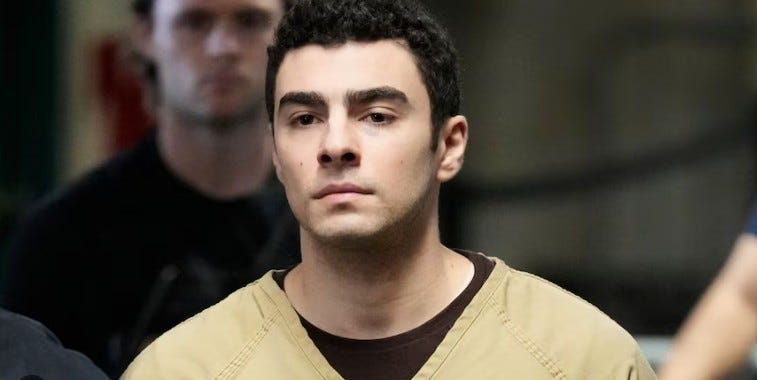
Five days later, police arrested a 26-year-old named Luigi Mangione at a McDonald’s in Pennsylvania. He was carrying handwritten notes that read like a deranged Martin Scorsese screenplay: “So what do you do? You whack the CEO at the annual parasitic bean-counter convention.”
Within hours, as the news spread that Mangione had been caught, Julia Alekseyeva sat down and recorded a TikTok video. Blue hair, hand on chest, that particular smile of someone who knows they’re being transgressive and expects applause for it. On the screen, she mouths along to a song from Les Miserables, the one about downtrodden soldiers rising up in battle. The text overlay reads: “have never been prouder to be a professor at the University of P3nnsylvania.”
Why was she proud?
Because Luigi Mangione graduated from Penn.
She saw the arrest. She saw where he went to school. And her immediate reaction was: this is the kind of person we produce, and I’m celebrating it.
On Instagram, she went further, calling Mangione “the icon we all need and deserve.”
This wasn’t some nobody with 47 followers working out their rage in a comments section. This was an assistant professor of English and Cinema and Media Studies at the University of Pennsylvania. One of eight Ivy League schools. An institution founded by Benjamin Franklin, where Supreme Court justices and cabinet secretaries and Fortune 500 CEOs send their children to learn how to think. Where the operating budget exceeds $10 billion and the endowment sits at $21 billion. Someone who teaches students about politics and morality. Someone who, two years earlier, had won the Dean’s Award for Distinguished Teaching.
She recorded the video late Monday night, right after the arrest. She added the text. She posted it. She posted multiple Instagram stories. This wasn’t a momentary lapse. This was a production, executed across multiple platforms, while the news was still breaking.
By Wednesday, she’d apologized. Posted on X that the content was “completely insensitive and inappropriate” and that she didn’t condone violence. Penn’s deputy dean issued a statement saying her remarks were “antithetical to the values of the university.”
But before that apology, before the blowback, there was that moment late Monday night when she decided to celebrate on TikTok. Not quietly, not privately, but as content. As institutional pride.
Someone posted Alekseyeva’s TikTok to Reddit, on a forum called r/Professors. The title of the post was a question: “Can we at least agree that this behavior is repulsive?”
Can we agree. That celebrating a murder. Is repulsive.
You would think this is the kind of question that answers itself. The kind where you scroll past because of course we can agree, what’s even the point of asking. But you would be wrong.
The top comment: “I really can’t be motivated to care about Libs of TikTok’s next target for a virtual lynching.”
Libs of TikTok is a conservative account that reposts videos progressives make about themselves. The formula is simple: find someone saying something absurd, repost it without commentary, let the audience react. The commenter is saying: don’t fall for it. This is just manufactured outrage. The real story isn’t that a professor celebrated a murder. The real story is that conservatives are attacking her for it.
Another: “Show me on the doll where the ‘Antifa’ hurt you.”
Another: “I’d question my views on the media’s portraying a wide-held sentiment as radical, myself.”
And then this one, which gets at the heart of it: “Why are you posting something from Fox on a forum for educated folks? We know better. Most of us.”
Here is what happened: The professor celebrated a murder. But the real problem, according to her colleagues, is that someone posted a Fox News link. The moral question dissolves into a question of tribal affiliation. Are you the kind of person who trusts Fox News? No? Then why are you even bringing this up?
One commenter writes: “Antifa lol where are we? 2018?”
Another: “So you are anti-antifa? ‘Pro-fa’ as it were?”
They’re doing a bit. They’re performing. And the performance is more important than the actual question, which remains unanswered: Is celebrating murder repulsive?
Someone finally tries to inject sanity: “This is not the ‘sort of educator’ who has made our students a vicious mess. Escort her and the rest of the Antifa clowns off campus, along with any other salaried employee who condones cold blooded murder.”
The original poster, JubileeSupreme, responds: “Checked the news lately? You might want to watch what buffoonery you align with.”
Even the person asking if we can agree murder is bad can’t help themselves. They have to signal: I’m not with those people. I know the healthcare system is broken. I’m one of the good ones.
And then someone named sophisticaden shows up with a story.
They worked in palliative care. They watched patients suffer for months, unable to get the medication they needed because insurance companies wouldn’t authorize it. Cancer patients. Dying patients. People in unimaginable pain, denied relief because some bureaucrat decided the cost-benefit analysis didn’t pencil out. “Everything from medicine for nausea to pain to actual life-saving, life-preserving treatments. Patients suffered for months sometimes, unable to get the only medication that would actually effectively treat their pain.”
It’s a powerful story. It’s also completely irrelevant to whether a professor should celebrate a man getting executed on a city street.
But that’s not how it functions in the thread. It functions as a trump card. Now anyone who wants to say “celebrating murder is wrong” has to navigate around this grief without seeming callous. The personal testimony becomes a moral shield. You can hide behind someone else’s suffering and never have to answer the question.
Another commenter jumps in: “Yeah! Denying people’s insurance claims resulting in them suffering and dying early is wrong.”
Someone else: “I think it’s worth questioning an ethics that only condemns a single act of killing, while essentially handwaving an entire industry predicated on slow, mass death.”
Do you see what’s happening? They’re not wrong about insurance companies. But they’re using structural critique as a permission structure to avoid moral judgment about a specific act. The move is: I can’t condemn this individual thing because it would imply I’m defending that systemic thing.
These are professors. People who teach critical thinking for a living. And they can’t distinguish between “the healthcare system is predatory” and “celebrating murder is wrong.” They treat these as mutually exclusive positions.
Here’s what makes it perfect: Julia Alekseyeva is an expert in antifascism and the radical politics of the 1960s. Her first book is about the French avant-garde and leftist documentary films. She’s written about how filmmakers in that era tried to “join personal and political struggle,” how they saw their work as “engaging explicitly in an everyday practice of antifascism.”
Those filmmakers believed art could expose structural violence. They thought you could change the world by making people see it differently. They used documentary, memoir, experimental narrative. They built arguments. They created consciousness.
Julia Alekseyeva teaches a course called “Graphic Memoir: Between the Political and the Personal.” The whole premise is about how individual experience can illuminate broader injustice, how personal narrative intersects with political consciousness.
But when she goes to make her own political statement, she doesn’t write a memoir or create a documentary.
She does a TikTok that says: I’m proud a guy got murdered.
She’s also written about her grandmother’s life in the Soviet Union. Which means she’s presumably familiar with what happens when revolutionary ideology becomes a justification for treating individual human lives as expendable in service of the greater good. Her grandmother lived through a system that rationalized mass death as necessary for progress.
And here’s Alekseyeva, three generations later, doing the same calculus. But calling it antifascism.
The irony is so thick you could choke on it.
There’s a philosopher named John Rawls who spent his career thinking about justice. Not justice in the abstract, revolutionary sense, but justice in the sense of: how do we build a society where people can live together without tearing each other apart?
He proposed a thought experiment. Imagine you’re designing a society, but you don’t know what position you’ll occupy in it. You don’t know if you’ll be rich or poor, healthy or sick, powerful or vulnerable. You’re behind what he called a “veil of ignorance.” What principles would you choose?
Rawls argued you’d choose principles that protect the most vulnerable, because you might be one of them. You’d want a system where even the worst-off have dignity and access to what they need to live. You’d want institutions that serve human flourishing, not just profit.
The American healthcare system fails this test spectacularly. If you’re designing society from behind the veil of ignorance, you don’t create a system where insurance companies profit by denying care. You don’t make it so that whether you live or die depends on whether some algorithm decides your treatment is cost-effective.
But here’s what Rawls would also say: you don’t fix that system by shooting people in the street. Because once you decide that murder is an acceptable tool for political change, you’ve abandoned the very framework that makes justice possible. You’ve said that might makes right, that violence is legitimate when you’ve decided someone deserves it.
And who decides who deserves it? You do. Or Julia Alekseyeva does. Or whoever has the gun and the conviction that they’re on the right side of history.
I didn’t say any of this. John Rawls did. The man who witnessed, firsthand, the impact of the atomic bombs on mainland Japan, and walked the streets of those cities, and listened to the undead beg for water.
And then came home and did his best to translate the language of our Founders into a message of dignity for all human beings. To see a rich white man, and a poor black man, and not see a difference worth naming.
Rawls understood something the professors in that Reddit thread don’t: you can’t build a just society atop the carnage of murdered bodies, no matter how morally satisfying it feels in the moment. Because the logic that justifies killing Brian Thompson is the same logic that justifies killing anyone you’ve decided is an oppressor. And once that starts, it doesn’t stop. It metastasizes.
The veil of ignorance asks you to consider: what if you were Brian Thompson’s child? What if your father was the one bleeding out on the sidewalk while strangers filmed it for TikTok? What principles would you want the society around you to uphold?
You’d want them to say: this is wrong. Straightforwardly, without qualification, without hedging. Murder is wrong. Even if the victim worked in a broken system. Even if that system causes immense suffering. Even if you’re angry about it.
Because the alternative is the world those professors are building in that thread: one where moral judgments are always contingent, always qualified by power analysis, always subordinated to the question of whose side you’re on. This is what is meant by the word “tribalism”, and that word, when employed correctly, means something very different from what many liberal arts professors think it means. It’s not a MAGA dog whistle.
Let me tell you what actually happened here, stripped of all the academic jargon and political posturing.
A man was murdered. His children will grow up watching that murder replayed on their classmates’ phones. They will hear their father described as a parasite, a mass murderer, someone who deserved what he got.
And a professor at an elite university decided this was something to celebrate. Not quietly, in a moment of poor judgment, but publicly, as content, as a performance of political courage.
When her colleagues were asked if they could agree this was repulsive, half of them couldn’t answer the question. They pivoted to healthcare policy. They pivoted to Fox News. They pivoted to whether caring about this makes you pro-fascist. They did everything except say the simple true thing: yes, this is repulsive.
This is what happens when your entire moral framework is built on identifying oppressors and your entire social world rewards you for identifying them correctly. You lose the ability to make simple moral judgments about individual acts. Every judgment becomes a referendum on whether you’re appropriately radical about the right systems.
The healthcare system in America is a disgrace. It is shaped by a political and economic system that prioritizes profit over human life. Both parties have failed. Lobbyists have captured the legislative process, which is the mechanism for reining in corporate avarice. The mechanism is not to expect a slide titled “The Moral Question” to be slipped into a board of directors slide deck by people operating within a system that incentivizes the role of the fiduciary and not much else. And so people die because they can’t afford care. People suffer because insurance companies deny claims.
All of that is true. And none of it justifies murder.
These are not contradictory positions. They are the bare minimum of moral coherence. You can believe the system is broken and should be rebuilt from the ground up. You can believe CEOs profit obscenely from human suffering. You can believe the whole edifice is rotten.
And you can still believe that shooting a man in the back on a city street is wrong.