People sometimes ask why I return to these accounts.I don’t return to them. They return to us.
Men and women encounter things that do not ask to be believed. They arrive in the night, or in still rooms, or in the quiet hours when the mind has lowered its guard. Whether the cause is body, mind, or something not yet named is a secondary concern.
What matters is that they happen.
They leave people altered. They rearrange what can be said aloud and what must be carried alone. No argument has ever prevented their arrival.
I record them for the same reason one records weather or war. Not to explain them, and not to redeem them, but because they pass through human lives and leave evidence behind.
They vary in circumstance, but they speak in the same images, the same movements, the same small vocabulary of the uncanny.
The debates will go on. The explanations will multiply. The dismissals will grow more confident.
It makes no difference.
They come all the same.
As for this next one, he told me his story and asked that his name be left out of it. It was never his name that mattered.
I. The Night the Sky Looked Back
He’d heard it as plainly as if someone had spoken beside him: Go outside. Look.
The voice wasn’t loud or strange; it carried the calm authority of instinct, the kind that doesn’t ask to be believed. So he put down what he was doing, pulled on a coat, and stepped into the night.
The air was cool and still. The world felt paused. Across the street a security light hummed against the dark, scattering across the moisture in the air. The neighborhood was asleep, windows dim, dogs quiet. And then he saw it, something low over the trees, gliding without sound or purpose.
At first it seemed like a trick of depth, a light out of place. But it wasn’t moving like a plane, or a drone, or anything else that belonged to the familiar inventory of the sky. It was just there, suspended. He squinted.
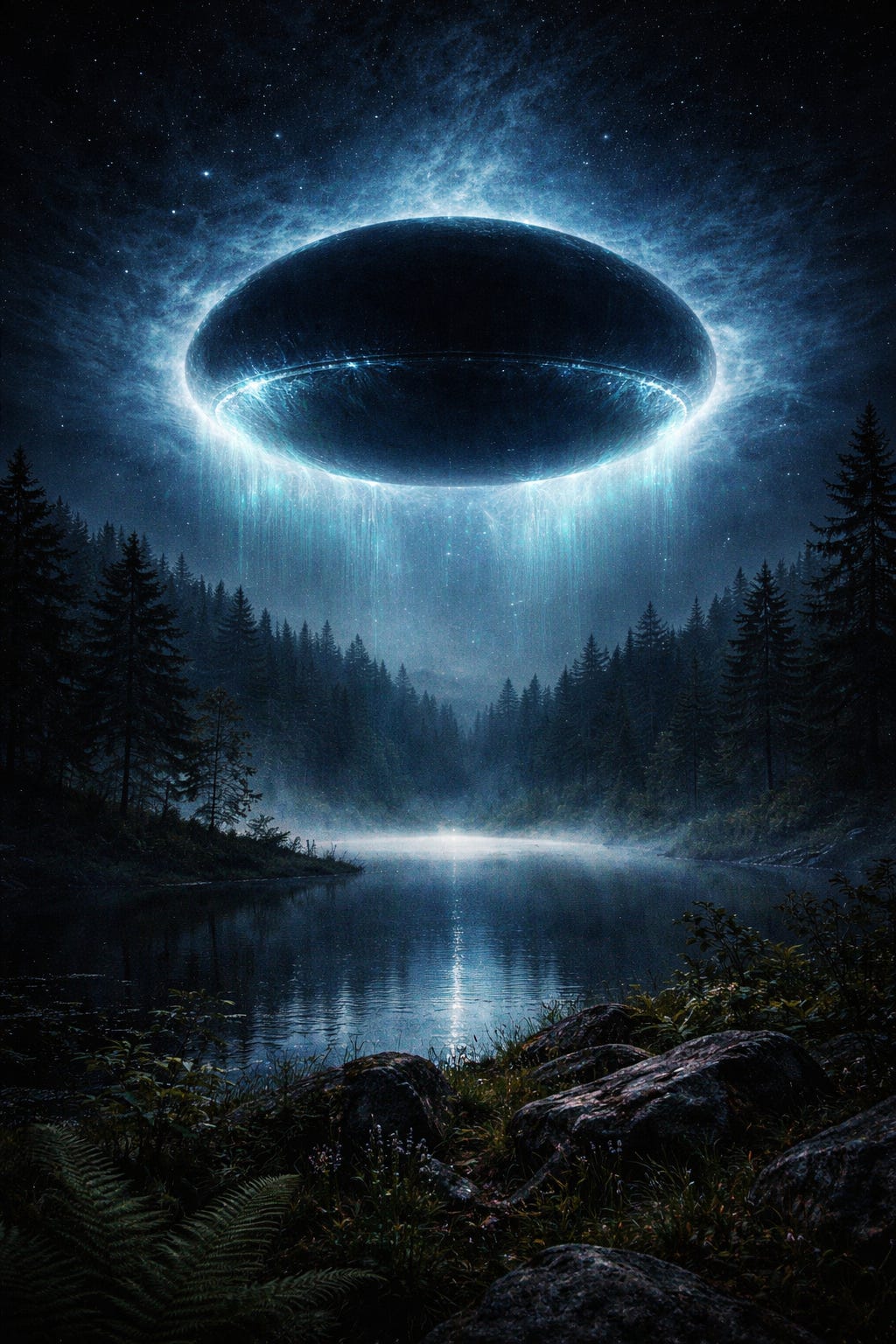
It was roughly spherical, too clean for cloud, too fluid for metal. The air around it bent, as if the object were bending its own pocket of atmosphere. It was blacker than black, an oval shape that swallowed the sky around it. Along its edges, the light refracted and fell away, as if refusing to touch what it did not understand. His body made the decision before his mind did – he stepped toward it.
The instinct was not curiosity so much as recognition. A quiet, almost cellular understanding that whatever it was, it was aware of him. That thought brought with it a pulse of heat under his skin, a rising sense that he had entered into something that did not usually include him.
And then it turned.
No sound nor beam, only the black thing, stark against the spent light of the world, drawing a slow breath from the night. The light of the streetlamp bent off it and died. His mouth went dry.
The thing regarded him with no eyes. The world shrank to the size of his pulse. For a moment he thought it would vanish and leave him doubting. But it did not vanish. It came closer, slow as thought, until the air thickened around him and his breath caught in his chest.
He couldn’t breathe. Couldn’t move. His vision broke, flickering once like a reel that jammed, the frame blistering before it went dark.
The sky is looking back, he thought.
He closed and re-opened his eyes, and the night was still. The streetlight hummed, the air sharp and thin. For a long moment he saw nothing but the trees, the quiet roofs, the air raw with mud and pine.
Then he found it again, drifting upward over the firs, only a few hundred yards away.
It didn’t hurry. It rose the way mist lifts off a lake at dawn, slow and certain, turning smaller as it climbed. No sound or trail, and just a dim pulse fading through the cold. He watched until it was gone, until even the shape of it had been taken back by the sky.
When the sky resumed its silence he remained, waiting for the vastness to take him and it would not.
II. The Man Who Didn’t Mean to Leave His Body
Six months earlier.
He worked in guns, though not in the way that left powder burns on his hands. He moved numbers, supply chains, quarterly forecasts.
When people asked what he did, he’d answer too quickly, as if speed might soften the sound of it. The men he worked beside had seen combat; their laughter carried the easy shorthand of people who’d once depended on one another to stay alive. He hadn’t served. That absence sat in him like a lodged round, invisible but heavy.
In Canada, the winters came early and refused to leave. Snow stacked on the edges of parking lots until it turned black with exhaust. Nights were long and clean. The quiet pressed against the windows like another kind of weather. From his house he could see the lake, flat and gray, the surface still enough to mistake for steel.
He would sit on his living room couch after work with a drink, the laptop glow washing his face, toggling between spreadsheets and old intelligence files – projects where men claimed to see beyond walls and oceans. Remote viewing, they called it: a discipline born of the Cold War, when governments believed the mind might be coaxed into a new kind of vision. It required only coordinates, focus, and the strange humility of believing that distance was an illusion.
Practitioners described it not as seeing, but as remembering something that was always known. It suggested that the mind was porous, that perception could reach past the body’s borders the way scent drifts through an open door. To read about it was to feel both awe and embarrassment; the mix of emotions that arises whenever human beings dare to name the mystical.
The idea was half ridiculous, half desperate. Like a man who sold guns for a living trying to prove the soul had range.
He came to it through fatigue, not faith. Through the slow awareness that he’d built a life of safety and still felt hunted by restlessness. He wanted something to answer back. And yes, he was curious.
As a child he’d been the quiet one in rooms that were too loud. The boy who read adults like barometers, who could tell when a fight was coming by the pitch of his mother’s voice. He’d grown up learning to stay still, to absorb, to survive on information that no one else admitted was there. It was not fear that made him that way. It was rebellion of a gentler kind – the refusal to become as dull as the people who never seemed to notice anything.
Years later, the same kind of watching returned. He began tracing coordinates, sketching what his mind saw before his eyes could argue. He found the discipline comforting. It demanded stillness, the one thing he’d practiced since childhood. He tried not to force it. The harder he tried, the less he saw. When he stopped caring whether it worked, shapes appeared – lines, triangles, arches that seemed to form themselves.
He followed the instructions exactly: date, target number, impressions. When he compared his drawings to the hidden photograph – a cylinder, a pattern of diamonds, the archways repeating – it felt like falling through the floor of logic.
He didn’t shout or smile. He just sat there, the pen still in his hand, listening to the clock tick. The world was suddenly larger and more delicate, like a thing that might break if he breathed too hard.
Outside, it was summer in Calgary, the air warm still, carrying the smell of sun-baked earth. The lake lay smooth and gray-green beneath a sky that refused to cool. The wind came across it in slow waves, lifting the scent of dust and grass.
He closed the blinds. The room went dark except for the computer’s light.Somewhere inside that silence, he felt the old sadness rising again, the kind born not of loss but of knowledge. The sense that he’d glimpsed a door he wasn’t meant to open, but he couldn’t unsee what was inside.
He poured another drink. The ice broke with the clean finality of a bolt sliding shut. He thought of the veterans’ laughter, the clatter of rifles on metal tables, the easy confidence of men who’d seen enough to stop asking questions. He envied them less than he used to.
Because he had begun to see things, too. Not the kind you carry on your back, but the kind that turn toward you in the dark.
III. Learning to See Without Eyes
He started keeping the curtains drawn even during the day. It wasn’t secrecy, exactly, and more like containment. The light outside felt too loud now. Inside, the quiet had shape, with edges he could move against.
He began every session the same way: the notebook open, the pen aligned just so, the air still enough that he could hear the pulse in his ears. He would slow his breathing until the room seemed to exhale with him. The first few minutes were nothing but noise, like the mind clearing its throat. Then the static would thin, and pictures started to rise like fish breaking through dark water.
He never knew if they were coming from him or to him. It didn’t seem to matter.
The images arrived half-formed: a triangle with its point bent sideways, curved lines that pressed into cylinders, smoke or water or something between the two. Sometimes there was movement in what he saw, a sense of wind, a feeling that whatever he was tracing wasn’t still long enough to be caught. He learned not to chase it.
He kept seeing the black pyramids. They came to him in that half-place between waking and sleep, clear as architecture. There was always a white gleam at the peak, a capstone that caught light from nowhere. He didn’t think of them as symbols, not really, more like memories from a place he hadn’t been yet. They had the stillness of monuments and the certainty of things that don’t care to be understood. What unsettled him most was how ordinary they began to feel, like something that had always been there, waiting for him to notice.
The moment you reached for it, it fled.
He wrote down everything: words that made no sense, impressions of temperature, flashes of color that disappeared when he blinked. Some sessions left him queasy, his skin cold and his stomach tight, as if he’d stood up too fast. He would lean over the table, waiting for the floor to stop moving.
He started comparing sketches to the target photographs as soon as they were revealed. The matches were never perfect, but they were close enough to break something open inside him. A pattern here, a curve there. The kind of resemblance you couldn’t dismiss without lying to yourself.
He told no one. The moment you said it aloud, it sounded like madness. But when he was alone, studying those lines, it didn’t feel crazy. It felt like he’d stumbled into the small overlap between the world that was measurable and the one that wasn’t.
After a while, he noticed his hearing had changed. He could sense hums in the house – the fridge, the lights, the almost-silent hiss of electricity in the walls. The air felt crowded. At night, lying in bed, he would stare at the ceiling and feel something moving just beyond vision, something waiting for him to notice.
IV. Into the Hollow
Spontaneously one night after a remote viewing session, when he was somewhere between asleep and awake, he saw something new: an orb.
A flash – black and curved, hovering against the inside of his eyelids. He thought it was just the usual blur, the brain firing shapes for attention. But it didn’t fade. It steadied. He followed it, letting the rest of the world fall away.
The blackness deepened until it had texture. Something iridescent shifted within it, colors that shouldn’t exist in air. It pulsed once, as if aware of being seen.
The thing turned.
Later, when he tried to describe it, he would say it didn’t have a face but somehow still looked at him. He’d never known before that looking could be mutual.
For a moment he forgot to breathe. The air thickened. His chest seized. The shimmer went from transparent to matte, from liquid to metal, from distant to consuming. His body locked. The sound in his head flattened to a single low frequency, like the hum of power lines at night.
He didn’t fall asleep, nor did he wake up. He just wasn’t in the room anymore.
He would remember the sound first, though it wasn’t a sound in the ordinary sense. It was pressure moving through silence, a vibration that hummed in his ribs and the table beneath his arm. Later he would try to describe it and fail; language was made for things that hold still, and this thing hadn’t.
The air pressed closer, the edges of the walls bending as if heat were warping them. The orb steadied. He found himself following it, not with his eyes but with something deeper, the way you follow movement at the edge of your vision. The harder he focused, the clearer it became.
It was there now – close, definite – a dark sphere floating in front of him. It shimmered like gasoline drifting over dark oil, color and shadow folding into one another. Colors rolled across its surface shifting even as he tried to fix on one. His breath caught. He leaned forward without meaning to, chasing the shimmer as though he might see behind it. The thing responded, almost imperceptibly, turning toward him.
It hung in front of him like a thought made visible, dense and alive. Not gas, not metal, not light, but something between, a form the human mind hadn’t yet learned to name. It was an orb, and it was real, and for a moment he had the terrible certainty that it had been waiting for him all along. He wanted to turn away, but curiosity had already made its claim on him.
He realized, with an almost clinical detachment, that the thing was studying him. The way the tide studies the shore - patient, unending, changing it without meaning to.
It began to move toward him. Slowly at first, then with the kind of inevitability that suggests choice is an illusion. The shimmer thickened into gray, the surface rippled, the edges went soft. The air between them grew dense and particulate, as though it were turning solid from the pressure of its own attention.
When it reached him, the boundary of his skin ceased to matter. He couldn’t tell where his body ended and it began. Every nerve felt suspended, unmoored. His breath stopped midway up his chest and stayed there.
The orb enveloped him all at once and he was soon inside a craft that looked as though it were melted from wax. Benches, tables, something resembling an instrument panel - each seamless, as though machined from a single slab of material.
First, he saw a face, which was pale and hard and without grace. The eyes were slits cut clean into the bone, black as spent coals. It might have been carved from stone or from something older than stone. There was no hatred in it, only the stillness of a thing that had outlasted both gods and men. It looked neither alive nor dead, only efficient. An expression made for watching, not for feeling. There were more beings behind the first one he saw, but they appeared preoccupied, standing before some sort of control panel. Some were close enough to feel, like heat on the back of the neck. Others hung far off, cool and ancient. None of them was kind. They studied him the way a farmer might watch a snake in the feed shed – curious, alert, faintly disgusted.
He felt the judgment in them, the cool, dead certainty that he’d trespassed somewhere sacred. It was like wandering into a place that wasn’t built for him, a homeless man stepping into a fine restaurant, the silverware already laid, the air perfumed with something expensive and unnamable. No one shouted or threw him out; they simply looked, the music going on as before, the kindness gone from their eyes. And somewhere behind that silence was a voice, not spoken but understood: You’re not supposed to be here.
The sense of being caught kept returning. He didn’t feel afraid. Not quite. He felt accountable.
Then came the jolt.
Not pain, but a rearranging of matter around the axis of his awareness, like the earth turning beneath a man who believes he’s still.
He was back in his bedroom. His body felt like borrowed equipment. The air trembled with the memory of something vast retreating. He could still see the afterimage of the sphere in the corner of his vision, fading like heat from metal.
On the table lay the open notebook, the page half-filled with the line that had started it all. His hand was shaking. He wrote without thinking, trying to hold the experience still long enough to translate it into words before it decayed. But already the details were dissolving, the ripples flattening, the sense of presence pulling back into abstraction.
He wrote faster.He wrote as if memory itself were a living thing trying to escape him.
After he put everything he could recall on paper, the words looked like the notes of a fever. He read them again and felt the growing certainty that he hadn’t imagined it. There was an intelligence on the other side of perception, and for a few moments, it had turned its gaze toward him.
The next morning, the lake was bright with morning glare, its surface flat as glass beneath a pale sky that seemed unchanged. But the world had already split. One version went on as before, with the spreadsheets, the emails, the polite small talk about weather. The other stayed here, in the thick, humming quiet of the room, where the air itself seemed thinner, as if reality had loosened just enough to let something else through.
He couldn’t explain it. But he knew this much:Whatever he’d touched wasn’t waiting to be found.It had been waiting to be noticed.
V. The Blue Woman and the Knowledge Sphere
This happened a few months later.
He was in bed, but it felt as though his consciousness detached from his body. It wasn’t a dream. But what he saw also wasn’t here, in the reality we mostly understand. He could still sense his body in bed, but his mind stood in another place entirely. The ground was soft, dark, faintly reflective, like wet obsidian. The air pulsed with a blue light that seemed to breathe with him.
Then she appeared.
She was tall – twelve feet, maybe more – her body elongated and elegant, her skin the color of glacial light. Her face had no lines, no sharpness, only the soft geometry of calm intelligence. The great almond eyes held no whites, only pale blue depth that seemed to stretch forever. There was no movement of lips, no muscles to suggest emotion, yet he could feel her expression – maternal, knowing, immeasurably patient.
A sense of communion replaced fear. She radiated something like love, but broader than love: an all-encompassing mercy that made him want to weep without knowing why. It was the feeling of being seen by something that had no use for judgment. It was a love without transaction, without the small print that governs human affection. What passed between them contained no ownership, no need to be returned. Our own love, so often freighted with fear and expectation, seemed crude by comparison, an echo of something purer. What he felt then was an absolute regard for sentient life itself, a mercy stripped of purpose or desire. It was love not as emotion but as element, bright and formless, the white light from which all feeling is made.
There was sorrow in her too, and it was old. Not the weeping kind but the kind that endures when all tears have gone to ground. The kind of grief that was no longer loud and pleading, but had learned to breathe on its own. It was the look of one who has buried what she loved and kept walking. He recognized it distinctly.
When she moved, the air rippled as though she were made of the same substance as the light around her. She turned slightly, and beside her grew a plant unlike any he had seen.
The blossom rose to his waist, broad-leafed and pale, the color of bone dipped in moonlight. Its petals were wide and translucent, trembling as if stirred by an unseen breeze. Each petal shimmered with faint veins of gold light that pulsed gently, breathing in rhythm with the room. The plant seemed alive in the truest sense – not decoration nor symbol, but a being. She ran her hand across a few of the petals, as one might calm a beast of burden, the gesture older than speech.
At its center, resting within the petals, was something brighter – a sphere of light, white at first, then softening to amber as it spun. It was as though the plant itself had grown the thing the way a tree grows fruit.
She lifted one long hand. The sphere rose to her palm. He felt its hum before he heard her voice. It wasn’t sound, but meaning: Knowledge.
The word appeared in his mind as text, bright and silent. Then another: Consume it.
He hesitated. The sphere began to shrink, compressing itself until it was no larger than a golf ball. He held it in his hand, felt it vibrate like a living pulse, and – without knowing why – swallowed it.
The light vanished. For an instant, all was dark. Then came a rush – not sight, not sound, but a widening inside his chest, a kind of remembrance. He felt suddenly aligned, as though every thought he’d ever had had been rearranged into a more perfect order.
She watched him, still and radiant. Her eyes conveyed what words never could: Everything you need is already within you.
He understood then that she hadn’t given him knowledge as an object. She’d shown him how to remember it.
The cavern brightened, walls rippling with faint veins of light, and she seemed to recede, dissolving into the color she’d been made of.
When he woke, the dark of the room felt fragile, like the residue of another world. His mouth still held the faint taste of ozone and salt. Something had been given, something impossible to return.
And as he sat upright, trembling with the enormity of what could not be proved, one thought remained – clear, unshakable, holy in its simplicity:
She had placed knowledge inside him, not to keep, but to remember.