We talk about autism as if it were a single thing, when it’s really an argument between biology, identity, suffering, and love, carried out inside real lives. People are always trying to define it, but it resists definition in the way lived things often do, by changing shape depending on where you stand.
It’s far more common than it used to be. In 1980, it was estimated to affect roughly one in 10,000 children. Today, the most reliable data puts that number closer to one in 36. Something has clearly changed.
The reasons for that increase are argued about loudly and often. Genetics. Environment. Diagnosis. Awareness. Fear. Certainty, traded too early by people who needed an answer more than they needed to be right.
All of that exists, and all of it can wait.
Autism is frequently defined, and almost always inadequately. It eludes definition not because it is vague or unknowable, but because it is plural. It doesn’t exist in isolation, but in the lives it rearranges.
What I want to do instead is try to explain what autism feels like. At least one version of it, as best as I can describe it from the outside. This is version my son lives in. The nonspeaking kind, where language arrives late, if at all, but attention and feeling arrive right on time. He’s seven years old, and this was his morning today.
You wake before anyone calls you. January light comes in thin and blue, like it has traveled a long way to reach your room. The house is still behaving. That’s good. You stay put and take attendance of the safe sounds. The heat clicks on, doing its job. A car goes by out front, not interested in you. The refrigerator hums downstairs, loyal as ever. Nothing unexpected.
Your body takes a moment to arrive. Hands first. Then feet. Then the rest. You sit up and feel the air on your face. Cold enough to notice. Not painful. You like noticing.
Downstairs, the kitchen is already awake. The bowl is waiting. Oatmeal, steam rising, the surface mapped with small soft hills. Mom moves carefully, because she has learned that the morning has a shape and that shape can be broken. She places the bowl in front of you. Spoon on the right. Always on the right.
You eat slowly. Oatmeal is reliable. It tastes the same each time, which is a sort of kindness. You rock a little while you chew, the way you do when things feel manageable but close to full. Not much. Just enough to feel where your body is. Mom watches without watching. She has learned how to look sideways, it seems.
When you are finished, she wipes your mouth and says it is time to go watch TV. Fifteen minutes on the YouTube app on the living room TV with child settings. She says the number of minutes out loud, clearly.
Numbers……help hold the world still. You sit on the couch, and bright shapes drift across the screen. Characters built for much younger people sing their careful songs. You know every one by heart. When a part comes on that works for you, you rewind it. Once. Then again. And again. And Again. The voices are sharp….but they keep their promises. You settle yourself into the rhythm and let it do the thinking for you. For a few minutes, the world agrees to make sense in exactly the same way each time.
Dad tells you it’s time for school.
“No, Daddy,” you say, not loudly. Not upset. Just a boundary.
Dad nods once and walks away. There is no…tension in it, though. The moment is allowed to pass.
Just a few seconds later, mom says, “Time for school, Teddy.”
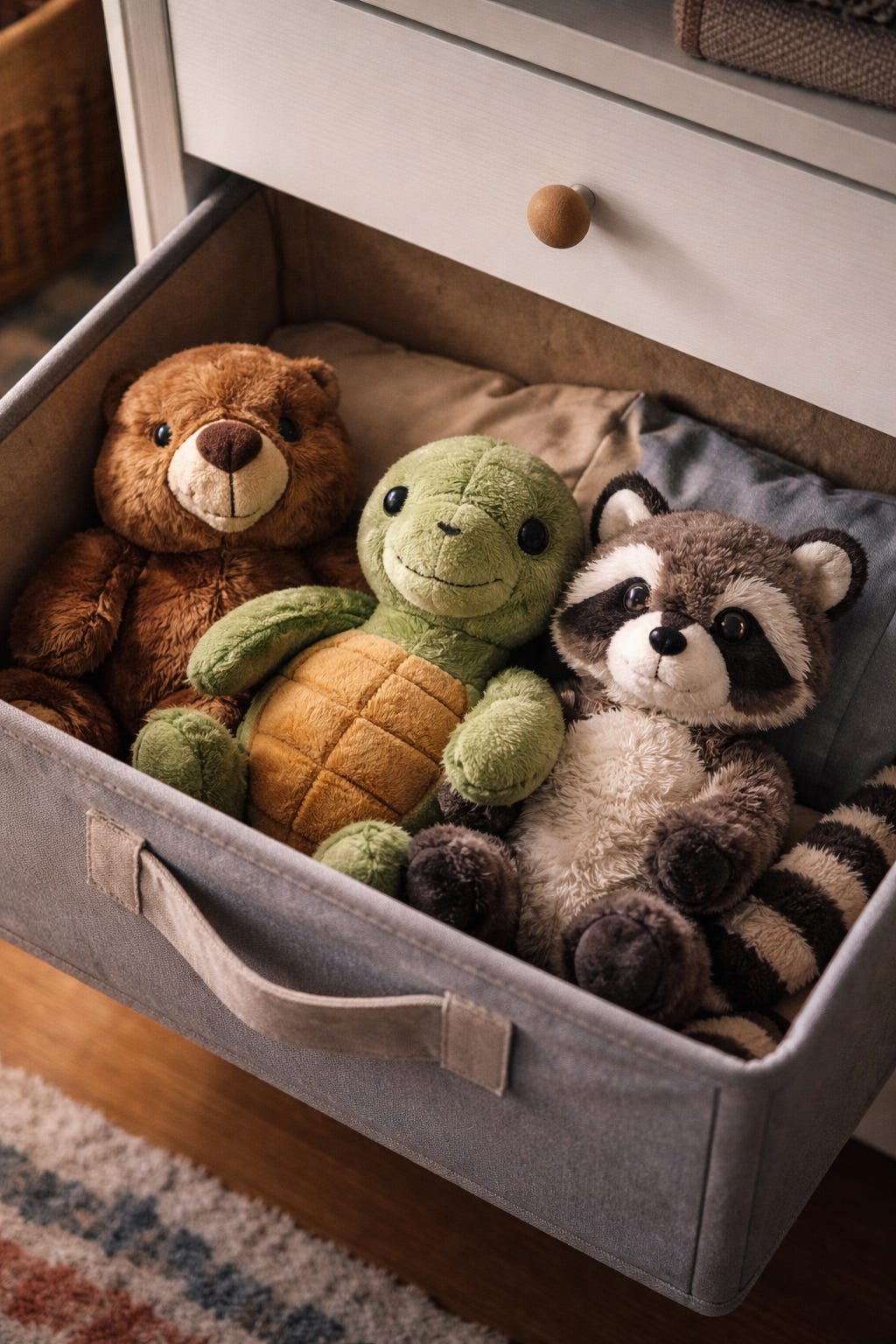
Her words land gently. But they land. Your central nervous system kicks into action without delay. Oh…Time to get a move on, for real this time. You cross the room and pull the soft fabric drawer from the play dresser, the one that sags a little in the middle. Inside are the important ones. You do a quick inventory. Raccoon. Beaver. Turtle. Not the exact animals from the Franklin books, but close enough to count, which matters. You adjust them so they’re comfortable.
All present. Good.
Now there is nothing left to delay. You scoop up the cloth drawer, as you do every morning, so you can keep an eye on them as you get dressed. School will happen whether you are ready or not…[pause] but you prefer to arrive ready.
You pause the video yourself before leaving the living room. That matters too. Halfway to the stairs, you turn back. You remember something important.
You know what you want to say. It’s simple. It has been waiting.
Your snack is still on the counter. You can see it. Pear. Almonds. The bag unsealed. You need it closed. You need it ready. The thought is complete in your head.
You turn to Dad and try to send it out.
Words form and disintegrate before they reach your tongue. You feel it pressing forward, asking for more space than your mouth can give. You open your lips and nothing comes. Time stretches. Dad leans in closer. You hate the waiting.
Your chest tightens. You try again. “Snack, please” you manage, and even that costs you. The word lands heavy, like it used up something you were saving. You look at me hard, willing the rest across the gap.
Dad says it for you. “I know, bud. I’ll get it ready.”
You nod, relief washing through you, sharp and brief. The thought is gone now, spent. The world has moved the way you needed it to. But the words cost you something.
Upstairs, your clothes are waiting. Shirt. Pants. Socks. Laid out in order, like instructions you can trust. You touch each one before you put it on. Proof that they are real. Proof that they have not changed overnight.
The car is warm when you get inside. Your father drives the same way he always does, past the same trees stripped bare for winter, their branches drawn dark against the pale sky. You watch the road, not because you care where you are going, but because movement helps you think. Your father’s hand finds yours at a red light. You let it stay.
At school, the building rises up quickly. Brick. Glass. Flags snapping in the cold. The doors open and sound rushes out. Children. Voices. Shoes scraping. A voice louder than the others greets you by name. The principal means well. The volume still hits you like a wave. You lean slightly into your father’s leg. He stays until you are steady.
You go in balanced on that narrow place where readiness and overwhelm touch, hoping the world will meet you gently.
The principal crouches down in front of you, smiling, voice loud with welcome. He says your name twice, the second time bigger than the first. He asks a question and waits.
You know the answer. It’s in there. But his face is close and the hallway is echoing and the question has too many edges. You look past him at the doorframe instead, counting the chips in the paint. One. Two. Three.
The silence stretches.
He laughs gently, mistaking the pause for shyness, and pats your shoulder. The touch comes without warning. Your body jerks back before you can stop it.
Everyone freezes for a second. Then the moment is smoothed over. Someone says it’s okay. You are guided forward.
You walk on, feeling the small, exact wrongness of it settle inside you, knowing you did not mean to refuse, and that it will look like you did. You want to fix it, but it’s too late.
You take a long, slow breath just before the threshold to your homeroom. You let it out through your lips, feeling them tighten as the air leaves you.
You step into the room carrying what cannot be put down.