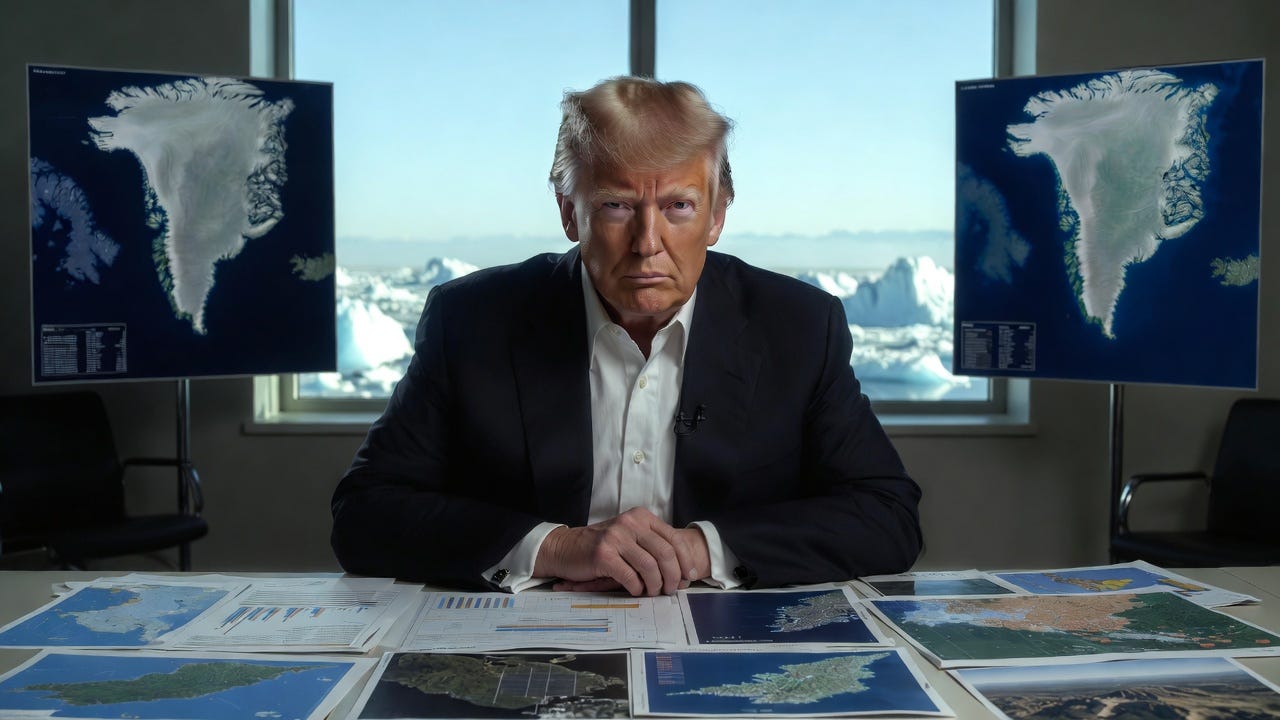
In this episode, I try to do the calm, slightly sheepish thing that feels increasingly rare, which is to pause for a moment and ask what’s actually happening before deciding what to feel about it. Using a small, unpretentious framework meant mainly to preserve my blood pressure, I walk through the recent Greenland episode, looking past the surface noise to the strategic realities underneath, and then to the deeper shift in how power is being described, claimed, and justified. Along the way, we talk about alliances, trust, and the quiet damage done when long-term relationships are treated like short-term leverage. It’s an effort to slow the moment down, to separate confidence from wisdom, and to ask whether the future being outlined in careful language and glowing maps is one we would still choose if we were thinking past the end of the week.
FULL TRANSCRIPT (since Peter asked for it): Before we begin, I should probably admit that this is not my first time trying to understand a Trump foreign policy decision by staring at it for a while, tilting my head, and thinking, Well. That can’t possibly be the whole story.
Because experience suggests it never is.
So, over time, I’ve developed a little framework. Not because I enjoy frameworks. I do not. I would rather be petting a dog. But because with an administration this casually dishonest, a framework is sometimes the only thing standing between you and a full day of yelling at your phone.
The framework is very simple.
First: what is actually going on.Not what was said. Not how it was framed. But the underlying situation that existed before the announcement, back when people were still using full sentences and inside voices.
Second: what is the Trump public-facing narrative.Which is usually streamlined, emotionally satisfying, and engineered to make you feel like something decisive is happening, even if the details remain politely offstage.
Third: what are they really saying behind closed doors.Meaning the conversations where no one is performing. Where the maps come out. Where the tone changes. Where the jokes stop being funny.
And finally: what does it all mean.Not just for this particular headline, but for how we now operate as a country. How we talk about power. How we treat allies. How comfortable we’ve become with the gap between reality and its press release.
This is not a clever framework. It is more like a flashlight you keep by the bed. Not elegant, but useful when the lights go out.
And with that in mind, it’s probably time to talk about Greenland.
Because one morning we wake up and discover that the United States of America is, apparently, interested in buying it.
Buying it.
Which is odd, because most of us last encountered Greenland in roughly seventh grade, as a large white shape on a classroom map that our teacher assured us was “very cold” and “not actually that big in real life,” and then we all moved on to learning about Peru or mitochondria or whatever.
Greenland, as a concept, has mostly existed for us as a kind of honorable blank space. A place where the rules of our normal thinking don’t fully apply. Ice. Silence. A few brave people. Dogs that look like they could survive a nuclear winter. End of list.
And then suddenly it’s on the news. The President is talking about it. People are asking, with varying levels of sincerity, whether it’s legal to buy a country.
You can almost feel the collective American brain doing that thing it does when it hasn’t quite caught up yet. Like when your phone autocorrects a word into something insane and you stare at it for a second thinking, No. That can’t be right.
But here’s where the laughter starts to thin out.
Because under the joke is a seriousness that refuses to go away.
It turns out Greenland is not just a big white shrug on a map. It’s a place with radar systems and shipping lanes and rare earth minerals. It’s a place where the ice is melting, which means the future is showing up early, like an uninvited guest who knows too much about you.
And at some point, usually mid-chuckle, you realize:
Oh.
This isn’t random.
The joke arrived first. The strategy arrived quietly. And now they’re sitting together at the same table, smiling at us.
Which is where the tone has to change.
Let us be precise.
The United States did not suddenly “discover” Greenland because of curiosity or whim. It did so because power, when it shifts, reveals what was always important and merely ignored.
Greenland occupies a strategic position in the Arctic that no serious military planner disputes. It sits beneath missile trajectories, astride submarine routes, adjacent to newly opening shipping corridors, and atop resources that modern economies require.
Russia understands this. China understands this. The United States understands this.
What changed was not the assessment, but the language.
Under the Trump administration, strategic necessity was translated into the vocabulary of ownership. Security became acquisition. Partnership became leverage. Geography became property.
This is not a small rhetorical shift. Language is policy rehearsing itself.
When a nation begins to speak of allies as assets, and treats territory as merchandise, it is preparing its citizens for a world in which consent matters less than control and power dynamics.
The outward narrative from Trump was blunt and unmoored by ethical principle, as it often is.
Greenland matters. Denmark is weak. America should act.
What was omitted was the cost.
Because empires do not collapse when they lose strength but when they lose credibility.
Power exercised without legitimacy invites resistance. And strength expressed without restraint provokes coalitions against it.
History is unambiguous on this point.
The danger is not that Greenland is important. The danger is that we are relearning the language of dominance and mistaking it for clarity.
And that brings us to what unsettles me most about this episode.
Not the proposal itself, but what it reveals about how we are learning to speak about the world again.
There is a loneliness in transactional thinking. A belief that everything must justify itself immediately, or be taken, or be discarded. It leaves no room for patience. No room for shared stewardship. No room for the quiet dignity of mutual dependence.
Greenland is not empty. It is not silent. It is home.
And Denmark, for all its imperfections, is not irrelevant. It is part of a web of trust that has, for decades, allowed American power to feel less like force and more like leadership.
When we erode that web, we do not become freer but more exposed.
Alliances are not treaties alone; they are habits of trust built slowly through restraint, memory, and the unglamorous discipline of keeping one’s word when no one is watching. After the Second World War, American power endured not because it was unmatched, but because it was embedded in relationships that made smaller nations feel protected rather than consumed. When that trust frays, it does not announce its departure. It lingers, then withdraws quietly, leaving behind cooperation that looks intact but no longer holds under strain. History shows that credibility, once lost, is not reclaimed through force or transaction, but only through time, humility, and acts that cannot be priced.
Behind closed doors, the conversations are likely sober. Analysts discussing missile arcs. Admirals pointing to maps. Intelligence officers worrying about Chinese investments that arrive smiling and leave permanent footprints.
Those concerns are real and deserve seriousness.
But seriousness does not require cruelty, and strength does not require humiliation.
A nation is judged not only by what it defends, but by how it defends it. By whether it can hold competing truths at once: that the world is dangerous, and that domination is not the same thing as security.
If we teach ourselves that everything valuable must be owned in order to be protected, we will eventually find ourselves very rich, very powerful, and very alone. This is true also for individuals.
And that is not the future most Americans think they are choosing.
Trump and Hegseth approach power the way a teenager approaches a weight room: everything is about lifting the heaviest object in sight, preferably while someone is watching. The point is not endurance or form or whether the building will still be standing in twenty years, but the brief, intoxicating sensation of having impressed the room. In this frame of mind, allies become background characters, planning becomes a buzzkill, and restraint reads as weakness. It is not that the future is ignored; it is simply assumed it will accommodate the ego presently occupying the space.
Marco Rubio knows better – you can see it on his face and hear it in the utter lack of conviction in his voice and the restrained precision of his statements. He’s no imbecile, like Hegseth. He is a coward, and an opportunist, and so he plays along for a chance at one more suckle on the teet of political influence and relevance.
This is the Rubio code of ethics.
And what’s sad is one can just picture this:
The room is quiet.
A conference table. Flat screens glowing with satellite images. Clean lines crossing the Arctic in colors chosen to look neutral. Flight paths. Missile arcs. Shipping lanes opening where ice used to be.
There is a document on the table. Twelve pages. Standard font. A purchase agreement for something that will never sign it back. Someone has already highlighted the favorable clauses.
No one speaks. They don’t need to. The numbers are persuasive. The map is precise. Everything important has been reduced to scale.
Outside the room, an ally waits. Not invited in. Not consulted. Just informed. Their silence mistaken for consent because it slows nothing down.
The men in the room believe they are being practical. They believe history favors those who act while others hesitate. They believe ownership is the same as security.
But the room does not record doubt.
And the agreement, once executed, does not learn.
It only moves forward.