Last week, a colleague sent me the publication below (van Laar et al., 2024).
The publication highlights that while gender equality efforts traditionally focus on women, including men is essential for achieving lasting social progress. The authors argue that restrictive gender roles significantly damage men’s physical and mental health by discouraging help-seeking and rewarding risky behaviours. Do you agree?
Furthermore, men often perceive diversity and inclusion initiatives as a zero-sum threat to their status, leading to resistance or psychological blindness toward their own privilege. Again, do you agree?
In the workplace, masculinity contests create competitive environments that harm well-being for all employees and prevent men from engaging in care-oriented roles. To move forward, the authors suggest mobilising men as allies by raising awareness of how equality benefits them personally. Ultimately, true freedom from gender stereotypes requires a holistic approach that allows every individual to reach their potential regardless of traditional norms.
Call to action
My colleague suggested doing two things for men with MS. Firstly, improving care and counselling across gender/sex concordance in MS care. In practice, that would be offering men with MS male doctors and women with MS female doctors. This is easier said than done, particularly in healthcare systems with few resources. I am aware of many centres in the UK where the neurology consultants covering the MS service are of the same sex.
Another suggestion is to improve benchmarks and guidelines for comprehensive, lifespan care for men. For example, young men with MS tend to have evolving mental health needs different to those of young women. In midlife, men with MS may need more support for sexual dysfunction, fertility and family planning. And finally, in older men with MS, ageing mechanisms are different, as well as the mix of comorbidities. Men don’t have a biological menopause that is defined and managed by the medical system. There is no male HRT. Men are susceptible to prostatism that needs to be investigated and managed differently from bladder dysfunction in women.
Some obvious questions come to mind:
* Are men with MS managed and treated differently from women with MS in your centre or country?
* The epidemiology of MS differs between men and women. Do we need to explain this to men?
* What male-specific issues in MS management differ compared to women?
* Do men with MS need a different management pathway, counselling, treatments, etc.?
* Are there cultural issues around how men with MS interact and use healthcare that can affect their management and outcomes?
* What male-related research priorities need addressing?
* Is there any evidence that males with MS are neglected relative to their female counterparts?
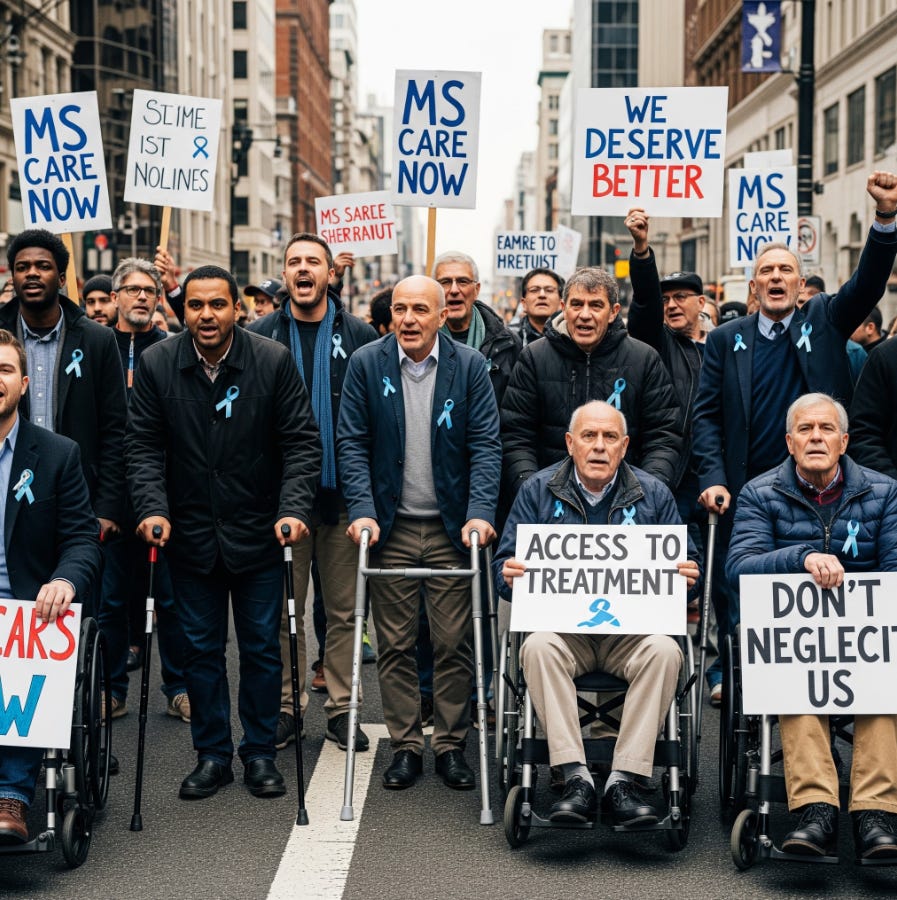
I would be interested in your take on the issues raised in this paper and the questions I have proposed. I have suggested branding MS a pink-ribbon disease in the past. Maybe we shouldn’t forget that it is also a light-blue ribbon disease.
Paper
Van Laar C, Van Rossum A, Kosakowska-Berezecka N, Bongiorno R, Block K. MANdatory - why men need (and are needed for) gender equality progress. Front Psychol. 2024 Mar 1;15:1263313.
Some criticisms of the paper
I found it interesting that all the authors on the paper were women. They identify several limitations to their approach and highlight potential criticisms of men's involvement in gender equality efforts. These criticisms generally fall into categories regarding the scope of the research, the potential for “backfire” effects when involving men, and the risks of performative support.
Their review relies heavily on a “western binary view of gender,” where individuals are defined strictly as men or women. The authors admit this approach excludes the experiences of non-binary and gender-fluid individuals and does not reflect how a growing number of people define themselves, though they argue this focus is necessary to understand how to remove the specific power of traditional gender stereotypes. I know this is a woke issue, but it needs to be said.
The majority of the research reviewed comes from “WEIRD” countries (Western, Educated, Independent, Rich, and Democratic). Consequently, the findings will not fully account for cultural, ethnic, religious, or national differences in how men experience gender roles. They discuss men as a single group, which risks overlooking their heterogeneity. I make the point regularly that fathers with daughters are different to men without daughters; we simply have a different worldview of women.
Many men (due to ethnicity, social class, physical ability, or sexual orientation) do not possess the same levels of privilege usually associated with men in WEIRD countries.
Engaging with men can potentially reproduce dominance or paternalistic relationships. For example, men may dominate interactions in gender-equality groups or claim “expert knowledge in areas they know little about”. Furthermore, specific forms of protest, such as men walking in high heels, can sometimes be derisive and reinforce rather than challenge gender inequalities. A criticism of involving men is that they often receive more recognition for their advocacy than women do. Men may be perceived as more credible and less self-interested, which can generate resentment among women and highlight the very inequality the movement seeks to dismantle.
Strategies to include men can sometimes decrease women’s engagement. The authors cite research showing that explicitly inviting men to participate in gender-parity task forces led to fewer women volunteering. Additionally, when men take leadership roles in protests (rather than supportive roles), it can reduce women’s identification with the movement. There is also a risk of “performative allyship” or “lip service,” in which men engage in easy, costless actions to boost their reputations without a genuine commitment to change. This appearance of change can ultimately cost the movement by replacing actual progress.
While the paper advocates appealing to men’s group-based interests (e.g., better health, better relationships), the authors note that this strategy can be counter-productive. It risks normalising the idea that men should only engage when they stand to “visibly benefit,” potentially hindering progress in areas where achieving equality requires men to give up power or privilege.
Accidental readers
If you have been forwarded this email and are not an MS-Selfie subscriber, please consider subscribing and helping MS-Selfie expand its resources for the broader MS community. MS-Selfie relies on subscriptions to fund its curated MS-Selfie microsite, MS-Selfie books, MS-Selfie Infocards, and other activities that extend beyond the MS-Selfie Substack newsletters.
Subscriptions and donations
MS-Selfie newsletters and access to the MS-Selfie microsite are free. In comparison, off-topic Q&A sessions are restricted to paying subscribers. Subscriptions are being used to run and maintain the MS Selfie microsite and other related activities, as I don’t have time to do this myself. You must be a paying subscriber to ask questions unrelated to the newsletters or podcasts. If you can’t afford to become a paying subscriber, please email a request for a complimentary subscription (ms-selfie@giovannoni.net).
Questions
If you have questions unrelated to the newsletters or podcasts, please email them to ms-selfie@giovannoni.net. Prof. G will try to answer them as quickly as possible.
Important Links
🖋 Medium
General Disclaimer
Please note that the opinions expressed here are those of Professor Giovannoni and do not necessarily reflect the positions of Queen Mary University of London or Barts Health NHS Trust. The advice is intended as general and should not be interpreted as personal clinical advice. If you have any problems, please tell your healthcare professional, who can help you.