Introduction
Sometimes, a thing becomes a habit almost by accident. I’ve never been one for looking at a year from the point of view of our manufactured calendrical New Year, a retrospective which never seems to fit, to me. Instead, I like to look for different places to mark the passing of time (obviously, the solstice is the beginning of the year, right?). Seasons, macro and micro, or anniversaries which only really have relevance for me (or even future ghost dates, as I discuss here). The 25th of November is one such date. This marks the point when I started sharing a newsletter with regularity, back in 2019, when we still lived in Thailand and were preparing to move to Portugal (which, for those of you who don’t know, we did, securing an apartment in rural Alentejo less than two weeks before the first Covid lockdown [after a Christmas in Scotland and New Year in England—a New Year when I was very, very sick, with something suspiciously proto-covid-esque]. Unlike many other nomadic or travelling types, we stayed where we were, in Portugal, rather than heading back to our home nation/nations. It was a strange year, to be in a new-to-us country, but not really to be there in the normal way).
Take advantage of 20% off the price of a subscription, locked in for as long as you subscribe, an offer I’m sharing to celebrate six years of this letter.
When I started this letter, it was a way to keep in touch with family and friends, whether old friends, or those I had met on travels, or whilst living on a different continent, let them know what we were doing or, for example, try to describe how it feels to wake up early and feel the jungle breathing behind our house:
At this time of year, in this place, the mountain exhales at night. Her breath is cool and descends to the city below, bringing with it the scent of the deep, dark places she hides, of lush flowers and constant decay, accompanied by a whisper of secrets and charms. The nights end still in darkness, when the monks in the temple begin their chants and ring their bell or strike their gong, setting off a daily cascade of soi dogs, each howling their welcome to the day, barking their devotion. The sun rises some hours later, tropical-swift, giving only slightly less daylight than in the middle of summer, framed by the harsh calls of myna birds and the roar of the waking airport.
or perhaps talk about Selkies:
Some stories are so deeply entwined with a place that it is impossible to untangle them. Whenever I hear of selkie stories I cannot place them anywhere else in my mind’s eye but Orkney. Those selkies—Orcadian selkies—they don’t travel. They stay close to their shores, even as their tales spread far and wide. After all, in the Orkney dialect, selkie simply means seal, there is no difference between those who can walk ashore and those who cannot—technically, they all possess that option.
or offer a personal perspective on travel, and how it entwines with my fiction:
I am first and foremost a writer, and travel adds substantial depth and substance of flavour to my words, my stories both real and made up. My series of fantasy novels and novellas—The Lesser Evil—are undoubtedly considerably richer thanks to my own travel experiences.
We writers are hoarders of observation, keeping notes, remembering the little details. These things are stored away until they reappear, subtly altered, percolated, ready to enhance a story.
Since those first few tentative steps into sharing my words in this manner, I’ve sent over 300 letters. (I completely missed the 300th, by the way, an anniversary which went uncelebrated—this is the 308th letter [or 309th, if you are listening to the podcast version].) Given that the majority of these letters amount to several thousand words each, that is a lot, mostly shared for free.
In time, I began to share more about my fiction, then promote and market such, utilising this letter as a part of that process. A wee while later, I began to move essays from the websites I ran and the other locations my virtual self inhabited over the years, eventually starting to craft new pieces exclusively for this space, Substack effectively replacing my websites. As you will see below, I am now at the point where I am once more moving things back to a platform I control (but keeping and expanding this space too, for now), circling around, always reconsidering what is best for my words.
Today, as I edit this piece, there are 2364 subscribers to The Crow’s Nest, and 5193 followers over on Substack Notes. I am in awe of these figures and so very grateful to each and every one of you who reads my words—even if you only skim and/or look at the photographs, that’s perfectly valid, too! And, introduced recently, there’s also those of you who listen to my words, as recorded by me, something that, not too long ago, I did not really think I would ever be able to do (I still don’t like the sound of my recorded voice, but I can live with it if it makes others happy). For the last two years on this anniversary, I have shared a post discussing where this newsletter is in regard to subscribers and growth and, crucially, direction—both where it has gone in the previous 12 months and where I plan for it to go in the next. I also add in a few wider-reaching observations regarding the platform I currently use for this letter—Substack.
This post might be shared with you, but it is also a way for me to take stock, to look hard at the last twelve months, and to consider what comes next. This year, I am writing more than last year’s letter on this subject, as I’m also including discussion on the direction I want this space (and others) to go. As such, it is long, which ties in neatly with the following paragraph. Perhaps the key takeaway from the process of observation and self-assessment, and from observing the paths of others, for years, is that this is a long game—sharing a letter—and ideas of success are as varied and different as are we all. Not to mention the fact that there are a million and one different and valid ways and reasons to share such a letter in the first place. Including not actually seeking growth, just enjoying sharing things because we can and a letter seems a suitable method to do so.
We are too often told we need to grow, to have hordes of clickthroughs, that to do so we need to download this free funnel ebook, sign up to this course, pay for a subscription to this guru, or that—but that, to me, is just, well, boring… It’s like everywhere else. It’s staid, stagnant, and simply feeds into the vast machine we are all currently enveloped within as a species-wide experiment (hat tip to John Twelve Hawks there).
If you don’t want to read on, then perhaps the most succinct and best advice I can give is this, something I said last year and, indeed, the year before:
…everyone’s journey is different.
The Grubby Elephant In The Room
From the outset, I think I will mention one of the biggest changes I’ve seen over the past year on Substack, a topic I have not really touched on in my writing, yet, and that is the rise and increasing proliferation of generative Artificial Intelligence and Large Language Models. Artificial help for ideas, drafting, or editing, or all of these. It is a contentious issue; some people believe it can help them write or edit and, if that’s you, then you do what you need to do. I want to make it clear here that I do not use generative AI. I never have, never will. Why? Well, I don’t need to. Why not? Because I’ve put in the time—lots and lots of time—and the considerable effort to get to a point where I am comfortable sharing the fact I know I am a good writer. (And yes, of course I have doubts, yes, of course I have moments when I wonder if anything I’ve ever shared has been worth it but, on the whole, I am very happy with where I am with my work.)
Generative AI is destructive. There’s no sugarcoating that. If you believe it to be useful, then you will continue to believe that—I very much doubt anything I say will change your mind. I believe such AI is destructive for two reasons. Firstly, the energy use from server farms powering these systems is growing exponentially and, quite literally, fatally. At a point when we are reaching tipping points in our climate—tipping points which will mean an almost unfathomable change in the near future of our species—and, indeed, when this year we have quite possibly passed the first of these nine (warm-water coral reef die-off), why then are we vastly increasing our energy needs, just to ask often inane questions—and receive answers which are not always true and, sometimes, dangerously untrue—of a machine? Secondly, such AI is destructive for the writer. It is a cheat, a shortcut which might shave time off the walk, but it does so at the expense of the very viewpoint or peak the walk was taking you towards in the first place. You do not master a thing by cheating—again, if you disagree, that is fine, that is your choice, but I have not yet read a single argument that can convince me otherwise. Whatever ideal of excellence you subscribe to, not one of these can be achieved by using such shortcuts.
No mastery of anything can.
(Personally, I am of the opinion that the very best masters are always students of their subject, rather than a finished product; no true master I have ever met has advertised themselves as such, and studying is not something we should cheat at—that helps no one.) You will never be a superb writer if you don’t hike up metaphorical mountains to witness those hard-to-reach viewpoints. I find the whole idea to be deeply sad. I wonder how many writers who are using AI to ‘craft’ their content could have become truly amazing, if only they had not relied on a crutch. Too often, this is the way—I’ve been at this writing game for a long time now (and not exactly secured a fortune although, as I often tell myself, reliance on economical scales of success is never reliable), and I do know that, when I want to say a thing, I can do so, myself, without machine aid beyond that provided by the red lines beneath my typos or misspellings, or the ability to store, access, and reorder my thoughts made possible by e.g. Scrivener and Obsidian—or a good, old fashioned notebook, of course. I do need to take a moment to also mention how I think it unfair that many people talk about AI solely from the perspective of generative AI, whether ‘art’, video, or words. AI is so, so much more than that, and some of the things that it can do—and IS doing—are simply remarkable, especially in the world of science and medicine, for example. All of which is to say, the slop we’re being fed from so many different directions, diluting the wonder of the internet—even beyond the already diluted state it is in thanks to ‘SEO content writing’—does not taste nice to me—and do not get me started on the texture.
Then there’s the issue of ownership—many of the GenAI platforms have cunning wording in the small-print you agree to when you sign up which, in short, makes it unclear who actually owns the prompts you use, and the outcome the AI provides. Ironic, really, given that they are usually trained on stolen material.
I know I will have upset a few readers by saying this, but I do think I needed to do so. I cannot condone the use of such tools when the damage they wreak is so vast for the world and the (potential) writer both. (And I have barely mentioned their incredibly illegal and unethical software training programmes.) However, perhaps perversely, when many seem to want to take up generative AI as the new saviour of ‘their’ work, perhaps that might not a bad thing for me? My words are my own, the way I write reflects the time I have put into finding my voice and honing it. And the way I craft each and every piece reflects this.
I see other writers not as competition, but as colleagues, which is how it should be, but I have to admit that, when I see AI drafted work—so obviously AI-drafted it is painful to the eyes and soul—then, sometimes, I smile a wry smile. Colleague they could arguably still be (but then I’m not entirely sure of that, either), but competition they certainly are not. Probably thanks to my cultural upbringing, I do feel a creeping urge to apologise for the above. I don’t usually like to rock the proverbial boat too much, in this space or any other, beyond occasionally/regularly reminding readers that we are firmly heading for a very, very dark place, thanks to our species’ ongoing desire to burn the only home we have to cinders. However, I would have done this piece, myself, and you a disservice if I had not at least touched on the subject.
Short tl;dr version of the above: I do not, and will not, use generative AI for either drafting or editing or images. Nope, no, never.
Some Figures and Facts
Moving swiftly on.
Last year’s essay on The State of the Nest was sent to 1698 subscribers. This year’s to 2364. On paper (or screen), this is a big rise but, if you look at the following graph, you’ll see where this increase peaks early in the year, then tails off, then begins to drop.
There’s a very simple reason for this initial rise—Substack recommendations and, especially, The Crow’s Nest being recommended by Simon Haisell at Footnotes and Tangents. I received 1348 subscribers from Simon’s kind recommendation of The Crow’s Nest last year (although a lot of them have also since unsubscribed, as is often the way, others have stayed, and they are very welcome, too).
In total, since recommendations began, I’ve received 2085 subscribers in this manner, with 43 publications recommending my work—a figure I find truly humbling.
As far as followers, over on Substack Notes, I’ve grown from 3106 to 5193. The big uptick there, at the beginning of the graph, mirrors that of subscriber numbers (which it also includes in the total), but then it continues to rise, if more steadily—which is what I had expected my subscriber list to do, only it did not. Even follower growth is beginning to slow down.
The sudden jump on both of the above graphs, on the 26th of February, is when I discovered Only One Death had been the book of the week on a promo site I used to use regularly, Bookcave, but had mostly stopped using. This was me importing the .csv file from said promo.
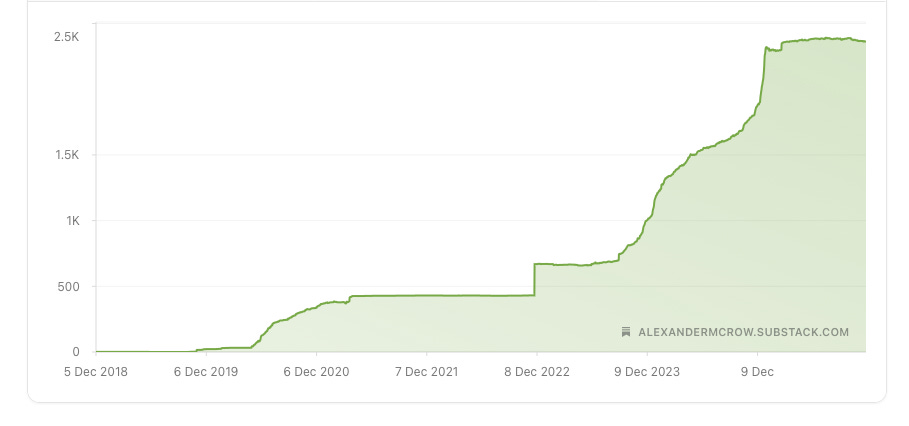
In case you want to see them, here are the graphs for the full time I’ve been present on Substack (as I mentioned before, that big flatline, from April 2021 to December 2022, is when I took my letter elsewhere, but kept this account open with a clear signpost for anyone wanting to read my work. Then I came back.).
Here are the subscribers:
And here is the follower chart:
After an outcry on Notes—people complaining that Followers can’t be downloaded, taken elsewhere, for example, unlike a Subscriber email list—Substack rather cunningly made these stats a little harder to locate. Personally, I have nothing against people following me instead of subscribing. I do it, following someone first, before subscribing later if I still like what they share. I already subscribe to a lot of letters, and this was one way to keep my inbox a touch less congested.
The problem, of course, is that not everyone shares their letters to their Followers, instead using Notes as the social media platform it is. There is even evidence to suggest that when you do put a link to your work in a Note, then it is shown to a lot, lot fewer people. Well worth reading the whole of the following Note, not just for the above point, but also for ‘good practice on Notes’.
I’ve noticed this too—Notes without links do much better. Which is, in my opinion, a bit stupid—surely Substack wants people to subscribe to things, as that’s how they make money? Still, I’m not going to waste too much time or effort second guessing the platform, it can be an interesting exercise, but little more than that. And don’t forget that this is a platform which is, after all, simply a tool for me (and you! You should view it like that and, like any tool, if it breaks, or becomes dull, you either find a new one [move your letter elsewhere], or sharpen it, make it work again for you [alter how you use the platform]).
Over the last year, I’ve gone from having subscribers in 68 countries to 73. Whenever I get someone who subscribes from Russia or China (two people from the latter, at the moment—hello! [I absolutely went down a rabbit hole of researching the correct Mandarin greeting here, then decided against it, but now have a strange hankering to learn the language and, especially, the characters and script]), my map suddenly looks a lot more full. Then they disappear and it grows empty once more. See also: Greenland (which always amuses me on such a projection. Greenland is really NOT this big, nowhere near—maybe that’s why certain administrations are talking of buying/invading? Perhaps map projections should be explained a little better?).
Whilst on the subject of the world at large, from what I understand, little to nothing has been done to remedy the situation of writers from many countries simply being unable to receive payment for their words. Stripe making this very difficult to impossible. This is unacceptable. I can’t change much about it, but I can keep pointing it out—a writer from India, for example, should be able to be paid just the same as one from Germany, or the US. One would think that this would be a priority for the company, given how much money they could potentially receive that way? If I am wrong about this, and something has changed, do let me know, so I can celebrate.
Here is the map for US states:
(I am still mildly irritated that we can’t default the maps to World, with US states second but, I guess, Substack is a US company. I always prefer to start zoomed out, before looking at the closer detail…)
Statewise, the joyous news here is that I finally cracked North Dakota! And now there is not one, but two readers from that state. Thank you, whoever you are, for giving me the full US sweep.
Words I Have Shared
I shared little this year—or thought I had shared little, compared to 2023/2024. After finishing sharing the novella Dancing With Death I have not shared any fiction, something I’ll discuss later in this piece. Whilst I was sharing this story, the percentage of opens per letter outstripped the number of opens per letter for all my other essays and thoughts, by a considerable margin. And they say there’s no demand for fiction on Substack... Here are some snippets from some of the things I have shared this year, with links for each. I know this adds volume to this post, a post which will undoubtedly be over ten thousand words long, but I am proud of my work here, and I want to share that.
To name a thing, to speak that name, is a power. Sometimes it is a power for the speaker, sometimes for the named. This has been a popular feature in story, mythology and history: Rumpelstiltskin, or a demon, summoned, bound, and trapped.
What happens when we do not name a thing? When we do not allow it the time to enter our head or world? What happens when we turn off the television, or remove ourselves from the ongoing onslaught of misery and deception on social media?
The Time, Right Now. January 2025
I decided I needed to pause writing fiction, wait until I had more experience of life to, well, write what I know, as we are constantly told (reader: I have never fought an assassin on the streets of a city where it is illegal to go without a mask; I have never led an expedition to a lost and dangerous city; I have never fled pursuers intent on killing me and taking my baby; and, although I did once very briefly work for the tax office, I did not formulate a plan to escape that job which involved murder, betrayal and risk, just to keep my family safe. Nor have I descended to hidden catacombs containing something terrible, ancient, and dangerous; or gone head-to-head with a horrific, terrifying monster).
My Fiction: Past, Present, Future. February 2025
Our world seems plunged into darkness. Drums of war, greed of the few, hatred of the other and, looming above and behind, through and around all of these, the very active and malevolent poltergeist of climactic breakdown and the (potentially-increasingly-likely) cascade effects of this.
To accept a darkness, to see it for what it is and yet to know, deep down know, that on the whole humanity is a wonder, a thing of extraordinary ability and endless reservoirs of love and kindness (despite what that news would have you believe), that we can change our world for the better, this is a truly, truly powerful thing. And, at the very heart of this lies that little word, hope.
Hope Is Rebellion. February 2025
Our lives are quests, every day another step on the path towards our common, shared end. There are times when the sun is low and dark, when our way is shrouded in mist, and our minds and bodies fail. Then, we need to pause and recharge, rest and recover, regain our impetus and, hopefully, be strong enough—for ourselves, and for others—to continue.
There are always moments of doubt on any quest. For what would be the adventure if all was a placid sea, or flat, paved road with comfortable, bug-free lodging along the way? We need those troughs as much as we need the peaks. We need the darkness to see the light for what it is—and I see the darkness overwhelming many right now.
A Sense of Purpose: And Imaginary Adventures. April 2025
Yet how do we keep going, in the face of horrors? How do we gently inform those who are absolutely burying their collective heads in the sand? How do we block out the constant drone and clamour of approaching doom, whilst also somehow keeping a balanced awareness? Where and what is that balance?
These are big, big questions, and I am not truly qualified to answer them; I certainly do not possess all the answers.
I would also be very wary of anyone who claims they do, as they are usually, in my experience, selling something you probably don’t need.
Make Good Soul: A List. May 2025
If you pay attention, and if you are lucky and wise enough, every so often a book comes along which changes your life. It makes you think in different ways, examine yourself, others, and the world in a new light, and generally adds so much to your very being that you are unsure how you coped before.
I am lucky enough to have encountered several of these books in my life and cannot wait to uncover more. This is the joy of reading, and reading widely. There are so many stories waiting to be discovered by readers, over and over, small miracles of happenstance which, in turn, have the potential to lead to yet others. This cycle of discovery never ceases to amaze me, especially when a book leads the reader (myself, in this case, but perhaps you, too), to a place where those words paint the world in a slightly different light to that in which you experienced it prior to reading.
One such book is, of course, Tove Jansson’s The Summer Book (originally Sommarboken, in Swedish).
The Summer Book: For All Seasons. July 2025, a guest post over on Beyond The Bookshelf
I have long espoused hope—active hope—looking at the world in ways which might make a difference, which might do some good. Yet, at some point this year, I realised my hope was shaken, it was jarred, dwindling and, for fear of losing it entirely, I took a step back to protect and nurture it, cradling what remained and trying to consider the best path toward rekindling. Telling others to be hopeful when you yourself are not seemed hypocritical and foolish.
Now, however, I am once more ready to release my hope back into the wild. She is rested, she is strong again but, crucially, she is also repurposed, retooled.
The Balance of Hope. September 2025
We have failed to reframe this climate crisis as one which ultimately threatens our survival, rather than that of the world. The world will heal, eventually, over scales of time we often fail to comprehend—unless, that is, your brain is different. What won’t heal, however, are countless species which shall disappear. Likely including ourselves.
All we can do is keep to our visions, keep using these strange brains of ours, and keep listening to the potentials the land gifts us, acting on these to ensure we do all we can to nurture, protect, and share what is good, joyful, and kind.
Strange, different brains will be an essential in the coming years: sharpen yours, and keep it sharp.
Build The Wall. September 2025
One of my favourite things about this—apart from the wolf in daylight!—is the wren (Troglodytes troglodytes) in the background. Sound on, you can hear her scolding the wolf and following along, telling everyone who understands her language that there is a wolf present. This, for me, is perhaps the most useful thing on all these videos, as it is a gap I can only realistically learn by observing—and, as I’m unlikely (not impossible, but unlikely) to be somewhere I can see a wolf with an angry little wren, this video is priceless to me. You can see her top middle right of the image, landing on the branch there, following the wolf along the trail.
What Passes in the Night. November 2025
I also once more shared my A Fall In Time series, about the time I left behind the city, caught a series of trains, and then walked out into the woods of western Scotland, to stay out there, alone, from late summer to early winter.
This year, however, I have not sent it to everybody on my subscriber list which, in hindsight, was probably something of a mistake. A weekly letter compiling the daily Notes I share for nearly twelve weeks is a powerful thing, after all. I was worried that sending it again to those who have already read it would alienate you, the reader but, having thought about it more since I made that decision, I have effectively deprived roughly 930 readers of following along with the whole series for the first time—those of you who subscribed since last year’s version began. True, some of you may have opened and read the pieces where I mentioned A Fall In Time, and how to subscribe to that section of my letter if you weren’t but, statistically, I think more people would have opened one of those twelve weeks of letters and perhaps become intrigued, going back through the introduction and navigation links to catch up if necessary.
However, aside from the wonderful comments I’ve received, and those of you who did subscribe thanks to A Fall In Time, one good thing that came of this series is that I am very happy to have taken the time to record the voiceovers for these letters. These were the impetus behind Voices From The Crow’s Nest, the podcast I have simultaneously used those voiceovers for and, while it may not have brought many subscribers, it has been listened to over on, for example, Youtube or, especially, Apple, enough that it adds a cherry to the proverbial cake. For me, this was perhaps the biggest item of growth for The Crow’s Nest, and one I’ve been considering for a long time. I have now managed to get the recording, editing, and uploading of these voiceovers and Podcasts down to a relatively quick and fine art, one where I don’t use up too much time to do so and, I believe, the value added is exponential. I know some other writers keep their voiceovers for paying subscribers, but this to me, personally, feels a little unfair for the reader/listener. (Nope, I’ll not make any money this way, will I?) I have also received some wonderful comments on my recordings. Really, really wonderful. And that means a lot to me—I have long been exceedingly self-conscious about how I sound when recorded and it is only in recent years that I have finally come to terms with this, a big part of which is thanks to now having lived outwith an English-speaking country for over eight and a half years. I have been told by several people whose first language is not English that my voice is clear, my speed of talking not too swift, and the way I annunciate perfect for them to understand my meaning. This means a lot to me. So, I decided to build on this, take that confidence and apply it to The Crow’s Nest as a whole, and I am delighted I did. (EDITOR: He says/types, whilst drafting, well aware he will have to read a multi-thousand word essay once it is finished, probably after publishing this, or it might never get sent...) I’m almost tempted to consider a few wee videos, too. Almost.
Finally, for this section, I also reshared mildly reedited versions of two different real-life ghost stories, The Foot of the Bed, and A Place, Invested in Memory: A Tale for Halloween. Both, I think, do what ghost stories are supposed to do, and I was especially pleased with the voiceovers for these.
Growth
As I have said before, slow and steady is the way. However, I would be lying by omission, if I did not say I am a little disappointed with Substack this year.
With A Fall In Time, I had hoped that, like last year, Substack Notes would have driven considerable engagement and sign ups. That has simply not happened. A few of you have found me that way but, for the most part, those Notes disappear into the ether without a restack or a comment beyond a very small group of you, such as the frankly awesome Susannah Fisher, who I know has enjoyed following along again this year, despite having done so already.
Something has changed on Notes, and not, I feel, for the better, visibility has disappeared and, when I dare have a peek at the Home setting (which, for those of you who don’t use the platform, is the feed which is suggested by Substack, some of the people I follow or subscribe to, and many I do not), then I see a depressing morass of Notes gaining traction which are either from already very-much-established celebrities or those who have simply gamed the algorithm. It is a little frustrating.
Every month or so, what seems to work appears to change subtly and, if I wanted to, I could simply follow the fashions and potentially receive all manner of subscribes and restacks—but I do not want that. I am not going to chase an algorithm (a statement which reappears in this letter several times). Instead, I’m going to keep doing what I want to—and what I want to do is to share things I know matter, words and images and now sound which are, in my opinion, worth reading, viewing, and listening to.
I know Substack is a business, and I know they have much going on behind the scenes, but I also worry that their shift to promotion of celebrities is directly impacting many other writers—work is going unread, unseen, and that is a bit of a retrograde step for the platform, as far as I am concerned. Many writers have already left—especially to Ghost—and I know others are also considering a move.
Other writers have also discussed this drop-off in subscribers, something I believe Claire Venus ✨ calls ‘the great Substack stall’, a moniker which fits rather neatly—I can’t find the Note she said that in, however, but relatively sure that’s where I heard it.
I am fairly sure this stall is principally due to something behind the scenes, a switch in the algorithm, rather than newsletter-fatigue, or too many writers for too few reading cake (which is, of course, what capitalism wants us to believe, scarcity, abundance, economics and all that—the only solution for which is to keep toiling, keep producing, for less and less, whilst the rich have become richer, and the poor have become poorer [thanks, Percy Bysshe Shelley]. I would argue that attracting big names to the platform, so that their draw brings in more subscribers for the rest of us, is the newsletter equivalent of trickle-down economics, a highly dubious system in the first place, but I guess only time will tell).
The fact that for many of us who share our work here, the stall began at more-or-less the same time definitely suggests it is something algorithmic. (Have a peek at Matthew Long’s own recent State of The Stack, for an example—and also for how upbeat and positive he remains despite the stall! I love that.)
Whatever the cause, the fact remains—something is broken, something is not working as it should. I am still hopeful it will be mended, however, and—although I reserve the right to move elsewhere at some future point if needed—I’m not going anywhere soon.
All of which should, of course, be seen as a perfect opportunity to just keep doing your (my) own thing… More on which, below.
The Money
In 2023, the first State of the Nest, I had eight paying subscribers, which rose to sixteen in the 2024 edition. Today, I have ten. I think a big part of this is perhaps due to a general tightening of belts around the world but also, I suspect, because I have not published as many essays and letters as I did in the previous couple of years? As I share more here, perhaps more people will pay for a subscription? Who knows?
I have also noticed that several paid subscribers did not choose to unsubscribe from the paid offering, but that their card was no longer valid/out of date, so they may not even be aware they no longer are paid subscribers.
However, one thing which HAS worked for me this year, and worked well, is the button/link to my Kofi account, a tip button if you will, which I pop into every letter. This has paid me more money than subscriptions in the last year. If you have a letter, and you don’t have a tip button, I’d highly suggest you consider it. I know people talk of wanting Substack to introduce their own tipping method, but honestly, why? (Subscriptions are how they make their money, after all.) It is simple enough to set up a Kofi account and doesn’t affect the subscriber model Substack is using. I am not a fan of Paypal, but lots of people use it, so having that option as a KoFi payment method is a happy bonus. Maybe subscriptions will pick up again (I really hope they do), but I am not counting on that. As I mentioned earlier, some people argue that the market is saturated, too many letters to choose from, but I personally disagree with that—it is simply a matter of keeping on keeping on, to try not to follow fashions or chase algorithms.
I’m certainly not one of those writers who ‘does it for the art’ and would always welcome an uptick in readers and any money they throw my way! I think that suffering/starving for art is ridiculous, and writers deserve to be paid what their work is worth. Which is a whole other letter, I’m sure—and not a new topic. See The Cost of Letters questionnaire from Horizon magazine, back in 1946, (and the updated version, edited by Andrew Holgate and Honor Wilson-Fletcher, in 1998) for a super example, in which George Orwell said this:
If one simply wants to make a living by putting words on paper, then the BBC, the film companies and the like are reasonably helpful. But if one wants to be primarily a writer, then, in our society, one is an animal that is tolerated but not encouraged—something rather like a house sparrow—and one gets on better if one realises one’s position from the start.
And who am I to disagree? (I’m also very fond of house sparrows.)
That whole book is superb reading, by the way, absolutely full of wonderful quotes, such as ‘To be a poet is a condition rather than a profession’ from Robert Graves, or ‘The commodity most necessary to the writer is not money at all, but time’ from Laurie Lee, or ‘My advice to young people who wish to earn their living by writing would be to go at it slowly, with infinite trouble, not burn any boats in the way of other support behind them, and not either expect or play for quick returns’ from Elizabeth Bowen.
On this subject, I would also like to direct you to this excellent recent piece from Elif Shafak, right here on Substack, in which she says: ‘What a writer needs, first and foremost, is freedom. Freedom to read, freedom to write, freedom to be.’
Open Rate
One positive outcome of sending this year’s edition of A Fall In Time to so few people is that my overall average open rate percentage has increased considerably, which feels somewhat like gaming the stats, to be honest! Perhaps I should create a section which only I subscribe to, then open each letter, for a 100% open rate...?
Not really, of course, but it does make me question (again) the validity of using figures as a method for assessing the value of your work: this is a prime example why it is important not to take the statistics on Substack as a be all and end all. They can be interesting and useful, to a point, but you (I) should concentrate on actually sharing things that people will enjoy, or find useful, interesting, emotionally engaging, informative, or whatever other reason you might have for sharing your work.
(In the draft of this piece, I also went on a minor rant about a recent spate of ‘create your art for you and for the world, for free’ Notes and letters I’ve seen, dismissing those who try to actually make some money from their work as little better than the cruellest of conmen or dirty-capitalist-pigdogs. I’ve edited that out but, needless to say, I think the image of the writer starving in their garret is one which should be solely in the past. We deserve to be paid for our work, and we deserve fair pay, something which is certainly not the case at present. Perhaps perversely, we also deserve to be allowed to do whatever we want with our work, including giving it away if we wish.)
Which reminds me, last year, I mentioned how I’d seen people talking of culling/tidying/cleaning their subscriber list, getting rid of those who ‘never open an email’. Last year, I said this:
“I don’t really like to offer anyone here too much advice, I find there’s rather a lot of that floating around, after all, but I recently noticed someone, once again a self-proclaimed ‘expert’, talking of removing email accounts which do not ‘engage’ with your letters.”
DO NOT DO THIS PLEASE!
And, this year, I’d like to add this:
REALLY, REALLY DO NOT DO THIS PLEASE!
For the love of all things newsletters, why on earth do people keep recommending this? It is foolishness in extremis. Just don’t.
Where I Am Now
Over the last twelve months, I have shared 64 pieces—10 chapters of fiction, 18 episodes of Voices From The Crow’s Nest and the rest a mixture of essays and guest pieces, along with a handful of pieces of older work, reshared to a much bigger audience.Looking at it like this, I should feel happy with that output, but instead I find myself wishing I had shared more, which is, quite frankly, silly.Which leads me to this point: it’s not you, it’s me. Or, actually, it’s all of this: *the writer waves around, to encompass the bleakness which seems intent on populating the internet and conversation in general. Whether genocide, war, famine, disease, exceptionally regressive politics, ongoing destruction of nature, or the biggest threat of all—a climate catastrophe which is spiralling far, far beyond anything we thought we’d experience at this juncture in time.* I’ve talked about this already, quite a bit, and will continue to do so. As should we all.
I’ve also talked about how I have been rebuilding myself, looking at the wiring under the board and, to stretch the metaphor, defragging, purging spy- and malware, adding extra RAM, a new hard drive, and possibly a faster processor. I have deconstructed what it means to be me, embarked on a long, deep trawl of the literature, and discovered much which makes a lot of sense. It has not been an easy process, especially not when twinned with the above. Add to these the fact I have not lived in an English-speaking nation in well over eight years, that I have been principally invested in raising our daughter, Ailsa, learning all about being a Papa, along with learning another language and all the customs and cultural references that come along with being in a different country, and I think those 64 posts are actually not bad, not bad at all (which is, of course, British for ‘rather good, really’). I would love more time. Time to read your work, time to respond to comments and replies when they come in, rather than much later (this is actually a priority for me, as I mention below), time to write more essays too but, quite frankly, I also know that time is scarce and needs exceptionally careful shepherding. I have, after all, spoken ad nauseam about time being the only currency that truly matters. And so, on to the next part of this piece—where does that shepherd lead the metaphorical flock?
What’s Next For The Crow’s Nest (and me!)?
I could be flippant and say something along the lines of ‘more of the same’ only, that’s not entirely true. There will be more of the same, certainly, but there will be much more of some things than others. For a start, my priority, when it comes to writing, has recently been offline work, principally new fiction and polishing old. That will also be the case going forward. I would like The Crow’s Nest to support my fiction, rather than my fiction be an afterthought, or minor subsidiary. Recently Claudia Befu said this:
And I am wont to agree. It can be all too easy to fall into the trap of content creation, of building up a following, then being told that the following you build is not big enough to even be considered as a following, and so the cycle continues, all the while churning out essays and supporting work for something which keeps getting shelved or pushed further into the future. That is a sad, lonely, and frustrating road, one which just leads to bitterness and, ultimately, failure. My priority is my fiction. It has to be, as it is the carrier to the message I want to share with the world (the same message I share in my essays, one of decency and kindness, one of hope when all feels hopeless, and one that we can actually make a difference, if we but try—only with some magic, some questionable morals, some violence, and an occasional monster, for some of those stories, at least), and it is the means to reach far, far more eyes and ears than those essays. Sneaking cold, dirty, hard truths into fiction is a long and time-honoured tradition, and one I know I truly need to focus on right now. That’s not to say there won’t be essays, there will. There are! I have lots to come, many things already drafted, some even edited. But it does mean I won’t be marketing ‘myself’ to the extent that this reply to Claudia’s Note suggests I should.
(I almost waded in to that exchange, as I once might have done on Twitter, for example, keen to point out the errors in that argument, quoting other professionals whose opinion I really value [such as the always sparkling and exceptionally helpful Juliet Mushens], but then stopped myself—I’m too tired to go debating with strangers on the internet, and Claudia is perfectly capable of defending her opinion after all, and did so succinctly and without resorting to anything remotely heated. I think all of this is proof I am getting old and/or am somehow actually focussed on what I really need to write...) Today, on the subject of novel writing, I shall also let you in on a little secret. Did you see this piece, all about my drafting process? That is tied to something I have been working on offline, a new project which appeared late this summer. How it appeared, the details of what it is and what it is becoming, will all be explained in due course. This project is a novel, that much I can tell you and, as I draft it, I am also keeping reams of notes on the process, drafting essays as I go, including ones on ‘where do ideas come from?’, ‘how do you know if an idea is worth pursuing?’ and ‘what even is a character, and why do they sometimes simply appear in your life unbidden?’ Or words to that effect. There are also blow-by-blow accounts of the genesis of this novel, the nitty gritty details, wordcounts, chapter structures, even something on software I use, etcetera. Each of these essays (and there will be several) will be shared here in my letter. When is another matter; what makes sense to me is to keep these for later, when the novel is done and due to be published, just published, or both. They are supporting material and, I suspect, will be very appreciated by both the reader of the story and, especially, by myself.
If you have a brain like mine then, when a project is done, it is done. I never want to market it, because in my head it is already finished. Why continue talking about it (even though no one else knows about it? 🙃 Yup, I used an emoji.)? As such, having pre-prepared material to share makes a huge amount of sense. It is, to be honest, not that much extra work now, after all, but it is work which will save me a vast amount of time and potential burnout later, precisely at the point when the last thing I’ll be wanting to do is write more about this particular novel. Crucially, I also think this is fun, and it makes me deeply consider the/my actual process behind the story. At the time of writing, I’ve yet to really discuss this project with anyone, beyond a few cryptic statements hither and thither, mostly because I am still not 100% sure what it actually is yet, and I don’t want the opinions (no matter how valid) of others to influence what it becomes. Needless to say, that will soon change, as I’m pretty confident this novel now has an increasingly solid shape and a journey which should prove interesting, the destination almost locked into place. Other projects I am working on, which will impact this space, include the following:
* Finalising the final two Tales of The Lesser Evil, to initially share here, both serialised and also as ebooks for paying subscribers.
* Relaunching the first four of these Tales as an ebook and print-on-demand (I mentioned this here, and there’ll be more on this soon!).
* Relaunching Une Seule Mort, the French translation of Only One Death, and also FINALLY publishing the other two completed translations, which have never been shared before. (Sorry, Aurélie!) I will also be serialising these here (most certainly WITHOUT a voiceover from me, no French speaker wants to hear me massacre the language...), available at a separate section of The Crow’s Nest (in a similar fashion to this year’s A Fall In Time, not adding my entire subscriber list, only those who opt in to receive it).
* Revisiting the book proposal for a non-fiction book related to A Fall In Time. I wrote one last winter, but then shelved it, unhappy with it, no matter how much I tinkered. Now, however, I am looking at this with rested, fresh eyes, and that time spent thinking proving very useful. Not least because I have finally thought of the perfect title, which encompasses everything I hope to say in that book.
* Extra essays and material for A Fall In Time (mostly to appear behind the paywall, as these will be experimental, supporting material for the book proposal, ideas I’d like to work on further and flesh out into chapters of a book, and I’d rather not have them freely available on the internet). In some ways, these will also be a continuation of my Ancestral, Wild Empowerment series.
* (This includes a rekindled invitation to you, the reader—I shall be relaunching my Let’s Take A Walk series. If you want to think about this, the link there should help, but I’ll send something else out soonish. I shall also be putting together a contents/link page for the walks I have already shared, very soon.)
* Recording all of the above for the voiceovers/podcast, and revisiting old posts to record, too, in a similar manner to that the remarkable Jonathan Foster has done, over at The Crow. (His own spoken work was definitely a big inspiration.)
* Recording me reading my own self-published fiction too, eventually, to put together as audiobooks.
I’m sure there’ll also be the odd impromptu, unplanned essay, and I do intend to start revisiting Notes with increased regularity (I have a project I’ve long wanted to share [ahem, for YEARS], which is almost ready to go, Notes being the obvious home).
(I am presently not 100% sure of my word of the year for 2026 (2025 was ‘compassion’), but two I am considering are community and communication. Both fit where I want to go in terms of my self development next year and also tally neatly with much of the above.)
Another thing I will soon be doing is revisiting my own recommendations, ensuring I write something for each and every publication I recommend, explaining why, what that writer means to me, and what I think you will gain by investigating their work yourself. I think that is both wise and fair, and is something which has niggled me for some time, now. Oh! Breaking news as I draft this piece—for one brief moment, I was apparently number 99 on the list (of 100) of ‘Rising in Climate and Environment’ Substack writers. I have no idea how this works, or what it even means, and I suspect it’s probably down to Susannah Fisher consistently liking, commenting on, and sharing my day-to-day A Fall In Time notes, something which has brought me much thankful joy. I really appreciate that, and all the other replies and shares I’ve had. Whatever people say about placing on these charts being due to subscribers and, especially, paid subscribers, I can verify it is not! Of course, I’m not even sure my Substack fits into ‘Climate and Environment’ but there’s still no Nature section, which makes little sense to me, nature really being the root of all things, but hey, I don’t make the rules (nor really follow them, for that matter).
General Goals
Aside from the above work, what are my general goals for The Crow’s Nest? Well, as I write this piece, I am really not sure. Chasing figures and numbers seems like capturing smoke in a bottle and, as such, I think it simply best to...not bother. (No change there, really, I would love more readers, more subscribers, as I am sure there are many others out there who would enjoy my work, whether fiction or non-fiction, but chasing those numbers is not good for my brain!)
Instead, I will focus on the work, focus on this space being a support to my fiction (and non-fiction, such as the book version of A Fall In Time, now, finally with a title I think works perfectly) elsewhere, rather than the focal point itself. Whether this will be a sensible choice, remains to be seen. (Amusingly, I scribbled this paragraph before the ones about the Rising charts, so clearly not chasing algorithms actually works?!) When it comes to bringing new readers to my work, I presently have little hope that Notes will work for this, but that doesn’t mean I’m not going to use it—I like it, it is the only social media I use, my feed is set to a default of ‘following’ and is full of friends. That’s a very good thing. Perhaps algorithms will change again and new people will find my work via Notes but, honestly, that doesn’t really matter. As I said above, I am certainly not going to invest time chasing an algorithm.
This happened too, on the subject of Notes and friends. I realised afterwards, that it was the longest face-to-face conversation in my native tongue with a fellow native speaker for a long time. Which is something I should really address (see Word of the Year, community/communication…etc).
It was also a lovely, varied, fascinating and, as Anne says, heartwarming conversation. Anne Thomas is someone I think you should all be subscribed to—her work has kept me buoyant and interested, not just her essays, but her daily series of observations over on Notes—they remind me of the wonder, fascination, and beauty available in the world, often when I really, really needed reminding. Please do have a peek! I’m quietly confident this won’t be our last face-to-face meeting, despite her moving away.
So, perhaps, one of my goals should be to actually meet more of you in real life? If you are ever in this corner of the world (the French Alps), do give me a shout—and I’ll be in Scotland next July, too—along with probably elsewhere at some point or another.
One other thing I am intent on pursuing is resurrecting my old Pinterest account, and then building boards into which I can slip pins of my own work, something Substack makes really easy to do, with their ‘share as image’ options. Add to this the fact that I don’t use generic art, and certainly not AI imagery, but my own images, and I think the visual side of my letters could really help to find new readers. I shall report back on this once it is up and running and as and when I have some data. (I also think it would be a good way to share the work of other people here, too.) Then there’s the podcast. So far, I’ve simply linked it to various platforms and done little (no) marketing for it, at all. Perhaps that is something I should pursue too—I’ve had positive feedback from some of you, which has made me really happy, seeing as I struggled to actually share my voice in the first place. What I won’t be doing is paywalling the voiceovers/podcast as an extra for paid subscribers as some do—I think accessibility is really important, and I’d like to enable those who either can’t read the words as easily, or who don’t have the time to read them to have a way to do so, without paying for it. Plus, it pushes me outside my comfort zone, takes only a wee bit more time, and offers other opportunities—opportunities I should deeply consider following. As I hinted earlier, I am also going to be relaunching my own website, alexandermcrow.com—‘under construction’ for a long time now—gradually taking things from Substack and all those other corners of the internet I’ve frequented, and making them a warm and cosy nest of their own, together (again, this ties in with community AND communication). This is something I’ve been meaning to do for ages—it just makes a lot of sense.
One thing I shall also use that space for is directly selling things, whether my fiction, or other products (I craft things by hand, sometimes, and I think I could work out a business model to sell these as extremely limited edition/one-off art), as well as using it in order to give away bonus items to paying subscribers here (such as the long-threatened-but-yet-to-materialise free ebooks or potentially an audiobook of all the A Fall In Time voiceovers, edited to make one long adventure).
I have a tendency, when I come out of a low, to realise my energy has built once more and immediately launch myself into brand new, large-scale projects. Often, these are successful projects, too. However, they come at the expense of the projects which I’ve been trying to do during that low, projects which then languish, unfinished, a tickle at the back of my head, a whisper barely heard, until such time as they are either forgotten entirely, or they growl and claw themselves into existence at some point in the future.
This year, I am aware of this, perhaps for the first time in my life. And, because I am aware, I am determined to harness that power. Instead of allowing projects to disappear, I’m going to be finishing them. I’m also going to be utilising this increase in energy to bring other things to life, including those listed above, but slowly, and carefully, with great consideration. I have other projects, some of which will be placed in 'future’ files, some of which I will only begin when I know I have finished X number of others. For this reason, despite my Obsidian folder on ‘future projects’ being considerably longer than the above, I’ll leave this here. And this letter is definitely long enough, already.
Finally
And here, I think, I should leave this. It is long enough already and, quite frankly, I’m not sure where I’m going to find the time to record and edit the audio!
If you can afford to, then there are currently two direct ways to support my work here. The first is to take out a paid subscription and, as it is nearing the last weeks of the year, and to celebrate six years of sharing this letter, I’m offering 20% off both monthly and annual subscription plans. If you subscribe at that price, it will lock in for the rest of your subscription, for as long as you remain a subscriber. In the New Year, I shall be raising my subscription fees slightly, so taking advantage of this might make sense. The offer ends mid-January.
The second way to support me here is to use my Kofi button/link. As I mention above, this last 12 months has seen a remarkable increase in readers paying me this way—after years of having a Kofi account, but no one ever paying me anything. I like to think I have my Mum to thank for this; somehow, by sending some money my way via Kofi, she started the ball rolling—and it rolls still, a strange magic. I’m very grateful to her, and to all of you who have used this method.
As we head into the festive season, a season of darkness for some, of light for others, let’s watch out for one another as best we can—I firmly believe that humanity, on the whole, is full of good people.
Many thanks for making it this far in this rather epic post, and for sticking with me and my letter, that means the world to me.