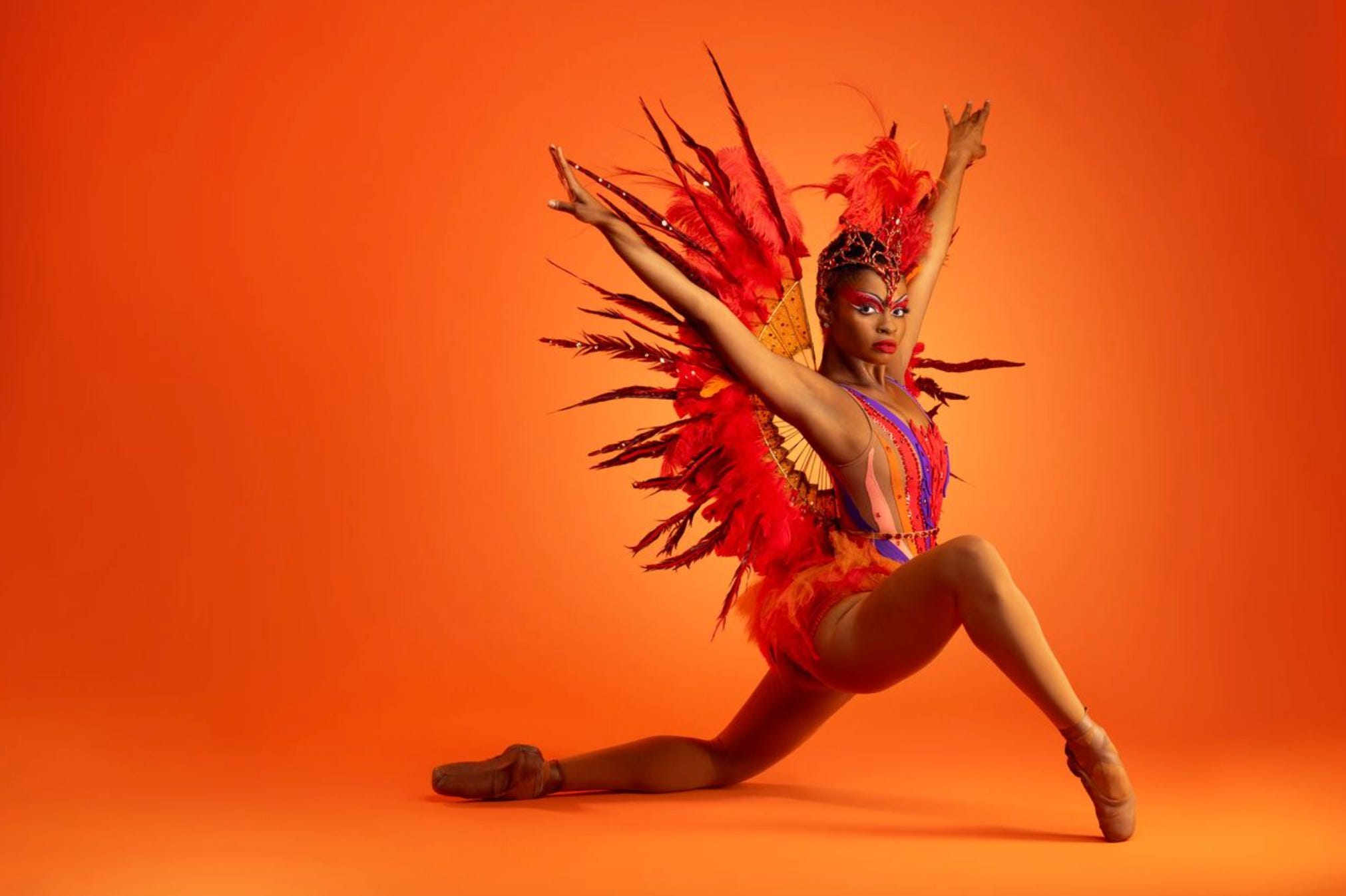
In this episode, we review the luminous interpretations of The Firebird at Dance Theatre of Harlem and its relationship to New York City Ballet’s. Both works are a deluge of beauty and an ocean of visual richness. Though distinct in style and staging, these productions are deeply connected through history, lineage, and artistic exchange.
At the center of that connection is Arthur Mitchell, founding force of Dance Theatre of Harlem and former principal dancer at NYCB under George Balanchine. Mitchell’s career bridges these two worlds in profound ways: shaped by Balanchine’s choreography, including works created on him such as Agon and A Midsummer Night’s Dream, and later transformed by his mission to build something entirely new. In 1969, in the wake of the civil rights era and the assassination of Martin Luther King Jr., Mitchell co-founded Dance Theatre of Harlem with Karel Shook—establishing a school and company where Black dancers could train, perform, and thrive in classical ballet. In that context, DTH itself became both artistic achievement and cultural critique, a bold act of resistance and redefinition.
Balanchine’s influence carried forward not only through aesthetics but through direct support: he served as one of DTH’s early board members and encouraged Mitchell to create a version of Firebird for the company. When it premiered in 1982, it was met with acclaim, praised for its inventive staging and audience-shifting energy.
Where Balanchine and Fokine’s versions of Firebird evoke mythic, wintry Russia, Dance Theatre of Harlem’s interpretation transports us into a Caribbean dreamscape—lush, humid, and alive with color and sound. Giant tropical florals hang over the stage, and Stravinsky’s score anchors the work across all versions, while the Firebird herself arrives in strikingly theatrical ways, including a flash of red light that feels almost playful in its simplicity.
The production thrives in its contrasts: methodical character work against playful theatricality, luminous principals against a shifting ensemble, and moments of imperfect stagecraft that remind us of ballet’s evolving relationship with illusion. At its center is the Firebird, whose presence is a metaphor and a force of nature.
Though Firebird has not been performed by DTH since 2004, its legacy remains a significant part of the company’s identity, reflecting both its artistic ambition and its historical role in reshaping who gets to inhabit classical ballet’s most iconic roles.
If you want more reviews, interviews, deep dives, and LIVES, make sure you join me on Dance Lens Substack—linked HERE: https://thedancelens.substack.com/