Silenced for one and a half centuries, Kathak dance, suppressed under British rule, went underground—yet survived, through secrecy and lineage.
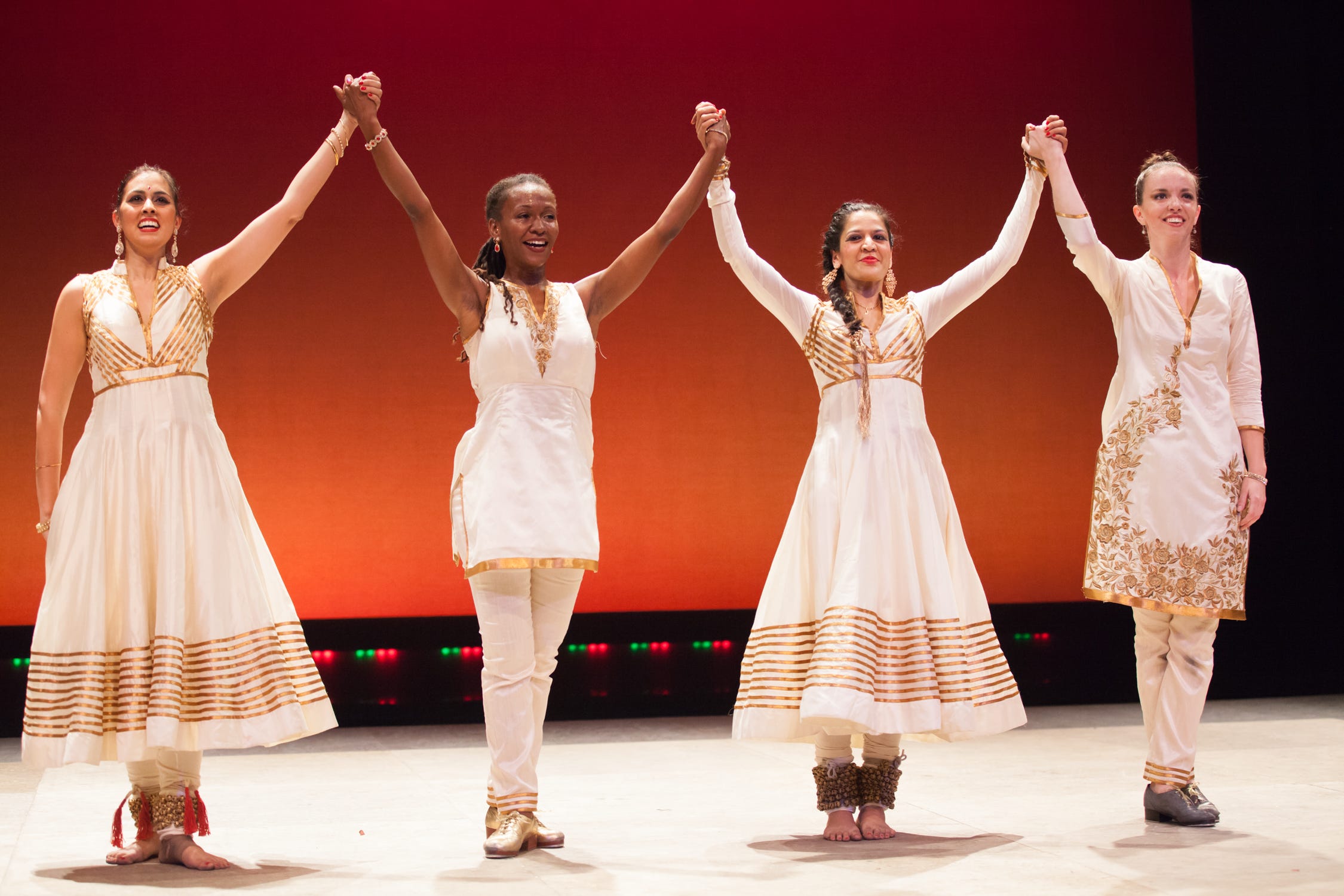
SPEAK Artists (L to R) Rukhmani Mehta, Dormeshia, Racha Nivas, Michelle Dorrance; photo by Margo Moritz.
Rooted in North India, Kathak is a classical form built on storytelling and rhythm, its name derived from the Sanskrit word katha, meaning story. It flourished in temple courtyards as a devotional practice and later in Mughal courts, where it absorbed Persian influences and evolved into a sophisticated interplay of rhythm and theatricality. Though nearly erased from public life during colonial rule, Kathak endured through family lineages and private teaching, preserving a rich vocabulary of footwork, gestures, and improvisation. By the 20th century, master artists revived it on stage, blending tradition and experimentation, reaffirming Kathak not as a relic but as a living, evolving form.
What is the true intention behind Kathak dance?
What place does a 2000 year old dance form have in modern times?
To answer these questions and more, we turn to two leading voices in contemporary Kathak: Rachna Nivas and Rukhmani Mehta, Co-Founding Artistic Directors of Leela Dance Collective.
Nivas, often described as a radical traditionalist, grounds her work in feminine consciousness and Eastern philosophies, challenging Eurocentric frameworks and insisting on Kathak as a living practice. Mehta, a Fulbright Scholar and cultural leader, bridges lineage and innovation through performance, education, and community-building. Together, they reflect on authorship, collaboration, and what it means to carry an ancient form into the present tense.
This conversation is in anticipation of the What Flows Between Us Festival on Feb 21 at the 92nd St Y—a day-long celebration of Indian classical dance and music, followed by an evening performance of SPEAK, a collaboration between virtuosic Kathak dancers Rachna Nivas and Rukhmani Mehta, and American Tap legends Dormeshia and Michelle Dorrance.
Below are excerpts (lightly edited) from the interview, listen/watch the full conversation in the podcast above.
Rachna Nivas
Cynthia: Rachna, you’ve been called a radical traditionalist. What does that demand of you in daily practice and not just in theory?
Rachna: Linda Murray, the New York Public Library for the Performing Arts Curator, she’s the one who had used that term once. When she was introducing me, and I loved it because, that is how I feel on a daily basis because it’s this constant balance of being so deeply rooted in the integrity of the form that was instilled in me day in and day out for so many years.
And the integrity of the form doesn’t mean being stagnant and being stuck in, “oh, well it has to be this way”. It’s not that, it’s being steeped in the spirit and understanding of an entire way of life and that way of life. How does, how does it translate daily is, well, it requires this choice of being really committed to my practice, understanding that, well, if I have to, you know, make choices. I have to decide to practice, maybe over doing a marketing flyer. And that was really, really instilled in us from, from day one. Like, if you can’t dance, what’s the point of all of these meetings? If if you don’t have the precision with your feet, what’s the point? If you’re not keeping your body in shape, in, you know, in tune with, in gear, our guru used to say, you should be able to dance a solo concert next week, an hour and a half solo concert. You should always be prepared. And then on top of that, it’s about trying to get better for the sake of getting better. Not for the sake of a particular performance for the sake of innovation. But for the sake of the pursuit of mastery. That that is the path that we’re on. And that’s not always sexy.
I think the radical part of it is that even though I am committed to this responsibility of not only to the art, but to my training, but to my body, but also it’s this constant interrogating of, okay, yes, that this was a certain way. How is this fitting today?
I have to take my own life experience and I’m a child of immigrants but I’m born here in the US, so I have this very specific lens of how I’m seeing things, both from the perspective of my parents who are immigrants, post-colonial, who have a post-colonial ethos. But then I’m an American kid also. You know, I have a tug of war between western hyper individualism versus the Eastern deeper community value systems. So I’m always thinking about what is the perfect kind of blend between the two?
Cynthia: That argument between the hyper individualism and the community-based sensibilities, that’s always with us whether or not your parents were immigrants. As artists, I think we run up into that daily. It’s like entities show up every day to take us away from our devotion to the form, and it is a constant workout.
Rachna: It’s hard. It’s really hard, especially today when we’re so distracted by it all, and artists are expected to do everything now.
“Ultimately the form is about self-expression. Yes. But also, and almost more importantly, self-actualization. That takes time. It’s why so many Indian classical artists reach their prime in their forties and fifties, because their artistry is backed up by a life that’s been lived.”
—Rukhmani Mehta
The Dance Lens with Cynthia Dragoni is a reader-supported publication. Join us for subscriber only live talks and classes.
.
Cynthia: What’s the biggest challenge with carrying the tradition forward?
Rukhmani: That’s kind of a tough question. I think for me, I would say the biggest challenge is time and the pace of modern life. I think passing on an art form like this takes time. I mean, that’s the challenge. Rachna and I, both of us, we studied with our Guruji for four days a week for 15, 18 years. On top of that, retreats and intensives and performances. The form is about self-expression, yes. But also, and almost more importantly, self-actualization. That takes time.
It’s why so many Indian classical artists reach their prime in their forties and fifties because their artistry is backed up by a full life that’s been lived. And in addition to performing and making marketing flyers and all this, teaching is a big part of our artistic practice, and that was something that our Guruji, our teacher, instilled in us that performing and teaching go hand in hand. Being a performer and being a teacher, those are not separate identities. It’s all one. So I think the time it takes to teach students, the time that students have to give to the art form before you can enjoy the fruits of that labor, you have to invest years and years in technique before you can express yourself and many more years before you can, you know, actualize anything.
Practice is a slow process. So here you have to wake up and post something on Instagram, and you have to answer some emails and there’s so many things you have to respond to and practice is, whoof, it slows you down, it stops you in your track and it lives at a very different pace.
SPEAK Artists Racha Nivas, Michelle Dorrance, Dormeshia , Rukhmani Mehta; photo by Margo Moritz.
Rachna: And I would say it’s challenging to uphold certain standards of the art. And that’s getting more and more challenging in an open market. I mean first of all, the art form was already so behind, we lost 150 years of the masses in India having any access to the art form during British rule.
It was outlawed, it was disenfranchised, it was underground. It wasn’t even seeing the light of day. So it was only during Indian independence, which was in the 1940s that. Indian people started even getting exposed to it. And they were already, for so many generations, had been indoctrinated and conditioned to believe that western things are better. That western way of thinking, western education, all of those things are superior. Our guru comes from a very fringe, sadly fringe deep, deep, artistic world. But it’s a world that, for example, that my parents didn’t have exposure to in India. And so we’re already up against that obstacle of our own community, not having a lot of knowledge about the form. Also trying to bring it to the west. And then on top of that, then you have the internet, and then you have YouTube, and then you have, you know, Instagram, and now you have a whole generation of people and anybody can put up a video of themselves saying they’re doing Kathak. But before this was all guru based, what I mean by that is it was all oral transmission. It was all students and practitioners were legitimized by their group.
They were not legitimized by an Instagram like they were. It was only a master, or like in Japanese, a sensei that will say, this is the next artist, this is the next one to pay attention to. That’s not really the case anymore. And so without that, it becomes very difficult to defend our work. You just kind of have to do it. And we have come to this thing where we’re just gonna keep doing our work and believe that those who are moved by it, those who can see the excellence of it, can feel it in their bones, can feel it in their soul—because integrity will always transcend, they will come to us and we will make progress that way.
Rukhmani: I think, just to add, going back to the time thing, that’s where time connects because standards and excellence take time. But beyond standards, it’s also about the core intent of the form. In the West, it’s easy to extract cultural traditions like yoga or dance as performance, but Indian classical music and dance are paths to consciousness. Masters teach them that way.
It’s that spiritual depth that takes time. It’s not just mastery of technique or artistry—it’s mastery of oneself: ego, psyche, heart. That’s what takes time. Students want pirouettes, footwork, compositions—but without the intent to face oneself, overcome ego, and connect with the divine, it’s just turns. Not dance, I’d say. That’s the stance of my teacher and our lineage.
SPEAK Racha Nivas photo by Margo Moritz.
Cynthia: You’ve spent decades shaping Kathak education in the U.S. How do you navigate holding power in a hierarchy-based tradition while fostering contemporary relevance? How are students brought into the conversation?
Rachna: I love this question. It’s so relevant today. Hierarchy has been questioned because it’s been abused, so it’s important to rethink it. In my classes, we don’t see it as hierarchy—we see it as reverence. And reverence cannot be forced; it has to arise organically from the energy in the classroom.
In my classroom, I don’t even like the word “respect.” It implies obligation. I ask students, “Why are you doing this?” so they critically engage.
At the beginning of class, we do an invocation to center ourselves and contribute to the room’s energy. We chant ancient shlokas and mantras, and students often assume it’s about respecting the teacher. I tell them no—it’s about opening themselves, respecting their own power. Once they do that, respect for teachers comes naturally.
Rukhmani: I’d add that my early days with Guruji were eye-opening. I came in very independent, questioning everything. Guruji didn’t force respect; he welcomed inquiry. Over four years, I learned to trust him—not surrender to him, but trust the process. That trust opened the art form to me and fueled my growth.
Teachers wield power in service to the art form and to the student. Saying “no” isn’t about control—it’s about creating a tight container for learning. Ultimately, education is about relationship: trust, vulnerability, intimacy, allowing another human to shape you. Like deep friendships, parenthood, or romantic relationships—it’s relationship at its core.
Cynthia: The teacher-student relationship is truly unique—probably closest to a parent, but really on its own plane. A truly intelligent teacher senses when a student’s “no” is genuine inquiry.
Rachna: One thing I wanted to add is that our guru loved being called the “modern guru in training.” One of his students called him that, and he loved it because it really captured his philosophy: he was learning every day. He would say, “The day I stop learning is the day it’s over.” He shared his failures and how he overcame them, always modeling intimacy and vulnerability. That’s something I do a lot too. It’s about wielding power in a way that builds trust—not by asserting authority, but by honestly sharing what you’ve experienced. That’s an evolution from older times, when you didn’t ask questions; you just did.
“Before British rule in the courts, the practitioners of Kathak were women and they were courtesans, but they were part of a very esteemed cultural institution where they were the ultimate authority on art, music, dance, conversation. They were quite powerful women. Men who affiliated with them, their was status increased.”
-Rachna Nivas
Racha Nivas
Cynthia: Your choreography interrogates Eurocentric and patriarchal paradigms. Where do you feel those pressures most acutely? Institutions? Audiences? Funding?
Rachna: All of the above. There are so many stereotypes about Indian classical art, and continual pushback against it. Indian women, in particular, get exotified. For example, in our teacher’s company, we trained for months on a complex nine-and-a-half-beat cycle piece, dripping in sweat, and audiences commented first on our colorful costumes, not the artistry or athleticism. So we changed the costumes to black tunics for a show and got great reviews highlighting precision, unison, and skill. We basically had to shed our femininity to be “seen.” That’s just one aspect.
Funding is another challenge. Often, we have to fit Western narratives, like creating a work about anti-racism, climate change, or some theme. Kathak is 2,000 years old; being forced to constantly create “new works” for Western contexts is restrictive. Even every performance, in a way, is a new work—improvisation is at the heart of the form—but externally, the system imposes constraints.
SPEAK Rukhmani Mehta; photo by Margo Moritz.
Rukhmani: Everything Rachna said. Kathak is traditional, but “traditional” carries assumptions. Tradition has always evolved; it adapts to its environment. Our Guruji would choreograph based on contemporary sounds, like a train he danced along with. Choreography itself is an evolution. North Indian classical dance is improvisational; each performance responds to the audience, musicians, and moment.
Rachna: Exactly. Tradition isn’t static, but we constantly navigate Eurocentric frameworks and patriarchy. As women, performing publicly means confronting internalized patriarchy daily. The funding climate and pressure to politicize work compound that. Doing Indian classical dance as a woman is inherently political—your very presence, your body, your artistry, your choices—they’re all political. And internally, after colonialism and assimilation, there’s still a tendency to value Western over our own culture. These barriers are both internal and external.
Rukhmani: Climate change, colonialism, racism—it’s all there. The fact that Kathak survives is a testament to resistance.
Rachna: Exactly. Kathak carries so much history—the syncretic blending of Hindu and Muslim cultures in North India. Persian-Islamic aesthetics merged with indigenous Hindu practices, creating embodied knowledge. That’s already embedded in the form.
The Dance Lens with Cynthia Dragoni is a reader-supported publication. Join us for subscriber only live interactive talks and classes.
Cynthia: You touched on reclaiming the divine feminine. Historically, how does Kathak make room for energies like desire and destruction, and where are you pushing its conventions?
Rachna: Kathak has a history that isn’t often discussed: before British rule, many practitioners were women. They were powerful cultural authorities, skilled in dance, music, poetry, and conversation. Desire, pleasure, sensuality, and precision were intertwined—they blurred the lines between eroticism and artistry. When colonial and puritanical forces arrived, these aspects were suppressed.
That history informs my work. For example, my piece on Kali draws from Indian philosophies that aren’t strictly Kathak but resonate deeply. Kali, though worshiped, is often framed around male figures. I wanted to highlight her autonomy—the primordial feminine energy, paradoxical and whole. This work was also semi-autobiographical: divorce, fertility struggles, moving across the country. Through Kali, I explore feminine energy in its contradictions—only embracing wholeness restores balance to the self and the world.
Cynthia: Beautiful. You’re tapping into a zeitgeist—these goddesses resurfacing reflect the feminine making itself known, a reckoning for the earth and for society. And the dancers historically had power, education, and autonomy. That archetype has long been underground.
Cynthia: Can you tell us a little about Leela Youth Dance Company and what you see as the most critical technical, cultural, and psychological needs of South Asian women in classical training today? You could also address students who are not South Asian women.
Rukhmani: In some classical Indian music and dance circles, and in Western classical music and dance circles, there’s often lamenting about the younger generation not valuing this art and how classical arts are dying. My experience with young women tells me the opposite. Their desire for discipline, excellence, and passion for classical Indian dance is strong. The arts have a bright future.
What they need are teachers and mentors. Mentorship is labor-intensive and doesn’t have much funding or glamour. Raising a dancer requires dedication. Artists are often forced to choose between performing and teaching. These young women need teachers and mentors who will create a container for them. Dance can be a container for conversations about bodies, patriarchy, race, immigration, and culture. They need a space to address these issues, dance through them, and experience joy.
Cynthia: Rhythm is central to your practices. How do you teach it as consciousness, not just speed, virtuosity, or mastery?
Rachna: Rhythm is the most fundamental aspect of being human. The first thing you hear in the womb is your mother’s heartbeat. All indigenous cultures have rhythm as fundamental to rituals. Our guru made it impossible to learn anything in the classroom without first understanding its relationship to the rhythmic structure of Indian classical music, which is cyclical, not linear. There are 16-beat, 10-beat, 12-beat cycles, and half-beat cycles like nine and a half or seven and a half beats.
To master it, you must be embodied. Time, patience, slowness, nature, repetition—all build consciousness because they teach awareness. From the moment students walk into class, it’s about awareness: bowing to the room, crossing thresholds thoughtfully, observing the space, and being present. These rules and discipline open us up to higher consciousness.
Rukhmani: Yeah, and one of the reasons why Kathak and tap can come together is because improvisation is core to both art forms. I would say that improvisation is a phenomenal way to teach rhythm and music as consciousness. Improvisation can be scary. To improvise in the moment can be scary. I can tell you, I’m historically extremely afraid of improvising. I’m still afraid of improvising. I really like to have a plan. I really like to know what I’m doing. I really like to be in control. And improvisation is exactly the opposite. You have to enter life. You have to surrender to some greater force—the collective consciousness. That leap, the minute you let go of self and trust that from somewhere deeper, something will come out in the moment that a tap dancer has just thrown you a rhythm, or a percussionist has just thrown you a rhythm, with 800 people watching—you have to let go of control and enter life. Improvisation is a phenomenal way to teach consciousness.
SPEAK Artists (L to R) Rukhmani Mehta, Dormeshia, Racha Nivas, Michelle Dorrance; photo courtes of Leela Dance Collective.
Cynthia: The festival What Flows Between Us is coming up on February 20. The 92nd Street Y places North and South Indian classical forms side by side while also highlighting residencies with Western classical and jazz traditions. What distinctions do you most want audiences to perceive, and what parallels do you hope they feel?
Rukhmani: The beauty of these forms, all the Indian classical forms, as well as the forms they are engaging in collaboration with, is that the artists are deeply rooted in their own forms. The collaboration is not for the sake of doing a cool project or a gimmick. It comes from deep discipline and devotion to their own forms. That’s when you start to see common currents. Without enough knowledge of your own form, collaborations can feel superficial. The festival title, What Flows Between Us, also reflects that. It centers women and their fluid energy, like rivers.
There are different juxtapositions: Western classical, jazz in the daytime, a poetry reading with dance, an all-female percussive battle between different regional drums of India. North and South India are culturally and artistically very different.
Cynthia: The day culminates in the New York premiere of Speak, which is a conversation between Kathak and tap. What does it mean for this cross-cultural exchange to be led by women, and how do you want audiences to experience the dialogue and the performance?
Rukhmani: One responsibility is to carry forward and evolve our own tradition. Another is to be in dialogue with the world and participate in the conversation happening in our communities. This collaboration carries forward the legacy of our Guruji and Jason Samuel Smith, who began the conversation between Kathak and tap and their communities. We are honored to evolve the tradition and bring female artists’ voices into the mix. All four of us—myself, Rachna, Michelle, and Dormeshia—feel strongly about honoring women in our lineages and elevating our peers.
What we want audiences to take away: in moments during rehearsals, we forget which art form is Kathak and which is tap. Those differences fall into the background because something more universal is at the forefront. It would be incredible if audiences saw how these dramatically different art forms have a seamless conversation while staying rooted in their own lineages and identities. We are not fusing or compromising tradition. Tap dancers are not borrowing Kathak vocabulary. We are having a phenomenal conversation while staying rooted in who we are.
For me personally, this collaboration represents what America has made possible: I am an Indian classical dancer participating in a conversation across artistic disciplines, cultures, races, and communities. I would not have access to these artists and their communities at this level of intimacy and depth without the pluralistic environment I live and work in.
FULL CONVERSATION IN THE PODCAST ABOVE
Join us for the What Flows Between Us Festival AND performance of speak with tap legends Michelle Dorrance and Dormeshia at the 92nd St Y on Feb 21st.
Find Rachna Nivas and Ruckmani Mehta on instagram and on Leela Dance collective.
The Dance Lens with Cynthia Dragoni is a reader-supported publication. Join us for subscriber only live talks and classes.