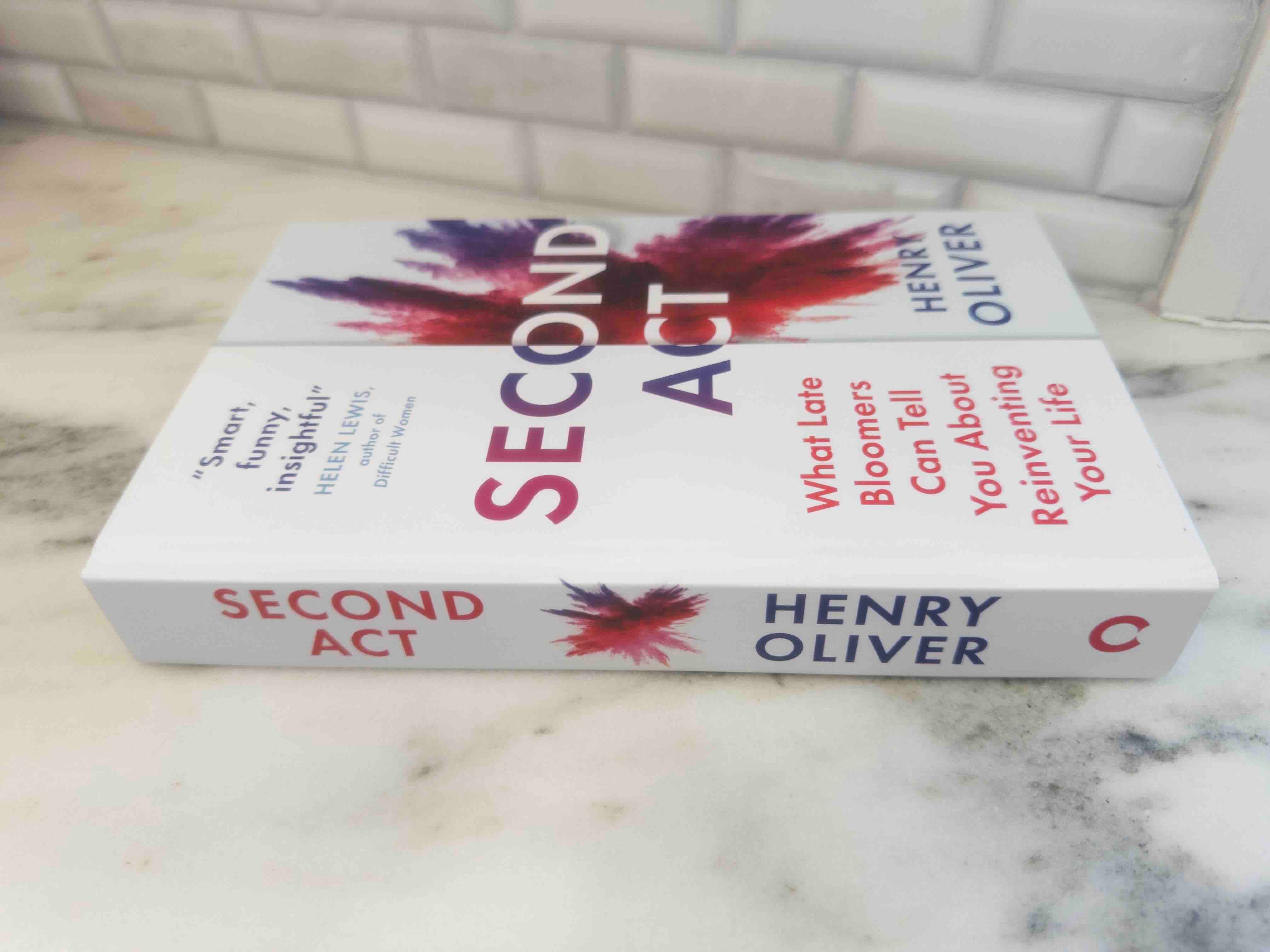
A few months ago, I interviewed Henry Oliver about his book, Second Act, which is my book of the year.
Second Act offers wonderful in-depth biographies and analyses of late blooming luminaries like Katharine Graham, Maya Angelou, Chris Gardner, Samuel Johnson, Ray Kroc, Margaret Thatcher, Frank Lloyd Wright and others. He also delves into less-heralded but no less instructive personalities, such as Audrey Sutherland, who began her solo kayaking adventures of the Arctic after age 60. It also includes shorter, snippet-like lessons from Grandma Moses, Dwight Eisenhower, Winston Churchill, Vera Wang, Norman Maclean, and many others.
(Alas, Henry had to cut a chapter on Dwight Eisenhower. Here it is. Pair it with my biography of General Fox Conner, Eisenhower’s great mentor, and my interview with Steven Rabalais, who wrote the best biography of Conner.)
During our interview, Henry’s revelations about the commonalities among the late bloomers and features unique to one fascinated me. Like the book, I learned so much from Henry’s wisdom during our discussion.
Some Points to Ponder
* I appreciated Henry’s research into people who found success later in life. In the modern age, we have such a fascination with and devotion to youth and achievements of the young. I’m glad Henry has finally given this topic the research and treatment it deserves.
* I came away with a much deeper appreciation of how we might view “success.” Audrey Sutherland fulfilling her dream of solo canoeing the waters of the Arctic, after age 60, counts as a remarkable success. Even if she’d never written about her adventures, doing them marks such a massive success. Henry David Thoreau died not having sold half the copies of Walden he paid to have printed. Was he a failure?
* We seem to struggle mightily to learn from people we disagree with or dislike. In my case, I’ve never read a biography of Napoleon because, well, he was a despicable human being. Margaret Thatcher seems woefully under-appreciated in today’s liberal European milieu. Henry’s book suggests we would do well to take a look at people we disagree with or dislike. They might have valuable lessons to tell.
* Henry notes the importance of The Club to Samuel Johnson’s success. Do you have a group of peers cheering you on? Helping you become better at whatever challenges you face? If you don’t, finding such people would make a huge difference in your work and life.
* I simply loved the conversation. Henry has so much knowledge, thoughtfulness, and wisdom about so many topics — old and new. I’ve gone back to listen to our talk several times — new joys pop out every time.
Tell me about the origin of the book? How did you come up with the idea for this book? Also, how did you meet Tyler Cowen and get connected with the Emergent Ventures grants?
My day job was in marketing, but we did not do advertising for chocolate bars or trainers or white goods. We did advertising for employment. All major companies, organizations, even mid-level places, have an advertising agency for their products and services. And then another one for their jobs. You have to go out to market and appeal to candidates and explain to people: “Why is this a good culture? Why is this a good place to work?” I was the research guy thinking about “Where is the talent? Where's the audience for these jobs? What's going on in the labor market?”
And I was increasingly seeing people in the 50-plus bracket being available, but not being chased by corporations. Then I got ill, and I took some time off work. I was doing a lot of reading of Penelope Fitzgerald, who is a novelist I really love. I was just thinking about her and her life. I read the biography and the letters, all of it. This started bouncing backwards and forwards with going back to work. I was thinking about the changing structure of the labor market and the idea that actually you don't always know how much potential someone has. Fitzgerald wrote her first serious novel when she was 60, and no one really expected it, right?
I became really interested in this topic. And I realized that my clients were not interested in it. The idea of a late bloomer was simply not on the radar for these organizations. You can come back to the labor force if you're a mother and you've been out of the labor force for five or six years. Organizations are desperate to appeal to you, and to reform their recruitment process for you. Because this is obvious talent that is finding it really difficult to come back into the labor force. But if you're a 55-year-old, and I'm saying, “hey, this person could have a whole new career,” organizations are not open to that.
Then I heard Tyler Cowan on a podcast say the phrase, “people who haven't done anything yet, but maybe they will.” And I was like, “Oh, that's it.” That's what I've been noodling on. I started blogging about it. One of my friends said to me, “this is a real thing that you're blogging about.” Then separately, it got to the point where I wanted to quit my job. And I thought, “to hell with it, I'll apply for an Emergent Ventures grant and see what happens.” And I got it. And I wrote the book. It's a long story, but I do think ideas often come out of there being a light bulb moment after a whole load of murky, fuzzy kind of stuff.
You say in the book it's difficult to spot late bloomers before they emerge. Why is that? Is there anything that can be done to spot them in advance? And do they detect themselves? Do they feel they have something inside themselves?
Well, I'm going to start with that last question. I don't think they always do. Some of them do, for sure. I don't know even if what I'm about to say is true. I think to some extent the poet always knows that they are a poet. Now that's obviously not literally true, because there are poets like Edward Thomas, who had to be told by Robert Frost: “you must write poetry.” But some people know that they have something in them, I think. But there are lots of late bloomers for whom that's not true, depending on their circumstances.
Katharine Graham, who I start the book with, had lost her confidence through years of her mother, and then her husband, essentially bullying her. That really did get in the way of how she thought about herself and what she was going to do. But it's very notable that at the crucial moment her husband killed himself, and she inherited the paper – which had been her father's paper, her family's paper – everyone said, “Well you should sell it. You should not run it.” And she said, “To hell with that. I'm not going to be the one who sells the family paper.” She had this great reserve of courage. When she wrote her autobiography, she looked back and she realized that her father had believed in her and supported her. Now, he was long dead by this point, so it was kind of there, but her courage had been squashed down by her mother and husband for years and years. Even the fact that she was quite patrician and privileged – even all that had been knocked out of her. So, I think it varies a lot depending on your circumstances and what's happening in your life.
We have this problem with the books in the nonfiction section called “Smart Thinking.” They present some great rule as if “This Is The Way Things Are. This Is Some Solution.” Psychology tells you that “This Is True,” right? But sometimes what actually happens would be a more accurate way of describing this phenomenon. With late bloomers, I didn’t want to sell you some grand theory that they're all the same. There are some core connections between them, such as having a secret life, or they’re quietly very persistent about their work. Or, often the trigger point for them becoming a late bloomer is some change in their circumstances: a midlife crisis or some opportunity comes through their network.
But they are individuals. We should spend more time thinking, not just about the averages we see when we measure them. Those averages are important and indicative. But we should also b…