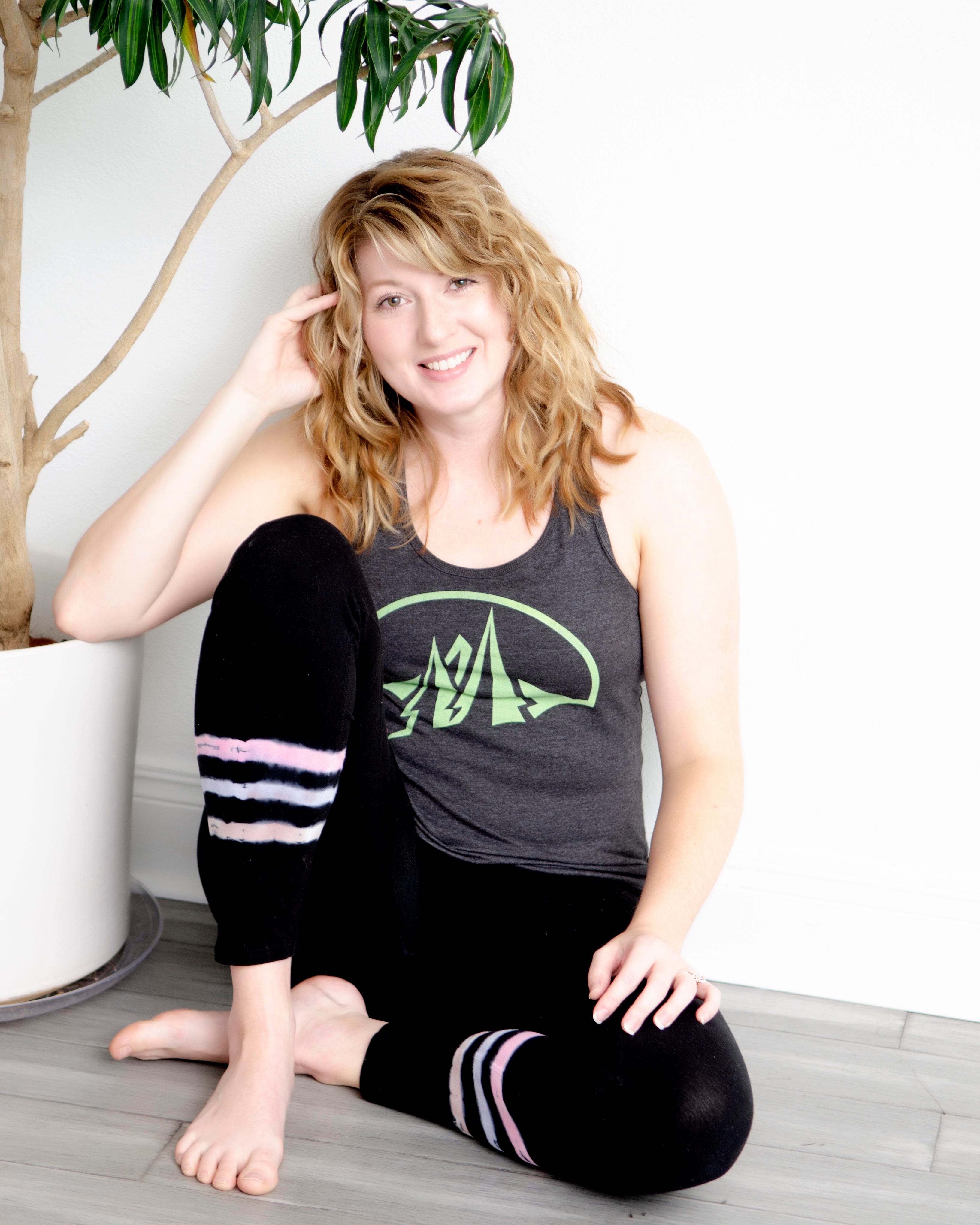
In 2017, coming off a health scare, I needed to become more active physically. My nutritionist suggested I reach out to Laurie LeCompte about yoga. At the time, she was offering private lessons at the Meridian Center on Wallace Avenue in Louisville. Laurie took great efforts to understand my health background – my congenital heart defect, sloped shoulders, near-scoliosis, and weak left arm. She created a yoga practice around my needs and with my aims in mind. For example, it’s good if I can improve my strength and posture – but it’s imperative that they don’t degenerate. Now Laurie owns Yoga Baum, a thriving yoga studio, still in the Meridian Center. I’ve worked with her for more than seven years. My weekly yoga class is a bedrock of my health and strength routine. They’re critical for me.
In 2022, I sat down for a conversation with Laurie. We delve into her journey into yoga and becoming a business owner, how you should evaluate your yoga and fitness “progress,” her interest in ferrets, what “self care” really should mean, reading horror books, and much more!
How did you first get attracted to yoga? What got you interested in yoga?
I was always into physical things and physical fitness. Really, I was looking for something as cross-training for running. I was running a lot of half-marathons. I needed more flexibility, mobility, those kinds of things. And I was having the typical runner-type pains, in my knees and hips, and I wanted to work them out. I'd only ever done endurance sports. I ran cross country in high school. I rowed in college. So I didn't have any experience with anything else. And I was curious about it. Also, it was a time when I was feeling a lot more stressed and anxious. So the idea of a more relaxing and meditative practice was appealing to me, as well as focusing on myself and not having to talk to anybody. Having that time for myself was really attractive.
How did you get started? Did you find a yoga instructor?
There was a studio that I would always pass. They had a 30-day deal and I went there. I had tried yoga a couple of times before that – with friends in college for a couple of classes. But nothing much. So doing yoga was pretty intimidating.
How did things develop from there? You started trying to solve a physical problem, and you became a teacher and then a yoga business owner. That’s quite a progression. Tell me more about that.
I always tend to make my hobbies into jobs somehow. I don't know if that's the perfectionist in me, but I always want to know more about what I’m doing. I had this desire to know more so I completed yoga teacher training. I didn't plan on actually being a yoga teacher. I already had jobs teaching German as an adjunct around town. So I took the teacher training because I wanted to know more, I liked it a lot, and it was fun. But of course, a lot of teachers will tell you that it starts that way. Then as soon as people know that you're a yoga teacher, you're called on to be a substitute teacher in classes. So literally the week I returned from teacher training, I had my first classes to teach. It took no time to find a job.
The fact you found a teaching role immediately – it speaks to the explosion of interest in yoga across the country over the past 20 or 30 years. What explains that astounding growth?
There was a big yoga boom when people in Hollywood started getting into yoga and looking into different types of fitness and spiritual practices. Some teachers would go to India to study and bring back what they taught, and some places started hosting famous yoga teachers for workshops. So a lot more people had exposure to yoga through these visiting teachers, and through what they were seeing celebrities doing.
Here's a terminology question I struggle with. I have a strength “trainer” and a physical “therapist.” When it comes to you and yoga, I struggle to describe what you do. What do you call yourself? How do you describe what you do?
The terms “teacher” and “instructor” are mostly interchangeable to me. If I want to get picky, teacher has a better ring to it, maybe more clout. I am actually teaching something and instructor sounds more like a fitness instructor simply leading people through the motions. And yoga is more than fitness. You can definitely get fit doing yoga, but since it's more, I prefer the term teacher. But please don’t call me your “guru”!
How do you think about a student's progress? Is “progress” even the right way to think about it? How do you evaluate how a student is doing and what they need to do going forward?
That's a really interesting question because people come in with certain goals, and oftentimes just by practicing yoga, their goals will change. They may start wanting to achieve something physically impressive. But then the more they practice yoga, that becomes less necessary for them – they just want to feel good. So it really depends. When my clients start out, I have them fill out an intake form. It gives me a lot of information about why they're seeing me in the first place. I want to understand what progress looks like for them. A lot of people's goals are oriented around pain relief. When they come to see me for private lessons, the most common reason they come is because they're in pain. And it's a pretty easy thing to measure: how much pain were you in when we started? And how much pain do you feel today?
So for private lessons, most people see you because of pain. What is it? Acute pain? Chronic pain?
Back pain is the main reason. But there are also injuries and people who are recovering from surgery, like a knee replacement. Some people feel terrified to move after a surgery like that. They think if they move a certain way, it’ll hurt really badly. And that sort of perpetuates the cycle of those areas becoming super-sensitive. So they come to yoga to learn a different way to move that hopefully feels better.
What’s the right timescale to be thinking about progress when you start a yoga practice? Looking back, I could tell a huge difference after about a year.
I think it depends on why they're here. For some of the pain issues, I would say a couple of sessions can make a difference. That doesn’t mean the pain will be gone. But they can tell a difference – in pain level and in their movement. Your goals were long-term, and so it took you longer to become aware of the progress.
I plan to keep doing this for life because I want to postpone regression as far as long as possible. Again, getting stronger is great, but I do yoga with you to help prevent deterioration.
We also have to be realistic with goals. People who want to get stronger – at some point they’re going to reach a limit, either because of age or just physical capacity for those things. So yes, there are reasonable goals and sometimes we have to have those conversations too, about what’s realistic. People might come in wanting to learn how to do a handstand. If they can't hold a plank for 15 seconds, we're pretty far off from the handstand.
We've gotten me up to where last year I held a five-minute plank. But my desire to go to a six-minute plank is virtually zero. It doesn't matter. But being able to maintain a plank for four of five minutes, that’s somewhat indicative that I’ve maintained strength, which is what I want to do. Let’s move to a different subject. Tell me about the mental shift you made when you moved from being a yoga student to a yoga teacher. And how do you think about being a teacher today?
Even now, there’s more and more to learn – absolutely a universe to explore. Continuing education is super important to me and at the studio. If you teach here, there's actually an annual continuing education requirement. So it’s very important to me that we all remain students and we all remain fresh. And I think that we should change as teachers throughout our careers. When I started teaching yoga, I was already teaching German. There was definitely an advantage there – I knew about teaching a…