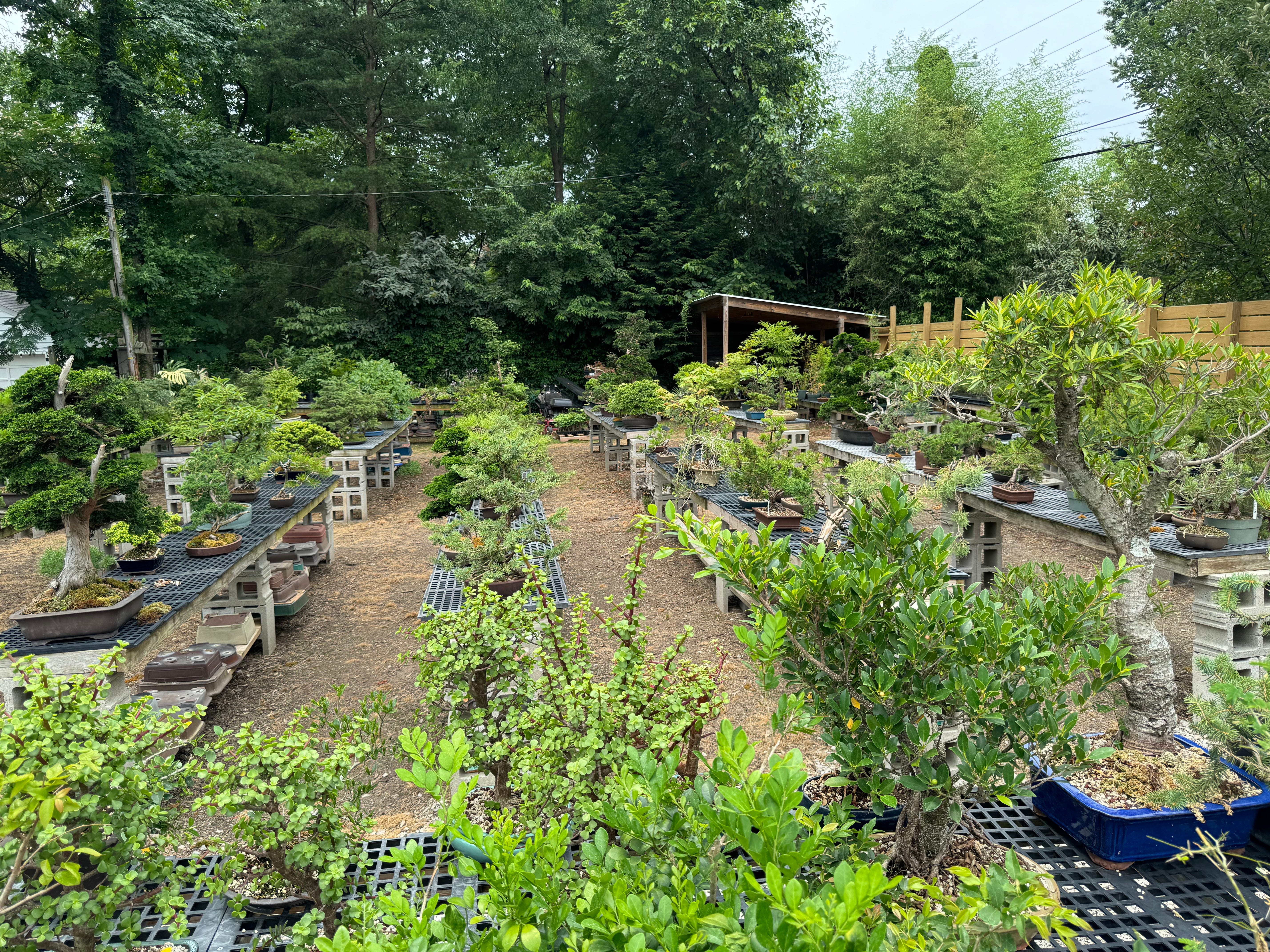
In 2022, prompted by, well, I don’t know what, I decided to look into getting a bonsai tree. I knew nothing about them, but something in the deep recesses of my mind urged me on. A few years before, my yoga instructor, Laurie LeCompte, had given me an air plant as a holiday gift. So I asked Laurie if she knew where I could find a bonsai.
“There’s one guy in town. I only know him as the Bonsai Guy. If you Google ‘Bonsai guy Louisville,’ he should turn up,” she said.
Sure enough, that search yielded Russ Stevens of Twisted Nature Bonsai. I reached out and set up a class. Russ spent two hours with me, teaching me the (very) basics of bonsai, soil, watering and fertilizer. I bought a small Brazilian Rain Tree. I was hooked.
I visit Russ’s nursery often, for education, fun and to give my bonsai some TLC at the “spa” as Russ calls it. Louisville boasts some truly wonderful outdoor spaces and gorgeous nature walks. Walking in Russ’s nursery remains one of my very favorite nature walks, in Louisville or anywhere. I visit as often as I can. His nursery and our conversations always inspire me.
Last summer, Russ kindly sat down with me to share some of his trees, artistry and wisdom. You will love it!
AND, if you live anywhere near Louisville, come check out Bonsai Weekend at Waterfront Botanical Gardens, May 30 to June 1, 2025. The shows in 2023 and 2024 were unbelievable. My family and I loved every tree. This year’s Bonsai Weekend is shaping up to be simply unforgettable!
Let's start with the basics: what is bonsai?
Bonsai simply means a tree grown in a pot. We use Ligneous wood, which is wood that actually grows on itself year after year, and specialty soil to be able to grow in a smaller container.
How'd you get into trees? You're an arborist – have you always been interested in trees and nature?
Actually it came later in life. I graduated with an IT degree from UK [the University of Kentucky]. I didn't want to do help desk work or work in an office. I had a number of lawn and landscaping clients and I decided to pursue that. I got a truck and equipment and started doing it full-time. That led to me gaining an interest in trees, Japanese maples specifically.
My mom's name is Rose. My grandmother always had a rose garden, so that was my first start. But, I don't like roses because they're thorny. They're beautiful. A lot of the good varieties are very fragrant, but they're a lot of work. I worked in my grandma's garden and we had some roses at home. My father's a surgeon, so I needed to do something besides be a lawn guy. That's when I started to specialize in trees. There's a horticultural consultant in town, and we did classes at Cave Hill Cemetery, which is a National Arboretum Cemetery. Some of the most beautiful trees around. This was back in 2010 or 2011, and we still had lots of the big trees. We've since had big storms that have taken some of the massive ones down. I got in with her and learned about tree identification through all the seasons.
Then I started doing a lot more tree plantings. I hired someone from Bob Ray. He performed most of their plant healthcare treatments, which would be deep root feeding, root collar excavation, and soil amendments, for example. He taught me about that stuff, which is pretty much the most technologically advanced thing you can do for a tree in the ground. That's when I switched over from cutting up trees to planting and growing them.
When I became interested in trees, I got a small bonsai, in Indianapolis at the White River Gardens. The local club had little vendors there. I got a little shimpaku juniper. The next year I took my first workshop, with Ryan Neil, my original teacher, from St. Helens, Oregon, and one of the world's most renowned bonsai professionals these days. It was with Ryan, but it was at Bjorn Bjorholm’s house with Owen Reich and Shannon Salyer, and other big names in bonsai today. It was kind of neat to be at his first workshop That was my first workshop with a professional and it was eye-opening, mind-blowing.
So, you buy one bonsai in Indianapolis, and then you go study with this famous teacher. Why did you decide to do that?
Well, there was an open spot in the workshop. So, I took it. I don't read a lot of books or magazines for education. I really like to practice with people that are currently performing these services. Ryan had just come back from Japan, where bonsai is most popular. He had plenty of good knowledge. The difference with him versus previous professionals who had traveled to Japan is that Ryan was sharing all of his knowledge. He wasn't holding it back. He had been to Europe, Africa, Canada, and other areas that had less strict importation laws. And they had much better trees all across the board. And he’s trying to elevate bonsai in the United States. In fact, he is still one of the top proponents for bonsai educational out there. Super good guy, super intentional. I studied with him consistently for three years, and I went to at least one workshop a year with him, for seven or eight years.
I was kind of a groupie and followed him around whenever he was within driving distance.
What does studying bonsai mean?
There's no college for bonsai. Lots of these teachers offer intensive courses. Bjorn’s class was three years. Ryan’s class was also three years. We would do 12 work days with them each year. I would spend three to four days at a time with them, practicing, learning new techniques. And I’d do that three years in a row. We’d come at different times to work in different seasons.
I completed Ryan’s program on junipers. It was a huge commitment. It was out in Portland. Luckily, I had a best friend who lived out there, so I stayed with him and drove to his Mirai nursery.
Bjorn had a very similar program. We got a certificate at the end, which doesn't necessarily mean much. In Japan, they've got the NBA, the Nippon Bonsai Association. It’s a certifying body that will make you a legit bonsai professional. And a number of Americans have achieved that certification.
Tell me about the difference between caring for big trees, and caring for small trees, for bonsai. I don't mean things like tools and soil. I mean the approach you take, your mindset and goals.
Whenever I work on a tree, I'm going for ultimate health. I want to help it get back to where it was. That's the number one goal. How aggressive I am in my treatment program will vary. When I'm working on a big tree, most of our problems are with roots or soil. So sometimes you'll be able to see the root issues, but if you see a fairly good root flare, trunk flare, then it's a soil issue. Meaning: whether the soil is too wet, too compacted, or doesn’t contain enough oxygen. There's an easy way to remediate that: by blowing that soil away and backfilling it with lighter, airier soil.
With bonsai, it's a direct correlation. Bonsai are super-pampered and well-cared-for. They get watered way more than yard trees and receive way more fertilizer. If there's a problem up top, then there's a problem in the soil. You can address that immediately with a bonsai. You can take it out of the pot, cut out the exact area of rot. Or you can take out that impervious area where water can’t get to, and then replace it with fresh soil. And the tree will continue to grow just fine. With bonsai, you can make that immediate resolution.
Part of bonsai is wanting to make bonsai look like big trees, like you’d see at Cave Hill Cemetery or in a National Park. If you see a big Western Red Cedar, you can recreate that into bonsai form. We want to provide the same look as a tree on a smaller scale.
The pictures in the American Bonsai Society magazine are amazing. Trees are hanging way down and they're…