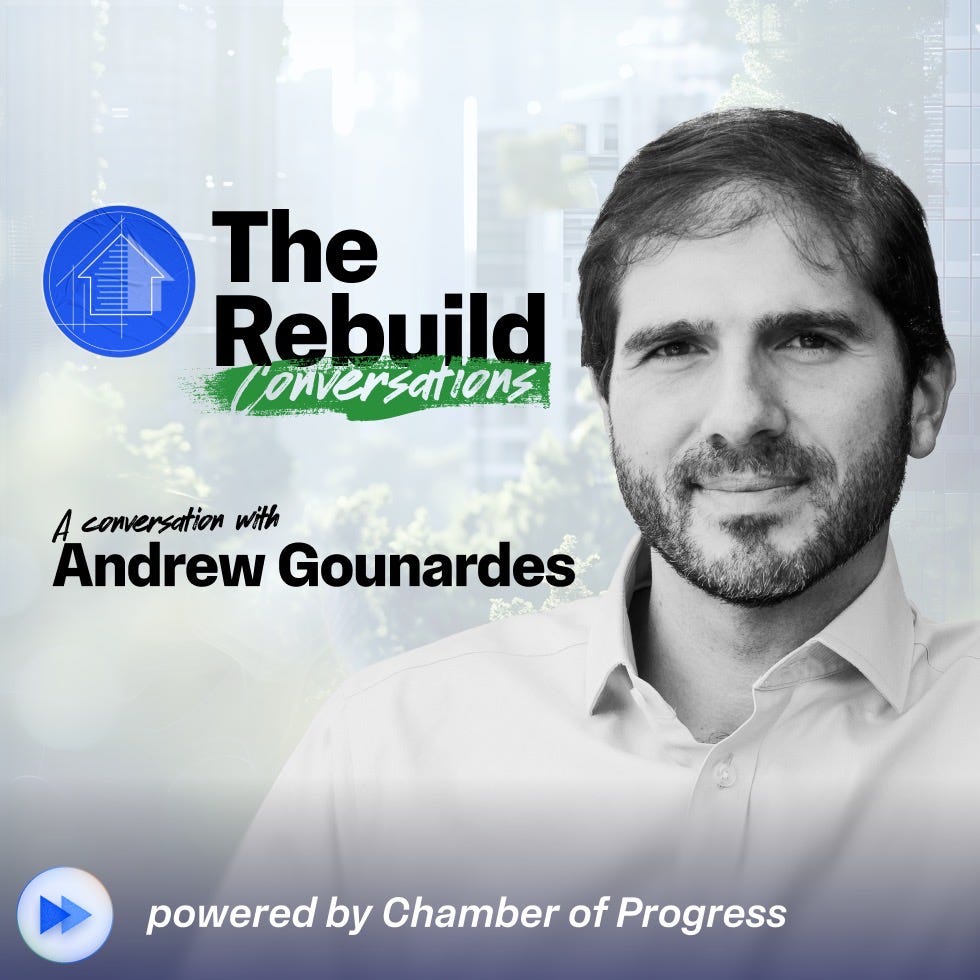
This week we sat down with New York State Senator Andrew Gounardes, who represents the 26th District in Brooklyn and chairs the Senate’s Budget and Revenue Committee.
What stuck with us is his diagnosis of the diagnosis. Every politician has learned to say “affordability.” It’s been poll tested, it passed every focus group, and as Andrew puts it, tattoo it on your forehead. Almost nobody has done the harder work of asking why a specific bill is too high for a specific family. He knows because he reads the call log every night. Fifteen calls about food security. Six about landlord-tenant disputes. Eight about people who can’t pay their heating bill. That’s not polling. That’s the district telling him what hurts.
From there we get into the Working Families Tax Credit he drafted on a napkin during downtime in Albany, the 8,000 units going up in Gowanus outside his office window, and why he thinks New York’s population loss is the ballgame: Texas gains five House seats next census, and blue states lose the ability to govern nationally. Stay for the rapid response round, where we find out his retirement plan is being a park ranger at Gettysburg.
What Brooklyn is actually calling about
Tahra Hoops: Hi everyone. My name is Tahra Hoops. I’m joined by my co-host, Gary Winslett, and today we have a very special guest, Andrew Gounardes, who represents New York’s 26th State Senate District. He covers the Brooklyn waterfront neighborhoods from Brooklyn Heights to DUMBO. He’s served in the Senate since January 2019, where he unseated Republican Marty Golden in what was then the 22nd District.
He chairs the Senate Committee on Budget and Revenue, which makes him a central player in Albany’s annual budget fight and one of the most visible legislators on state tax and fiscal policy. He’s been a major champion of family affordability policy, where his signature push has been trying to expand the Working Families Tax Credit, and he’s written more than a hundred laws since 2019. And also, he was my former professor way back in the day at Hunter College, so very happy to have him here.
Andrew Gounardes: Great.
Tahra Hoops: Yeah, thanks for being here. So obviously, you represent a very diverse area of Brooklyn. It’s basically the full spectrum of the New York affordability story. So I would love to know what constituents are telling you right now and how it might differ from area to area.
Andrew Gounardes: Yeah. So I’m lucky that I get to represent 350,000 Brooklynites in the State Senate, spanning from Bay Ridge down in the south where I was born and raised and where I live now with my wife and my three kids, all the way up to Brooklyn Heights and DUMBO and Vinegar Hill, and including a wide swath of the very, very diverse socioeconomic trends that are rippling across the city.
And I think that we keep saying that affordability is a top concern for so many people, and it really is true, but it really hits people in different ways. We see this in my office constantly based on the phone calls we get from constituents asking for help. And the things that we hear the most about from people are, of course, housing, because housing is perpetually in New York a challenge.
But even with housing, it depends neighborhood by neighborhood what types of phone calls we get from people. We hear a lot about housing. We hear a lot about childcare, and a lot of excitement around this push for universal childcare, but just a lot of people struggling to figure out how they can solve their own childcare needs while we build out a full universal system.
We hear about energy costs quite a bit, and just the overall everyday cost of things like food and school supplies and utility bills, which have been skyrocketing here in New York and everywhere across the country. So it really runs the gamut, I would say, across the board. People are feeling the pinch in their pockets and in their wallets, and it’s been like this for quite some time. This is not a new phenomenon that we’ve all of a sudden just discovered. This has been going on for years.
The diagnosis Democrats skipped
Gary Winslett: So you mentioned that it’s been going on for years because, so Democrats have been talking a lot about affordability in the last year or two, but you’ve been on this beat for a while. And so I’m just curious, what do you think Democrats maybe, maybe not right now, but in the past got wrong in terms of how they talk about affordability?
Andrew Gounardes: Yeah. So for me, this has been a primary focus. And one of the reasons why is because, and every office operates differently, but every night I get a summary of every call that comes into our office, and it’s organized by what they’re calling about and a summary of what the issue is.
So I can see in almost real time, at least on a daily basis, we had 15 phone calls today about food security. We had six phone calls about landlord-tenant disputes. We had eight phone calls about utility, unable to afford their heating bill or their cooling bill or whatever. And so I get this data pretty regularly, and so I had a good sense as to where people are feeling the biggest challenges in their life.
And what I think we have missed the mark on, everyone is using affordability as a watchword today because it’s been poll tested, it’s buzzy, it’s passed every focus group. Everyone’s talking about it. Tattoo it on your forehead. It’s like the word to say. But what I think we’ve gotten wrong is a more honest diagnosis, A, about the depth and the severity of the problem, and B, the multiple factors contributing to the causes as well as potential solutions.
I think when politicians talk, they like to identify a problem, and then they have the solution for it. The one solution. So whatever idea is theirs, either they created it or it’s part of their ideological worldview, but that’s the only solution for that particular problem. And that’s just not true, and that doesn’t always accurately capture an honest diagnosis as to what the real underlying problem is.
Your utility bills are too high, so are mine. Why are they too high? And so let’s deconstruct that. Let’s figure out what are the number of tools we can deploy to solve that problem. Your housing is too expensive. My housing is too expensive. Is it because your landlord is illegally raising your rent, and that’s a problem? Is it because you can make your ends meet, but your head’s barely above water? That’s a different problem. Is it because you’re trying to save money to maybe buy an apartment, right, a starter apartment? That’s a different problem. We have to do a better job, I think, at looking at the full field of what people are experiencing, and then come to the table with a whole array of ideas and options to try to help solve for them.
The Working Families Tax Credit, written on a napkin
Tahra Hoops: I’m glad that you were looking at the different causes that could happen, because a lot of the times when people are in such a massive crunch, they just try to get through to the next paycheck. And we shouldn’t want that to be the standard of living. It shouldn’t just have to be to just survive paycheck to paycheck.
We want everyone to have a standard basis where they feel comfortable. And a lot of studies have shown that putting money back in families’ pockets, not just benefits where they could only use it to redeem food or so forth, like actual money, people have been very responsible in using it for necessities. And because they don’t have to worry about their necessities, they are able to now build themselves out and create more economic opportunities for themselves.
And that’s why I wanted to talk about what I mentioned previously, the Working Families Tax Credit that you mentioned. I would love to know what it does differently from existing patchworks. How does a quarterly payout work? And just give us an overall feel for it in case people might not be aware of it.
Andrew Gounardes: Sure. So the Working Families Tax Credit is a proposal …