The best way to enjoy this episode is to watch the video, which comes complete with subtitles, maps and other visuals. I urge you to watch it; you'll find it at edmerrison.substack.com. Don't forget to follow along with happenings on Instagram, too: @vininspo.wine
So, when Bryan Adams was getting his first real six-string, Guillaume Michel’s grandfather Louis was kissing goodbye to his last oak barrel. Two pivotal moments during the summer of ‘69 right there; one led to a cheesy soft-rock catalogue, the other to a library of flinty, pure Chardonnay. I know which repertoire I prefer.
This domaine in the heart of the village of Chablis is a reference point. “Those who favour stainless steel want the purest flavour of Chablis, with the firm streak of acidity and the mineral quality that the French describe as goût de pierre à fusil, or gunflint,” goes the entry in the Oxford Companion to Wine, before declaring: “Louis Michel’s is generally considered to be the epitome of this style.”
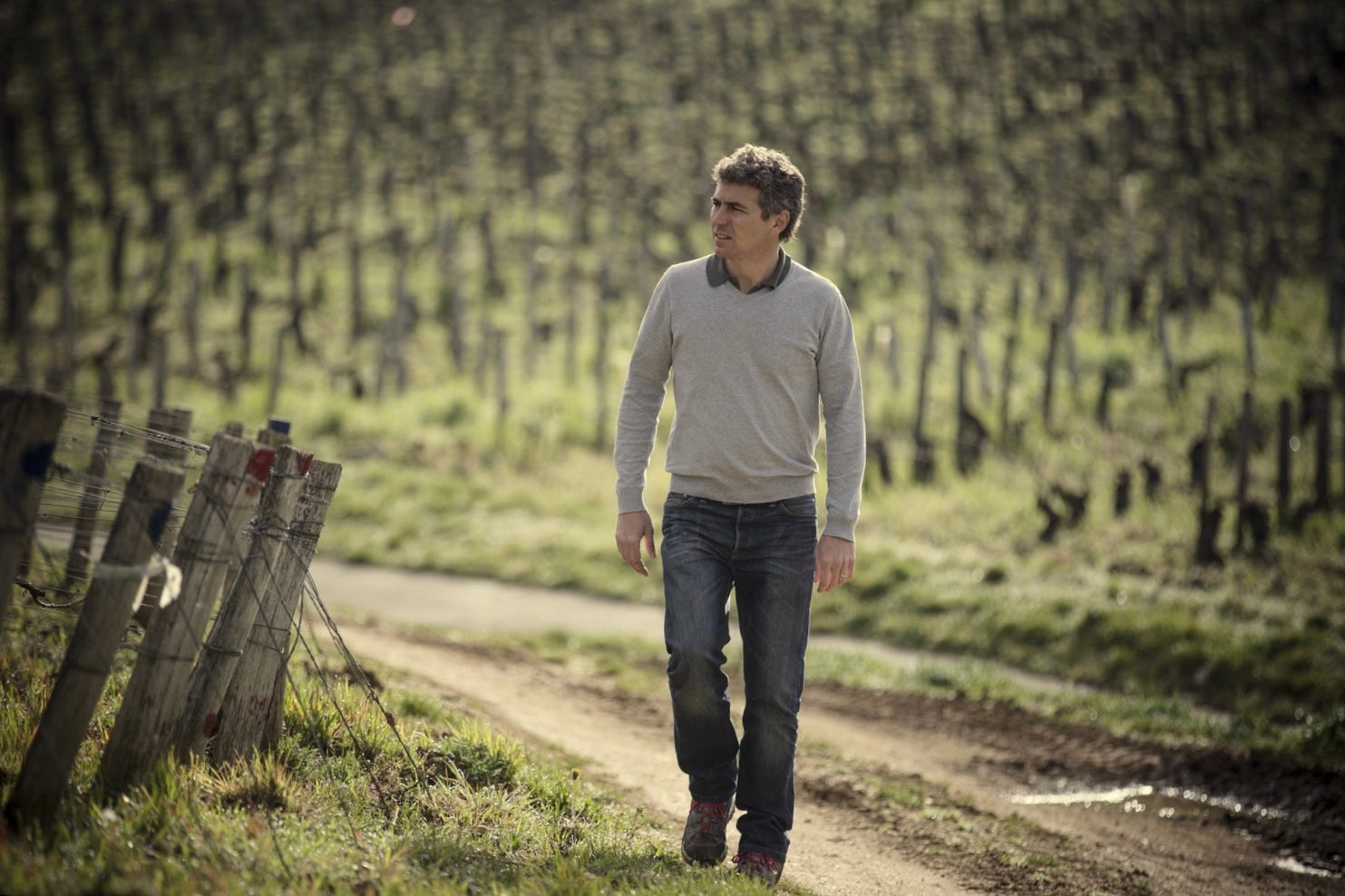
I’ve known its current custodian, Guillaume, for over a decade and work for his Australian importer, CellarHand. His good humour, exceptional English and incredible vineyard holdings in the historic heart of the appellation convinced me that he is the ideal guest for an in-depth discussion of the lie of the land and the wines it produces.
The purpose of this 45-minute video is to start with the historical and geographical basics—climate, topography, geology, etc.—and delve deeper into the subtleties of terroir and how to mitigate challenges to maximise its expression in the glass. Much of this is objective, some is subjective, but I hope it is all, somehow, instructive, adding to a listener’s understanding and, crucially, enjoyment.
Guillaume sprinkles the domaine’s specifics through our conversation, but in a nutshell, premier and grand cru wines account for 70% of production at this 25-hectare estate, turning the norm for the region on its head. He owns vines in the Left Bank premiers crus Montmains, Forêts, Vaillons, Séchets and Butteaux (plus a separate parcel bottled as Butteaux Vieilles Vignes), and the Right Bank premiers crus Vaulorent and Montée de Tonnerre. The domaine also produces Grand Cru Chablis from parcels in Grenouilles, Les Clos and Vaudésir.
There’s a particularly enlightening segment about flag-bearing premiers crus. This refers to the practice of grouping a family of premier cru sites under a headline or banner climat. Wines carrying the flag-bearer’s name could contain grapes from various sub-climats within the family, or just from the flag-bearing climat or, indeed, a sub-climat within the group that enjoys less fame than the flag-bearer. We discuss Guillaume’s Forêts, Butteaux and Montmain wines, all of which are grown on the Montmain hill. Séchets and Vaillons grow on the Vaillons hill. On the Right Bank, Vaulorent is part of the Fourchaume premier cru grouping, and Montée de Tonnerre is a flag-bearing premier cru.
The maps help illustrate this, and my thanks go out to the Bourgogne Wine Board (BIVB) for its assistance with visual material. It is an excellent resource for anyone interested in Burgundy’s wines.