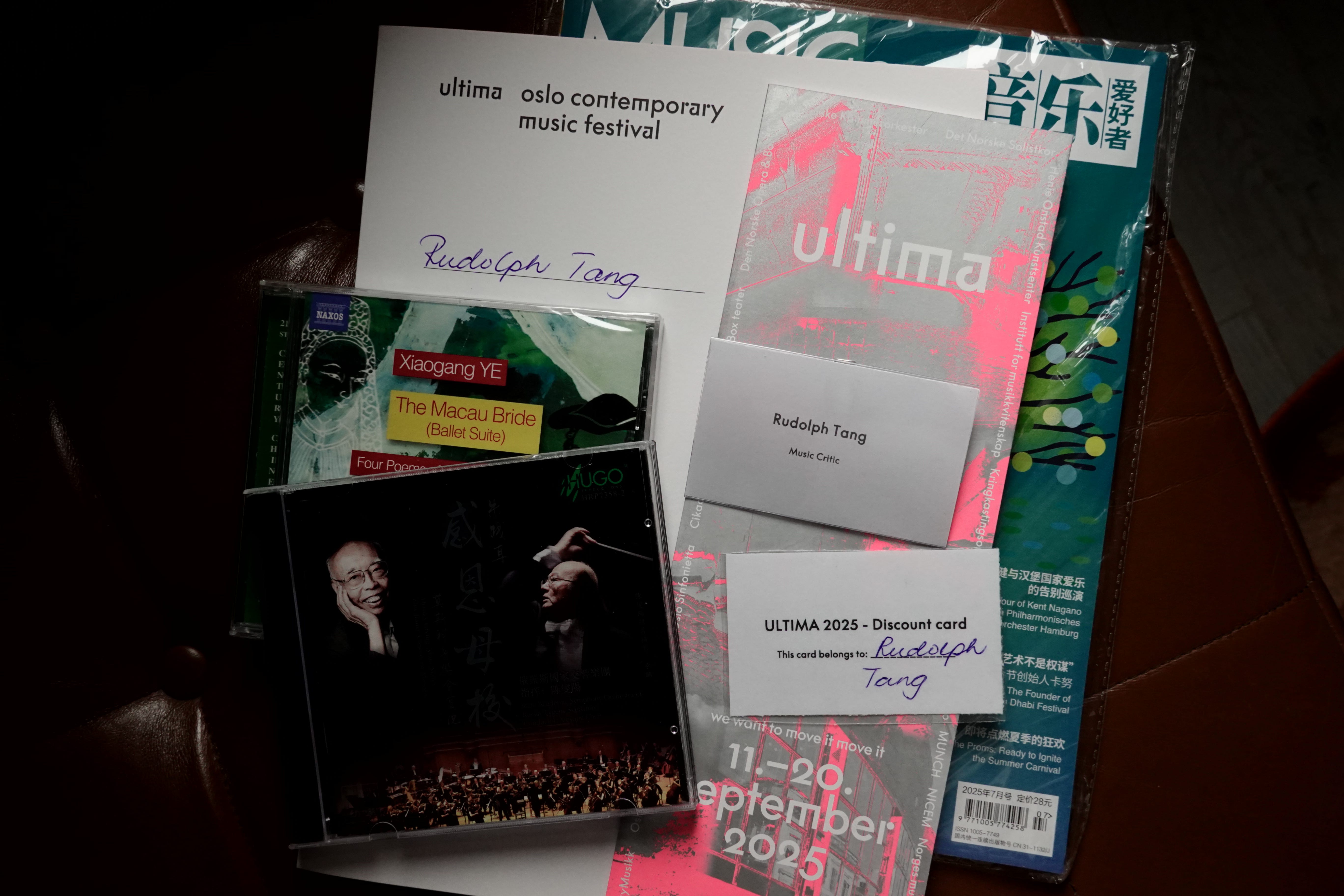
Ultima - Oslo Contemporary Music Festival once again affirmed its reputation as one of the world’s most adventurous platforms for contemporary music. The 2025 edition runs from September 11 to 20 across theatres and unconventional venues like a mausoleum, a sewage treatment plant as well as galleries sparsely scattered around the town.
Established in 1991 by Norway’s leading cultural institutions, the festival has become a fixture of the international calendar, known for stretching the boundaries of sound, place and experiments.
Arrival in Oslo
A Chinese delegation of three attended the festival’s delegation programme running from September 11 to 14: Guo Hai’ou, Executive Director of the Beijing Modern Music Festival hosted by the Central Conservatory of Music; Rudolph Tang, Shanghai based member of the Chinese Music Criticism Society; and Wang Tiantian, Professor of Composition and Conducting at the Shanghai Conservatory of Music. For Guo and Wang, it was their first visit to Ultima or even Norway. For Tang, it was a return after attending in 2019.
Arriving on early morning of September 11, the delegation set to work almost immediately, combing through the festival programme and studying maps in the hotel lobby before checking in. That mixture of eagerness and urgency set the pace for what was to come.
Sounding the City
The first afternoon was spent at Oslo Central Station Square, where Guo and Tang experienced an outdoor sound installation staged in a modest wooden festival cabin amid a constant rain pour. Musicians on double bass, flute and marimba improvised with a conductor, drawing the city’s own noises into the textures. The reverberant quality of wood, the shifting rhythms of traffic and the damp acoustics of a rainy afternoon folded seamlessly into the work.
That evening, the festival’s official opening concert, City Lines by Joanna Bailie, filled Oslo Cathedral.
The work stitched together 280 field recordings gathered from tram lines, metro stations and intersections across the city. Oslo Cathedral Choir performed with electronics, tuning forks, stylised block patterns and fragmented, repetitive and static melodies, producing a meditation on the sonic life of urban motion. The opening drew a full house, with the cathedral’s vaults resounding under the combined weight of memory, ritual and experiment.
Afterward, a reception at Sentralen, Ultima’s central hub, brought together international visitors. Guo shared programme books of the Beijing Modern Music Festival, while Tang distributed copies of Music Lover magazine carrying his stories on Borealis in Bergen.
Beneath the City: Nordheim’s The Droplets
The next day brought an unforgettable journey underground. At the Bekkelaget sewage treatment facility, Arne Nordheim’s The Droplets—a sound installation first realised in 2001—was staged in vast grotto-like caverns. Hard hats, goggles and reflective vests were mandatory.
From dozens of speakers hidden in the chambers, tiny sounds—drips, footsteps, voices—were captured, refracted and recombined by electronic processors into endless variations. The result was both awe-inspiring and unsettling, an environment that blurred the line between industrial function and artistic imagination.
Walking through those echoing spaces felt less like visiting an artwork and more like entering a living organism, or stepping onto a film set suspended between Hitchcock and science fiction.
Museums, Music and Rain
Rain was a constant companion, but it didn’t dampen enthusiasm. Rudolph Tang took a ferry to the The Norwegian Museum of Cultural History on September 13th, where the open-air campus preserves wooden houses and farmsteads from the medieval period to the early 20th century. Exhibitions devoted to the Sámi people provided a parallel perspective on Norway’s layered history, reminding visitors that sound is also cultural memory.
That evening, the festival’s experimental streak came to the fore with Liquid Room XII: A Perfect Life. A hypnotic music marathon orbiting Robert Ashley at the Norwegian National Opera’s black-box theatre. For more than three hours, ensembles moved seamlessly between three stages in an unbroken stream of sound. With no conductor and no formal cues, the musicians achieved uncanny synchronisation. The audience, standing throughout, remained transfixed until nearly 11pm. The setting recalled Stockhausen’s Gruppen for three orchestras, not in sound but in stage setting.
Breakfast with Stockhausen’s Legacy
Perhaps the most intimate encounter came on September 14, when a small group of international guests, including Rudolph Tang, were invited to the home of Christel Stockhausen, daughter of Karlheinz Stockhausen, who recently took Norwegian citizenship.
Her fjord-overlooking house just outside Oslo doubles as a private archive, with shelves of manuscripts, paintings and the Grotian-Steinway grand piano once used by her father purchased in 1951 around his first marriage. After an introduction made by Heloisa Amaral, Artistic Director of Ultima, a young Norwegian pianist played selections from Stockhausen’s piano works on the instrument, turning the breakfast gathering into a living homage. Discussion by Christel moved through her childhood, her father’s fascination with harmonics, and the genesis of Stimmung, each anecdote layered with both scholarship and intimacy.
Later that morning, Stimmung itself was performed in the Emanuel Vigeland Mausoleum with an extraordinary 17-second reverb which created a panoramic sound effect. Six singers from the Nordic Voices intoned for over one hour, weaving harmonics and overtone chanting into an immersive atmosphere that felt simultaneously sacred and otherworldly. The resonance was so profound that some listeners described it as a kind of soul-lifting detachment. Christel herself attended, accompanied by her son, completing the circle between family legacy and exclusive ritual.
A Festival of Encounters
Taken together, these days in Oslo demonstrated Ultima’s rare ability to weave music into the fabric of place. Whether in cathedrals, sewage plants, museums or black-box theatres, sound was never isolated from its surroundings. It was part of a larger ecology of architecture, weather, history and community.
For the Chinese delegation, the week was not only about listening but also about exchange—between cultures, traditions, individuals and institutions. Ultima offered more than performances; it offered encounters that resist easy translation. The memory of rain-soaked streets, echoing caverns and voices dissolving into harmonics will linger long after the festival’s close.