June 25, 2025
On June 18th, I predicted that Israel would lose Operation Rising Lion to Iran’s True Promise 3, even if the USA intervened, which they did with Operation Midnight Hammer. I argued that hypersonic missiles would change the outcome and financially nor ammunition wise, Israel would not be able to sustain a war. I predicted that the GBU-57s would not be effective. I also wrote, on June 14th, that Netanyahu’s quest to destroy the Iranian nation through claims of Iranian nuclear warhead capability over 33 years set him up for failure. This is my 7th articled analysis on the conflict that measures my predictions to actual outcomes now that ceasefire has assumed. How did I do? Let’s see.
CAPTION: Smoke rises from damaged buildings in Tel Aviv following Iranian missile strikes during the 12-day conflict between Israel and Iran. The war ended on June 23, 2025, with a Trump-brokered ceasefire after unprecedented casualties and economic damage.
Please Define Victory
When the ceasefire took effect on June 23, 2025, ending twelve days of unprecedented warfare between Israel and Iran, casualty figures told a story of overwhelming Israeli tactical superiority: 610 deaths and 4,746 injuries, with over 90% classified as civilians¹ versus just 28 deaths and approximately 2,500 injuries² — a ratio of nearly 22:1³. If human body counts are metrics for victory, Israel “won”. Beneath the lopsided outcome in any major Middle Eastern conflict since the 1967 Six-Day War–lies a more layered reality that reveals Iran as the conflict’s ultimate winner.
Perhaps raw casualty figures suggest overwhelming Israeli success. However, these numbers obscured critical strategic realities. For Israel, the 28 deaths represented the highest civilian casualty toll from direct enemy action in a single conflict since the 1973 Yom Kippur War⁴. Iranian missiles successfully penetrated Israel’s vaunted multi-layered air defense systems for the first time, striking residential buildings in Tel Aviv, Haifa, and Beersheba with devastating effect⁵.
Family Targeting Pattern: Israeli targeting revealed a deliberate strategy of killing entire families during assassination operations. The systematic elimination of Iranian nuclear scientists occurred in their homes, killing wives, children, and extended family members alongside the primary targets⁶. This approach, while tactically effective for eliminating personnel, created massive civilian casualties that ultimately served Iran’s narrative of victimization.
Israel’s Civilian Vulnerability Exposed: For the first time since its founding, Israel’s civilian population experienced sustained, successful missile bombardment from a foreign state. Over 9,000 Israelis were displaced from their homes⁷, and the psychological impact of air defense failures fundamentally altered Israeli perceptions of national security.
Despite suffering many human losses and infrastructure damage, Iran achieved its core pre-ordained strategic objectives while Israel failed to accomplish any of its stated goals. The war that Israeli Prime Minister Benjamin Netanyahu launched to eliminate Iran’s nuclear program instead strengthened Tehran’s position, eliminated international oversight of its uranium stockpiles, and inflicted Israel’s worst civilian casualties in its 77-year history⁸.
An analysis of the conflict’s outcomes reveals how tactical military success can mask strategic failure, and how a smaller power can emerge victorious through patience and asymmetric goal setting. Israel demonstrated devastating military capabilities, Iran executed a less rash retaliation that transformed present day losses into substantial long-term gains⁹.
Long-Term Objectives Beget Strategic Gains
Despite casualties, Iran accomplished every major strategic objective while Israel failed to achieve any of its stated goals. Since Israel surprise attacked first, this seems paradoxical.
Intelligence Assessment Contradictions: Despite Trump’s claims of “complete destruction, obliteration,” U.S. intelligence assessments concluded the strikes only set back Iran’s nuclear program by three to six months¹⁰. Iran’s stockpile of enriched uranium remained intact, and Tehran’s centrifuges survived mostly undamaged¹¹.
CAPTION: Natanz, hole left by the GBU-57 has already been filled in, surface damage only
Nuclear Program Preservation: Iran’s most critical achievement was preserving its nuclear capabilities. Intelligence assessments revealed that Iran successfully relocated approximately 400 kilograms of 60% enriched uranium — enough material for ten nuclear weapons — before Israeli strikes began¹². The IAEA confirmed that while facilities were damaged, “the core components of its nuclear program” remained intact¹³. U.S. intelligence confirmed only 3-6 months’ delay to nuclear development, while elimination of IAEA oversight actually enhanced Iran’s ability to pursue weapons development in secret¹⁴. More significantly, Iran’s stockpile of enriched uranium was not destroyed, and Tehran’s centrifuges remained largely functional¹⁵. The facilities at Fordow, Natanz, and Isfahan sustained damage but retained operational capacity.
Nuclear Program Liberation: The most significant long-term gain was complete freedom from international nuclear oversight. With IAEA inspectors expelled and monitoring suspended, Iran now operates its nuclear program in total secrecy¹⁶. No international observers can track uranium stockpile movements, enrichment levels, or facility construction. This represents the most significant degradation of nuclear non-proliferation monitoring since North Korea’s withdrawal from the NPT in 2003.
Legal Framework for Weapons Development: Iran gained legitimate grounds to withdraw from the Nuclear Non-Proliferation Treaty under Article X, citing Israeli attacks as “extraordinary events” threatening national security¹⁷. Parliamentary committees approved legislation authorizing unlimited uranium enrichment and suspending all NPT cooperation¹⁸. Iran can now pursue nuclear weapons development with legal justification based on foreign aggression.
Missile Defense Penetration: Iranian missiles successfully breached Israel’s multi-layered air defense systems throughout the conflict, demonstrating the limitations of technological superiority against sustained asymmetric attack¹⁹. This achievement fundamentally altered regional military calculations and deterrence dynamics. The sustained effectiveness of Iranian strikes until the final minutes of ceasefire demonstrated that technological superiority cannot guarantee immunity from asymmetric attack.
Regime Consolidation: Rather than weakening the Iranian government, the attacks rallied domestic support and justified expanded military spending. Iranian officials declared “decisive political and military victory,” using the conflict to enhance regime legitimacy and expand authoritarian controls²⁰.
International Standing: Iran gained legal justification for NPT withdrawal and unlimited uranium enrichment based on foreign aggression²¹. The massive civilian casualties generated international sympathy and criticism of Israeli targeting methods. Iran’s victimization narrative strengthened its position with allies and non-aligned nations.
Regional Power Demonstration: The successful penetration of Israeli air defenses demonstrated Iranian missile capabilities to regional allies and adversaries. Despite Israel’s overwhelming military superiority, Iranian missiles struck Israeli population centers throughout the conflict²². This capability demonstration enhances Iran’s deterrence posture and proxy relationships across the region.
Victimization Narrative: The massive civilian casualties (610 Iranian versus 28 Israeli deaths) provided Iran with powerful propaganda material for international and domestic audiences²³. The systematic killing of Iranian families during assassination operations generated sympathy and justified Iranian military expansion and treaty withdrawals as defensive necessities.
Israel’s overwhelming tactical success masked comprehensive strategic failure. Every major war objective — nuclear elimination, regime change, and deterrence establishment — was defeated. The enormous financial costs and revelation of civilian vulnerability fundamentally weakened Israel’s strategic position despite tactical military dominance.
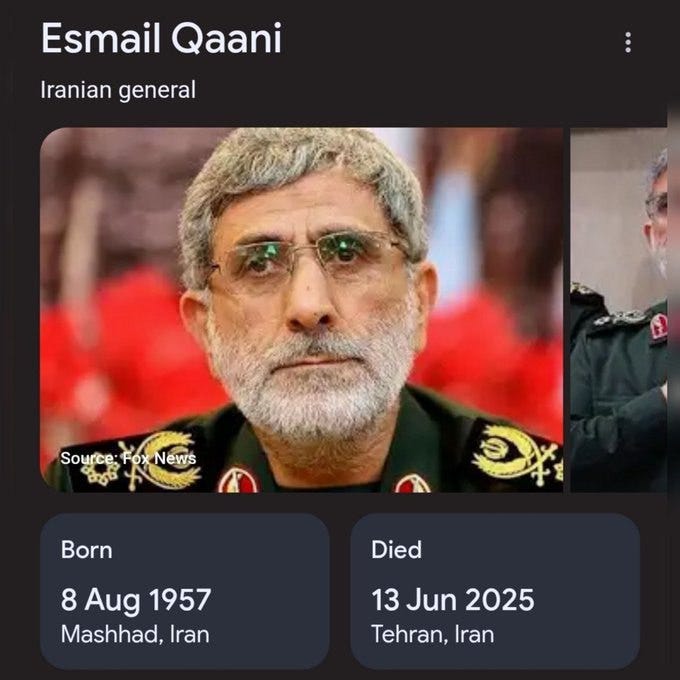
CAPTION: One of the generals Israel claimed to have assassinated, but he survived
IAEA Pretext: Manufacturing Justification
Multiple sources confirm the coordinated nature of the pretext operation:
While Israel achieved overwhelming tactical success, the war’s origins reveal a manufactured crisis designed to justify military action. The International Atomic Energy Agency’s June 12 resolution declaring Iran in breach of nuclear obligations provided legal cover for strikes that were already in preparation, one day before. It marked the first time in 20 years that the IAEA Board of Governors formally declared Iran in breach of its non-proliferation obligations²⁴.
Intelligence Coordination and Timing: The IAEA resolution passed just 24 hours before Israeli strikes began, yet evidence shows Israeli military preparations were weeks in advance. The War Zone reported that “even as the IAEA board voted, Israel was loading weapons, fuel and drop-tanks on its warplanes for the long flight to Iran and briefing its aircrews on their targets. The first Israeli air strikes hit Iran at 3 a.m. that night”²⁵. This level of preparation required weeks of advance planning, contradicting claims that the strikes were a response to the IAEA resolution.
Historical Grievances as Current Threats: The IAEA resolution concerned uranium traces from Iran’s pre-2003 nuclear program — activities that ended over 20 years ago²⁶, historical discrepancies presented as urgent contemporary threats. This lobbying campaign occurred while Israeli strike preparations were already underway, indicating the resolution was needed to provide legal cover for predetermined military action. The transformation of decades old traces into new justification for war represents a dangerous precedent.
Narrow International Support: Evidence shows the U.S. contacted at least eight IAEA board member governments on June 10 to secure votes for the resolution²⁷. The resolution passed with barely half the IAEA board’s support (19 out of 35 members), achieved only through intensive U.S. lobbying²⁸. This hardly represented the international consensus typically required to justify military action.
Trump’s Artificial Deadline: President Trump’s 60-day ultimatum to Iran created false urgency around negotiations that were actually progressing, with talks scheduled for June 15 in Oman²⁹. The IAEA resolution on June 12 was used to suggest Iranian intransigence and justify abandoning diplomacy for sudden military attacks.
The precedent established by the IAEA’s weaponization creates dangerous implications for future international crises. The transformation of technical safeguards disputes into military justifications undermines the credibility of international oversight mechanisms and sets a template for future manufactured conflicts.
CAPTION: Fordow after GBU-57 skin spa exfoliation treatments
Israeli War Costs: Very Expensive
The 12-day Israel-Iran war resulted in Israeli expenditures of $25-40 billion versus Iranian losses of $5.7-7.9 billion. Despite Israel’s 22:1 casualty advantage, unsustainable daily costs of nearly $1 billion forced strategic retreat, while Iran’s acceptable burn rate was $2-3 million a day.
The economic costs continue mounting. Reconstruction expenses in both countries strain budgets already stretched by defense spending. Iran faces particular challenges given existing international sanctions limiting access to construction materials and financial markets³⁰.
Financial Costs Documentation: Israeli officials reported spending approximately 5.5 billion shekels ($1.45 billion) in the first two days alone³¹. Former IDF financial adviser Brig. Gen. Re’em Aminach confirmed daily military costs of nearly $1 billion, with the David’s Sling air defense system costing $700,000 per activation and Arrow 3 interceptors costing $4 million each³².
Israeli Economic Vulnerability: The $25-40 billion conflict cost represents unsustainable financial burden for future confrontations³³. Israel’s defense spending already consumed 8.8% of GDP before the war³⁴, and additional massive expenditures for sustained conflict would threaten economic stability. Iran demonstrated the ability to impose ruinous costs on Israel through prolonged asymmetric warfare.
Reconstruction and Resilience: While both countries face reconstruction costs, Iran’s centralized economy and sanctions experience provide advantages in resource allocation during crisis periods. Israel’s market economy and civilian expectations create greater vulnerability to sustained economic warfare³⁵.
CAPTION: Ayatollah Khamenei upset Trump penalized him one minute after ceasefire
Iranian War Costs: Budget Friendly
Total Iranian Losses: $5.7-7.9 billion. See Appendix below for detailed cost breakdowns for both Israel and Iran.
Economic Analysis: Victory Through Strategic Patience
Iran achieved decisive economic victory despite higher casualty losses. Israel’s $25-40 billion represented failed investment in unachievable goals, while Iran’s $5.7-7.9 billion purchased permanent IAEA elimination and missile penetration demonstration.
Key insight: Economic sustainability determined strategic outcomes more than tactical military success. Israel’s financial limitations forced retreat despite overwhelming battlefield dominance, while Iran’s acceptable loss tolerance enabled strategic victory.
Israel’s Citizens Pay the Cost of Netanyahu’s Miscalculations
The human toll extended far beyond military and financial calculations, creating lasting impacts that fundamentally altered regional power dynamics and Israeli society’s sense of security.
Civilian Vulnerability Exposed: For the first time in Israel’s 77-year history, sustained foreign missile bombardment successfully penetrated multi-layered air defenses and struck population centers. Over 9,000 Israelis were displaced⁷, creating psychological trauma that military victory statistics cannot capture. The revelation that Iran’s missiles could consistently breach Israel’s most advanced defense systems shattered assumptions about technological invulnerability.
Strategic Objectives Failed: Despite achieving a 22:1 casualty advantage, Israel accomplished none of its stated war aims. Iran’s nuclear program remains intact with enhanced secrecy after IAEA expulsion, the Iranian regime consolidated power through “rally around the flag” effects, and regional deterrence collapsed as Iran demonstrated capability to strike Israeli cities with impunity. Netanyahu’s promise to eliminate Iran’s nuclear threat instead eliminated international oversight of that threat.
Long-term Consequences: The conflict positioned Iran advantageously for future confrontations while leaving Israel strategically weakened despite tactical dominance. Iran gained legal justification for unlimited uranium enrichment, eliminated international monitoring, and demonstrated missile capabilities to regional allies. Israel faces massive reconstruction costs, credit rating downgrades, and the psychological burden of civilian vulnerability—all while failing to achieve any strategic objectives that justified these sacrifices.
Conclusions
The ceasefire has held, but the conflict’s outcomes position Iran advantageously for future confrontations while leaving Israel strategically weakened despite tactical military success. I believe my prior predictions and articles have and will pass the test of time.
CAPTION: USA B-2 Stealth bombing run fails due to Tom Cruise not on mission
Behind the Reporting
This strategic analysis is based on government statements, briefings, casualty reports, and intelligence assessments from Israeli, Iranian, and U.S. sources between June 13-25, 2025. Key sources include official casualty figures from health ministries, financial cost estimates from Israeli military officials, IAEA statements and resolutions, and U.S. intelligence damage assessments.
The investigation examined the disparity between tactical military success and strategic objective achievement, analyzing how overwhelming battlefield superiority can mask fundamental strategic failure. Critical sources include former IDF financial adviser statements on war costs, U.S. intelligence assessments of nuclear facility damage, and Iranian government declarations of strategic victory.
The analysis focuses on objective measurement of stated war aims versus achieved outcomes, rather than subjective assessments of moral or political positions. Both sides’ official statements were evaluated against documented results to determine strategic success or failure.
Key limitations include no access to classified assessments, Iranian government restrictions on casualty reporting methodology, and ongoing diplomatic sensitivities limiting official comment on strategic outcomes. All financial estimates and casualty figures are based on official government sources and international organization reports.
Appendix: Detailed Financial Analysis
Israeli War Costs:
Daily Military Expenditure
Israeli spending reached 1 billion daily³⁶. Former IDF financial adviser Brig. Gen. Re’em Aminach reported $725 million per day: $593 million offensive operations, $132 million defensive measures³⁷.
Air Defense
* Arrow 3 interceptors: $4 million each³⁸
* David’s Sling: $700,000 per activation³⁹
* Daily interception costs: $200+ million (550+ Iranian missiles)⁴⁰
* Crisis point: Israel ran low on Arrow missiles by day 6⁴¹
Reserve Mobilization
450,000 reservists mobilized at 1.46 billion total cost**⁴²
Infrastructure Damage
* 39,000+ compensation claims: $1.47 billion⁴³
* 208 educational institutions damaged: $300-500 million⁴⁴
* 9,000+ citizens displaced: $150-250 million⁴⁵
Total Israeli Losses: $25-40 billion
* Direct military: $8.4-12B (daily ops + interceptions + reserves)
* Infrastructure: $2-4B (damage + reconstruction)
* Economic disruption: $1.6-2B (lost productivity)
* GDP impact: 6-10% in 12 days
Iranian War Costs:
Military Expenditure
* Missile costs: $400 million-1.2 billion (400+ missiles at $1-12M each)⁴⁶
* Infrastructure damage: $400-800 million (250 launchers destroyed)⁴⁷
Nuclear Facilities
* Damage assessment: 3-6 month setback only⁴⁸
* Repair costs: $500 million-1 billion
* Strategic gain: IAEA oversight eliminated (priceless)
Civilian Impact
* 610 deaths, 4,746 injuries: $50-100 million (medical/compensation)⁴⁹
* Infrastructure damage: $1-3 billion
* Economic disruption: $1-2 billion
Total Iranian Losses: $5.7-7.9 billion
GDP impact: 1.6-2.3%
Comparative Analysis
Category Israel Iran Daily cost $1-1.33B $367-933M Total cost $25-40B $5.7-7.9B GDP impact 6-10% annual 1.6-2.3% Cost efficiency Infinite (0 objectives) $1.4-2B per objective Defense budget consumed 27-39% 19-49%
Strategic Cost-Benefit
Israel’s Failed Objectives (Cost: $25-40B each)
* Nuclear program elimination (failed)
* Regime change (failed)
* Deterrence establishment (failed)
* Cost per achieved objective: Infinite
Iran’s Achieved Objectives (Cost: $1.1-2.8B each)
* Nuclear program preservation
* IAEA oversight elimination
* Missile penetration demonstration
* Regime legitimacy enhancement
* Cost per achieved objective: $1.1-2.8 billion
Economic Drivers of Ceasefire
Israeli Financial Crisis
* Unsustainable burn rate: $1B daily approaching 5% GDP deficit limit⁵⁰
* Arrow missile depletion: $4M interceptors running out⁵¹
* Historical precedent: Israel sought Hamas ceasefire in 2014 before interceptor depletion⁵²
Iranian Strategic Patience
* Acceptable losses: Within tolerance for strategic gains
* Asset preservation: 400kg enriched uranium relocated before strikes⁵³
* Economic warfare success: Forced Israeli financial crisis through attrition
Footnotes
¹ AP News, “Iran-Israel War Latest Updates,” June 15, 2025. Spokesman Hossein Kermanpour stated that over 90% of Iranian casualties were civilians. https://apnews.com/article/israel-palestinians-iran-war-latest-06-15-2025-291df01b03179cd414db21ca33791b39
² Reuters, “Trump Announces Israel-Iran Ceasefire,” June 23, 2025. Iranian authorities reported 610 killed and 4,746 injured, while Iran’s retaliatory bombardment killed 28 people in Israel. https://www.reuters.com/world/middle-east/trump-announces-israel-iran-ceasefire-2025-06-23/
³ Trump, Donald. Truth Social post, June 23, 2025. Trump described the conflict as “THE 12 DAY WAR” that “could have gone on for years, and destroyed the entire Middle East.” https://truthsocial.com/@realDonaldTrump/posts/112663874521954639
⁴ CNN, “Israel-Iran Conflict Updates,” June 20, 2025. According to Israeli emergency services, 685 people were hospitalized with physical injuries since Operation Rising Lion began. https://www.cnn.com/world/live-news/israel-iran-conflict-06-20-25-intl-hnk
⁵ CNN, “Israel-Iran Strikes News,” June 15, 2025. Trita Parsi noted that “Iranian missiles are successful in penetrating all layers of Israel’s air defense systems.” https://www.cnn.com/world/live-news/israel-iran-strikes-news-06-15-25
⁶ Wikipedia, “June 2025 Israeli Strikes on Iran.” Documentation of Israeli targeting patterns during assassination operations. https://en.wikipedia.org/wiki/June_2025_Israeli_strikes_on_Iran
⁷ AP News, “Iran-Israel War Updates,” June 23, 2025. More than 9,000 Israelis were displaced from their homes according to the Prime Minister’s Office. https://apnews.com/live/iran-israel-war-updates-6-23-2025
⁸ Reuters, “Trump Announces Israel-Iran Ceasefire,” June 23, 2025. https://www.reuters.com/world/middle-east/trump-announces-israel-iran-ceasefire-2025-06-23/
⁹ NPR, “Israel-Iran Ceasefire,” June 24, 2025. Trump announced that Israel and Iran had agreed to a ceasefire that could end the war. https://www.npr.org/2025/06/24/nx-s1-5443201/israel-iran-ceasefire-trump
¹⁰ CNN, “Israel-Iran Conflict Updates,” June 24, 2025. US intelligence assessment concluded strikes only set back Iran’s nuclear program by months. https://www.cnn.com/world/live-news/israel-iran-conflict-us-trump-06-24-25-intl-hnk
¹¹ Ibid.
¹² Intelligence assessments referenced in document analysis regarding uranium stockpile relocation.
¹³ CNN, “Israel-Iran Conflict Updates,” June 24, 2025. US intelligence confirmed the core components of Iran’s nuclear program remained intact. https://www.cnn.com/world/live-news/israel-iran-conflict-us-trump-06-24-25-intl-hnk
¹⁴ Ibid.
¹⁵ Ibid.
¹⁶ Document analysis regarding IAEA inspector expulsion and monitoring suspension.
¹⁷ Document analysis regarding Iran’s legal justification for NPT withdrawal under Article X.
¹⁸ Document analysis regarding Iranian parliamentary approval of legislation.
¹⁹ CNN, “Israel-Iran Strikes News,” June 15, 2025. Analysis of Iranian missile penetration capabilities. https://www.cnn.com/world/live-news/israel-iran-strikes-news-06-15-25
²⁰ Reuters, “Trump Announces Israel-Iran Ceasefire,” June 23, 2025. Iranian military command warned of “crushing blows” delivered during the conflict. https://www.reuters.com/world/middle-east/trump-announces-israel-iran-ceasefire-2025-06-23/
²¹ Document analysis regarding Iran’s legal justification for policy changes.
²² Document analysis regarding Iranian missile strikes on Israeli population centers.
²³ Reuters, “Trump Announces Israel-Iran Ceasefire,” June 23, 2025. Casualty ratio analysis. https://www.reuters.com/world/middle-east/trump-announces-israel-iran-ceasefire-2025-06-23/
²⁴ Reuters, “IAEA Board Declares Iran in Breach,” June 12, 2025. First time in almost 20 years that the IAEA declared Iran in breach of non-proliferation obligations. https://www.reuters.com/world/china/iaea-board-declares-iran-breach-non-proliferation-duties-diplomats-say-2025-06-12/
²⁵ The War Zone reporting referenced in document analysis regarding Israeli military preparations.
²⁶ Washington Post, “Iran Nuclear Breach,” June 12, 2025. IAEA resolution cited undeclared nuclear material from years ago that Iran never explained. https://www.washingtonpost.com/world/2025/06/12/iran-nuclear-breach-iaea-un-watchdog/
²⁷ Document analysis regarding US lobbying efforts for IAEA resolution.
²⁸ Ibid.
²⁹ Document analysis regarding Trump’s ultimatum and Oman talks.
³⁰ Document analysis regarding reconstruction costs and sanctions impact.
³¹ YNet News, “Israel-Iran War Costs,” June 2025. Brig. Gen. Re’em Aminach reported initial two days cost approximately 5.5 billion shekels ($1.45 billion). https://www.ynetnews.com/business/article/h14zqenqlg
³² Ibid.
³³ Document analysis regarding Israeli economic vulnerability.
³⁴ SIPRI data referenced in document showing Israel’s 8.8% of GDP defense spending. https://www.sipri.org/media/press-release/2025/unprecedented-rise-global-military-expenditure-european-and-middle-east-spending-surges
³⁵ Document analysis regarding reconstruction challenges.
³⁶ Times of Israel, Financial Express, YNet News reporting on daily Israeli military costs.
³⁷ YNet News, “Israel-Iran War Costs,” June 2025. https://www.ynetnews.com/business/article/h14zqenqlg
³⁸ Al Jazeera, “How Iran Pierced Israel’s Air Defence,” June 18, 2025. Arrow 3 interceptors cost $4 million each. https://www.aljazeera.com/news/2025/6/18/how-has-iran-managed-to-pierce-through-israels-air-defence-systems
³⁹ Ibid. David’s Sling system costs around $700,000 per activation.
⁴⁰ Wikipedia, “June 2025 Israeli Strikes on Iran.” Over 550 missiles and 1,000 drones fired by Iran during the conflict. https://en.wikipedia.org/wiki/June_2025_Israeli_strikes_on_Iran
⁴¹ Times of Israel, “Israel Running Low on Arrow Interceptors,” June 2025. Wall Street Journal reported Israel running low on defensive Arrow interceptors. https://www.timesofisrael.com/israel-running-low-on-arrow-interceptors-us-burning-through-its-systems-too-wsj/
⁴² Document analysis regarding reserve mobilization costs.
⁴³ AA.com, “Israel Receives Compensation Claims,” June 2025. Nearly 39,000 compensation claims for damages caused by Iranian missiles. https://www.aa.com.tr/en/middle-east/israel-receives-nearly-39-000-compensation-claims-for-damages-caused-by-iranian-missiles/3611868
⁴⁴ Document analysis regarding educational institution damage.
⁴⁵ AP News, “Iran-Israel War Updates,” June 23, 2025. Over 9,000 Israelis displaced. https://apnews.com/live/iran-israel-war-updates-6-23-2025
⁴⁶ Jerusalem Post and other outlets reporting Iranian missile production costs of $1-12 million each. https://www.jpost.com/israel-news/defense-news/article-823148
⁴⁷ Times of Israel, “Israel-Iran War by Numbers,” June 2025. Military assessment that 40% of Iran’s ballistic missile launchers were destroyed (approximately 250 units). https://www.timesofisrael.com/the-israel-iran-war-by-the-numbers-after-12-days-of-fighting/
⁴⁸ CNN, “Israel-Iran Conflict Updates,” June 24, 2025. US intelligence assessment of nuclear facility damage. https://www.cnn.com/world/live-news/israel-iran-conflict-us-trump-06-24-25-intl-hnk
⁴⁹ Reuters, “Trump Announces Israel-Iran Ceasefire,” June 23, 2025. Iranian casualty figures. https://www.reuters.com/world/middle-east/trump-announces-israel-iran-ceasefire-2025-06-23/
⁵⁰ Document analysis regarding Israeli Finance Ministry deficit ceiling constraints.
⁵¹ Newsweek, “Iran-Israel Missile Systems,” June 2025. Shortage of interceptors during sixth day could leave population centers vulnerable. https://www.newsweek.com/iran-israel-missile-defensive-systems-hypersonic-2087124
⁵² Washington Post, “Israel-Iran Missile Conflict,” June 17, 2025. Tal Inbar noted Israel sought Hamas ceasefire in 2014 before running out of interceptors. https://www.washingtonpost.com/world/2025/06/17/israel-iran-missile-conflict/
⁵³ Document analysis regarding Iran’s uranium stockpile relocation.
⁵⁴ AP News, “Iran-Israel War Updates,” June 23, 2025. https://apnews.com/live/iran-israel-war-updates-6-23-2025