July 8, 2025
“You are talking about war. You cannot talk about war as if it’s a picnic. You have destruction, you have killing, you have everything. That’s why war is bad.”—Bashar al-Assad, September 2013, Syrian presidential palace in Damascus
Interviewed by Greg Palkot, Fox News Senior Foreign Affairs Correspondent and Dennis Kucinich, Fox News contributor and former U.S. Congressman
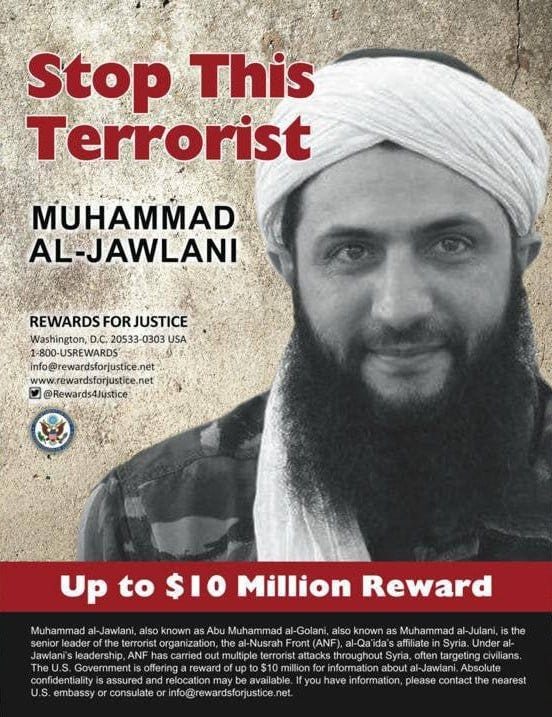
Caption: The transformation of Ahmad al-Sharaa from jihadist commander to Syria’s interim president represents the culmination of America’s longest and most expensive democracy promotion project.
Imagine that Osama bin Laden is alive and well. Not only that, he is President of a consolidated Iraq, Libya, and Afghanistan. And imagine if the United States, Israel, Turkey, Jordan, the EU, and some Gulf States installed him as President of ISIS/ISIL+ and he is a comforting Western Democracy puppet, just as he was before breaking ranks as a CIA asset only to go rogue in the 1990’s. Then imagine this plan going horribly wrong 10 years from now in 2035, but with uncomputably worse consequences than SkyNet and millions more dead over than 9/11. Is this a crackpot analyst theory? No, it’s a hard reality with names changed. When you finish reading, you should be able see, not imagine, the entire Middle East as such.
The new President of Syria adjusts his Trump copycat tie in Damascus’s presidential palace. Built by Hafez al-Assad during his period of isolated controlled fury at the West and Israel — this new President once had a $10 million American bounty on his head. Ahmad al-Sharaa, until recently known by his terrorist nom de guerre Abu Mohammad al-Jolani, now receives Western diplomats in tailored suits, speaking of pluralism and inclusive governance. His metamorphosis from Al-Qaeda commander to Syria’s interim president represents more than rebranding. It marks the grotesque culmination of America’s most expensive covert operation in modern history: a $675 billion “democracy promotion” apparatus that turned a nation into a charnel house, a story outstripping even Kafka’s fictional absurdities.
al-Jolani means “from the Golan,” to signal his unwavering commitment to liberating the Israeli-occupied Golan Heights. People change their names far less than they change their spouses. For most of his adult life, this name was his banner — an anti-Zionist, pan-Islamist, jihadist worldview of Al-Qaeda and its offshoots. It is a non-negotiable tenet for not just jihadists, but acceptable to many ordinary people even if they don’t do anything about it.
Yet today, President al-Sharaa watches as if a stooge while Israel not only solidifies its control over the Golan but actively seizes new territory in the UN buffer zone. Following Assad’s fall, the Israeli military launched over 480 strikes, systematically destroying Syria’s remaining military capabilities without a single word of protest from Damascus. The man whose very name is a claim to this territory now presides over a government that is powerless and, seemingly, unwilling to defend it.
The speed of this metamorphosis defies belief. In December 2024, al-Sharaa led Hayat Tahrir al-Sham (HTS), a designated terrorist organization, in toppling Bashar al-Assad. By March 2025, his forces had massacred 1,479 Alawite civilians. (al-Assad was Alawite Muslim.) By July, the United States lifted sanctions on Syria, with al-Sharaa’s government now recognized as legitimate. HTS was formally taken off the terrorist watchlist by the Marco Rubio and the State Deparment. The man who once pledged allegiance to Al-Qaeda had become Washington’s newest partner in the Middle East.
This unreal set of circumstances is no accident. It represents the logical endpoint, 20-years of regime-change operations that began not with Syria’s Arab Spring protests, but much earlier, part of a sophisticated intelligence apparatus disguised as humanitarian democracy promotion. The evidence, drawn from declassified documents, financial records, and investigative reporting, reveals how America’s foreign policy establishment transformed from covert coup-plotting to an industrial-scale regime change machine that has destabilized nations from Serbia to Syria.
The human cost of this grand experiment? Over 600,000 Syrian dead, 13 million displaced, and a former terrorist now presiding over a fractured state. This is the story of how America’s democracy promotion machinery created its own monster, and then dressed him in a suit. Or is he just using Assad’s left behind wardrobe?
The Color Revolution Blueprint: From Belgrade to Damascus
The Serbian Laboratory
The template for modern regime change was forged in Belgrade’s streets in October 2000. The overthrow of Slobodan Milošević, marketed as the “Bulldozer Revolution,” appeared spontaneous, a triumph of people power over dictatorship. The reality was far more orchestrated.
U.S. government documents reveal that organizations like the National Endowment for Democracy (NED) and USAID poured millions into Serbian opposition groups, particularly the youth movement Otpor! (“Resistance!”), long since disbanded. The support was comprehensive: from 2.5 million stickers to thousands of spray paint cans, all channeled through the State Department[^1]. The operational blueprint drew heavily from Gene Sharp’s writings on nonviolent resistance, providing what one analyst called “a cost-effective and publicly palatable model for toppling disfavored governments.”
Allen Weinstein, NED’s founding president, later admitted the organization’s true purpose:
“A lot of what we do today was done covertly 25 years ago by the CIA”[^2].
This admission would prove prophetic as the Serbian model spread across the former Soviet sphere.
Color Revolution Contagion Spreads
Between 2000 and 2005, a wave of “color revolutions” swept through Georgia, Ukraine, and Kyrgyzstan. Each followed the Serbian script: youth movements with catchy names, Western NGO support, contested elections as triggers, and rapid international recognition of new governments.
Financial analysis reveals the massive scale of this apparatus. Between 2020 and 2024 alone, the democracy promotion machinery spent astronomical sums[^3]:
* CIA and Intelligence Community: $465.6 billion
* USAID Democracy Programs: $11.6 billion
* National Endowment for Democracy: $1.455 billion
* Open Society Foundations: $5.15 billion
The patterns were too repetitive to be “organic”: operational waves followed by reassessment periods, with costs escalating dramatically over time. Early color revolutions succeeded for approximately $125 million each. By the Arab Spring, the price had risen to $1 billion per regime change. The declining return on investment suggested targets were learning to resist, or that the model itself was fundamentally flawed. The Arab Spring was massive, designed to overthrow the entirety of the Arab world, 18 countries in all from 2011 till now in 2025 culminating in the overthrow of Syria.
Syria’s Manufactured Uprising
Pre-Positioned Assets
The groundwork for Syria’s uprising was laid years before the first protests in Daraa. State Department cables reveal that since 2005, the U.S. had been funding Syrian opposition groups, channeling $6.3 million to the Movement for Justice and Development, a London-based organization operating Barada TV satellite channel[^4]. This media infrastructure would prove crucial when protests erupted in 2011.
The appointment of Ambassador Robert S. Ford to Damascus in January 2011 raised immediate red flags. Ford had served under John Negroponte in Iraq during the height of sectarian violence, Negroponte himself having organized death squads in Central America. Ford’s arrival preceded Syria’s uprising by a mere two months, suggesting his mission involved more than traditional diplomacy[^5].
Unlike genuine grassroots movements, Syria’s opposition demonstrated remarkable organizational sophistication from the outset. The Syrian National Council formed in Istanbul just months after protests began, …