July 31, 2025
[This is Part 1 of a 5-part series on the hidden history of money and power, following my investigation into how financial crises are engineered in “Recession by Design.”] Please subscribe if you like my content.
“You think your world is safe? It is an illusion. A comforting lie told to protect you. Enjoy these final moments of peace. ”
— Khan, Star Trek Into Darkness (2013)
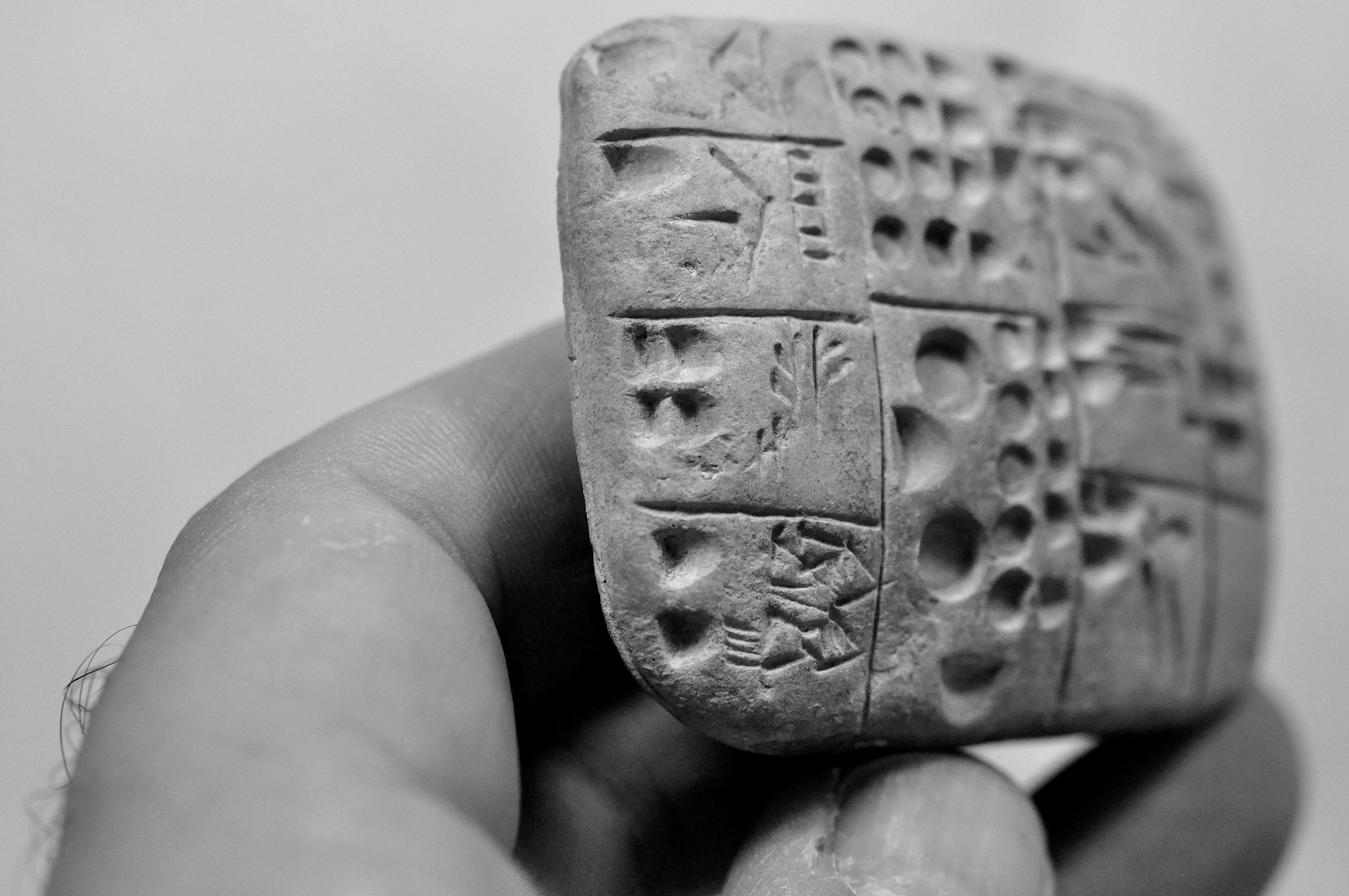
A 5,000-year-old clay tablet from Mesopotamia records grain debts - evidence that credit preceded coins by millennia. Photo: British Museum
Adam Smith and Sumerian Ledgers of Debts
In the dim light of a Sumerian temple, circa 3000 BCE, a scribe pressed his reed stylus into wet clay. He wasn’t recording a trade of chickens for pottery, as economic textbooks might have you believe. He was documenting debt - a farmer’s obligation to repay seed grain after harvest, with interest calculated at precisely 33.3%.^[1] This mundane accounting entry, one of thousands discovered by archaeologists, reveals a truth that shatters the foundational myth of economics: money didn’t emerge from barter. It emerged from power.
The standard story, crystallized by Adam Smith (the 18th-century Scottish economist whose Wealth of Nations became capitalism’s bible) and repeated in every Economics 101 course, goes like this: primitive humans bartered goods directly until the “double coincidence of wants” problem became unbearable. How inconvenient to haul chickens around hoping to find someone with spare shoes! So… these clever primitives spontaneously adopted precious metals as a medium of exchange. Therefore, from this impetus, banking, credit, and modern finance naturally evolved.^[2]
There’s just one problem with this tidy narrative. After two centuries of searching, anthropologists have found exactly zero evidence of societies that relied on spot barter as their primary economic system.^[3] What they have found, in overwhelming abundance, is debt.
This isn’t merely an academic curiosity. The myth of barter’s origin serves a critical ideological function: it makes our current monetary system appear natural, inevitable, and apolitical. But if money originated not from market convenience but from state power - if debt preceded coins by thousands of years - then every assumption about banking, interest, and monetary control is wrong.
The real elites have always understood this. For untold generations across millennia, those who control the creation of money and the terms of debt have controlled entire civilizations. They’ve passed this knowledge through banking dynasties, temple hierarchies, and central bank boardrooms like a secret recipe for societal control. The masses believe money is neutral and want it. Rulers know it’s a weapon and make it.
The implications ripple through time to this moment, as central banks prepare digital currencies that would grant them unprecedented control over every transaction in the economy.
David Graeber and The Founding Myth of Economics
Fast forward 5000 years to any economics textbook about money’s origin, and you’ll encounter some variation of what the late David Graeber called “the founding myth of economics.”^[4]
Graeber was an American anthropologist who taught at the London School of Economics and became one of the intellectual architects of Occupy Wall Street - the movement that gave us “We are the 99%.” Before his untimely death in 2020, this anarchist thinker had achieved something remarkable: he’d lectured at Google, appeared at Davos, and convinced mainstream institutions to listen to his radical rethinking of money’s history. His essential 2011 book Debt: The First 5,000 Years demolished economic orthodoxy with the methodical precision of an archaeological dig.^[5]
The narrative Graeber and others dissected typically unfolds in three acts:
Act One: In primitive societies, people engaged in direct barter. A fisherman with extra fish sought out a farmer with spare grain. This system worked adequately in small communities where everyone knew what others produced.
Act Two: As societies grew more complex, barter’s limitations became apparent. What if the farmer didn’t want fish that day? What if the fisherman needed grain, but his catch had spoiled? The “double coincidence of wants” created endless friction. Markets ground to a halt.
Act Three: Some clever merchant realized that certain commodities - salt, cattle, but especially precious metals - were universally desired. These became the first money. Once gold and silver coins appeared, commerce flourished. Credit and banking followed naturally as extensions of this monetary system.
This story possesses an almost hypnotic elegance. It requires no kings, no violence, no power relations - just rational individuals solving practical problems through voluntary exchange. Money appears as humanity’s collective invention, as natural and politically neutral as the wheel.
Adam Smith, despite never conducting anthropological fieldwork, presented this sequence with remarkable confidence in The Wealth of Nations:
“The division of labour…must have given occasion to the invention of money…In order to avoid the inconveniency of such situations, every prudent man…must have been led to acquire some commodity…which few people would be likely to refuse.”^[6]
For over two centuries, this speculation hardened into fact. Carl Menger, founder of the Austrian School of economics, refined it with Germanic precision in the 1870s. Stanley Jevons, the English economist who helped mathematize the field, incorporated it into his equations. By the time Paul Samuelson - the first American to win the Nobel Prize in Economics - wrote his bestselling textbook in 1948, the barter myth had become unquestionable dogma. Samuelson’s textbook would educate millions of students over dozens of editions.^[7] By sheer repetition, conjecture became axiom.
Barter Myths vs. Anthropological Reality
The first crack in this edifice appeared when anthropologists actually studied how pre-monetary societies functioned. What they discovered wasn’t barter economies struggling toward monetary enlightenment. They found something far more sophisticated and, for economic orthodoxy, far more troubling.
In 1985, Cambridge anthropologist Caroline Humphrey delivered what should have been a death blow to the barter myth:
“No example of a barter economy, pure and simple, has ever been described, let alone the emergence from it of money; all available ethnography suggests that there never has been such a thing.”^[8]
This wasn’t an isolated finding. Decades of fieldwork across hundreds of societies revealed consistent patterns that contradicted the textbook narrative. Bronisław Malinowski, the Polish-British founder of modern anthropology, spent years in the Trobriand Islands off New Guinea studying their elaborate gift-exchange networks - not barter markets.^[9] Marcel Mauss, the French sociologist whose work influenced everyone from Claude Lévi-Strauss to Graeber himself, documented similar systems worldwide - complex webs of mutual obligation that had nothing to do with spot trading.^[10]
When anthropologists did observe barter, it occurred almost exclusively between strangers or enemies - people who would never see each other again or who actively distrusted one another. The Pukhtun of northern Pakistan bartered with lowland communities they despised. African societies bartered across tribal boundaries during temporary truces. This wasn’t the foundation of economic life; it was its periphery.^[11]
Within communities, economic life operated on entirely different principles. If your neighbor needed wheat, you gave it to them. If you needed help raising a barn, the community appeared. (Think of those viral videos of Amish communities moving entire barns by hand - dozens of men literally picking up a building and walking it to a new location. That’s a “human economy” in action.) These weren’t calculated exchanges but the fabric of social existence. The closest modern equivalent might be how families function internally - you don’t charge your children for breakfast or invoice your spouse for laundry.
Amish men transporting a barn. Video: Youtube
The critical innovation of anthropology was recognizing these systems as sophisticated economies, not primitive predecessors to “real” markets. They allocated resources, motivated production, and distributed goods - everything a monetary economy does, but through social mechanisms rather than price signals.
The Rai Stones of Yap, 15th Century AD
Perhaps no example better illustrates the social nature of money than the rai stones of Yap, a small island cluster in Micronesia. These massive limestone discs, some weighing several tons, functioned as the island’s high-value currency for centuries.^[12] Yet they violated every assumption about money’s physical requirements.
The stones’ value derived not from their material properties but from their histories. A rai stone quarried from distant Palau and transported across treacherous seas was worth more than an identical stone that arrived safely. If lives were lost in transport, the value increased further. The specific chief who commissioned it, the craftsmen who carved it, the navigators who guided the journey - all became part of the stone’s identity and worth.^[13]
Most remarkably, the stones rarely moved after arrival. They might sit in one location for generations while ownership changed repeatedly. When a significant debt was settled or a marriage negotiated, the community simply acknowledged the new owner. The stone itself remained immobile, sometimes resting at the bottom of the sea if the transport canoe had capsized.^[14]
In one documented case from the 1890s, a massive rai stone fell from its raft and sank in a storm. The crew survived to report its exact location. That stone, resting on the ocean floor, continued to function as money for decades. It was bought, sold, and inherited by people who had never seen it. Its value remained intact because the community maintained consensus about its existence and ownership.^[15]
This system reveals money’s essence: it is not a thing but a system of credits and debts, a collective agreement about value and obligation. The physical token - whether a stone, a coin, or an electronic entry - merely represents social relationships. The Yapese understood this with a sophistication that modern economics obscures.
German colonial administrators, encountering this system in 1898, dismissed it as primitive. They demanded the Yapese build roads using “proper” payment in German marks. When the islanders refused, considering road work beneath their dignity, the Germans painted black crosses on the most valuable rai stones and declared them worthless until the roads were complete. Faced with the devaluation of their wealth, the Yapese complied. The roads were built, the crosses removed, and the stones regained their value - a stark demonstration of how political power, not market forces, ultimately determines what counts as money.^[16]
Although Rai stones may be anywhere from 500 to 2,000 years old, they are still in use in certain contexts in Micronesia.
Rai stones being transported to Yap Island (1880). Photo: Wikipedia
Debt and Credit Before Money’s Slight of Hand
The archaeological record tells a different story about money’s origins than economics textbooks. The earliest evidence of complex accounting systems comes from Mesopotamian temples and palaces around 3500 BCE - not coincidentally, the same period that saw the emergence of the first cities and states.^[17]
These institutions faced a novel problem: how to provision armies, maintain irrigation systems, and support specialized craftsmen in an economy still largely based on subsistence farming. Their solution was revolutionary. Temples began issuing credit to farmers - seed grain in spring, repaid with interest after harvest. Palace administrators distributed rations to workers, recorded as debts against future labor. These obligations, inscribed on clay tablets, became history’s first money.^[18]
The sophistication of this system staggers the imagination. Sumerian scribes developed standardized interest rates: 33.3% for grain loans (reflecting natural increase from planting), 20% for silver.^[19] They created financial instruments that wouldn’t look out of place on Wall Street: promissory notes, letters of credit, even derivatives contracts for future delivery. One tablet from 1750 BCE records what amounts to a put option on date palms.^[20]
Physical currency - stamped pieces of precious metal - didn’t appear until nearly 3,000 years later, around 600 BC in Lydia (modern Turkey).^[21] Even then, coins emerged not from merchant innovation but royal decree. Kings minted coins to pay soldiers, then demanded taxes paid in those same coins. This forced their subjects to sell goods and services to acquire the currency needed for tax payment, effectively monetizing the entire economy.^[22]
The pattern repeated worldwide. In ancient China, the state created money by issuing bronze tokens for public works, then demanding their return as taxes.^[23] In medieval England, kings paid with notched wooden sticks (tally sticks) that could be used to settle tax obligations.^[24] In colonial Africa, European powers imposed “hut taxes” payable only in colonial currency, forcing subsistence farmers into wage labor.^[25]
The State’s Monetary Weapon: Money Backed by Violence
Understanding money as a creature of state power rather than market evolution reveals its inherently political nature. The ability to define the unit of account, to create credit, and to demand repayment in specific tokens represents one of sovereignty’s core powers - perhaps the core power.
Here’s the uncomfortable truth: state money has always been backed by violence. Not the implicit violence of property rights that libertarians acknowledge, but explicit, physical coercion. Pay your taxes in the sovereign’s currency or face imprisonment. Accept the king’s coins or be branded a traitor. This isn’t a bug in the system - it’s a foundational feature.
States discovered early that monetary systems enabled unprecedented control over their populations. By demanding taxes in official currency, governments could:
* Force Market Participation: Subsistence farmers who needed nothing from markets suddenly required currency for tax payment, driving them into commercial relationships.
* Direct Economic Activity: By choosing what to purchase with newly created money, states could channel resources toward military ventures, public works, or favored industries.
* Extract Resources: The difference between money’s creation cost (near zero) and its purchasing power (face value) provided states with “seigniorage” - essentially free resources.
* Impose Social Hierarchies: Debt obligations enforceable by state violence created and maintained class structures. Debt slavery, documented from ancient Mesopotamia to colonial Africa, weaponized monetary systems against the vulnerable.^[26]
“All money is a matter of belief.”
— Adam Smith
But belief enforced at the point of a sword is not faith - it’s submission. The ruling classes have always understood this distinction and deployed it with no moral compunctions. Trade had finally become weaponized, good faith indebtedness was now something to be historically revised over time.
Violence, actual or implied, that underlie monetary systems remains hidden in stable times. We forget that terms like “pay” derive from Latin “pacare” - to pacify or appease. “Finance” comes from “finis” - to settle or end a dispute, often violently. These etymologies preserve memory of money’s coercive origins.^[27]
Ancient rulers understood this connection explicitly. The Code of Hammurabi - history’s first written legal code from Babylon circa 1750 BCE - devoted extensive passages to debt regulation, including periodic debt cancellations (clean slates or “jubilees”) designed to prevent social collapse from excessive debt accumulation.^[28] These weren’t acts of charity but pragmatic governance - rulers recognized that unchecked debt concentration would destroy their tax base and military recruitment pool.
The pattern holds even in modern times. Every significant expansion of state power - from ancient empire-building to 20th-century total wars - coincided with monetary innovation. The Napoleonic Wars saw the Bank of England suspend gold convertibility. The U.S. Civil War birthed fiat greenbacks. World War I ended the classical gold standard. Each crisis became an opportunity to assert greater monetary control.^[29]
Why the Barter Myth Persists
If barter stories of the past are so thoroughly debunked, why do they maintain its grip on economic thinking? The answer lies not in its explanatory power but in its ideological utility.
The myth serves multiple functions for those who benefit from current arrangements:
Naturalization: By presenting money as emerging spontaneously from voluntary exchange, the barter story makes alternatives seem unnatural or impossible. If money predates states, then state control over money appears as interference rather than origination.
Depoliticization: Market origins imply market solutions. If money arose from individual optimization rather than collective power, then monetary policy becomes a technical rather than political question - best left to experts insulated from democratic input.
Legitimation: The enormous profits and power concentrated in the financial sector appear justified if banks merely facilitate natural market processes rather than wielding state-delegated powers of credit creation.
The myth also resonates with deep cultural values, particularly in Anglo-American societies. The imagery of independent traders voluntarily creating money appeals to ideals of individual liberty and spontaneous order. It fits the frontier narrative of self-reliant pioneers building civilization through voluntary cooperation.
Academic economics, despite its scientific pretensions, has powerful incentives to maintain the myth. Careers are built on mathematical models assuming money as a neutral veil over “real” economic activity. Acknowledging money’s political origins would invalidate vast theoretical edifices and question the discipline’s claim to scientific objectivity.^[30]
“It is well enough that people of the nation do not understand our banking and monetary system, for if they did, I believe there would be a revolution before tomorrow morning.”
— Apocryphally Attributed to Henry Ford
Even heterodox economists who reject other orthodox assumptions often retain the barter story, perhaps unconsciously. It’s simply too foundational, too convenient, too aligned with other cherished beliefs about markets and human nature.
Will the Masses Reclaim Money?
Recognizing money’s true origins - in debt, state power, and social relationships - doesn’t lead to any single political conclusion. Libertarians might see it as confirming their suspicions about government manipulation. Socialists might view it as validating public control over finance. The historical record supports more nuanced interpretations.
What it does demand is abandoning the comfortable fiction that monetary systems are natural, neutral, or inevitable. Every feature of modern money - from interest rates to bank regulations to currency issuance - reflects political choices that could be made differently.
Consider contemporary debates through this lens:
Central Bank Digital Currencies: Proposals for CBDCs aren’t technical upgrades but profound expansions of state monetary power. Understanding money’s coercive history should inform discussions about programmable currency that could restrict purchases or expire on command.^[31]
Cryptocurrency: Bitcoin’s appeal partly stems from its promise to separate money from state power. Yet its origin story - anonymous creation, voluntary adoption, emergent value - eerily echoes the barter myth. Does this repetition reflect deep truth or persistent ideology?^[32]
Modern Monetary Theory: MMT’s claim that sovereign governments face no financial constraints, only real resource constraints, follows logically from recognizing states create rather than use money. The policy implications remain contentious, but the analytical framework aligns with historical evidence.^[33]
Banking Reform: If banks create money when making loans - a fact the Bank of England now acknowledges - then they exercise a form of public power through private institutions. Should this power be democratized, regulated, or abolished?^[34]
These aren’t merely technical questions for specialists. They’re fundamental choices about power, freedom, and social organization. But we can’t make informed choices while clinging to creation myths that obscure money’s true nature.
Conclusion: Money Is a Complicated Construct
The clay tablets of ancient Mesopotamia hold more than commercial records. They preserve evidence of humanity’s first great ideological cover-up - the transformation of power into nature, of political choice into economic law. For 5,000 years, states and their allied financial institutions have exercised the extraordinary privilege of creating money and defining debt. For most of that time, they’ve hidden this power behind stories of spontaneous market evolution.
“The few who understand the system will either be so interested in its profits or be so dependent upon its favours that there will be no opposition from that class… The great body of people, mentally incapable of comprehending the tremendous advantage that capital derives from the system, will bear its burdens without complaint, and perhaps without even suspecting that the system is inimical to their interests.”
— Apocryphally Attributed to The Rothschild Brothers of London, 1863
Today, as we stand at another monetary crossroads, the stakes for maintaining or abandoning this fiction couldn’t be higher. Central banks openly discuss programming money to control consumption patterns. Financial surveillance reaches depths that would stagger ancient temple administrators. The infrastructure for monetary control that took millennia to build could be perfected in a few years of coding.
Yet this same historical moment offers unprecedented opportunity. The veil has lifted. Academic economists acknowledge money creation by banks. Central bankers admit their policies drive inequality. The tools for creating alternative monetary systems - from local currencies to blockchain networks - have never been more accessible.
The question isn’t whether money will be political - it always has been. The question is whether we’ll acknowledge that reality and demand democratic participation in monetary design, or continue accepting creation myths that benefit those who already wield financial power.
The Sumerian scribe pressing his stylus into clay wasn’t just recording a debt. He was inscribing the first chapter of a story we’re still writing - a story about who controls society’s credits and debts, who decides what counts as money, and who bears the costs when those decisions go wrong. After 5,000 years, perhaps it’s time to change the plot.
[This investigation continues in Part 2 of 5: “Knights Templar and Kings Created Financial Systems More Sophisticated Than Your Bank” - exploring how the Knights Templar created international banking and why England’s 700-year-old tally stick system was more sophisticated than today’s electronic payments.]
Footnotes
^[1]: Hudson, Michael, “The Archaeology of Money: Debt versus Barter Theories of Money’s Origins,” in Credit and State Theories of Money, ed. L. Randall Wray (Edward Elgar, 2004), pp. 99-127. The 33.3% rate reflects the natural increase from planting seed grain.
^[2]: Smith, Adam, An Inquiry into the Nature and Causes of the Wealth of Nations, Book I, Chapter 4, “Of the Origin and Use of Money” (1776). Smith’s speculation was based on no anthropological evidence.
^[3]: Humphrey, Caroline, “Barter and Economic Disintegration,” Man, New Series, Vol. 20, No. 1 (March 1985), p. 48. This finding has been confirmed by every subsequent anthropological survey.
^[4]: Graeber, David, Debt: The First 5,000 Years (Melville House, 2011), p. 28.
^[5]: For Graeber’s influence and speaking engagements, see: Tepper, Jonathan, “David Graeber’s Debt Changed My Life,” The American Conservative, September 4, 2020.
^[6]: Smith, Wealth of Nations, Book I, Chapter 4. Note Smith’s revealing use of “must have” - pure speculation presented as logical necessity.
^[7]: For the myth’s persistence in textbooks, see: Ingham, Geoffrey, The Nature of Money (Polity Press, 2004), Chapter 1, documenting its appearance in major economics textbooks from 1900-2000.
^[8]: Humphrey, “Barter and Economic Disintegration,” p. 48.
^[9]: Malinowski, Bronisław, Argonauts of the Western Pacific (Routledge, 1922), documenting the complex Kula ring exchange system.
^[10]: Mauss, Marcel, The Gift: The Form and Reason for Exchange in Archaic Societies (1925), trans. W.D. Halls (Norton, 1990).
^[11]: Graeber, Debt, pp. 29-32, synthesizing multiple ethnographic studies of barter’s limited role.
^[12]: Furness, William Henry, The Island of Stone Money: Uap of the Carolines (J.B. Lippincott, 1910), the first Western account of the rai stone system.
^[13]: Gillilland, Cora Lee C., “The Stone Money of Yap: A Numismatic Survey,” Smithsonian Studies in History and Technology, No. 23 (1975), pp. 1-39.
^[14]: Friedman, Milton, “The Island of Stone Money,” Working Papers in Economics, No. E-91-3, Hoover Institution (1991), using Yap to illustrate money’s social nature.
^[15]: Furness, Island of Stone Money, pp. 96-98, describing the famous underwater rai stone.
^[16]: The German colonial intervention is documented in: Hazell, Peter, “The Power of Money: A Case Study of the Stone Money of Yap,” Economic Anthropology, Vol. 3, No. 2 (2016), pp. 123-138.
^[17]: Schmandt-Besserat, Denise, Before Writing: From Counting to Cuneiform (University of Texas Press, 1992), documenting the evolution of accounting systems.
^[18]: Hudson, Michael, “The Development of Money-of-Account in Sumer’s Temples,” in Creating Economic Order, ed. Michael Hudson and Cornelia Wunsch (CDL Press, 2004), pp. 303-329.
^[19]: Interest rates from the Laws of Eshnunna (c. 1930 BCE), translated in: Roth, Martha T., Law Collections from Mesopotamia and Asia Minor (Scholars Press, 1995), p. 62.
^[20]: The date palm option contract: Oppenheim, A. Leo, “The Archives of the Palace of Mari,” Journal of Near Eastern Studies, Vol. 13, No. 3 (1954), pp. 141-148.
^[21]: Howgego, Christopher, Ancient History from Coins (Routledge, 1995), pp. 1-7, on Lydian coinage origins.
^[22]: Knapp, Georg Friedrich, The State Theory of Money (1905), trans. H.M. Lucas and J. Bonar (Macmillan, 1924), the classic chartalist account.
^[23]: Von Glahn, Richard, Fountain of Fortune: Money and Monetary Policy in China, 1000-1700 (University of California Press, 1996), Chapter 2.
^[24]: Jenkinson, Hilary, “Medieval Tallies, Public and Private,” Archaeologia, Vol. 74 (1925), pp. 289-351.
^[25]: Bush, Barbara, and Josephine Maltby, “Taxation in West Africa: Transforming the Colonial Subject into the ‘Governable Person’,” Critical Perspectives on Accounting, Vol. 15, No. 1 (2004), pp. 5-34.
^[26]: On debt slavery across cultures: Patterson, Orlando, Slavery and Social Death: A Comparative Study (Harvard University Press, 1982), Chapter 5.
^[27]: Etymology from: Seaford, Richard, Money and the Early Greek Mind (Cambridge University Press, 2004), pp. 23-24.
^[28]: Hudson, Michael, “The Lost Tradition of Biblical Debt Cancellations,” (1993), available at michael-hudson.com, documenting Near Eastern debt jubilees.
^[29]: Kindleberger, Charles P., A Financial History of Western Europe (Oxford University Press, 1993), on monetary innovations during wartime.
^[30]: On economics’ ideological blindness: Mirowski, Philip, More Heat than Light: Economics as Social Physics (Cambridge University Press, 1989).
^[31]: Bank for International Settlements, “Central Bank Digital Currencies: System Design and Interoperability,” Report No. 2 (September 2021), outlining CBDC capabilities.
^[32]: Nakamoto, Satoshi, “Bitcoin: A Peer-to-Peer Electronic Cash System” (2008), presenting Bitcoin’s origin narrative.
^[33]: Wray, L. Randall, Modern Money Theory: A Primer on Macroeconomics for Sovereign Monetary Systems (Palgrave Macmillan, 2015).
^[34]: McLeay, Michael, Amar Radia, and Ryland Thomas, “Money Creation in the Modern Economy,” Bank of England Quarterly Bulletin, 2014 Q1, the central bank’s admission of credit creation by commercial banks.