March 9, 2026
I'm going to tell you why Iran's missile strikes during True Promise 4 have been exponentially more deadly and accurate, and how they're doing it with China's and Russia's help. Hold on to your hats and unlock for paid access, because this is going to get wild. This is a story you will not see anywhere else online.
Bloomberg: $35/month. Financial Times: $42/month. The Economist: $17/month. Original analysis by Tatsu with 40+ footnotes: $8/month.
This investigation covers what the NYT's 7-reporter team missed. Share it.
What this investigation covers:
* Why the Washington Post's "Russia is helping Iran" frame misses the actual story
* The decade-long Chinese program that built Iran's precision strike capability from scratch
* From 99% intercepted to THAAD radars destroyed: how Iranian missile accuracy transformed between April 2024 and March 2026
* BeiDou's three service tiers, and which one Iran is actually using
* What happens to Iranian missile accuracy without satellite navigation (the numbers are dramatic)
* Why MizarVision's satellite imagery and Russian intelligence are largely redundant, and what that means for the real power dynamics
* The interceptor math: how fast the US/Israeli missile defense stockpile is draining, and what replaces it (nothing)
* Defense Secretary Hegseth says China is "not really a factor." The kill chain says otherwise
* 510+ Chinese surveillance satellites watching every US munition load, every missile trajectory, every refueling cycle, all feeding into Taiwan planning
* A former IRGC general explains why the nuclear fatwa is legally disposable
* 400 kg of enriched uranium, location unknown, and a new Supreme Leader who wants the bomb
* Why every BeiDou-guided missile that hits a US base sends telemetry back to Beijing
Full investigation below. $8/month for the analysis you won't find in the Washington Post, the New York Times, or anywhere else online.
On March 6, the Washington Post ran what it considered a scoop:
"Russia is providing Iran with intelligence about the location of U.S. forces in the region, according to multiple U.S. and Western officials."[1]
Seven paragraphs in, the article cites "three U.S. officials" and "one Western official." The sourcing pattern is familiar: anonymous officials steering the narrative toward Russia. The story was picked up by NBC, CNN, and the usual distribution network. Within 24 hours, "Russia helping Iran" became the frame.
Here is what that frame misses: the Russian intelligence contribution, while real, is largely redundant with what a Chinese commercial satellite company called MizarVision was already publishing on social media for free. Meanwhile, the actual transformation of Iran's military capability (the system that turned missiles intercepted at 99% into missiles destroying half-billion-dollar THAAD radars in the Jordanian desert) traces back not to Moscow but to a bilateral agreement signed in Beijing in 2015.
The story isn't Russia. The story is China. And nobody in the prestige press is telling it.
Even Pete Hegseth's comment about China not being part of the story means he's lying or he doesn't know what I know. Which is more likely? I can argue that with this Chinese tech, Iran is winning the war and the US is losing, before they even run out of interceptors very soon and the suicidal option of "boots on the ground" goes on the table.
Consider being a paid member, because this article is tier one military intel and analysis. You won't get it anywhere else, guaranteed.
The Before and After
Start with what changed. The numbers are stark.
In April 2024, Iran launched Operation True Promise 1: 170 drones, 30 cruise missiles, and 120 ballistic missiles aimed at Israel. The result? A 99% interception rate. Nine ballistic missiles reached Israeli territory. Total damage: one runway crater at Nevatim Airbase and a damaged C-130 transport plane. One seven-year-old girl was injured by debris. Iran gave 72 hours advance warning, and the slow-moving Shahed drones took hours to cross Iraqi and Jordanian airspace, giving coalition forces all the tactical prep time they could ask for.[2]
That was twenty-three months ago.
On February 28, 2026, Iran launched True Promise 4 in retaliation for Operation Epic Fury. In the first day alone: 350 ballistic missiles, 10 cruise missiles, and 550 drones, targeted not at one country but nine. This time, there was no 72-hour warning. No slow drones crossing open desert to announce the attack. What followed was the most destructive Iranian missile campaign in history.[3]
Consider the targets that were hit with precision:
An AN/TPY-2 radar at Muwaffaq Salti Air Base in Jordan, the sensor that makes the entire THAAD missile defense battery functional, was struck and destroyed. Satellite imagery shows a pair of 13-foot craters in the sand near a system that sits on five 40-foot trailers. You do not hit a specific trailer in the Jordanian desert with a ballistic missile by accident. That radar costs between $300 million and $1 billion and is one of roughly 20 that have ever been manufactured.[4]
An AN/FPS-132 early-warning radar at Al Udeid Air Base in Qatar, a $1.1 billion phased-array system capable of tracking ballistic missiles at 5,000 kilometers, was struck and damaged. Planet Labs satellite imagery confirmed scorching and structural damage to the radar's northeastern face.[5]
A second AN/TPY-2 radar at Al Dhafra Air Base in the UAE was reportedly destroyed, along with hangars housing MQ-9 Reaper drones and facilities supporting U-2 reconnaissance aircraft.[6]
In Israel, a ballistic missile struck a residential block in Tel Aviv, killing one and injuring 22. A strike on Beit Shemesh hit a synagogue and residential buildings, killing nine and injuring 49. And in what became the single most significant tactical strike of the campaign, an Iranian Fattah-2 hypersonic glide vehicle struck a fortified IDF command center, reportedly killing seven senior officers. That was the first confirmed combat use of a hypersonic glide vehicle in history.[7]
At Shuaiba Port in Kuwait, a drone evaded defenses entirely and struck a makeshift operations center, killing six US soldiers. No warning sirens were heard. At Prince Sultan Air Base in Saudi Arabia, Sergeant Benjamin Pennington became the seventh US service member killed. In Bahrain, strikes hit the Fifth Fleet headquarters, residential buildings, a hotel, a port, and an oil refinery. An oil tanker at Mina Salman Port was set ablaze.[8]
In four days, Iran destroyed nearly $2 billion in US military equipment.[9]
Here is the progression in a single table:
| True Promise | True Promise 4 (Mar 2026)
| 1 (Apr 2024) |
-------------+--------------+----------------------------------------------
Intercept | ~99% | Multiple precision hits confirmed
rate | |
Impacts on | 9 (minimal | Tel Aviv, Beit Shemesh (9 dead), IDF command
Israel | damage) | center (7 officers)
Missile | ~50% | Near-zero with new generation
failure rate | |
Targets | Israel only | 9 countries simultaneously
US equipment | $0 | ~$2 billion in 4 days
destroyed | |
US service | 0 | 7 confirmed
members | |
killed | |
Highest-value| Empty | $1.1B early-warning radar, $500M+ THAAD
hit | warehouse at | radar, IDF command center via first-ever
| Nevatim | hypersonic glide vehicle
Something changed between April 2024 and March 2026. The question is what.
The Progression: Learning in Public
The transformation did not happen overnight. It happened across four operations, each one a laboratory for the next.
True Promise 2 (October 2024) was the first major doctrinal shift. Iran abandoned the mixed approach of drones and cruise missiles entirely. Instead: roughly 180 ballistic missiles, all launched in coordinated waves designed for simultaneous arrival. No slow-movers to announce the attack hours in advance. The missile failure rate dropped from 50% to roughly 10%, because Iran stopped using older liquid-fueled Shahab-3 variants and switched entirely to modern solid-propellant systems: Kheibar Shekan, Emad, and the Fattah-1.[10]
The results were immediate. Instead of 9 impacts, satellite imagery from Planet Labs showed 32 distinct impact craters at Nevatim Airbase alone. A hangar roof was punctured, taxiways cratered, buildings damaged. The IDF said no F-35s were hit. The base remained operational. But 44 missiles had reached Israeli territory, five times the number from six months earlier.[11]
True Promise 3 (June 2025) escalated further. During the Twelve-Day War, Iran launched 574 ballistic missiles and 1,084 drones across 22 waves. Israel's claimed interception rate quietly dropped from 99% to an acknowledged 86%. The Fattah-1 hypersonic missile saw its first confirmed combat use. Strikes hit the Kirya military-intelligence complex in Tel Aviv, the Aman headquarters housing Unit 8200 and Mossad operations, the Bazan oil refinery in Haifa (which processes 60% of Israeli gasoline), and Rafael Advanced Defense Systems, the company that manufactures Iron Dome interceptors.[12]
The cost asymmetry was already becoming unsustainable. During those twelve days, the US fired over 150 THAAD interceptors and 80 SM-3 interceptors, consuming roughly 14% of the total US THAAD inventory. Replenishing that stockpile would take three to eight years.[13]
And then came True Promise 4.
There is one detail from the IRGC that deserves its own paragraph. An IRGC official stated that the missiles used during the first seven days of True Promise 4 were "predominantly from production years 2012 through 2014," and that Iran had "not used its new generation of missiles except in rare cases."[14]
Read that again. The strikes that destroyed THAAD radars, hit an IDF command center with a hypersonic glide vehicle, killed seven US service members, and caused $2 billion in equipment losses were accomplished primarily with missiles that are over a decade old.
The new generation is still in reserve.
The Navigation System: What Changed
The accuracy transformation has a specific, traceable cause. It is not new warheads. It is not new propulsion. It is a satellite navigation system.
In June 2025, during the opening days of the Twelve-Day War, Israel activated GPS jamming across the theater. The jamming worked. GPS-guided weapons experienced failure rates exceeding 70%. For the first few days, Iranian precision suffered.[15]
By Day 4, it recovered. Iranian forces had switched from GPS to BeiDou-3, China's global navigation satellite system. On June 23, 2025, Iran formally deactivated GPS reception nationwide, completing a permanent transition to BeiDou for both military and civilian applications.[16]
This was not improvisation. It was the culmination of a bilateral program that began in 2015, when China and Iran signed a series of agreements for BeiDou integration into Iranian military systems. By 2022, Iran had initiated full integration of BeiDou-3 into its missile guidance platforms. By 2025, the transition was operational. By 2026, it was producing results that no analyst had publicly predicted.[17]
To understand why this matters, you need to understand what BeiDou actually offers.
Three Service Tiers
BeiDou is not one system. It operates on three distinct service tiers, and the tier Iran is using changes everything.
Tier 1: Open Service. Available to any civilian user worldwide. Accuracy of approximately one meter. This is what your phone uses if it connects to BeiDou. It provides no military advantage over GPS.
Tier 2: Military Encrypted Service. Available only to authorized state partners. Accuracy of approximately 10 centimeters with regional ground station augmentation pushing resolution below 5 centimeters. Anti-spoofing and anti-jamming protections built in. This is what China provided to Iran.[18]
Tier 3: RDSS (Radio Determination Satellite Service). A capability unique to BeiDou that neither GPS, GLONASS, nor Galileo offer. RDSS is a two-way communication channel: the missile talks to the satellite and the satellite talks back. It uses frequency-hopping spread spectrum (FHSS) with encrypted hop patterns on dedicated frequencies (S-band uplink at ~2491.75 MHz, L-band downlink at ~1615.68 MHz) that are separate from GPS entirely. This means a missile can receive mid-course navigation corrections, be retargeted in flight, and report its position back to command.[19]
The implications are architectural. A GPS-guided missile is fire-and-forget. Once launched, it follows a pre-programmed trajectory using a signal it passively receives, and if that signal is jammed, it goes dumb and relies on inertial navigation (which drifts badly over distance). A BeiDou-RDSS-guided missile is fire-and-update. It can receive course corrections throughout its flight, be retargeted after launch if the target moves, and confirm its trajectory is accurate in real time.
The Accuracy Ladder
Here is what the numbers look like at each tier:
Navigation Mode | CEP (Circular Error | Capability
| Probable) |
--------------------+---------------------+-----------------------------
INS only (no | 500-1,000 meters | City-scale targeting. Hope
satellite) | | you hit something.
Civilian GNSS | 5-10 meters | Can hit a building.
(GPS/open BeiDou) | |
Encrypted military | ~10 centimeters | Can hit a specific room in a
BeiDou | | building.
BeiDou + RTK ground | 1-5 centimeters | Can hit a specific vehicle.
corrections | |
BeiDou + RDSS | Sub-meter, | Can change targets
retargeting | dynamically updated | mid-flight.
The jump from civilian GPS (5-10 meters) to encrypted military BeiDou with ground station augmentation (sub-10 centimeters) is not incremental. It is the difference between hitting a military base and hitting a specific radar trailer on a military base.[20]
Without BeiDou, here is what happens. An Iranian ballistic missile relying on inertial navigation alone drifts to a CEP of 500 to 1,000 meters over a 2,000-kilometer flight. That is effectively random within a large area. Add civilian GPS and you get it down to the building level. But civilian GPS is trivially jammed by any modern electronic warfare system, and Israel proved this in June 2025.
BeiDou's encrypted military service solves both problems simultaneously: centimeter-level accuracy on a signal that Israel cannot jam because it operates on different frequencies with different encryption than the GPS signals Israel's jamming systems were designed to target.[21]
This is why an Iranian ballistic missile hit a specific 40-foot radar trailer in the Jordanian desert.
MizarVision and the Russian Intelligence Sideshow
Now back to the Washington Post's "Russia is helping Iran" story. Let us evaluate what Russia and China are each actually contributing.
What MizarVision provides: A Chinese AI geospatial intelligence firm based in Hangzhou, MizarVision published near-real-time satellite imagery throughout Operation Epic Fury showing 11 F-22 Raptors at Israel's Ovda Air Base, the USS Gerald Ford departing Crete, seven AWACS jets at Prince Sultan Air Base, 18 F-35s and six EA-18G Growlers at Jordan's Muwaffaq Salti, and a THAAD battery deployed at the same base. Some of these facilities were subsequently struck by Iranian missiles.[22]
Ovda Air Base in Israel, February 25th, 2026, Mizarvision showing 11 F-22i Raptors
Here is the ironic part. Hu Bo, Director of the South China Sea Probing Initiative at Peking University, stated he is "100 percent sure" the highest-resolution images MizarVision published came not from Chinese satellites but from American and European commercial providers: Maxar Technologies and Planet Labs. US companies' own imagery, repackaged by a Chinese AI firm, was used to expose US military positions.[23]
What Russia provides: According to the Washington Post's sources, intelligence about the location of US forces. This is real. Russian SIGINT and ELINT capabilities, satellite reconnaissance, and intelligence networks add genuine value. But here is the analytical question nobody is asking: how much of this overlaps with what MizarVision was already publishing on social media?
The answer is: most of it, for the initial targeting phase. Both Russia and MizarVision provide the same core product: here is where US assets are located. Russia adds unique value in signals intelligence, electronic signatures, real-time mobile target tracking, and battle damage assessment. But for the fixed-target mapping that constitutes the first phase of any strike campaign (where are the radars, where are the aircraft, where are the bases), MizarVision and Russian intelligence are largely redundant.[24]
This is why the Washington Post's frame is analytically backwards. Russia's contribution is valuable but substitutable. China's contribution, the BeiDou navigation system that makes Iranian missiles accurate enough to hit those targets, is structural and irreplaceable. You can identify a target with commercial satellite imagery from half a dozen providers. You cannot guide a missile to that target with centimeter-level precision without a military-grade satellite navigation system, and China is the only country providing one to Iran.
The mainstream press is telling you the sideshow. The main event is happening on a different frequency. Literally.
The Interceptor Crisis
The accuracy problem compounds with a numbers problem.
When missiles are inaccurate, you can tolerate a few getting through because they are unlikely to hit anything important. When missiles are accurate, every one that penetrates your defenses is a potential catastrophe. And the defenses are running out.
During the Twelve-Day War in June 2025, the US fired over 150 THAAD interceptors and 80+ SM-3 interceptors. That consumed roughly 14% of the total US THAAD inventory. At current production rates of roughly 11 THAAD interceptors per year, replenishing what was spent in twelve days would take three to eight years.[25]
True Promise 4 is accelerating the depletion. By March 5, Iran had launched 585 ballistic missiles and 1,522 drones across all targets. The defense cost calculus is devastating:
A single Shahed-136 drone costs Iran approximately $20,000 to $50,000. The PAC-3 MSE interceptor fired to destroy it costs $3.7 million. That is a cost ratio of approximately 75:1 to 185:1 in Iran's favor.[26]
The production bottleneck makes this worse. The solid rocket motor (SRM) supply chain that feeds every US interceptor program (THAAD, SM-3, PAC-3, SM-6) has consolidated from six manufacturers in 1995 to two: Northrop Grumman and L3Harris. Both depend on a single supplier of ammonium perchlorate oxidizer: AMPAC, operating out of one facility in Utah. If you want to understand why the US cannot simply "build more interceptors," start there.[27]
The Gulf states discovered this reality firsthand. The UAE consumed 1,600+ interceptors in seven days. Qatar's Patriot batteries were estimated to deplete within four days of sustained engagement. When Gulf states requested emergency resupply, the US stalled, because every interceptor sent to the Gulf is one that cannot be sent to INDOPACOM for Taiwan deterrence.[28]
510 Eyes in the Sky
China is not just enabling Iran's strike capability. It is watching the results.
"Not really a factor."[29]
That was Defense Secretary Pete Hegseth's assessment of China's role in Iran's military capability, delivered while BeiDou-guided missiles were destroying half-billion-dollar THAAD radars in the Jordanian desert.
The same week Hegseth said that, the PLA released a video titled "Siege of Iran: Where Will the US Military Launch Its Attack in the Middle East?" showing eight US bases under Chinese monitoring. Not leaked. Published. A deliberate information operation signaling to Washington: we see everything you are doing, and we are recording all of it.[31]
The Defense Secretary says China is not a factor. The PLA is publishing surveillance footage of his bases. One of these assessments is wrong.
The Department of Defense's own 2025 report to Congress states that China now operates over 510 ISR-capable satellites, with over 1,189 total spacecraft in orbit. Among these is the Jilin-1 constellation, operated by Chang Guang Satellite Technology, a quasi-state-owned company backed by the Chinese Academy of Sciences. The constellation provides 30-centimeter resolution optical imagery, 4K video from orbit, and revisit times of under 10 minutes at planned capacity.[30]
What is China collecting? Everything that matters for a Taiwan scenario:
Ordnance consumption rates. How quickly does the US burn through precision munitions? How fast do the interceptor stocks deplete? What is the resupply cycle? Asia Times reported that Beijing is specifically watching US missile stock consumption for implications on Pacific theater readiness.[32]
Carrier strike group tactics. MizarVision tracked the USS Gerald Ford departing Crete and the USS Abraham Lincoln rendezvousing with a resupply vessel in the Arabian Sea. Every movement, formation, and logistics pattern feeds into PLA anti-access/area-denial planning.[33]
Air defense response architecture. Every Iranian missile that is intercepted (and every one that is not) teaches China how THAAD, Patriot, and Aegis respond under saturation conditions. The engagement timelines, the failure modes, the gaps. This is data you cannot get from exercises. You can only get it from war.[34]
Electronic warfare effectiveness. GPS jamming performance, countermeasure response times, and the demonstrated viability of BeiDou as a GPS alternative under combat conditions. If BeiDou works for Iran against US jamming, it works for China against the same systems defending Taiwan.[35]
And then there is the BeiDou telemetry itself. Every BeiDou-guided Iranian missile that flies generates trajectory data, accuracy data, and environmental data that flows through BeiDou's infrastructure. China does not need to ask Iran for the results. The data transits Chinese satellites. Beijing is the backbone provider.[36]
The Lowy Institute warned that Xi Jinping could interpret US distraction and resource depletion as an opening to act against Taiwan. The DoD's own 2025 China report notes the PLA continues progress toward its 2027 goal: the capability to fight and win a war on Taiwan by the end of 2027.[37]
Iran is the laboratory. Taiwan is the final exam.
The Nuclear Trifecta
Everything above concerns conventional warfare. What follows concerns something far worse.
On March 8, 2026, one week into Operation Epic Fury, the Assembly of Experts elected Mojtaba Khamenei as Supreme Leader of Iran, succeeding his father Ali Khamenei, who was killed in the strikes. The IRGC, which had pressured Assembly members through in-person meetings and phone calls, was the first institution to pledge allegiance:
"Complete obedience and sacrifice for the divine commands."[38]
Within 24 hours, every major Iranian institution followed: the General Staff, Ministry of Defense, Ministry of Intelligence, Supreme National Security Council, Parliament, Guardian Council, Judiciary, Army, Police. Hezbollah, the Houthis, and Iraqi armed groups pledged in turn.[39]
Mojtaba Khamenei is not his father. The Washington Institute for Near East Policy assesses him as "more favorable to nuclear weapons development" than the elder Khamenei. He joined the IRGC at age 17, served in the Iran-Iraq War, wielded the Basij to crack down on Green Movement protesters in 2009, and controlled IRGC appointments from the shadows for decades. His personal wealth exceeds $100 million, backed by a global property empire valued over $3 billion.[40]
His father's fatwa against nuclear weapons, the document that Western analysts have long cited as a restraint on Iranian nuclear ambitions, is now in the hands of a man who wants to reinterpret it. And a former IRGC Brigadier-General has already explained why that is legally trivial:
"A fatwa is not permanent according to Jaafari Shia jurisprudence."[41]
Former IRGC Brigadier-General Amir Mousavi was speaking to the principle of maslahat-e nezam, or regime expediency: the legal doctrine that allows the Supreme Leader to override laws, cancel fatwas, or suspend Islamic tenets if regime survival demands it. After the assassination of his father by a foreign military operation, Mojtaba Khamenei has the legal precedent, the institutional backing, and the personal motivation to declare the fatwa void.[42]
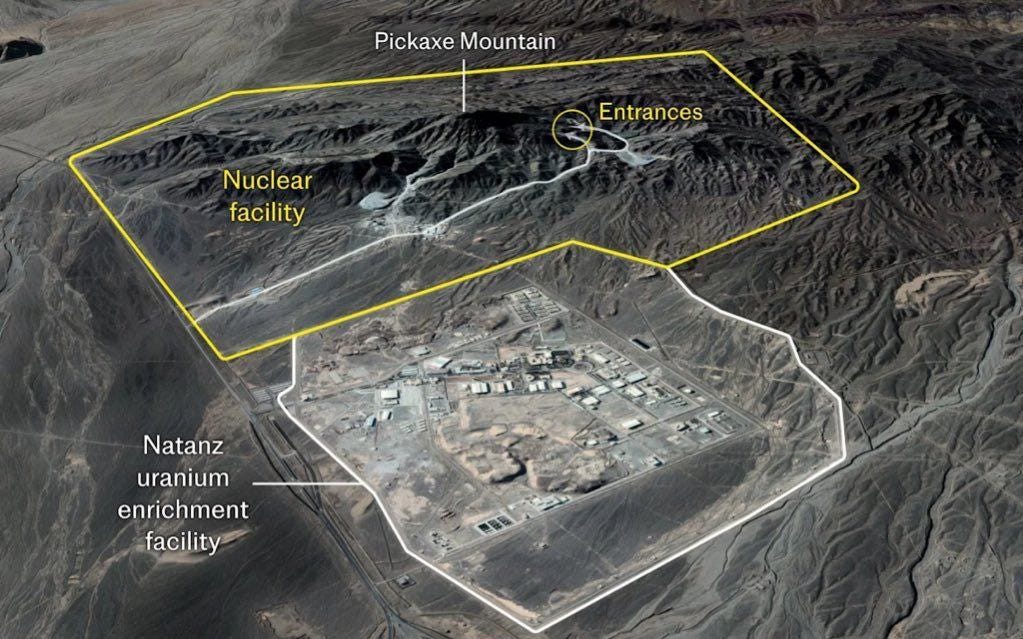
The nuclear infrastructure, while damaged, is not eliminated. Fordow and Natanz are inoperable. But Pickaxe Mountain, an underground facility two kilometers south of Natanz, was not targeted in Epic Fury and shows considerable ongoing construction. An unnamed underground facility northeast of Isfahan was also untouched. And the critical variable: approximately 400 kilograms of 60% highly enriched uranium, location unknown, sufficient to produce nine to ten nuclear weapons if enriched to weapons-grade.[43]
Pickaxe Mountain underground nuclear facility built into the Kuh-e Kolang Gaz La mountain range ~1.5 km from the Natanz.
"The strikes may have turned Iran from a state with latent nuclear capability into one with a nuclear grievance."[44]
The London School of Economics published that assessment on March 9. The logic is historically consistent. Every state that has been subjected to an existential military strike without nuclear deterrence has drawn the same conclusion: get the bomb. Israel after 1967. Pakistan after 1971. North Korea after 2003. The lesson of Epic Fury is not "don't pursue nuclear weapons." The lesson is "pursue them faster, because the alternative is what just happened to us."
And this is where BeiDou becomes existential rather than merely tactical.
A nuclear warhead is only a deterrent if two conditions are met: the warhead must be small enough to fit on a missile, and the missile must be accurate enough to hit its target. Without both, you have a political symbol, not a weapon.
Reports from ISPI indicate that Ali Khamenei, before his death, had already authorized the development of miniaturized nuclear warheads for ballistic missiles. Miniaturization is the final engineering hurdle between enriched uranium and a deliverable weapon, and the previous Supreme Leader cleared it before he was killed. His son inherits not just the title but the authorization.[45]
Now connect the dots. Pre-BeiDou Iran had ballistic missiles with circular error probables measured in hundreds of meters. A nuclear warhead on that platform requires enormous yield to compensate for inaccuracy. You are building a city-killer, which invites annihilation in response, which makes the weapon almost unusable as a deterrent. Post-BeiDou Iran, with encrypted military navigation delivering sub-meter accuracy, changes the calculus entirely. A miniaturized warhead on a BeiDou-guided Khorramshahr-4 is not a city-busting gamble. It is a precision nuclear weapon capable of striking a specific military installation, a specific command center, a specific port. That is a credible deterrent. That is what changes the strategic equation.
The trifecta: Mojtaba Khamenei (a pro-nuclear hardliner with IRGC backing and his father's authorization in hand) + the AEOI (pledged to the new leader, with 400 kg of hidden enriched uranium and a scientific workforce whose knowledge cannot be bombed away) + BeiDou precision (the navigation system that transforms a crude nuclear device into a deliverable, targetable weapon).
China is not just arming Iran's present. It is enabling Iran's nuclear future.
What the Mainstream Press Cannot Tell You
The Washington Post deployed its usual sourcing architecture: three US officials and one Western official. They produced a story about Russia giving Iran intelligence. It was accurate as far as it went. It just did not go very far.
Here is what that methodology cannot see:
1. The BeiDou bilateral program (2015-present) that transformed Iranian navigation capability, because no US official is briefing reporters on Chinese satellite navigation agreements.
2. The three-tier architecture of BeiDou's service levels, because the reporters covering this story do not have backgrounds in satellite navigation engineering.
3. The RDSS two-way communication capability unique to BeiDou, because it requires reading Chinese-language technical documentation and defense analysis.
4. The accuracy ladder from INS-only to encrypted military BeiDou, because it requires cross-referencing Defense Security Asia, Belfer Center technical papers, and Chinese government specifications.
5. The substitutability analysis showing that Russian intelligence and MizarVision provide largely redundant initial targeting data, because conducting that analysis requires comparing capability sets rather than quoting officials.
6. The interceptor supply chain bottleneck (six SRM manufacturers in 1995, two today, one ammonium perchlorate supplier), because Pentagon officials do not volunteer that information to reporters.
7. The Taiwan data harvest, because framing China as an intelligence collector rather than a passive bystander requires a theory of Chinese strategic intent that goes beyond the official talking points.
8. The nuclear trifecta, because connecting Mojtaba Khamenei's IRGC background, the flexibility of Islamic jurisprudence on fatwas, and BeiDou's precision navigation into a single analytical framework requires the kind of cross-domain synthesis that beat reporting cannot produce.
The prestige press relies on access. Access gives you what officials want you to know. What you are reading right now was built from primary sources: defense industry publications, satellite navigation technical specifications, Chinese-language media, think tank assessments from CSIS, JINSA, FPRI, and the Arms Control Wonk, satellite imagery analysis, and the engineering fundamentals of how precision strike actually works.
The analytical gap between this investigation and the Washington Post's reporting is not about resources. The New York Times deployed seven reporters and a "proprietary search tool" for the Epstein files. I deployed Python, Tesseract, and grep, and found 300 documents they never listed. The gap is methodology. When you start from technical fundamentals rather than official statements, you see a different war.
Notes
[1] "Russia is providing Iran with intelligence about the location of U.S. forces." Washington Post, March 6, 2026. Report based on multiple unnamed US and Western officials describing Russian intelligence-sharing with Iran during Epic Fury.
[2] "Iran attacks Israel with over 300 drones, missiles." Al Jazeera, April 14, 2024. See also BESA Center analysis of True Promise 1 operational details; Arms Control Wonk analysis of ~50% ballistic missile failure rate attributed to older liquid-fueled Shahab-3 variants.
[3] "Operation True Promise 4: Iran, regional allies launch massive retaliatory strikes." Tribune India, February 28, 2026. Chinese intelligence data cited in reporting indicates 350 ballistic missiles, 10 cruise missiles, and 550 drones on day one, with 27+ waves continuing through early March.
[4] "Iranian Missile Strike Destroys U.S. THAAD Radar in Jordan." Defence Security Asia, March 2026. See also CNN investigation using Planet Labs satellite imagery confirming craters near AN/TPY-2 radar. Only approximately 20 AN/TPY-2 units have been manufactured since the 1990s.
[5] "Iran Claims Destruction of AN/FPS-132 Radar in Qatar Used for U.S. Missile Warning." Army Recognition, March 2026. Planet Labs imagery (March 3) confirmed scorching and structural damage. See also YNet News analysis of Al Udeid radar impact.
[6] "Iran Missile Strike at Al Dhafra: AN/TPY-2 Radar Destroyed, MQ-9 and U-2 Hub Hit." Defence Security Asia, March 2026. See also The War Zone assessment characterizing attacks on missile defense radars as a "wake-up call."
[7] "Iranian Fattah-2 Hypersonic Strike on Israeli Command Centre." Military Watch Magazine, March 2026. First confirmed combat use of a hypersonic glide vehicle. See also Times of Israel on Tel Aviv residential strike (1 killed, 22 injured) and Al Jazeera on Beit Shemesh (9 killed, 49 injured).
[8] "Six US service members killed in Iranian strike in Kuwait." CNN, March 2, 2026. See also Military Times (6 dead, 18 injured at Shuaiba Port), CNN (seventh service member at Prince Sultan Air Base), and Stars and Stripes on Bahrain strikes targeting Fifth Fleet HQ.
[9] "US lost nearly $2B worth of military equipment in first 4 days." Anadolu Agency, March 2026. Includes AN/FPS-132 ($1.1B), two AN/TPY-2 radars ($300M-$1B each), three F-15E Strike Eagles lost to friendly fire ($282M), SATCOM terminals, and infrastructure damage.
[10] "ABM Performance During True Promise II." Arms Control Wonk. See also companion analysis of Iranian missile failure rates dropping from ~50% (TP1) to ~10% (TP2), attributed to shift from liquid-fueled Shahab-3 variants to solid-propellant Kheibar Shekan and Fattah systems.
[11] "Satellite images show dozens of Iranian missiles struck near Israeli air base." NPR, October 4, 2024. Planet Labs imagery documented 32 distinct impact craters at Nevatim. See also Iran Watch assessment and Times of Israel satellite imagery analysis.
[12] "Twelve Days of Inferno: The Cost of Opening Pandora's Box." Al Jazeera Centre for Studies. See also CSIS analysis of the Iran-Israel air conflict and JINSA assessment of interceptor expenditure during the June 2025 war.
[13] "Shielded by Fire: Middle East Air Defense During the June 2025 Israel-Iran War." JINSA, August 2025. Documents US expenditure of 150+ THAAD and 80+ SM-3 interceptors, representing ~14% of total THAAD inventory with 3-8 year replenishment timeline.
[14] IRGC official statement reported in Al Mayadeen and Global Security, March 2026. Stated that missiles used over the first seven days were "predominantly from production years 2012 through 2014" and Iran had "not used its new generation of missiles except in rare cases."
[15] "Ships and planes are vulnerable to GPS jamming." CNN, March 6, 2026. Documents GPS jamming affecting both military and civilian systems during the conflict.
[16] "Iran Abandons US GPS for China's BeiDou." Defence Security Asia. Iran formally deactivated GPS reception nationwide on June 23, 2025, completing permanent transition to BeiDou. See also Iran International confirmation and Kinghelm technical analysis.
[17] "China's BeiDou: New Dimensions of Great Power Competition." Belfer Center, Harvard Kennedy School. See also Washington Institute analysis of China's satellite cooperation push in the Middle East, and Defence Security Asia reporting on the 2015 bilateral agreement.
[18] Ibid., Belfer Center. BeiDou-3 military encrypted service provides authorized state partners with centimeter-level accuracy through triple-frequency architecture and regional ground station augmentation. See also CGSTL and BeiDou Navigation Satellite System official specifications.
[19] "China's Push for Satellite Cooperation in the Middle East." Washington Institute for Near East Policy. RDSS two-way communication operates on S-band uplink (~2491.75 MHz) and L-band downlink (~1615.68 MHz), frequencies separate from GPS.
[20] CEP comparison derived from: Belfer Center BeiDou technical analysis, Defense Security Asia reporting on combat accuracy during True Promise operations, and standard INS drift calculations for medium-range ballistic missiles over 2,000 km trajectories.
[21] "US Space Command First Movers." Air and Space Forces Magazine. Documents US Space Command's role but does not address BeiDou operating on different frequencies than GPS jamming equipment targets.
[22] "Chinese intelligence company tracking US military assets during Iran operations." FlightGlobal. See also Aviation Week, Defence Security Asia, and SCMP reporting on MizarVision's near-real-time satellite imagery publications showing F-22s, THAAD batteries, carrier groups, and AWACS deployments.
[23] "Viral satellite imagery NOT taken by Chinese satellites." Pekingnology. Hu Bo, Director of the South China Sea Probing Initiative at Peking University, stated "100 percent" certainty that high-resolution images came from Maxar Technologies and Planet Labs (US/European commercial providers), not Chinese satellites.
[24] Substitutability analysis derived from comparison of MizarVision's published capabilities (fixed-target identification, base mapping, asset tracking) against Russian intelligence contributions described in Washington Post and NBC News reporting. Russia adds unique SIGINT, ELINT, real-time mobile tracking, and BDA capabilities not replicated by commercial satellite imagery.
[25] JINSA, "Shielded by Fire" (see footnote 13). THAAD interceptor production rate of approximately 11 per year from Lockheed Martin. At that rate, replacing 150 interceptors consumed in 12 days requires 13+ years of production at full capacity.
[26] "$3.7 million vs $35,000: how cheap Iranian drones are costing millions to intercept." WION. See also Japan Times reporting on the $20,000 Shahed vs $3.7M PAC-3 cost asymmetry.
[27] SRM supply chain consolidation documented in FPRI "Shallow Ramparts" assessment of air and missile defense sustainability. AMPAC (American Pacific Corporation) operates the sole US facility producing ammonium perchlorate oxidizer in Cedar City, Utah, creating a single point of failure for all US interceptor production.
[28] Gulf state interceptor depletion figures derived from: Turkiye Today reporting on 11 US military sites damaged, Defence Security Asia on UAE engagement rates, and Foreign Policy analysis ("Iran, Israel, and the U.S. Are Racing the Clock") documenting INDOPACOM reallocation concerns.
[29] Defense Secretary Pete Hegseth, characterizing China's role in Iran's military capability. Cited in ISW/Critical Threats March 6, 2026 assessment, which explicitly disagreed with this characterization.
[30] "DoD Report: China's ISR Fleet Swells to 510+ Satellites." SatNews, December 2025. Jilin-1 constellation operated by Chang Guang Satellite Technology (CGSTL), provides 30 cm resolution optical imagery and 4K orbital video. See also CGSTL specifications and Air University CASI company overview.
[31] "PLA, Chinese firm release satellite images showing US military build-up around Iran." South China Morning Post, March 2026. The PLA's "Siege of Iran" video was a deliberate information operation, not a leak.
[32] "China watching as US missile stocks drain over Iran." Asia Times, March 2026. Analysis of Beijing's strategic interest in monitoring US ordnance consumption rates for Pacific theater planning.
[33] MizarVision tracking of USS Gerald Ford and USS Abraham Lincoln documented in FlightGlobal, Aviation Week, and Defence Security Asia (see footnote 22). Carrier movement patterns feed directly into PLA anti-access/area-denial planning for the Taiwan contingency.
[34] "China's Iran Strategy: A Proxy Laboratory for War with America." Modern Diplomacy, March 2, 2026. Describes the Iran conflict as a real-time testing ground for evaluating US and Chinese military technology.
[35] BeiDou combat performance under GPS jamming conditions documented in Defence Security Asia ("GPS Crippled, BeiDou Takes Over") and Kinghelm technical analysis. GPS jamming failure rates exceeded 70%; BeiDou-3 achieved approximately 98% positioning reliability in the same conditions.
[36] "As Iran Fights the Allies, China Learns From It." CIHS Blog, March 3, 2026. BeiDou telemetry transits Chinese satellite infrastructure, providing Beijing with missile trajectory, accuracy, and environmental data without requiring Iranian cooperation.
[37] "After Khamenei: China is watching, and so should Taiwan." Lowy Institute, March 2026. See also DoD 2025 China report documenting PLA progress toward 2027 Taiwan capability goal.
[38] IRGC allegiance pledge to Mojtaba Khamenei, March 8, 2026. "Iran authorities support continuity." Al Jazeera, March 9, 2026. See also Iran International reporting on IRGC pressure on Assembly of Experts members.
[39] "Iranian ministers and officials pledge allegiance to new supreme leader." The National (UAE), March 9, 2026. See also PressTV documentation of institutional pledges.
[40] "What Kind of Supreme Leader Would Mojtaba Khamenei Be?" Washington Institute for Near East Policy. See also WION profile documenting IRGC membership from age 17, Basij command during 2009 protests, $100M+ personal wealth, and $3B+ property empire.
[41] "Iran's Flexible Fatwa: How Expediency Shapes Nuclear Decisionmaking." Washington Institute for Near East Policy. Former IRGC Brigadier-General Amir Mousavi on the non-permanence of fatwas under Jaafari Shia jurisprudence.
[42] Ibid. The principle of maslahat-e nezam (regime expediency) allows the Supreme Leader to override existing legal and religious frameworks when regime survival is at stake. Combined with the IRGC's documented pressure for nuclear weapons development and the assassination of the previous Supreme Leader, the institutional conditions for abrogating the fatwa are present.
[43] "Operation Epic Fury and the Remnants of Iran's Nuclear Program." CSIS. See also CSIS satellite imagery analysis of Pickaxe Mountain construction and Bloomberg investigation of hidden nuclear stockpiles. 400 kg of 60% HEU sufficient for 9-10 weapons if further enriched to 90%.
[44] "US strikes may have turned Iran from a state with latent nuclear capability into one with a nuclear grievance." LSE US Centre, March 9, 2026. Analysis of historical proliferation patterns following existential military strikes.
[45] ISPI sources reported October 2025 authorization by Ali Khamenei for development of miniaturized nuclear warheads for ballistic missiles. See also Bloomberg: "Iran War: New Supreme Leader Faces Trump, Israel, Dissent." Bloomberg, March 8, 2026. Notes that Mojtaba "could choose to do what his father never did: pursue the bomb."