April 7, 2026
Three days ago, an F-15E Strike Eagle was shot down over western Iran. The crew ejected. One was rescued from Iranian soil. The other was not.
What began as a rescue mission has become a ground war.
OSINT reporting confirmed on April 4 that U.S. ground forces are engaged in active combat with IRGC soldiers in Kohgiluyeh and Boyer-Ahmad Province, the same region where the F-15E went down. A-10 Warthog attack aircraft are providing close air support to American troops in contact with the enemy near Yasuj in southwestern Iran. The A-10 is not a rescue platform. It is a ground attack aircraft. You send A-10s when your troops are being shot at.[1]
One of the A-10s was then shot down over the Strait of Hormuz. The New York Times confirmed the loss. The pilot reached Kuwait but the aircraft crashed on arrival. Iranian state media released footage of air defenses engaging the A-10 before it went down. CBS confirmed it was the same A-10 that had been providing CAS for the rescue mission.[2]
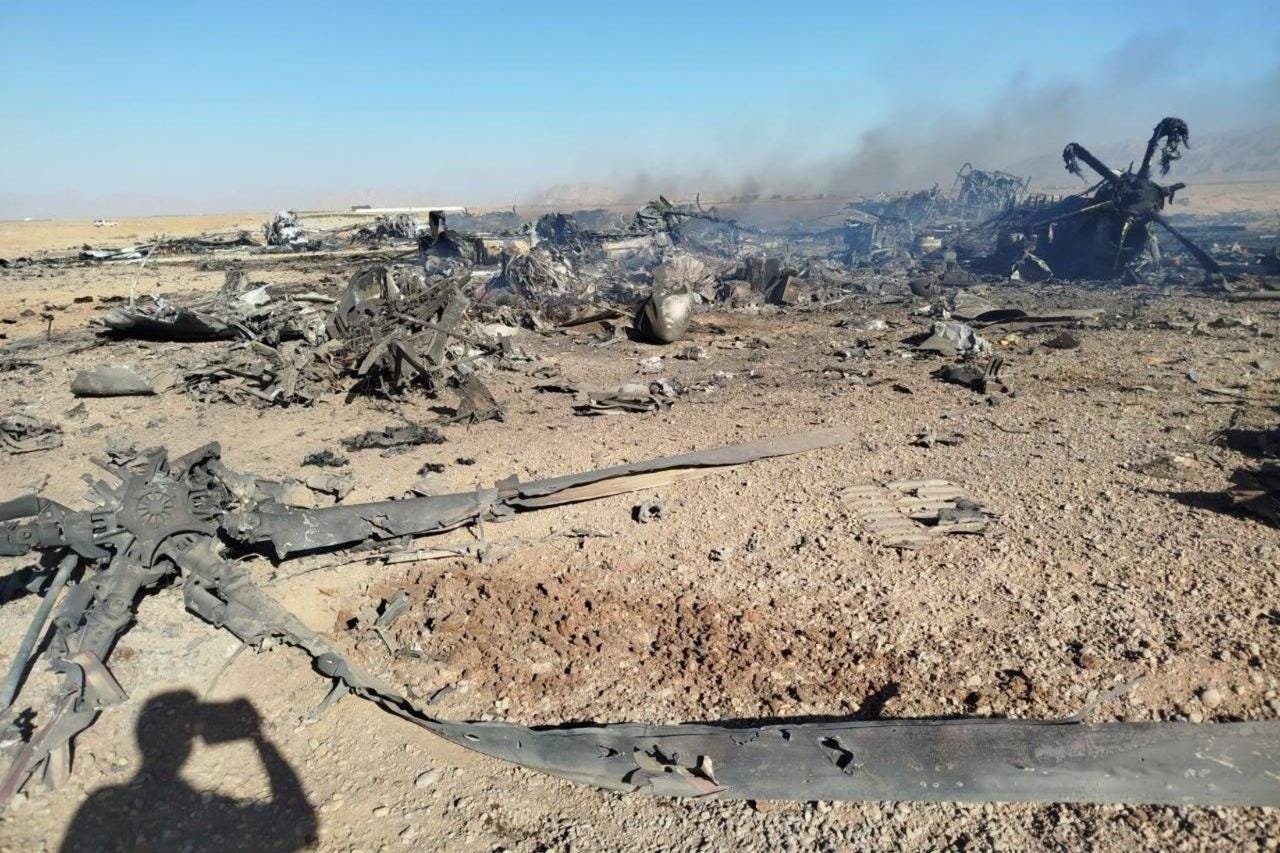
The C-130 Hercules transport aircraft that accompanied the rescue helicopters was also shot down. Iranian police released footage showing their forces engaging American helicopters with medium weapons. In the same footage, the wreckage of the C-130 is visible. It had been looted.[3]
[VIDEO: Iranian police footage showing engagement of American rescue helicopters with medium weapons. C-130 wreckage visible in background. Source: IRGC-affiliated channels.]
[IMAGE: Charred remains of MC-130J Commando II in Isfahan Province. Each aircraft cost over $100 million. U.S. forces destroyed them on the ground to prevent capture. Iran claims its forces shot them down.]
[IMAGE: IRGC propaganda photo displaying USAF identification card and Israeli border control permit recovered from the crash site. Persian caption reads: "identification documents of enemy pilots."]
In 24 hours, Iran shot down or destroyed an F-15E Strike Eagle, an A-10 Warthog, a C-130 Hercules, and possibly a Black Hawk helicopter. American soldiers are fighting on Iranian soil. The rescue became a battle that is generating more casualties than the incident it was meant to resolve.
Bloomberg: $35/month. Financial Times: $42/month. The Economist: $17/month. Original analysis by Tatsu with 40+ footnotes: $8/month.
Share this preview with others.
This is no longer an air war. It is no longer a standoff campaign. American troops are in ground contact with Iranian soldiers inside Iranian territory, supported by close air support aircraft that are being shot down, resupplied by transport aircraft that are being shot down, and rescued by helicopters that are being shot at. The mission to save two pilots has become a battle that is consuming aircraft, personnel, and whatever remained of the "air superiority" narrative.
Inside this report:
* Ground clashes: American CSAR troops fighting IRGC soldiers in southwestern Iran
* Four aircraft lost in 24 hours: F-15E, A-10, C-130, possible Black Hawk
* South Pars destroyed: Israel hit 85% of Iran's petrochemical export capacity
* IRGC intelligence chief killed: Major General Majid Khademi assassinated
* The ceasefire that wasn't: Iran's 10-point rejection of the 45-day proposal
* 30 missiles in 6 hours: 98th wave targeting Israel and US amphibious assets
* Joint three-front strike: IRGC, Hezbollah, and Houthis attacking Israel simultaneously for the first time
* Trump: "We are going to blow up the entire country of Iran." "They're animals."
* The pause expires: April 6 was the deadline. South Pars was the answer.
Built from Iran-related messages across OSINT channels, verified against NYT, CBS, ABC, Axios, and Reuters. A paid subscription is $8/month.
$8/month. The mainstream doesn't show you verified real-time OSINT news.
The Trap
On April 3, General Randy George, the Army Chief of Staff, told the president that ground operations inside Iran would produce exactly the kind of escalation spiral the United States could not control. Trump fired him. Three days later, American ground troops are fighting IRGC soldiers in southwestern Iran, supported by A-10 Warthogs that are being shot down, resupplied by C-130s that are being looted, and rescued by helicopters that are being engaged with small arms by Iranian civilians hoping to collect a bounty.
The general was right. The president fired him for being right. And now the president's replacement is managing the disaster the fired general predicted.
This is not a failure of execution. It is the logic of escalation operating exactly as political scientists have described it for decades. Each operation designed to solve the last problem creates two new ones. An F-15E is shot down, so you send a rescue mission. The rescue mission comes under fire, so you send A-10s for close air support. The A-10 is shot down, so you need another rescue. The C-130 gets stuck in the sand, so you destroy it to prevent capture. Now you've lost four aircraft, you have troops in ground contact, and the original pilot still needed extracting. The mission to save two people has consumed more resources and created more risk than the incident itself. This is the war in miniature. Every escalation designed to end the problem deepens it.
Here is the box Trump has built around himself. There are four walls and none of them move.
He cannot withdraw. The Strait of Hormuz is still closed. The original strategic problem that justified the war (Iran's nuclear program and regional threat posture) is unsolved. Withdrawal means the most expensive air campaign since Iraq produced nothing: no regime change, no nuclear disarmament, no reopened Strait, no oil access. It means every aircraft lost, every pilot shot down, every billion spent bought zero strategic gain. For a president whose entire political brand is built on strength and winning, withdrawal is political suicide. He would be the president who started a war, lost aircraft on Iranian soil, and quit.
He cannot escalate to decisive victory. A ground invasion of Iran would require 500,000+ troops and produce casualties that would end any presidency. The nuclear option is politically unthinkable and would collapse every alliance simultaneously. Destroying all remaining civilian infrastructure (the "blow up the entire country" threat) would trigger a global oil crisis that destroys the American economy faster than it destroys Iran. Every escalation option that might theoretically force capitulation carries a cost that exceeds the value of the objective.
He cannot negotiate from strength. This is the cruelest wall. Before the war, Iran offered a nuclear deal. Trump rejected it. Now, 38 days and billions of dollars later, any deal Iran would accept is worse than the deal that was on the table before the first bomb dropped. Iran's negotiating position has improved, not deteriorated, because the war proved that American air power cannot force Iranian capitulation. Tehran knows this. Every mediator knows this. The 10-point "maximalist" response was not irrational. It was Iran pricing in 38 days of evidence that the United States cannot compel better terms through force. Trump would have to accept a worse deal than the one he rejected, and explain why the war was necessary to arrive at it.
He cannot maintain the status quo. The current tempo is unsustainable. The Strait closure is bleeding the global economy. American aircraft are being lost at a rate that depletes specialized airframes (MC-130Js, A-10s) faster than they can be replaced. Ground troops are now in contact, which means casualties, which means public attention, which means political cost. The bombing campaign has not degraded Iran's missile capability (98 waves and counting). Every week of status quo increases the economic damage to American allies, erodes coalition support that barely existed to begin with, and gives Iran more time to coordinate the three-front offensive capability it demonstrated on Day 38.
Four walls. No exit that doesn't require admitting the entrance was a mistake.
This analysis is a…