Share this preview with others.
"I know what America is. America is a thing you can move very easily, move it in the right direction." Netanyahu, secretly recorded in 2001, explaining how he destroyed the Oslo Accords. Twenty-five years later, he did it again in Islamabad.
"Men ought either to be well treated or crushed, because they can avenge themselves of lighter injuries, of more serious ones they cannot." Machiavelli, The Prince, Chapter 3.
The conventional narrative is simple: the US and Iran tried to make peace in Islamabad, it didn't work, and now we have a naval blockade. Iran was too stubborn. Trump was too aggressive. The ceasefire is collapsing.
That narrative is wrong. Or rather, it's incomplete in a way that serves one person's interests.
The ceasefire didn't collapse because of Iranian intransigence or American maximalism, although both were present. It collapsed because Israeli Prime Minister Benjamin Netanyahu systematically separated the fronts, torpedoed the one condition that would have held the deal together, and then opened his own negotiations on terms that excluded Iran entirely.
The evidence is in the timeline. All of it sourced from open-source intelligence channels, cross-referenced against Reuters, Axios, Kann (Israeli state broadcaster), Al Mayadeen, and CENTCOM statements.[1]
Wall Street pays $40k/year for this intelligence. You get it for $8/month.
Below the paywall: the complete timeline showing how three parallel negotiations were sabotaged, who benefited, and what comes next as the ceasefire clock runs out.
* The Islamabad talks: from "inches away" to collapse in 21 hours
* The Lebanon carve-out: how Netanyahu killed the deal Iran needed
* The Washington channel: Israel's separate peace on its own terms
* The blockade that doesn't work: 20+ vessels transiting daily while CENTCOM claims control
* The triple chokepoint threat: Iran's endgame if diplomacy fails
* What happens when the clock hits zero
This analysis is available to paid subscribers
Three Tables, One Architect
To understand how the ceasefire collapsed, you need to see all three negotiations simultaneously. They weren't parallel tracks. They were a single chessboard, and Netanyahu was the only player who saw all the pieces.
Table 1: Islamabad (US/Iran, Pakistan-mediated)
The highest-level direct US/Iran engagement in 47 years. Iran sent Parliament Speaker Qalibaf, FM Araghchi, the Defense Council Secretary, the Central Bank Governor, and Professor Marandi (the nuclear expert who negotiated the JCPOA). The US sent VP Vance, Kushner, and Witkoff. Pakistan's Army Chief Asim Munir hosted.[2]
Table 2: Washington (Israel/Lebanon, US-mediated)
Direct face-to-face talks between Israeli and Lebanese delegations, held simultaneously with the Islamabad round. The Israeli ambassador stated both sides agreed on "liberating Lebanon from Hezbollah."[3]
Table 3: The Shadow Channel (Israel via the US)
Netanyahu received daily briefings from Vance on the Islamabad talks. He wasn't at the table. He was above it.[4]
The Sequence
April 8: The Ceasefire
The US and Iran agree to a two-week ceasefire brokered by Pakistan. Iran reopens the Strait of Hormuz. Talks to begin Friday in Islamabad based on Iran's 10-point proposal. Trump calls it "a big day for world peace."
Iran's condition from the start: Lebanon must be included. FM Araghchi, President Pezeshkian, and Parliament Speaker Qalibaf all stated this publicly and repeatedly. Iran would not sign a deal that let Israel continue bombing Hezbollah while Tehran stood down.[5]
Netanyahu's response, within hours: The ceasefire does not cover Lebanon. Israel's operations against Hezbollah will continue. This was announced the same day the ceasefire was signed.[6]
Pakistan's PM Sharif said the deal covered Lebanon. Iran said it covered Lebanon. Netanyahu said it didn't. The ceasefire text was apparently ambiguous on this point. Ambiguity that precise is never accidental.
April 9 to 10: Israel Escalates in Lebanon
While the world celebrated the ceasefire, the IDF launched the most intense airstrikes on Beirut's southern suburbs in years. Tyre was hit. Southern Lebanon towns were bombed. The IDF killed Hezbollah leader Qassem's nephew and personal advisor in a targeted strike.[7]
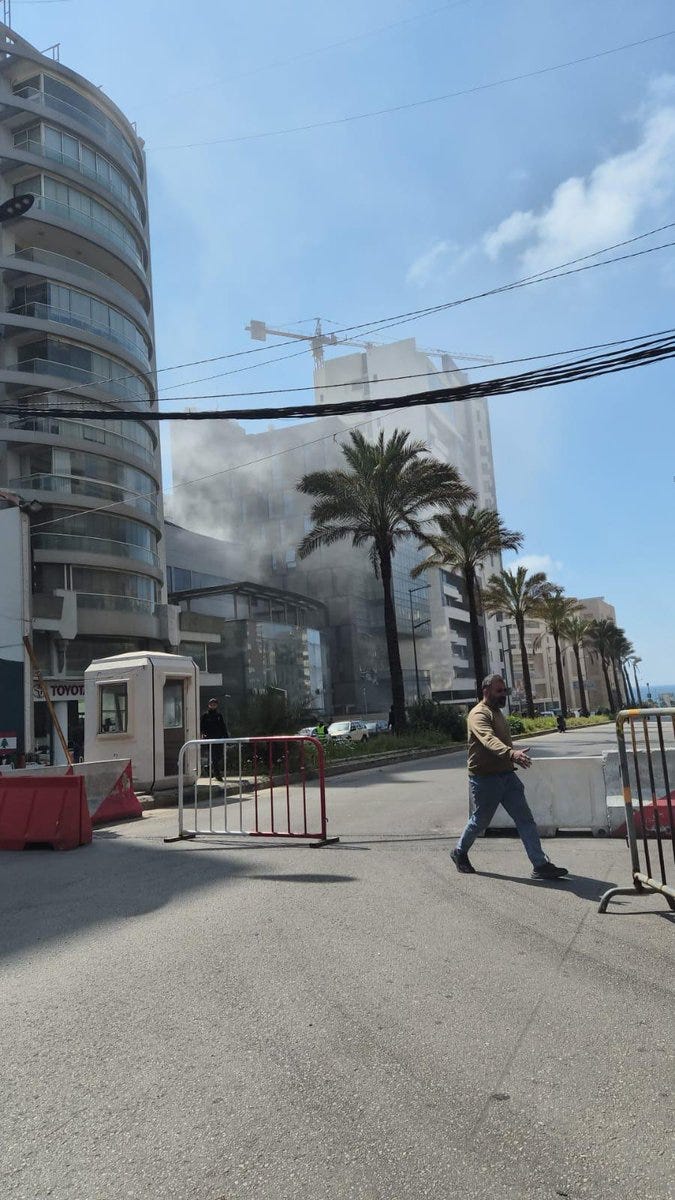
[IMAGE: Israeli airstrike on Beirut during the "ceasefire." The IDF escalated in Lebanon the same week the world was celebrating peace with Iran.]
Hezbollah responded by resuming military operations: 17 published strikes in a single morning, including Noor C-802 anti-ship missiles at Israeli naval vessels.[8]
Iran's response to the Lebanon escalation was immediate: the delegation post about traveling to Islamabad for Friday talks was deleted. Negotiations were in doubt before they started. Iran conditioned attendance on Israel halting Lebanon strikes.[9]
This is the first pivot. Netanyahu's Lebanon escalation nearly killed the Islamabad talks before a single word was exchanged.
April 11: Islamabad Begins
Iran sent its delegation anyway, after Pakistan's army chief personally intervened. The talks began with indirect communication through Pakistani mediators, then moved to direct trilateral engagement (the Qalibaf/Vance handshake was the first direct contact).[10]
[IMAGE: The Qalibaf/Vance handshake confirmed by NYT. The highest-level direct US/Iran contact in 47 years. It lasted 21 hours.]
Iran submitted four red lines:
1. Iranian sovereignty over the Strait of Hormuz
2. War reparations
3. Unfreezing of all blocked financial assets
4. Comprehensive regional security arrangements (including Lebanon)[11]
The US countered. The frozen assets question became the first flashpoint: Reuters reported the US agreed to release $6 billion held in Qatari banks. CBS immediately reported a US official denying it.[12] Classic negotiation signaling, except both leaks served to keep pressure on without commitment.
Meanwhile, Netanyahu was receiving daily briefings from Vance on exactly what Iran was asking for, what the US was offering, and where the gaps were.[4]
April 11 to 12: 21 Hours, Then Collapse
The talks went 21 hours. Araghchi later said they were "inches away from an Islamabad MoU" before encountering "maximalism, shifting goalposts, and blockade."[13]
Vance's final offer, per Fox News and Axios:
* End all uranium enrichment
* Dismantle all major nuclear facilities
* Surrender highly enriched uranium
* Stop financial support for Hamas, Hezbollah, and the Houthis
* Fully open Hormuz without tolls[14]
This was not a negotiation. This was a demand for unconditional surrender from a country that had just fought the US military to a standstill for six weeks, maintained operational capability across nine countries, and still controlled the world's most important chokepoint.
Iran rejected it. Vance said Iran "chose not to accept." The Iranian delegation departed. Reports indicate they felt "threatened" after a Washington Post op-ed suggested assassinating Iranian negotiators was published during the talks.[15]
The Lebanon Connection
Here is what the conventional narrative misses.
Iran's fourth red line was "comprehensive regional security arrangements." This meant Lebanon. It always meant Lebanon. Every Iranian official from Pezeshkian to Qalibaf to the parliamentary National Security Committee stated that Iran would never abandon Hezbollah and that Lebanon must be part of any deal.[16]
The US requested Israel approve a one-week Lebanon ceasefire timed to coincide with the Iran ceasefire expiration. Israel's war cabinet met at US request to discuss it.[17]
Israel rejected it. Kann, the Israeli state broadcaster, reported the rejection was because the proposal "was pushed for by Iran and the Pakistanis."[18]
The US asked Israel for a one-week pause. Israel said no because Iran wanted it. The logic is circular by design: Iran won't sign without Lebanon, Israel won't pause Lebanon because Iran wants it, therefore no deal is possible. Netanyahu created a closed loop with no exit.
The Washington Track
Within days of torpedoing the Islamabad talks by refusing …