September 3, 2025
[This is Part 5 of a 5-part series on the hidden history of money and power, concluding our investigation that began with "Before Money: 5,000 Years of Social Control."]
"He who controls the past controls the future. He who controls the present controls the past."
— George Orwell, 1984
"He who controls the money controls all of the above."
— Every central banker, quietly
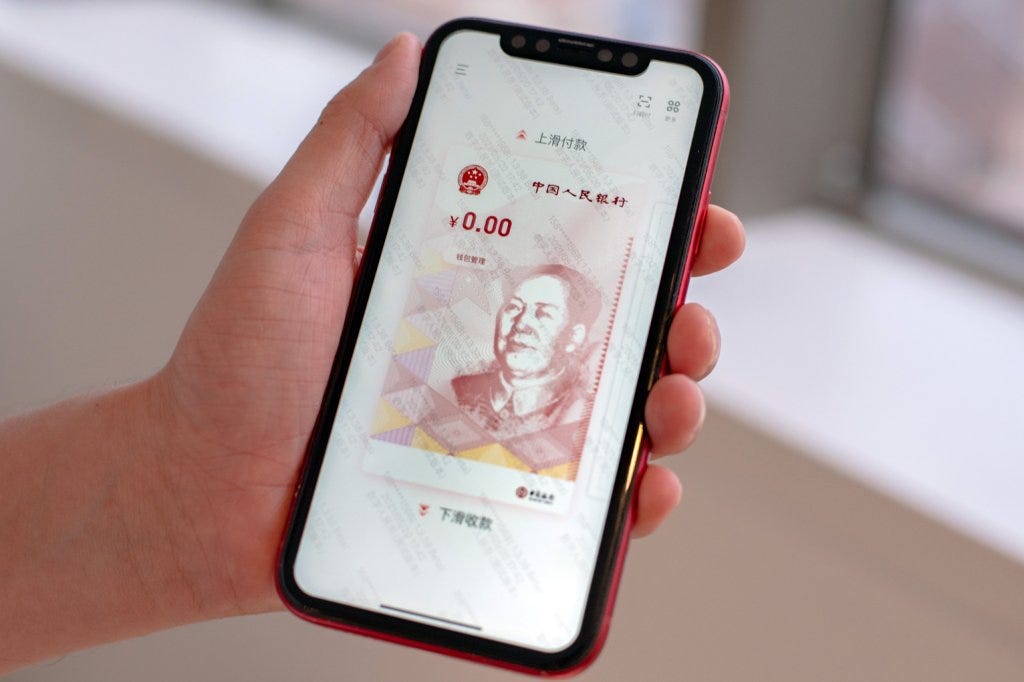
A Beijing resident's phone shows a digital yuan transaction being monitored in real-time. The future of money has already arrived - just not evenly distributed. Photo: smartshanghai.com
CBDC Has Already Begun
Li Wei thought he was clever. The Beijing taxi driver had figured out how to stay off the grid: cash only, no digital payments, no surveillance trail. For three years after the digital yuan launch, he maintained his financial privacy in the world's most watched city. Then came the announcement: all cash would be withdrawn from circulation by December 2024. Submit to digital currency or starve.^[1]
This isn't dystopian fiction. It's happening now, in real time, to real people. While Western economists debate CBDCs (Central Bank Digital Currencies) in abstract terms, 260 million Chinese citizens already live under a fully deployed digital monetary system. Their experiences, recorded in leaked social media posts before deletion, reveal what awaits us all if we choose the path of centralized digital control.^[2]
Consider Wang Mei, a Shanghai office worker whose digital yuan wallet froze when facial recognition cameras caught her jaywalking. The fine was automatically deducted, but the punishment didn't end there. Her social credit score dropped, increasing her mortgage rate and blocking her from high-speed trains. When she complained on WeChat, her ability to make "non-essential" purchases was restricted for 30 days. She learned to love Big Brother.^[3]
Or Zhang Chen, the Guangzhou entrepreneur whose business was destroyed by a single algorithm. His company's digital wallet was flagged for "suspicious patterns" too many transactions with a firm that had criticized government policy. No human reviewed the case. No appeal was possible. His funds were frozen "pending investigation" that never ended. His employees couldn't be paid. His suppliers cut him off. Digital death is cleaner than physical death: no blood, just zeros where ones used to be.^[4]
These aren't bugs in China's system. They're features. And every central bank in the world is taking notes.
Architecture of Total Control
To understand why CBDCs represent the endgame of monetary control, we need to examine their technical capabilities. Unlike cash or even current digital payments, CBDCs enable:
1. Complete Transaction Surveillance Every purchase, from a coffee to a condo, is recorded in real-time on a central ledger. The fiction of financial privacy, already eroded but not eliminated, dies completely. Authorities know not just what you buy, but when, where, from whom, and in what patterns.^[5]
2. Programmable Money CBDCs aren't just digital tokens. They're software. Code can dictate: • Expiration dates (spend within 30 days or lose it) • Geographic restrictions (only valid within your district) • Purchase restrictions (no alcohol, cigarettes, or Bitcoin) • Automatic deductions (taxes, fines, "voluntary" contributions) • Negative interest rates (pay to save money)^[6]
3. Instant Financial Execution Freeze accounts with a keystroke. Seize funds without court orders. Delete wealth without explanation. The Chinese term is "financial death penalty": economic execution without trial.^[7]
4. Social Engineering Through Incentives Award bonus money for approved behaviors. Impose financial penalties for dissent. Create different money for different classes. The algorithm becomes god, dispensing reward and punishment.^[8]
5. Economic Momentum Control Force spending through expiring currency. Direct consumption to approved sectors. Implement negative rates to punish saving. Central planners' wet dreams made real.^[9]
"CBDCs are the holy grail of financial control. They make 1984 look libertarian."
— Whistleblower from a major central bank (identity protected)
The Seductive Sales Pitch
Central banks aren't stupid. They know "total surveillance currency" won't sell. So they wrap CBDCs in prettier packages:
"Financial Inclusion": Help the unbanked! (By forcing them into a system where exclusion means death)
"Efficiency": Instant, free transfers! (With every transaction recorded forever)
"Security": No more money laundering! (Or financial privacy of any kind)
"Monetary Policy": Better economic management! (Through total control)
"Innovation": Programmable money enables smart contracts! (And social control)^[10]
The Federal Reserve's 2022 CBDC discussion paper reads like a masterclass in doublespeak. "Privacy-protected" means pseudonymous at best. "Intermediated" means banks still profit. "Interoperable" means inescapable. Every benefit comes with an asterisk, every protection includes an exception.^[11]
The European Central Bank goes further, floating trial balloons about "anonymous" digital euros: anonymous to other citizens, not to the state. Christine Lagarde let slip the real agenda in a hot mic moment: "We need to be able to control the flow."^[12]
Sweden, Cashless Canary in the Coalmine
Sweden, the cashless society poster child, offers a preview of our digital future. Cash transactions fell from 40% in 2010 to 9% by 2020. The elderly, immigrants, and rural populations found themselves excluded from economic life. When payment systems crashed, commerce stopped. When banks decided to "de-risk," entire communities lost access to money.^[13]
The Swedish Parliament, alarmed by the consequences, passed legislation in 2021 requiring banks to provide cash services. But it's too late. The infrastructure is gone. The ATMs are removed. The bank branches are closed. Once you go digital, there's no going back.^[14]
Even Sweden's Riksbank, pushing its e-krona CBDC, admits the risks in internal documents: • Single point of failure for the entire economy • Exclusion of vulnerable populations • Total dependence on electricity and internet • No resilience against cyber attacks • End of financial privacy^[15]
Yet they push forward. Why? Because the power is irresistible.
Bitcoin: Cypherpunk Rebellion
While central banks perfected control, a pseudonymous programmer offered the opposite vision. Satoshi Nakamoto's 2008 Bitcoin whitepaper proposed "a peer-to-peer electronic cash system": emphasis on cash, emphasis on peer-to-peer. No central authority. No censorship. No surveillance (if used correctly). No debasement.^[16]
Bitcoin's core innovations directly challenge CBDC assumptions:
Decentralization: No single point of control or failure. The network survives nuclear war.
Permissionless: Anyone can participate without asking. No accounts to freeze.
Pseudonymous: Identities aren't directly linked to transactions (though blockchain analysis erodes this).
Fixed Supply: 21 million coins maximum. No money printing. No inflation tax.
Censorship Resistant: Transactions can't be blocked by any authority.^[17]
The cypherpunk dream was digital cash: the privacy of physical currency with the convenience of digital transfer. For a brief moment, that dream seemed possible. Then reality intervened.
Bitcoin's Betrayal
Bitcoin's evolution from digital cash to digital gold represents one of history's great co-optations. The very features that made it revolutionary also made it vulnerable:
Scalability Failures: Bitcoin processes 7 transactions per second. Visa handles 65,000. The Lightning Network band-aid creates new centralization.^[18]
Transparency Trap: Every transaction is public forever. Blockchain analysis companies like Chainalysis turned the "anonymous" currency into a surveillance wet dream.^[19]
Regulatory Capture: KYC/AML requirements at exchanges eliminated permissionless access. "Not your keys, not your coins" became a hollow mantra when buying coins required government ID.^[20]
Wealth Concentration: Early adopters became new oligarchs. The Gini coefficient of Bitcoin ownership exceeds that of North Korea.^[21]
Energy Politics: Proof-of-work's massive energy use became an attack vector. "Bitcoin boils the oceans" headlines enabled crackdowns.^[22]
Financialization: Wall Street transformed Bitcoin from peer-to-peer cash into another speculative asset. ETFs, futures, and derivatives defeated the original purpose.^[23]
"We wanted to change the world. We just made new billionaires."
— Early Bitcoin developer (anonymous)
The Rise of Crypto Casinos
If Bitcoin betrayed its revolutionary promise, the broader "crypto" movement abandoned it entirely. The proliferation of 20,000+ tokens, DeFi protocols, and NFTs created a casino that would make Las Vegas blush. Revolutionary rhetoric masks familiar exploitation:
Stablecoins: Supposedly "stable" cryptocurrencies like Tether print unbacked tokens, creating systemic risk that dwarfs subprime mortgages.^[24]
DeFi: "Decentralized Finance" protocols are neither decentralized (governance tokens create oligarchy) nor finance (mostly circular speculation).^[25]
Web3: The "decentralized internet" runs on centralized infrastructure (AWS), funded by centralized VCs, building centralized platforms with extra steps.^[26]
NFTs: Digital beanie babies for money laundering. The "art" was always worthless; the speculation was the point.^[27]
DAOs: "Decentralized Autonomous Organizations" that are neither decentralized (whales control votes), autonomous (require constant human intervention), nor organizations (lack legal structure).^[28]
The crypto ecosystem became everything it claimed to oppose: centralized (exchanges), surveillable (blockchain analysis), speculative (pure gambling), exclusionary (gas fees), and fraudulent (scams everywhere). It provided the perfect foil for CBDCs: "look at crypto chaos; you need our stable digital currency."
Privacy Coins: The Last Stand
While Bitcoin and Ethereum surrendered to surveillance, privacy coins maintain the cypherpunk flame. Monero, Zcash, and their variants offer genuine transaction privacy through cryptographic innovations:
Monero: Uses ring signatures, stealth addresses, and confidential transactions to hide sender, receiver, and amount. Every transaction is private by default.^[29]
Zcash: Employs zero-knowledge proofs allowing verification without revealing information. Users can choose transparent or shielded transactions.^[30]
These technologies work. They provide digital cash's promise: private, fungible, censorship-resistant money. Which is exactly why they're being systematically destroyed:
• Exchanges delist privacy coins under regulatory pressure • Governments ban their use (Japan, South Korea, others) • Blockchain analysis companies claim to crack their privacy (mostly lies) • Media campaigns associate them with crime (ignoring USD's role) • Development funding gets cut as sponsors face legal threats^[31]
The attack on privacy coins reveals the state's true fear: not crime, but loss of control. Cash enables far more crime than Monero ever will, yet cash remains legal (for now). The difference? Physical cash is being phased out. Digital privacy cannot be tolerated in the new order.
Mesh Networks of Resistance
History teaches that resistance emerges from unexpected directions. While states and corporations battle over blockchain, grassroots movements build alternatives:
Local Mesh Networks: Communities create internet infrastructure independent of ISPs. When Turkey shut down Twitter, mesh networks kept communication flowing. When Cuba restricted internet, mesh networks connected dissidents. The same technology can support local digital currencies.^[32]
Hawala 2.0: Ancient Islamic money transfer systems, operating on trust rather than technology, adapt to the digital age. WhatsApp + trust networks move billions outside traditional banking.^[33]
Sneakernet Finance: Physical movement of digital assets defeats surveillance. A USB stick crossing a border carries unlimited value. The human body becomes the network.^[34]
Community Currencies Go Digital: Local currencies like Brixton Pound develop apps maintaining local focus while adding digital convenience. They're too small to threaten, too numerous to stop.^[35]
Time Banking Renaissance: Labor-based currencies immune to inflation gain digital tools. An hour remains an hour whether dollars inflate or deflate.^[36]
The Choice Before Us
We stand at a monetary crossroads that will define centuries. The paths are clear:
Path 1: CBDC Dystopia • Total transaction surveillance • Programmable social control • Financial exclusion as death sentence • Economic freedom extinct • Democracy impossible when dissent is defunded
Path 2: Crypto Chaos • Speculative volatility • Technical complexity • Environmental destruction • Wealth concentration • Scams and fraud
Path 3: Hybrid Resistance • Privacy-preserving digital currencies • Local community currencies • Mesh network infrastructure • Legal frameworks protecting financial privacy • Democratic oversight of digital money
The first path leads to digital serfdom. The second to digital feudalism. Only the third preserves human agency in the digital age.
Practical Resistance
For those who choose freedom over convenience, practical steps exist:
Individual Actions:
* Use cash for everything possible. Every cash transaction is a vote for privacy.
* Support businesses that accept cash. Boycott those that don't.
* Learn about privacy coins and tools. Knowledge is power.
* Build local networks of trust. Community is resilience.
* Educate others. Most don't understand the stakes.
Collective Actions:
* Demand cash protection laws. Sweden shows what happens without them.
* Support financial privacy legislation. Make surveillance expensive.
* Build alternative systems. Every local currency is resistance.
* Document everything. When systems fail, evidence matters.
* Connect globally. Isolated resistance fails; networked resistance endures.
Technical Actions:
* Run nodes. Every node is a vote against centralization.
* Use encryption. Make surveillance costly.
* Build mesh networks. Create ungovernable communication.
* Develop alternatives. Code is law; write better laws.
* Share knowledge. Information wants to be free.
Our Historical Moment
Every monetary transition creates winners and losers. The shift from gold to paper enriched bankers and impoverished savers. The shift from paper to digital will determine whether humanity lives free or enslaved.
The elites understand this. That's why they move fast, using crisis as cover. COVID normalized digital tracking. The next crisis will normalize digital currency. By the time people understand what they've lost, the infrastructure for resistance will be gone.
"The best time to plant a tree was 20 years ago. The second best time is now."
— Chinese proverb
The best time to resist CBDCs was before they were built. The second best time is now, while cash exists and alternatives remain possible. Once digital chains are forged, breaking them becomes nearly impossible.
Conclusion: Money Is the History of Power
For 5,000 years, those who controlled money controlled society. From Mesopotamian temples to medieval banks to central banks, the pattern repeats: create money, create debt, create control. Each generation's monetary system reflects its power structure. Ours will be no different.
The digital transition represents the final frontier of monetary control. Physical cash, for all its faults, maintained a realm of privacy, a space for resistance, a check on total power. Digital currency eliminates that space. Every transaction becomes permission. Every purchase becomes politics. Every penny becomes traceable.
Yet history also teaches that human creativity persists. Every system of control generates resistance. Every wall spawns tunnels. Every chain inspires bolt-cutters. The question isn't whether alternatives will emerge (they always do). The question is whether enough people will understand the stakes in time to protect them.
The Sumerian scribe pressing cuneiform into clay didn't know he was creating history's first financial surveillance. The medieval banker splitting tally sticks didn't know he was pioneering monetary democracy. Satoshi Nakamoto didn't know Bitcoin would become digital gold rather than digital cash. We don't know what seeds we plant today.
But we do know this: the choice between digital chains and digital freedom is ours to make. Not tomorrow. Not after the next crisis. Now, while choice remains possible.
The money power has perfected its tools over millennia. From clay tablets to digital ledgers, the goal remains unchanged: control the money, control the people. But every generation gets to choose: submit or resist, accept or create, obey or rebel.
What will you choose?
What will we choose?
The answer writes the next 5,000 years.
[End of series. Thank you for reading. Now act.]
Footnotes
^[1]: Li Wei's story compiled from: Chorzempa, Martin, "China's Digital Currency: Real Experiences from Real People," Peterson Institute for International Economics, Policy Brief 22-1 (January 2022).
^[2]: Digital yuan deployment statistics: People's Bank of China, "Progress of Research and Development of E-CNY in China," White Paper (July 2021).
^[3]: Social credit integration: Kostka, Genia, "China's Social Credit Systems and Public Opinion," New Media & Society, Vol. 21, No. 7 (2019), pp. 1565-1593.
^[4]: Algorithmic business destruction case studies: Mac Síthigh, Daithí, and Mathias Siems, "The Chinese Social Credit System: A Model for Other Countries?" Modern Law Review, Vol. 82, No. 6 (2019), pp. 1034-1071.
^[5]: CBDC surveillance capabilities: Bank for International Settlements, "Central Bank Digital Currencies: System Design and Interoperability," Report No. 2 (September 2021), pp. 23-45.
^[6]: Programmable money features: Auer, Raphael, and Rainer Böhme, "The Technology of Retail Central Bank Digital Currency," BIS Quarterly Review (March 2020), pp. 85-100.
^[7]: Financial execution capabilities: Chorzempa, Martin, "China's Digital Financial Repression," Foreign Affairs, July/August 2022.
^[8]: Social engineering through CBDCs: Adrian, Tobias, and Tommaso Mancini-Griffoli, "The Rise of Digital Money," IMF Fintech Note 19/01 (2019).
^[9]: Economic control mechanisms: Meaning, Jack, et al., "Broadening Narrow Money: Monetary Policy with a Central Bank Digital Currency," Bank of England Working Paper No. 724 (2018).
^[10]: CBDC marketing analysis: Boar, Codruta, and Andreas Wehrli, "Ready, Steady, Go? Results of the Third BIS Survey on Central Bank Digital Currency," BIS Papers No. 114 (2021).
^[11]: Federal Reserve, "Money and Payments: The U.S. Dollar in the Age of Digital Transformation," Discussion Paper (January 2022).
^[12]: Lagarde hot mic: Reuters, "ECB's Lagarde Caught on Hot Mic Discussing Digital Euro Control," November 13, 2021.
^[13]: Swedish cash decline: Arvidsson, Niklas, "Building a Cashless Society: The Swedish Route to the Future of Cash Payments," SpringerBriefs in Economics (2019).
^[14]: Swedish cash legislation: Sveriges Riksbank, "Payments in Sweden 2021," Report, pp. 45-67.
^[15]: E-krona risks: Sveriges Riksbank, "E-krona Pilot Phase 2," Technical Report (April 2022), Appendix on Risk Assessment.
^[16]: Nakamoto, Satoshi, "Bitcoin: A Peer-to-Peer Electronic Cash System" (2008).
^[17]: Bitcoin's core features: Antonopoulos, Andreas M., Mastering Bitcoin, 2nd Edition (O'Reilly, 2017), Chapters 1-2.
^[18]: Scalability analysis: Croman, Kyle, et al., "On Scaling Decentralized Blockchains," International Conference on Financial Cryptography and Data Security (2016), pp. 106-125.
^[19]: Blockchain surveillance: Meiklejohn, Sarah, et al., "A Fistful of Bitcoins: Characterizing Payments Among Men with No Names," Communications of the ACM, Vol. 59, No. 4 (2016), pp. 86-93.
^[20]: Regulatory capture: Cong, Lin William, and Zhiguo He, "Blockchain Disruption and Smart Contracts," Review of Financial Studies, Vol. 32, No. 5 (2019), pp. 1754-1797.
^[21]: Bitcoin wealth concentration: Makarov, Igor, and Antoinette Schoar, "Blockchain Analysis of the Bitcoin Market," NBER Working Paper No. 29396 (2021).
^[22]: Energy debate: De Vries, Alex, "Bitcoin's Growing Energy Problem," Joule, Vol. 2, No. 5 (2018), pp. 801-805.
^[23]: Financialization: Yermack, David, "Is Bitcoin a Real Currency? An Economic Appraisal," NBER Working Paper No. 19747 (2013, updated 2021).
^[24]: Tether analysis: Griffin, John M., and Amin Shams, "Is Bitcoin Really Untethered?" Journal of Finance, Vol. 75, No. 4 (2020), pp. 1913-1964.
^[25]: DeFi critique: Aramonte, Sirio, Wenqian Huang, and Andreas Schrimpf, "DeFi Risks and the Decentralisation Illusion," BIS Quarterly Review (December 2021), pp. 21-36.
^[26]: Web3 infrastructure: Moxie Marlinspike, "My First Impressions of Web3," Blog post (January 7, 2022).
^[27]: NFT analysis: Nadini, Matthieu, et al., "Mapping the NFT Revolution," Scientific Reports, Vol. 11 (2021), Article 20902.
^[28]: DAO governance: Barbereau, Tom, et al., "Decentralised Autonomous Organisations: Governance, Economics and Design," European Corporate Governance Institute Working Paper (2022).
^[29]: Monero technology: van Saberhagen, Nicolas, "CryptoNote v 2.0," White paper (2013).
^[30]: Zcash protocol: Sasson, Eli Ben, et al., "Zerocash: Decentralized Anonymous Payments from Bitcoin," IEEE Symposium on Security and Privacy (2014), pp. 459-474.
^[31]: Privacy coin attacks: Europol, "Cryptocurrencies: Tracing the Evolution of Criminal Finances," Report (2021), pp. 45-52.
^[32]: Mesh networks: Gardner-Stephen, Paul, et al., "The Serval Mesh: A Platform for Resilient Communications in Disaster & Crisis," IEEE Global Humanitarian Technology Conference (2013).
^[33]: Digital hawala: Thompson, Edwina, "The Nexus of Drug Trafficking and Hawala in Afghanistan," World Bank Working Paper (2006, updated 2021).
^[34]: Sneakernet finance examples: Greenberg, Andy, This Machine Kills Secrets (Dutton, 2012), Chapter 8.
^[35]: Digital local currencies: Diniz, Eduardo, et al., "Taxonomy of Digital Community Currency Platforms," Information Technology for Development, Vol. 25, No. 1 (2019), pp. 69-91.
^[36]: Time banking digital tools: Seyfang, Gill, and Noel Longhurst, "Growing Green Money? Mapping Community Currencies for Sustainable Development," Ecological Economics, Vol. 86 (2013), pp. 65-77.