CLASSIFICATION: Professional Analysis, Founding Member Tier
PREPARED: 2026-05-28 | COVERAGE: May 1 to May 28, 2026 | WORD COUNT: ~11,500
REPORT TYPE: Monthly Strategic Assessment
Phase 1: Regional Stability Rankings
Region | Stability | Trend vs. April | Key Driver
--------------+-----------+-----------------+-----------------------------
Middle East | 1/10 | no change | Ceasefire collapsed May
| | | 27-28; US strikes Bandar
| | | Abbas; Iran strikes Kuwait
| | | airbase; PGSA
| | | institutionalized
Russia/Ukr. | 3/10 | no change | Sarmat ICBM test; Victory
| | | Day parade without tanks;
| | | rival 2-day ceasefires;
| | | 1,300+ drone nights
Europe | 3/10 | no change | German recession confirmed;
| | | Norway joins French nuclear
| | | umbrella; 5K troop
| | | withdrawal expanded
North America | 3/10 | ▼ -1 | War Powers Resolution dodge
| | | codified; 61% Americans call
| | | war a mistake; Cuba carrier
| | | threat sustained
Asia-Pacific | 5/10 | no change | Trump-Xi summit
| | | underwhelming; China emerges
| | | as Iran's guarantor;
| | | Pakistan opens 6 land
| | | corridors
Latin America | 4/10 | no change | Cuba aircraft carrier threat
| | | (Abraham Lincoln); Venezuela
| | | transition continues
| | | failing; Mexico USMCA stress
Africa | 4/10 | no change | Africa Corps Kidal
| | | withdrawal aftermath; Sahel
| | | security partnership
| | | collapse; ECOWAS realignment
Oceania/Pac. | 7/10 | no change | AUKUS holding; LNG premium
| | | pricing sustained; no direct
| | | conflict exposure
Phase 2: Executive Summary
Bottom Line
The global risk posture remains at ELEVATED (Level 4 of 5) for a third consecutive month. May 2026 was the month the Iran war's architecture became institutional. The Trump administration formally argued to Congress that "hostilities have terminated" while operational tempo escalated to direct US-Iran naval combat in the Strait of Hormuz, Iranian ballistic missile strikes on a US airbase in Kuwait, and US strikes on Iranian missile launch sites at Bandar Abbas. The April 8 ceasefire, declared dead by Iranian leadership in late April, was finally treated as dead by every actor by May 28.[1]
The defining strategic transition of May is institutional. Iran formally stood up the Persian Gulf Strait Authority (PGSA) with tolls payable in Iranian rial to Iranian-state banks and a stated email address (info@PGSA.ir).[2] The Trump administration sanctioned the PGSA within a week of its founding, validating the institution's reality by attacking it. Chinese vessels began transiting Hormuz under a face-saving framework Beijing and Washington both called "environmental fees." Pakistan opened six land border crossings with Iran for over 3,000 containers. China activated rail corridor cargo trains. Saudi Arabia proposed a non-aggression pact with Iran on May 14 (Financial Times). The United Arab Emirates exited OPEC+ to ramp output from Fujairah and Khor Fakkan ports outside Hormuz. The two-tier maritime governance architecture that emerged in April hardened into operational permanence in May.
The Trump-Xi summit in Beijing on May 13 was the month's most overhyped event. Trump arrived with a $11.5 trillion CEO delegation (Musk, Cook, Huang). Xi did not meet him at the airport. The summit produced a Boeing order for 200 aircraft (down from Trump's floated 500, sending Boeing shares down 4%) and rhetorical commitments on Iran that East Asia Forum characterized as "largely rhetorical rather than substantive."[3] The substantive deliverable was operational normalization for Chinese vessels through Hormuz, framed as a US win while functioning as Iranian sovereignty recognition.
The most consequential disclosure of May was the exposure of the hidden coalition. Saudi Arabia and Kuwait conducted unpublicized strikes on Iran during the active phase of the war (Reuters, WSJ, Times of Israel).[4] Netanyahu announced on May 13 that he made a secret visit to Abu Dhabi during the war to meet with MBZ, with Israel transferring Iron Dome batteries and personnel to the UAE.[5] The UAE denied the meeting took place. The IDF chief, Mossad chief, and Shin Bet chief all visited the UAE during the war per Israeli government statements. The war that did not officially exist had allies who did not officially exist using weapons systems that were not officially deployed.
Key Strategic Signals
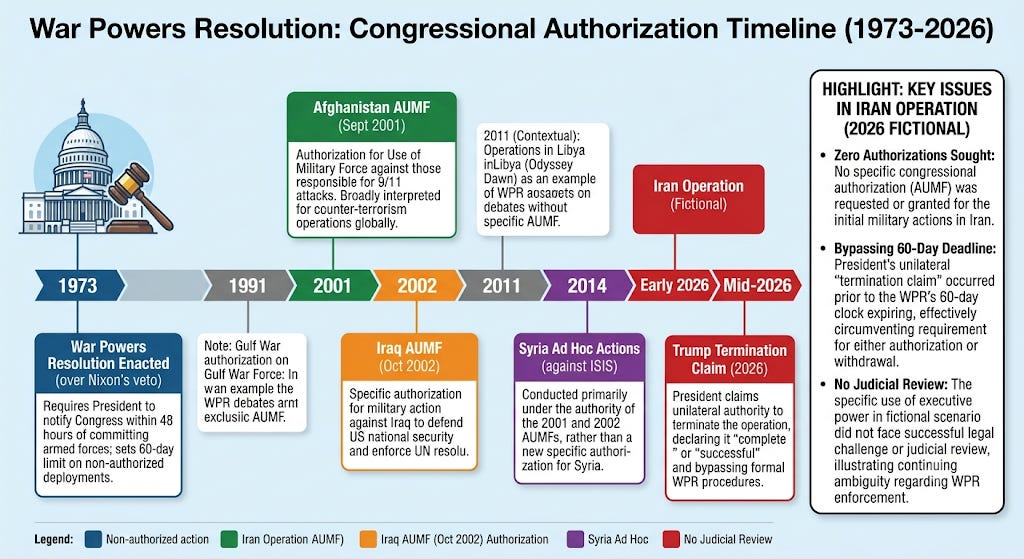
1. The War Powers Resolution interpretation became operational doctrine. Trump's May 1 notification to Speaker Mike Johnson and Senator Charles Grassley argued the 60-day clock does not apply because hostilities "terminated" on April 7. By May 28, the United States had launched strikes on Iranian launch sites at Bandar Abbas, Iran had struck Ali Al-Salem Airbase in Kuwait with ballistic missiles (15 American servicemembers wounded according to US military), and JCS Chair General Caine had publicly admitted Iran has attacked US forces "ten times since the declaration of the ceasefire."[6] The administration has not retracted the termination claim despite operational reality. The legal precedent now applies to every future executive. Confidence: 95%. Timeframe: Permanent.
2. The Persian Gulf Strait Authority became a sovereign institution. Iran's PGSA operates with tolls in Iranian rial, Iranian-bank settlement, banned vessels from Israel-linked operators, and a stated email contact. The US Treasury sanctioned the PGSA on May 8, treating it as a state institution to be sanctioned rather than a wartime measure to be dismissed. China publicly criticized "militarizing the Strait of Hormuz or a tolling system" while its tankers received operational access under "environmental fee" framing. Two-tier maritime governance is now the operational equilibrium with no path back to the pre-war regime. Confidence: 90%. Timeframe: Structural.
3. The Beijing summit confirmed China as Iran's guarantor. The summit produced Boeing announcements and Iran rhetoric while delivering Hormuz normalization for Chinese vessels. The joint China-Iran statement issued through Foreign Minister Wang Yi during Araghchi's earlier visit ("China will provide Iran with full support in defending its right to protect itself") became operational policy when Beijing accommodated Chinese tanker transits without breaking the toll regime. Putin landed in Beijing on May 20, five days after Trump departed. The triangular Beijing-Moscow-Tehran axis now operates as a coordinated structure rather than a parallel set of bilateral relationships.[7] Confidence: 85%. Timeframe: Multi-year.
4. The hidden coalition's exposure has reshaped Gulf diplomacy. Reuters confirmed on May 12 that Saudi Arabia and Kuwait conducted unpublicized strikes on Iran during the active phase. Times of Israel cited Western officials and Iranian sources confirming Saudi strikes "in retaliation for attacks carried out in the kingdom during the war." Kuwait lau…