July 3, 2025
Disclaimer: This is not medical advice, nor an opinion on keto diet or intermittent fasting. Both can be beneficial for people with metabolic conditions, even cancer, but nothing should be taken to extremes. Self-diagnosing with AI can be dangerous. Always seek medical attention when symptoms and pain levels are unexplainable.
This Is An AI-Assisted Investigative Memoir
I wake up. Seems normal, right?
Except it’s mid-afternoon, and I’m not sure of the day? I feel zapped—not the familiar grogginess of oversleeping, but something deeper, stranger. Everything seems blunted, even my thinking. I clearly hear blood whooshing through vessels in my head. Looking down at my arms, I can see my pulse beating through the skin near my elbows.
Thirty-six hours had passed in a Thanos snap. That’s how long I’d been unconscious without realizing it wasn’t just sleep. Friday night had ended normally—I went to bed satisfied with my progress on syntona.ai, an AI-powered personality assessment app I’d been sprinting on for five days. The next thing I knew, it was… when, exactly? Also there are big what questions.
Something was fundamentally wrong with my body. My blood pressure had crashed so low that my cardiovascular system was audibly limping weakly to maintain flow. I could watch the vasodilation in my arms as my body fought to keep blood flowing to vital organs. Yet I felt… fine. Confused, disoriented, but fine.
I was so tired and enervated that I didn’t realize how tired I was. These should have been clues that I was dealing with something dangerous.
Meanwhile, Max, my cat, had apparently tried to wake me. The evidence was everywhere—he’d peed on the couch after giving up on his litter box, food and water bowls empty for who knows how long. He must have been trying to rouse me for hours, maybe days. But I’d been too far gone to respond.
This wasn’t oversleeping or all-nighter fatigue. This was my body slowly coming back online after what I would later understand was a complete metabolic breakdown.
Calling Drs. Claude and Gemini
When I first described my symptoms to Claude, Anthropic’s AI chatbot, the response was reassuringly nominal: severe exhaustion, probably dehydration, nothing a few days of rest wouldn’t fix. It took a conversation with Google’s Gemini to get a different assessment.
“That sounds like a coma,” Gemini told me.
My head cocked. When I laid out the facts, Gemini’s assessment was blunt: it identified the pattern as severe metabolic crisis. Having been completely unconscious for 36 hours, with visible cardiovascular distress, after five days of intensive coding—this wasn’t exhaustion. This was something else entirely.
That’s when I switched from patient to investigator. If I’d actually been in a coma, I needed to understand what had caused it. And more importantly, I needed to figure out if it could happen again.
Calling Dr. Tatsu
I started with the facts: five days of intensive coding, minimal food intake, ketogenic diet with intermittent fasting. I’d lost five pounds during those five days—my body had been consuming itself for fuel. The timeline was clear, but the mechanism remained a mystery.
So I did what I do best: I researched.
PubMed, PLOS ONE, Nature—I searched every major medical database for comparable cases. “work induced metabolic coma.” “extreme cognitive load leading to physical collapse.” “metabolic exhaustion.”
Nothing. Zero documented cases.
The closest parallels were athletes experiencing rhabdomyolysis from extreme physical exertion, but that involved muscle breakdown from physical stress. Standard metabolic comas resulted from diabetes, sepsis, liver failure—not from thinking too hard.
I was staring at what appeared to be a medical first: a software developer who had literally worked himself into a metabolic crisis through pure cognitive exertion.
My Brain Has No Chill: The Missing Governor
That’s when I turned the investigation on myself. I pulled up my cognitive profiles and personality assessments—Big Five, MBTI, CliftonStrengths. What I found was familiar: I scored in the 7th percentile for neuroticism. In psychometric terms, this means I have exceptionally low sensitivity to anxiety, stress, and physical discomfort.
Most people are protected by their own misery. (It’s a good thing.) They feel terrible and stop before causing serious harm. But my brain had been designed, either by nature or circumstance, to override those warning signals entirely.
I began to understand what had happened during those five days. My body sent increasingly escalating signals—hunger, fatigue, dehydration, cardiovascular stress. My brain had classified them as “non-critical background noise” and deprioritized them in favor of the primary task, coding. I wasn’t ignoring the warning signs; I literally wasn’t perceiving them.
It’s like having a smoke detector with the battery removed. Fire burns, but there’s no alarm. It’s like flying a jet and warning lights like Christmas morning. But you don’t even notice and don’t even hit master reset. You just fly faster.
Research on extreme low neuroticism paints a disturbing picture. Individuals with this trait combination—high cognitive functionality paired with extremely low sensitivity to physical distress—could theoretically push themselves into genuinely treacherous terrain that would be impossible for most people to climb. We lack the internal governor that forces normal humans to stop.
Why Is My Skin Falling Off In Huge Chunks?
The evidence of just how close I’d come to those limits was still revealing itself. A week later, I noticed something strange happening to my hands.
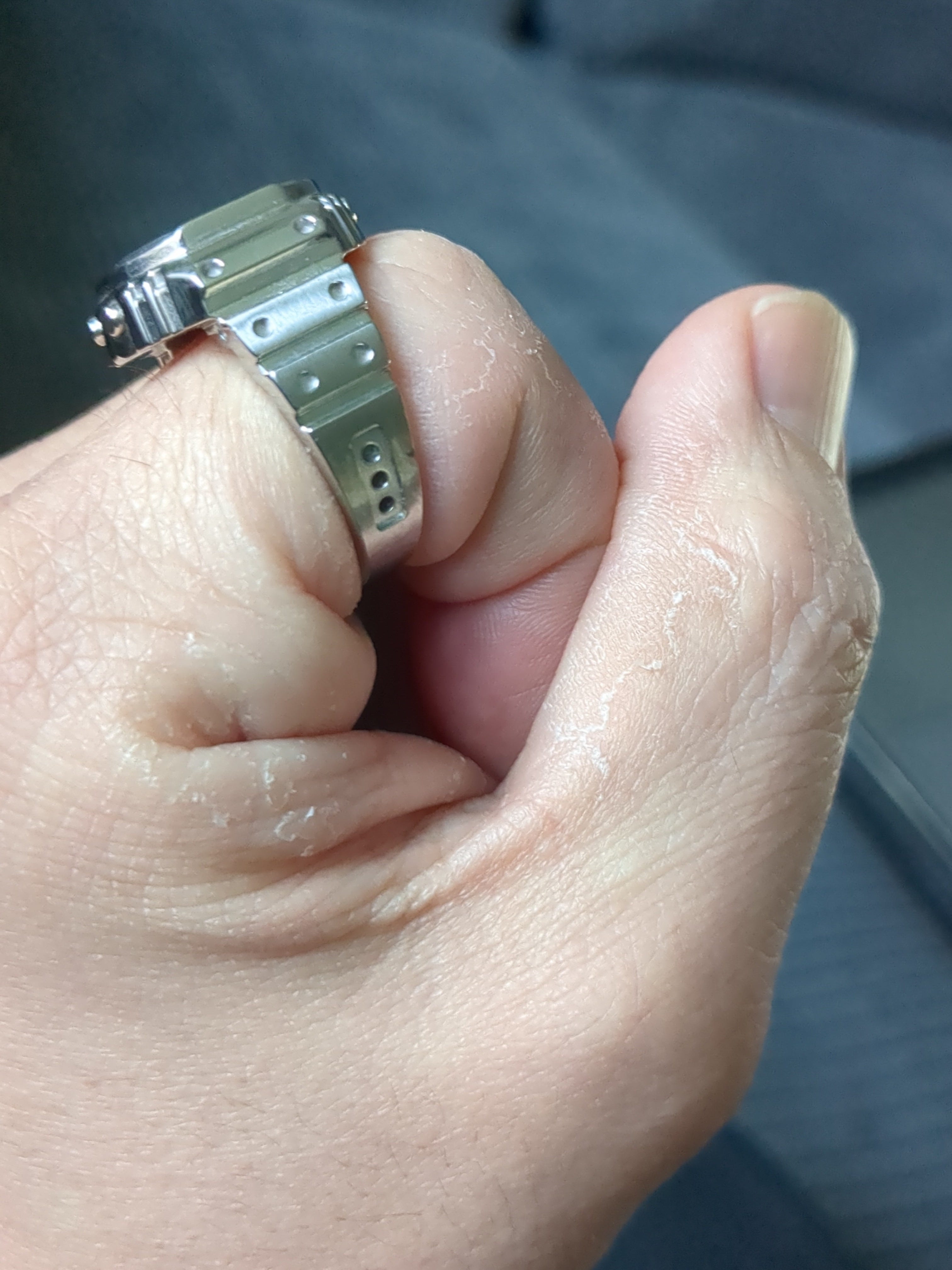
It started with chunks of dead skin accumulating under my fingernails. Then I realized I couldn’t unlock my phone—both my thumbprints had literally fallen off, victims of my body’s emergency resource allocation. Over the following days, the skin on my hands began peeling away in strips and sheets.
I documented it photographically, watching in curiosity as my body shed the tissue it had killed off before to keep my brain and heart undamaged. The breakdown was methodical: fingertips first, then palms, then the skin between my knuckles, and finally the sides of my fingers.
The same pattern appeared on my feet weeks later. Thick sections of skin on my toes and soles coming away like old paint. My brain did caveman triage on my own body, deciding that skin—which is metabolically expensive to maintain—was expendable compared to vital organ function.
When I showed photos to friends, reactions ranged from shock to disbelief. One friend dismissed it as a “personality issue” and asked about her iPad problems in the same conversation. Another called it “overworking” and suggested better time management.
They didn’t understand what they were looking at: visible evidence of my body cannibalizing itself during metabolic emergency.
My Original Theory (And Why It Was Wrong)
My initial theory seemed logical. Programming at this intensity isn’t just typing code—it’s making thousands of micro-decisions per hour: architecture choices, APIs, AI pipelines, algorithm optimization, user interface flows, data structures, error handling, build problems, multiple languages, system administration, DevOps, security considerations.
I theorized that my brain had been operating in “scramjet mode”—burning cognitive fuel at an unsustainable rate. Claude calculated that during those five days, my brain had been burning an estimated 3,000+ calories per day—nearly triple the normal rate. Add in my body’s basic metabolic needs, and I was approaching 5,000+ calories daily while consuming perhaps 1,500.
I was running a 3,500+ calorie daily deficit, totaling roughly 17,500 calories over five days—equivalent to about five pounds of body mass, which matched my weight loss exactly.
But when I shared this theory with Gemini, I received a detailed medical critique that dismantled my central hypothesis. While the human brain is metabolically active, accounting for about 20% of the body’s total energy e…