January 30, 2026
Bloomberg: $35/month. Financial Times: $42/month. The Economist: $17/month. Original analysis by Tatsu with 40+ footnotes: $8/month.
This post is public. Share it with anyone who needs to see this.
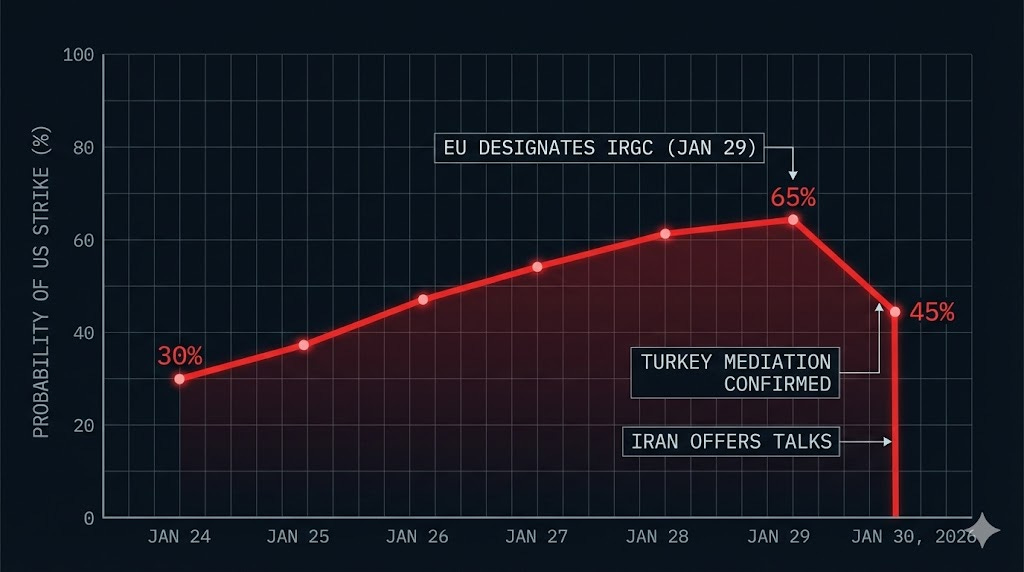
Twenty-four hours ago, I assessed the probability of US strikes on Iran within 72 hours at 65%. The European Union had just unanimously designated Iran's Islamic Revolutionary Guard Corps as a terrorist organization. The USS Abraham Lincoln carrier strike group had arrived in Middle Eastern waters. Iran was preparing live-fire drills in the Strait of Hormuz. Every indicator pointed toward escalation.
Today, that probability stands at 45%.
What changed? Iran blinked. Or more precisely, Iran opened a diplomatic channel while maintaining its military posture, creating the first genuine off-ramp since this crisis began accelerating in late December 2025.
This is what real-time intelligence analysis looks like. Not static predictions written in stone, but probability assessments that shift as new signals emerge. And in the last 24 hours, three major signals emerged that fundamentally altered the calculus.
$8/month for real-time geopolitical intelligence. Bloomberg charges $35.
What Happened in 24 Hours
Signal One: Turkey Mediation Confirmed
Iranian Foreign Minister Abbas Araghchi met with Turkish President Recep Tayyip Erdoğan in Istanbul today. This wasn't a symbolic courtesy call. Turkey is actively attempting to mediate between the United States and Iran, creating an indirect communication channel between two governments that severed diplomatic relations in 1980.
The timing is significant. The meeting occurred within 24 hours of the EU IRGC terrorist designation, the very event I identified as a potential escalation trigger. Instead of responding with pure military posturing, Iran engaged diplomatically.[1]
Signal Two: Iran Offers to Resume Nuclear Negotiations
Hours before the Erdoğan meeting, Iran's Foreign Ministry announced willingness to resume nuclear negotiations with the United States, conditional on talks being "fair and based on mutual respect."
This is a tactical de-escalation offer. Iran is signaling that it prefers negotiation to confrontation, while carefully preserving domestic credibility through the "mutual respect" qualifier. The Iranian government cannot be seen as capitulating to American pressure, but it can frame negotiations as a dignified engagement between equals.
The offer came one day before Iran's scheduled live-fire drills in the Strait of Hormuz and 48 hours after the EU designation. That sequencing matters. Iran absorbed the diplomatic blow, then pivoted to talks rather than retaliation.[2]
Signal Three: Hormuz Drills Moved Forward
The drills are now scheduled for February 1-2, not February 3-5 as initially reported. Iran moved them up by two days.
Why does this matter? Because February 1 is also the day the Russia-Ukraine energy truce expires. The Trump administration negotiated a seven-day pause in Russian strikes on Ukrainian energy infrastructure to create space for Ukraine negotiations. That pause ends Saturday.
The convergence of these timelines creates a narrow window of maximum tension: Russia-Ukraine truce expires, Iran conducts drills with the USS Abraham Lincoln carrier strike group on station, and diplomatic channels are freshly opened but untested. February 1-2 becomes the decision point.[3]
The Dual-Track Strategy
What we're witnessing is a classic dual-track approach: military posture plus diplomatic engagement.
The Military Track:
Iran has not backed down from its show of force. The Islamic Revolutionary Guard Corps naval forces will conduct live-fire exercises in the Strait of Hormuz, the chokepoint through which approximately 20% of the world's oil and natural gas flows. The drone carrier IRIS Shahid Bagheri has been deployed. Iranian officials continue to issue threats: "Fingers on the trigger, ready to respond to any aggression," Foreign Minister Araghchi warned. Another senior official stated bluntly that "the USS Abraham Lincoln is a target. It does not deter us."[4]
The United States has matched this posture. The Abraham Lincoln carrier strike group remains in position from the Strait of Hormuz to the Arabian Sea. Thirty-six F-15E Strike Eagles are stationed at a Jordanian airbase within range of Iran. UK Eurofighter Typhoons are deploying to Qatar. THAAD missile defense batteries are positioning throughout the region. President Trump has stated the fleet is ready to act with "speed and violence."[5]
Neither side is de-escalating militarily. What's changed is the addition of a diplomatic layer that didn't exist 48 hours ago.
The Diplomatic Track:
Turkey's mediation effort represents the first serious attempt at conflict prevention since this crisis entered its acute phase. Erdoğan has positioned Turkey as the indispensable intermediary, the only NATO member with credible relationships in both Washington and Tehran.
The Russian angle adds another dimension. Moscow negotiated the Ukraine energy truce at Trump's request, demonstrating that diplomatic back-channels between the Kremlin and the White House are functional. Russia has limited ability to materially support Iran (Moscow is militarily exhausted in Ukraine and economically isolated itself), but it can provide diplomatic cover and potentially facilitate indirect US-Iran communication through a Russia-Turkey-Iran triangle.[6]
The sanctions track continues in parallel. The US Treasury announced sanctions on six IRGC officials for "repression and corruption" and two London-based cryptocurrency exchanges, Zedces and Zedixion, allegedly tied to IRGC financing. Financial warfare alongside diplomatic engagement: dual pressure.[7]
The Collision on February 1
Tomorrow, three separate timelines converge:
1. The Russia-Ukraine energy truce expires. Will Russia resume strikes on Ukrainian power infrastructure, collapsing the diplomatic momentum Trump has been building toward a Ukraine settlement?
2. Iran begins live-fire drills in the Strait of Hormuz. Will the exercises proceed without incident, or will a drone intercept, a close call, or a misidentified radar contact trigger an escalatory spiral?
3. The US carrier strike group remains on station. How does the Abraham Lincoln respond if Iranian drones approach within intercept range? What are the rules of engagement?
The probability of an accidental clash during the drills is approximately 50%. Not because either side wants conflict, but because live-fire exercises in confined waters with opposing naval forces present create opportunities for miscalculation.
If an incident occurs, does the US conduct a limited retaliatory strike? Does Iran respond against regional targets (Saudi oil facilities, Emirati ports, American bases in Iraq)? Does oil spike to $95 per barrel? Do the negotiations collapse before they begin?
Or do both sides exercise restraint, complete the drills without incident, and allow Turkey's mediation to proceed?
February 1-2 is the test.
Why the Probabilities Shifted
My assessment framework tracks both escalation and de-escalation signals across multiple domains: military deployments, diplomatic statements, economic actions, and intelligence from both mainstream and alternative sources.
Escalation signals in the last 24 hours:
* EU IRGC terrorist designation (confirmed)
* US Treasury sanctions on IRGC officials and crypto exchanges (confirmed)
* Iran drills moved forward to Feb 1-2 (confirmed)
* Continued US military buildup in Gulf region (confirmed)
De-escalation signals in the last 24 hours:
* Iran offers to resume nuclear negotiations (confirmed)
* Turkey mediation active, Araghchi-Erdoğan meeting (confirmed)
* No additional US force deployments announced (absence of signal)
* No Israeli strikes on Iranian targets (absence of signal)
* Iran engaging diplomatically despite EU designation (behavioral shift)
The balance has shifted. Not decisively toward de-escalation, but enough to reduce immediate strike probability from 65% to 45% within 72 hours, and from 75% to 60% within 30 days.
The updated probability matrix:
Notice that while strike probability decreased, the probability of a Hormuz incident increased. The drills create tactical risk even as the diplomatic opening reduces strategic risk.
What I'm Watching Next 72 Hours
Critical indicators for escalation:
* Additional US force deployments to the region
* Israeli strike on Iranian nuclear or missile facilities
* Hezbollah mobilization in Lebanon
* US diplomatic staff evacuations from Gulf states
* Oil tanker traffic disruptions through Hormuz
Critical indicators for de-escalation:
* Iran scales back scope or duration of Hormuz drills
* US announces pause in military buildup
* Direct US-Iran communication channel opens (beyond Turkey mediation)
* Sanctions relief discussions begin
* Iran postpones drills entirely
Events to monitor:
* Friday, January 31: Turkey announces results of mediation effort. Iran confirms final drill plans or modifications. US responds to Iran's negotiation offer.
* Saturday, February 1: Russia-Ukraine energy truce expires (watch for Russian strikes on Ukrainian infrastructure). Iran Hormuz drills begin (or are postponed). US carrier movements. Oil market reaction.
* Sunday, February 2: Hormuz drill outcomes. Any incidents reported. Weekend diplomatic activity.
The most likely scenario, with approximately 50% probability, is that Iran proceeds with scaled-back drills (shorter duration or reduced scope), the US maintains military posture but delays strike decisions pending talks, Turkey facilitates indirect communication, and both sides claim victory to domestic audiences while managing tensions through February.
The alternative scenarios: full escalation (15% probability) if drills produce an accidental clash, complete de-escalation (5% probability) if Iran cancels drills and Trump announces a breakthrough, or prolonged stalemate (30% probability) where talks begin but stall and low-level tensions continue indefinitely.
The Intelligence Gap
None of this analysis would be possible relying solely on mainstream media coverage. The Turkey mediation confirmation, the drill date change, the Russia-Ukraine truce details, and the nuanced shifts in Iranian positioning all emerged from OSINT sources I monitor continuously.[8]
Mainstream outlets reported the EU IRGC designation. They covered the carrier deployment. But the granular, real-time updates that allow probability assessments to shift in 24-hour cycles? That requires monitoring hundreds of data points from open-source intelligence channels, separating signal from noise, cross-referencing claims against official sources, and building a mosaic of intelligence that no single outlet provides.
This is Thesis Intel methodology in action. Not static predictions, but dynamic probability assessments updated as new information emerges. Not waiting for events to be confirmed by three Western newspapers, but tracking developments in real-time through open-source intelligence and then validating through triangulation.
And it works. When I wrote about the Minneapolis off-ramp on January 26, I predicted the city would offer a settlement to avoid federal intervention. Four days later, they did exactly that. When I wrote about Iran protests in mid-January, I assessed regime survival as most likely despite the uprising's intensity. The brutal crackdown followed the pattern I outlined.[9]
The Iran crisis is the current test. February 1-2 will show whether the diplomatic opening is genuine or theater, whether the drills proceed without incident or trigger escalation, and whether my updated probabilities hold.
I'll be monitoring OSINT sources, mainstream media, satellite imagery reports, oil markets, and force posture changes continuously. The next update will come within 48 hours, after the February 1 collision point has passed.
This is what $8 per month gets you. Real-time intelligence. Probability updates as the situation evolves. Access to signals that aren't in Bloomberg or the Financial Times or The Economist, all of which charge 2-5 times more for analysis that arrives days late.
The Hormuz drills start tomorrow. By Sunday night, we'll know whether this de-escalation is real or whether we're 72 hours from regional war.
I'll be watching.
Notes
Notes
[1] Turkish mediation confirmed by multiple OSINT sources and mainstream Turkish media. Araghchi-Erdoğan meeting occurred January 30, 2026 in Istanbul.
[2] Iran's willingness to resume nuclear negotiations reported by Al Jazeera and confirmed via OSINT sources, January 30, 2026. Statement from Iranian Foreign Ministry emphasized "fair and based on mutual respect" conditions.
[3] Iran Hormuz drill dates updated to February 1-2 per OSINT sources and confirmed by Notice to Airmen (NOTAM) filings. Russia-Ukraine energy truce expiration confirmed by OSINT sources citing Russian government statements.
[4] Iranian military threats and IRGC statements via OSINT sources and reported in multiple mainstream outlets. "USS Abraham Lincoln is a target" statement covered by Fox News, January 29, 2026.
[5] USS Abraham Lincoln carrier strike group deployment confirmed by AL-Monitor and Military.com. F-15E deployments and THAAD positioning reported by OSINT sources with supporting satellite imagery.
[6] Russia's role in Ukraine energy truce mediation reported by OSINT sources, with confirmation from Ukrainian President Zelensky's evening address. Russia's limited capacity to support Iran materially assessed based on ongoing Ukraine commitments and Western sanctions pressure.
[7] US Treasury sanctions on IRGC officials and cryptocurrency exchanges announced January 30, 2026. Zedces and Zedixion exchanges designated for alleged IRGC financial ties. Reported via OSINT sources and official Treasury statements.
[8] Primary intelligence derived from continuous monitoring of multiple OSINT sources, including regional media outlets, military analyst networks, and open-source intelligence channels. Analysis conducted over 24-hour periods with cross-referencing against official government statements and mainstream media reporting.
[9] Minneapolis settlement prediction from "The Off-Ramp After Alex Pretti's Death," January 26, 2026. Iran protest analysis from "When Khamenei Dies, the Middle East Burns," January 13, 2026, predicting brutal crackdown and regime survival as most likely outcome.