September 4, 2025
"The white savior supports brutal policies in the morning, founds charities in the afternoon, and receives humanitarian awards in the evening."— Teju Cole
"In my experience, the worst f*****s are the do-gooders."— William S. Burroughs
"We were not laboratory rats. We were human beings."— Grigory Yavlinsky, Russian economist, on shock therapy
Moscow’s winter had already tightened its grip when Jeffrey Sachs stood before Russian economic officials in December 1991. The Harvard professor, 37 years old and brimming with certainty, promised transformation in days, not years. “You can’t cross a chasm in two jumps,” he declared.^[1] Within months, Russia’s economy contracted by 40%. Poverty exploded from 2 million to over 70 million citizens. Male life expectancy plummeted seven years.^[2] The policies Sachs guaranteed would create prosperity instead birthed one of history’s most predatory oligarchies.
Today, Sachs directs the UN Sustainable Development Solutions Network, shaping global policy for 193 nations. His metamorphosis from “Dr. Shock” to humanitarian sage marks one of modern history’s most audacious reinventions. This reinvention is no historical curiosity; as a key voice shaping global policy on the war in Ukraine, COVID pandemic origins, and climate finance, the Sachs Doctrine is more influential than ever. Yet examination reveals not evolution but repetition: the same methodology repackaged across decades. The vocabulary shifted from “market liberalization” to “poverty alleviation” to “sustainable development,” but the blueprint never changed.
This investigation draws on economic data, internal documents, and testimony from development economists who witnessed these disasters firsthand. The behavioral patterns align with what psychologists describe as “dark triad” personality traits: narcissism, Machiavellianism, and specific antisocial characteristics.^[3] Clinical diagnosis remains beyond journalism’s scope, but the documented behaviors paint a portrait demanding scrutiny.
Sachs Literally Begat Vladimir Putin
No peacetime economic intervention matches the human toll of Sachs’s Russian experiment. Isabella Weber documented that shock therapy produced “a rise in mortality beyond that of any previous peacetime experiences of an industrialized country.”^[4] GDP collapsed 40%, hyperinflation hit 2,500% in 1992, poverty rates soared from 1.5% to 49%.^[5] By 2015, average real income for 99% of Russians remained below 1991 levels.^[6]
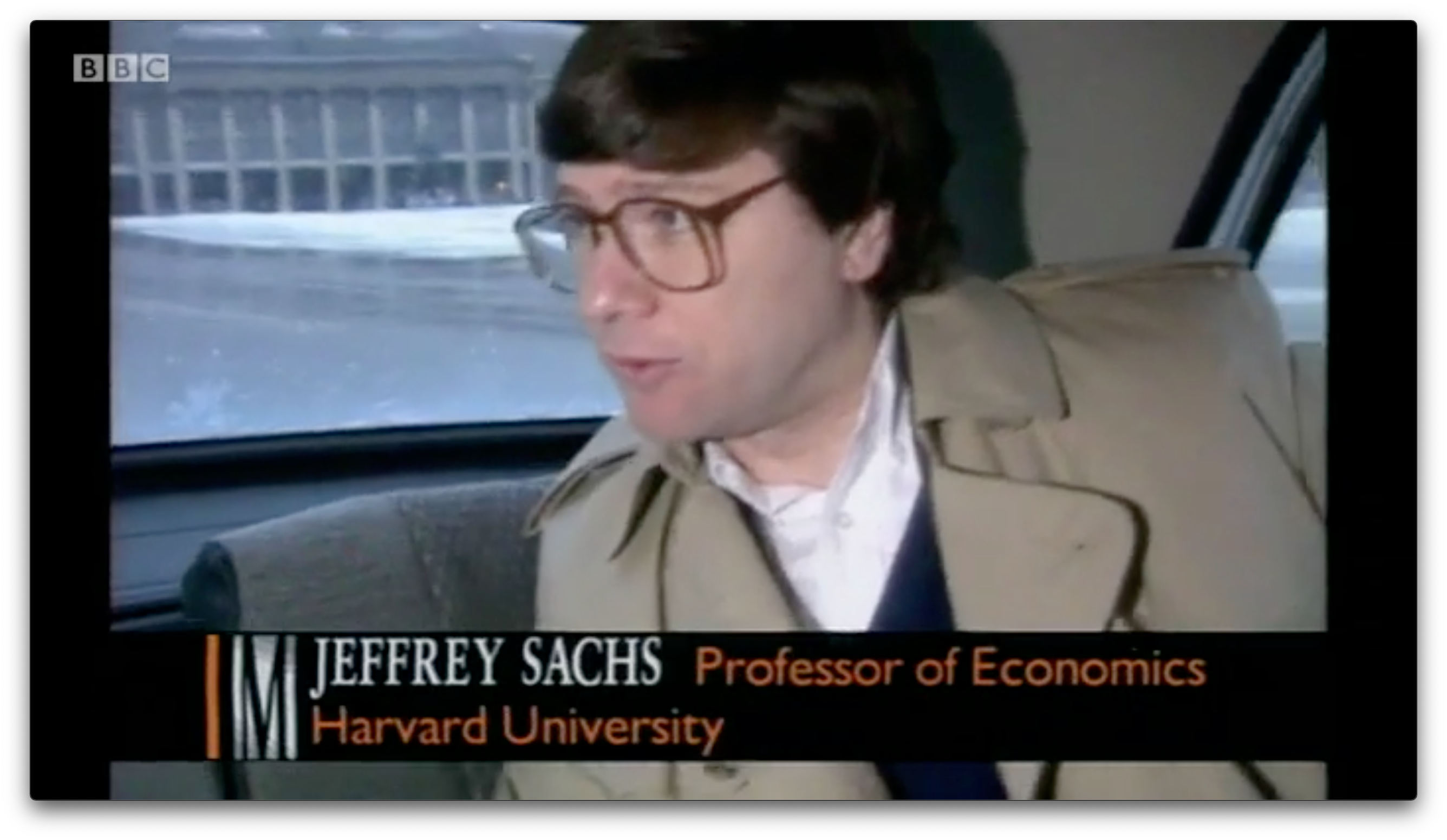
Sachs in Moscow of 1992, as featured in Adam Curtis’s BBC documentary “The Trap”
Sachs’s defense never varies: shock therapy “was never tried” in Russia.^[7] Russian officials bungled implementation. Western governments withheld promised aid. This rhetorical firewall between theory and catastrophe preserves his model’s purity while deflecting accountability.
Contemporary evidence demolishes this narrative. Sachs worked directly with Anatoly Chubais crafting privatization strategies that culminated in “loans-for-shares”: rigged auctions transferring Russia’s crown jewels to politically connected bankers for pennies.^[8] The Harvard Institute for International Development, which Sachs directed from 1995, managed the USAID program linked to these schemes.^[9]
When confronted with mounting death tolls, Sachs displayed what researchers identify as narcissistic injury response: inability to acknowledge error, reflexive blame, grandiose self-perception maintenance.^[10] He insisted the problem was insufficient shock, not the therapy itself.
Africa: Sachs and George Soros’ $120 Million Retcon Failure
By 2005, the architect of Russia’s apocalypse had repositioned himself as humanity’s savior. His Millennium Villages Project, bankrolled with $120 million from George Soros, promised to lift African villages from poverty.^[11] MTV filmed Angelina Jolie introducing him as “the world’s leading expert on extreme poverty.”^[12]
The MVP replicated every Russian flaw. Its 147-page handbook, written by Manhattan academics, prescribed interventions for villages they’d never visited.^[13]
Nina Munk documented predictable failures: broken wells nobody could fix, crops nobody wanted, markets that violated local customs and collapsed.^[14]
No control villages. No baseline data. When Nature published an editorial excoriating “unreliable analysis,” and economists declared “no one takes the Millennium Villages seriously as a research project,” Sachs didn’t reconsider.^[16] He blamed insufficient funding and rebranded failures as “lessons learned.”^[17]
A One-Man Clinton Foundation: For Humanity or for Speaking Fees?
While precise figures are guarded, analysis of standard compensation for his positions, known speaking fees, and typical advances for bestselling authors in his field allows for conservative estimation. Columbia University’s highest academic rank commands over $300,000 annually. Speaking fees exceed $20,000 per engagement, with dozens yearly.^[42] His multiple bestselling books generated seven-figure advances. Conservative estimates place his net worth between $10-20 million.^[43]
The compulsive speaking circuit reveals what psychologists term “narcissistic supply seeking”: constant need for admiration.^[44]
Tucker Carlson, Ron Paul conferences, Judge Napolitano’s podcast—each appearance provides financial gain, narrative control, and psychological sustenance from audiences treating him as oracle.^[45]
While listing $0 compensation as UN Solutions Network President, this unpaid position legitimizes everything else.^[28] The UN affiliation drives speaking demand, attracts funding to Columbia centers, provides institutional validation. The Jeffrey Sachs Center at Sunway University, established with $20 million, exemplifies how nonprofit leadership converts to material benefit.^[30]
Sachs Leaves Far Too Many Tells
Across three decades, Sachs’s behaviors align with what psychologists like Robert Hare have identified as characteristic of “successful psychopathy”: antisocial traits with high social functioning.^[19]
At 28, tenured at Harvard, he proclaimed knowing “everything needed” about hyperinflation.^[20] Economists are almost never correct, and it is not a science. Decades later, he claimed ability to end poverty “easily” by this year in fact, 2025.^[21] Thirty years, multiple catastrophes, never once acknowledging fundamental error. All of his failures stem from external sabotage, by his accounts. This inability to accept responsibility aligns with what researchers term “moral disengagement” despite presenting himself as the foremost moral thinker in the world.^[22]
Most disturbing: apparent disconnection from consequences. He discusses Russia’s demographic catastrophe as technical glitches. When questioned about oligarchs, he expresses frustration about implementation, never grief.^[23]
Sustainable Development Is Shock Therapy with Green Paint
The UN Sustainable Development Goals represent Sachs’s playbook perfected. As Solutions Network Director, he defines how progress is measured globally.^[25] The framework enables “SDG-washing”: corporations cherry-pick goals, wrap existing practices in virtue, claim progress without change.^[26]
Voluntary goals. No enforcement. No legal standing. Concepts like “anti-corruption” and “press freedom” absent.^[48] Only 17% of targets projected achievable by 2030, but failure is built in: vague enough to avoid accountability, comprehensive enough to justify permanent intervention.^[15]
Turn to page 47 of Sachs’s 2024 SDG Summit Report, where he casually proposes that developing nations need $2.5 trillion every year to achieve the Sustainable Development Goals. He frames this staggering sum as merely “2.5% of global GDP,” as if stating a percentage makes history’s largest wealth transfer sound reasonable. That’s more than France’s entire GDP, required annually, forever.
How would this unprecedented tsunami of money flow? Sachs offers nothing beyond hand-waving about “international cooperation.” No mechanism for raising it, no system for distributing it, no controls against corruption. Just trust and hope. But here’s the tell: buried in the appendices, away from scrutiny, sits a single footnote revealing that his own organization, the SDSN, would “coordinate” this $2.5 trillion annual flow. The same UN and World Bank channels that hemorrhaged billions in failed aid programs would now handle a hundred times that amount, with Sachs positioned as gatekeeper. It’s the Millennium Villages con scaled to planetary level: promise the impossible, demand the unthinkable, position yourself as indispensable, then blame ‘lack of political will’ when reality intervenes.
RT, Bernie Sanders, Tucker Carlson: Reputation Laundering Explained
Sachs now appears on Russian media defending Putin’s invasion as NATO provocation.^[31] Again, Sachs single-handedly created the conditions for Putin and Russian Oligarchs to arise. He claims the war ends “tomorrow” if America declares NATO won’t expand.^[32] His venues tell the story: World Economic Forum to Tucker Carlson, Davos to Ron Paul conferences, Columbia seminars to conspiracy theory podcasts.^[45]
His COVID theories follow identical deflection. After disbanding the Lancet commission he chaired, he promotes lab-leak theories suggesting American bioweapons involvement.^[46] The virus’s furin cleavage site points to U.S. military research, he testifies.^[47] This is Bill Gates levels of being a health expert on the other side of the same coin. Just as he blamed insufficient American aid for Russia’s collapse, he blames America for potentially creating the pandemic.
Three hundred forty economists condemned his Ukraine positions.^[34]
The criticism only reinforced his brand as establishment victim rather than architect. His European Parliament speech urging Europe to “break free” from American influence garnered standing ovations from the same elite whose policies he once enforced to their countries collapsing.^[48] EU elites are no different from Putin, they profit from the poverty, extraction, and demise of their citizenry.
The Sanders Institute, founded by Bernie’s wife Jane and run by his stepson David Driscoll, received $350,000 from Bernie’s shuttered presidential campaign and over $200,000 from his Senate campaign. This family-run foundation featured Sachs as a founding fellow alongside Cornel West and Nina Turner.^[38] Democracy Now introduces him as “leading economist” without mentioning Russian mortality statistics.^[49] Jacobin publishes his capitalism critiques without irony. Progressive validation provides perfect cover: when conservatives attack, the left defends; when economists criticize, he dismisses them as neoliberals.
Columbia University Capture, Participation, and Reproduction
At Columbia, Sachs reproduces himself. Students learn his cruel methods of economic extraction without its history. “Challenges of Sustainable Development” contains zero readings on shock therapy outcomes.^[50] They master poverty trap models without studying corpses at the bottom.
These students populate the World Bank, UN agencies, NGOs, carrying his frameworks forward. One recent PhD now designs Gates Foundation agricultural interventions using the same blueprint that failed in Africa.^[51] Each cohort becomes another protection layer, their careers invested in validating theories that validate them.
Jeffrey Sachs Never Changed Over 30 Years
Three decades reveal patterns: messianic self-belief, lawyerly deflection, symbiotic power relationships, emotional disconnection from consequences. This explains why Sachs can pivot from neoliberal to progressive to anti-imperialist without any apparent internal conflict, because he has no real ideology. What he does have is a sophisticated and ruthless methodology for maintaining relevance and extracting resources from institutions and countries. While many investigators, writers and economists have borne witness to his many stunning disasters, no one has quite picked up that the man has never changed at all. Same playbook, different markets and levels of complexity.
The pattern fits what Kevin Dutton terms “successful psychopathy.”^[39] Grandiosity, absence of remorse, consistency despite negative outcomes, parasitic institutional relationships align with diagnostic criteria, though clinical evaluation remains necessary.^[40]
The documented cost: millions impoverished in Russia, billions wasted in Africa, a global framework enabling corporate greenwashing. Each failure enhanced rather than diminished influence, exposing a system rewarding ambition and failures over results.
Tomorrow, Sachs delivers another keynote, publishes another report. Next week, he’ll explain why Ukraine deserves dismemberment, why American bioweapons caused COVID, pontificate on Trump’s tariffs, a subject so complex no one can predict outcomes, but he is always certain and always wrong. In every single project he has been involved during his career, Sachs is also certain his failures were everyone else’s fault and not his. He has never admitted a single mistake, ever. The con continues because institutions need him: credentialed enough for cover, shameless enough for any position, disconnected enough to ignore bodies.
Here is the Jeffrey Sachs playbook in a nutshell, ladies and gentlemen. Establish credentials, identify crisis, blame America/the West, position himself as essential to the solution, collect fees, leave destruction, blame others for failure, pivot to next crisis while upgrading his global influencer infrastucture.
The tragedy isn’t Jeffrey Sachs exists. It’s that our hierarchy of elites creates, rewards, and reproduces Jeffrey Sachses. Until that changes, there will always be another Harvard professor experimenting with other people’s lives, another foundation funding them, another UN agency platforming them, another generation becoming them. That’s on us, not Jeffery Sachs. Yes this article will piss him off, but he’s laughing at us because we let parasites like him get away with it. Still, whether Sachs realizes it or not, he’s evil personified as a university professor.
Please subscribe to my Substack for Part 2 of The Sachs Doctrine, where I explain how Sachs overplayed his hands many times over. I reveal who Jeffrey Sachs truly is: a proxy for the Washington Consensus, Harvard, USAID, and his game with Israel.
Footnotes
^[1]: Passell, Peter, “Dr. Jeffrey Sachs, Shock Therapist,” The New York Times Magazine, June 27, 1993, p. 34.
^[2]: Weber, Isabella, “How the West’s Shock Therapy Destroyed Russia’s Economy,” Foreign Policy, March 2022; Rosefielde, Steven, “Premature Deaths: Russia’s Radical Economic Transition in Soviet Perspective,” Europe-Asia Studies, Vol. 53, No. 8 (2001), pp. 1159-1176.
^[3]: Paulhus, Delroy L. and Williams, Kevin M., “The Dark Triad of personality,” Journal of Research in Personality, Vol. 36, No. 6 (2002), pp. 556-563.
^[4]: Weber, Isabella, University of Massachusetts economic analysis, 2021.
^[5]: Stiglitz, Joseph E., Globalization and Its Discontents (Norton, 2002), pp. 133-165; World Bank, “Russian Economic Report,” 1991-2000.
^[6]: Novokmet, Filip, Piketty, Thomas, and Zucman, Gabriel, “From Soviets to Oligarchs: Inequality and Property in Russia 1905-2016,” NBER Working Paper No. 23712, 2017.
^[7]: Sachs, Jeffrey, “What I Did in Russia,” jeffsachs.org, March 14, 2012.
^[8]: Hoffman, David E., The Oligarchs: Wealth and Power in the New Russia (PublicAffairs, 2002), pp. 189-230.
^[9]: McClintick, David, “How Harvard Lost Russia,” Institutional Investor, January 2006, pp. 40-52.
^[10]: Pincus, Aaron L. and Lukowitsky, Mark R., “Pathological Narcissism and Narcissistic Personality Disorder,” Annual Review of Clinical Psychology, Vol. 6 (2010), pp. 421-446.
^[11]: Munk, Nina, The Idealist: Jeffrey Sachs and the Quest to End Poverty (Doubleday, 2013), pp. 45-67.
^[12]: MTV Documentary, “Diary of Angelina Jolie and Dr. Jeffrey Sachs in Africa,” 2005.
^[13]: Millennium Villages Project, “Millennium Villages Handbook,” Columbia University, 2006.
^[14]: Munk, Nina, “Jeffrey Sachs’s $200 Billion Dream,” Vanity Fair, July 2007.
^[15]: United Nations, “Sustainable Development Goals Report 2023.”
^[16]: Editorial, “Learning from Failure,” Nature, Vol. 485, May 10, 2012, p. 149; Miguel, Edward, Foreign Policy, 2013.
^[17]: Sachs, Jeffrey, quoted in “Millennium Villages Project Evaluation Report,” 2015.
^[19]: Hare, Robert D., Without Conscience: The Disturbing World of the Psychopaths Among Us (Guilford Press, 1993).
^[20]: Sachs, Jeffrey, quoted in Blustein, Paul, The Chastening (PublicAffairs, 2001), p. 123.
^[21]: Sachs, Jeffrey, The End of Poverty (Penguin, 2005), p. 289.
^[22]: Bandura, Albert, “Moral Disengagement in the Perpetration of Inhumanities,” Personality and Social Psychology Review, Vol. 3, No. 3 (1999), pp. 193-209.
^[23]: Sachs, Jeffrey, Charlie Rose interviews, 1993-2010.
^[25]: United Nations, “Sustainable Development Solutions Network Annual Report,” 2023.
^[26]: Hickel, Jason, “The Problem with Saving the World,” Jacobin, August 2015.
^[28]: SDSN Association, Form 990, IRS filings, 2020-2023.
^[30]: Sunway University, “Jeffrey Sachs Center Launch,” press release, 2016.
^[31]: Sachs, Jeffrey, RT appearances, 2022-2024.
^[32]: Sachs, Jeffrey, “The War in Ukraine Was Provoked,” Common Dreams, June 2023.
^[34]: “Open Letter to Jeffrey Sachs,” 340 economists, VoxUkraine, March 2023.
^[38]: Sanders Institute, Form 990; FEC reports, 2021-2023.
^[39]: Dutton, Kevin, The Wisdom of Psychopaths (Scientific American, 2012).
^[40]: American Psychiatric Association, DSM-5 (2013).
^[42]: Speaking agency rate sheets, 2023-2024; Columbia Faculty Handbook, 2023.
^[43]: Analysis based on publishing standards, speaking engagements, academic compensation, 2024.
^[44]: Ronningstam, Elsa, “Narcissistic Personality Disorder,” Journal of Psychiatric Practice, Vol. 17, No. 2 (2011), pp. 89-99.
^[45]: Sachs appearances: Tucker Carlson Tonight, Judge Napolitano’s “Judging Freedom,” Ron Paul Liberty Report, 2022-2024.
^[46]: Sachs, Jeffrey, “Questions surrounding origins of COVID-19,” Boston Globe, May 31, 2022.
^[47]: Sachs, Jeffrey and Harrison, Neil, “Call for independent inquiry into SARS-CoV-2,” PNAS, Vol. 119, No. 21, May 2022.
^[48]: Sachs, Jeffrey, European Parliament speech, February 2025.
^[49]: Democracy Now archives, 47 Sachs appearances, 2015-2024.
^[50]: Columbia Course Directory, “SDEV UN3390,” Fall 2024.
^[51]: Gates Foundation Agricultural Development Team biographies, 2024.
^[52]: Sachs, Jeffrey et al., “Sustainable Development Report 2024,” SDSN, September 2024, p. 47.